This site uses affiliate links to Amazon.com Books for which IANDS can earn an affiliate commission if you click on those links and make purchases through them.
1. About Dr. Barbara Rommer
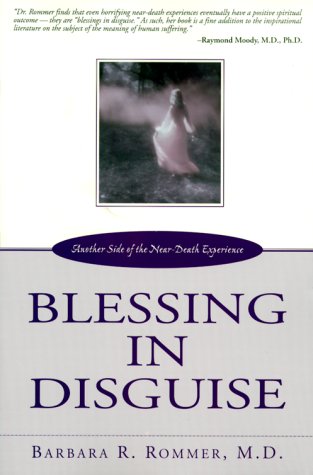
The late Dr. Barbara Rommer practiced Internal Medicine in Fort Lauderdale, Florida where she founded and facilitated the South Florida chapter of the International Association for Near-Death studies. Dr. Rommer personally interviewed more than 300 “less than positive” (LTP) near-death experiences (NDEs) – most of whom confirmed her hypothesis: that even the most horrifying NDEs eventually have a spiritual outcome. “The LTP experience is a spiritual wake-up call, causing the person to stop, look back, and review past choices, ” says Rommer, “It can help him or her understand the consequences of those choices, reevaluate thought patterns and ‘glitches’ in thinking or reasoning, and then make necessary changes where indicated. I view it as the ultimate learning experience.” A Gallup poll found that at least 13 million Americans have had an NDE. Of these, the data suggests that 17.7% of these are LTP experiences that are distressing and sometimes frightening.
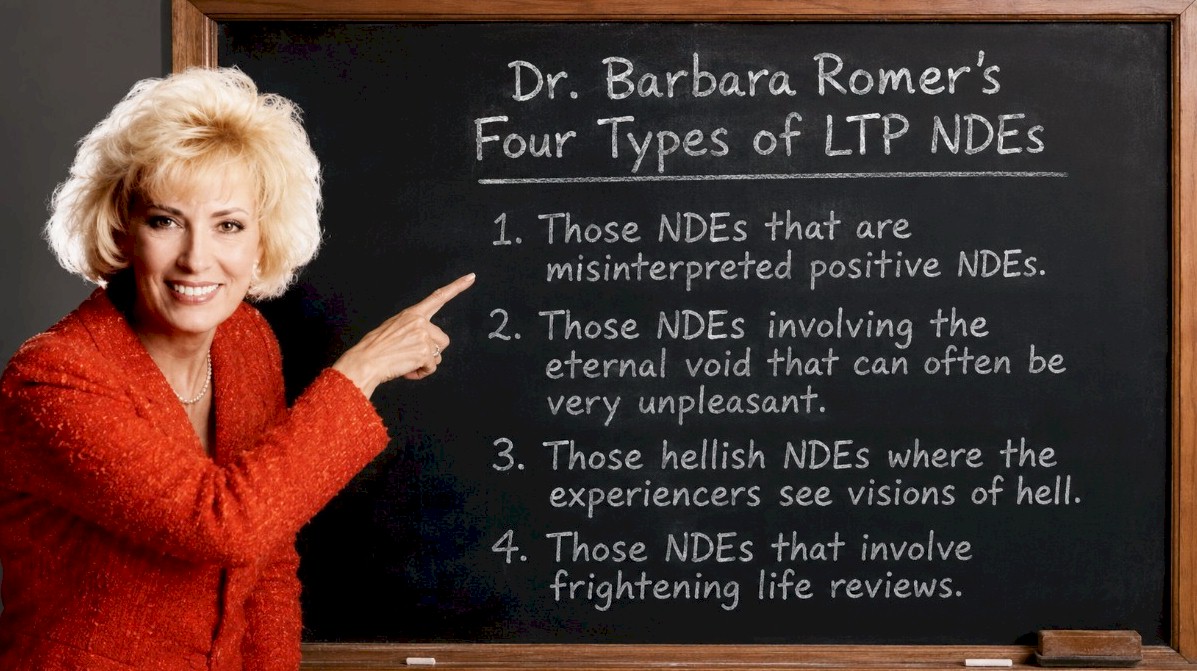
2. The Four Types of LTP Near-Death Experiences According To Dr. Barbara Rommer
- Those NDEs that are misinterpreted positive NDEs.
- Those NDEs involving the eternal void that can often be very unpleasant.
- Those hellish NDEs where the experiencers see visions of hell.
- Those NDEs that involve frightening life reviews.
3. An Example of a Type #1 LTP NDE
The following is an example of a Type #1 LTP NDE which is a misinterpreted positive NDE. Lyle was a 38-year old physician who had a severe allergic reaction to a prescription drug. He stated:
“I found myself flying through the air, head first, down this dark, dark tunnel. In the distance there was a bright light.
“I couldn’t feel anything. I couldn’t feel my body. It was like a numbness.
“I was in total blackness, pitch black, like the darkest I’ve ever seen. And it was total emptiness in that tunnel. It was frightening! There was the absence of all noise.
“I felt totally isolated because of the blackness and the lack of sound.
“I was consciously trying to fight my way back. I actually was trying to crawl out backwards!
“My wife gave me mouth-to-mouth resuscitation until the medics got there. I’d say I definitely flirted with death. Afterwards, I did feel very scared and much more vulnerable, and yet I don’t fear death.”
4. An Example of a Type #2 LTP NDE
The following is an example of a Type #2 LTP NDE which is a involves an eternal void that can often be very unpleasant. Sandra was in her twenties when she attempted suicide. She stated:
“I swallowed a bottle of 100 Quaaludes in California and I remember just fading and hearing people call my family to tell them I was dead.
“I’m on this steel table in a dark room at USC Medical Center in LA. I just remember looking down from above at this humongous black nurse. She was basically like yelling at my body saying: ‘You stupid girl!’
“I know I actually saw my family, even though I was in California and they were in New York. So I traveled that far without my body.
“I didn’t want to die, but I didn’t not want to die.
“I was in some holding place that was dark, with just a ray of light. There were shadowy figures, and I heard music, definitely angelic music, that had a semi-Christian tinge to it. The entities were telling me: ‘You have to go back.’ The message was: ‘You have a purpose and lessons to learn in this lifetime.’
“I was getting spoken to and getting coached on coming back. I was told I had to find the answers out for myself. See, I wasn’t given information. I wasn’t open to it because there was so much pain in me. I thought I wanted to die, or at least I didn’t want to be in pain, and I didn’t know how not to be. All four times I was in that same holding place…
“I was brought up in a Jewish home and was taught that when you die you just go to sleep forever, which to me was a good comfort, because I didn’t want to have to deal with anything. But now I know that if you commit suicide you don’t just go to sleep, but you have to do it again. You have to learn your lessons.
“That sliver of light was perfect with the darkness, because it was saying to me: ‘You can get out of here.’ In other words, just do it!! Do it!!
“To me, hell is separation from God and we do that to ourselves. I think if you believe in hell, then you’ll be in it. Even though it was mostly dark, I felt safe where I was, but the message was to get out because you don’t belong here. So I got exactly what I needed and I think that’s how it works.”
5. An Example of a Type #3 LTP NDE
The following NDE is an example of a Type #3 LTP which is a hellish NDE where the experiencer sees visions of hell. Such was the case with Joel, who is now seventy-five-years old, but was fifty-eight years old at the time of his first NDE. Joel was raised in a Jewish home. After World War II, he became a pharmacist. He became a diabetic when he was in his forties and later developed many of the common complications of the disease. He stated:
“The first experience was when I was in the hospital with gangrene. They were marking the progression up my leg. The pain was horrendous. They decided to amputate the next day. I kept screaming, ‘I want to die. Hell with the leg!’
“During the surgery this is what happened. Out comes this ladder, right out of the heavens, like Jacob’s ladder. And here’s this angel, male, in a mist, dressed in a grayish-tan-gauze overlay. The angel told me I have no right to want to die. I tried to climb that ladder, but the angel had strong arms. I kept trying to get up there, and he slapped me, told me that only the Lord will decide and that I should stop complaining. Then he disappeared.
“I was out of the hospital for two weeks, didn’t feel right, went to the ER and had to be readmitted with congestive heart failure. I developed bad pain in my side while I was there, had a workup and ended up with a colostomy because it was cancer. What the hell! Why not? That’s when I had the second experience.
“Would you believe, here came the devil! There was a band of people, all dressed in black, all wearing shrouds with hoods, about eight of them and a leader. I said: ‘Oh, shit!’
“They all had candles. The leader had slanted eyes and I thought maybe the Japs were after me. I was in the Pacific theater in World War II, so I know what Japs look like, but this was a tall son of a bitch! Nobody spoke. They just nodded and pranced around with the candles. If I’d had a gun I would’ve shot them.
“They were out to kill me. That I believe. They didn’t want me to live, maybe because I derided them. I don’t believe in hocus pocus. It was the candles that threw me off, and the fact that I saw these slant eyes. I thought they were all Japs, but really knew they weren’t. But they were people I didn’t like. They wanted to do me harm and I was already in enough pain. I didn’t want any more. I didn’t need this bullshit! And then the surgery was over. It was awful surgery.
“I was in there for five weeks. Toward the end of the hospitalization, BINGO, I was visited again, but this time it was just a voice. A male voice called my name.
“It told me, in essence, to mind my p’s and q’s, not to get excited, and that I’m being tested. I asked, ‘For what?’
“I was admonished not to question, to take my medicine and if I don’t like it to keep quiet. It also suggested that I do a little praying, and I’m ‘son-of-a-bitching’ all over the place. I said, ‘Praying don’t help me.’
“The pain was unbelievable, because they had to clean and pack my open wound four times a day. I had said, ‘Just pull the pipes and let me go.’
“The voice said, ‘You don’t decide. He’ll decide.’
“Then, here comes this fella down the ladder again right out of the heavens, right out of the clouds. I said, ‘This time are you going to take me up the ladder?’
“The answer was, ‘No.’
“In the meantime, back at the ranch, the surgeon was telling my family that there was no hope for me. My heart had stopped a couple of times, but here I am!
“Afterwards, one of the rabbis came up to the room to see me. I told him that I wasn’t interested in rabbis. I told him about the meeting with the Man from upstairs and I said to him that I don’t want to live anymore. That rabbi took off his yarmulke and started to curse me. I have never heard anyone who could curse as well as I can. He asked me who the hell I thought I was. I told him to mind his own business and that he can go to hell and take his religion with him. I told him to get the hell away from me. He said: ‘Only God decides who lives and dies.’
“I said, ‘I don’t believe in God.’
“He said that if I didn’t believe in God, then I wouldn’t see angels. I got so angry that I put the side rails down, got out of bed and fell, so they had to stitch me up and tie me down. I told him that I want to get the hell out of this life, no matter where I go, down below or wherever. And it must be something that all these rabbis learned way back, because he also said again, ‘God decides who lives and who dies.’
“I told him, ‘During the war I didn’t believe in God, and when they say there are no atheists in foxholes that’s bullshit. When these priests come in and cross themselves, that’s bullshit also. So don’t come in here and start preaching.”
The “why” of Joel’s LTP was twofold. First, he kept wishing himself dead, and second, he said repeatedly that he didn’t believe in God, even using the word “atheist.” The LTP “suggested” to him that there is, in fact, a Higher Power, and that only that Higher Power has the authority to decide when one’s life is over. The symbolism, Joel thinking that the group of shrouded figures with candles were led by a “Jap,” goes back to his awful experience of being held captive by Japanese in WWII and the horrors that he endured there. Joel is a very visual person. Has he changed as a result of what happened? Yes, he has. He now goes to temple often, and does feel that there is a Higher Power.
6. An Example of a Type #4 LTP NDE
The following is an example of a Type #4 LTP NDE which is an NDE that involves a frightening life review. Anita was a 29-year old who overdosed on drugs. She stated:
“The first thing I remember is feeling like I was being restrained, like I couldn’t move, and there was no reason I couldn’t move. I’m one of those people who can’t stand to be tied up. Finally, I did get loose and I know this will sound strange, but there were people walking around in what I thought were white uniforms. I thought I was on the deck of a cruise ship. I was trying to find my way out. Finally, I was able to break free, like from the upper part of my body.
“The room I was in first was small and white. There wasn’t anything there but a bed and a chair. I looked at myself. I was in the bed and I looked like hell. I broke free, first from the upper part of my body, and then I was walking through the corridors. That’s when I saw my grandfather.
“My grandfather had died about a year before. I told him I wanted to leave and he wouldn’t let me. He was in a grumpy mood, which was always how he was. He was very stubborn.
“He said: ‘What the hell are you thinking? You’re not going anywhere. Go back to your room.’
“I thought this was very strange. He was wearing like a white robe, which was not his usual dress, and he was wearing a gray-blue shirt underneath and nothing on his feet. He was standing in front of a door to a room that I wanted to get into, but he wouldn’t let me. Where I was it was cold and dark. The room I couldn’t get into I knew was warm and had sunlight and sky. I knew the beach was there.
“There was a man standing with my grandfather. He looked like Jesus Christ, with long hair and a beard and mustache. He had on simple clothing and sandals on his feet. I didn’t really confront Him at all, but I knew He was mad, though, because He was carrying the same expression as my grandfather, which was very disapproving. They were not going to let me past them. Basically, they were like Gestapo.
“It was then that I saw everything that I ever did wrong. I was on trial. It was strange. I saw things that happened years and years ago that I couldn’t even remember in my own consciousness. It was like they were judging. Any white lie or any little fib and stuff like that seemed to pop up. It was like anything mean that you ever did to somebody, whether you meant to hurt them or not, came up. You know, you may not consciously want to hurt somebody, but you do it anyway. It was like a big broad sweep where I saw all the bad things I ever did. Honestly, it felt like I was in hell already. I felt like I was being judged for absolutely every single thing I had ever done. As far as what’s right or wrong, I had always been pretty clear on that, but I think everybody has the capability of telling little white lies. They’re nothing that would seen to hurt anybody, but you hurt yourself in the long run.
“After I saw all of that, my grandfather said I had to go back, and I knew I did if he said so. I remembered what his wrath could be like from when I was younger. I always trusted him, though. He was a good man even if he was grumpy. So I went back to my room. I felt alone in that room. I kept waiting, and it seemed like I waited forever. Then, finally, I felt restricted again, and there I was back in my body.
“Now I know I’m here for a purpose. I still don’t know what it is, but this gave me a kick in the butt to tell me I’d better find out what I’m supposed to be doing on this fine planet. I guess if I’m going to be honest now, I’d better tell you that I was trying to take the easy way out. I am a fighter and I don’t give up easily, but I was trying to give up.”
7. Conclusion
The NDE accounts shared by Dr. Barbara Rommer reveal that not all NDEs are peaceful or comforting. Some NDErs encounter darkness, fear, judgment, isolation, or visions that deeply challenge their beliefs and emotions. Yet even the most disturbing NDEs often contain a common thread: they appear to confront individuals with unresolved pain, destructive attitudes, despair, or spiritual conflict in ways that ultimately encourage transformation and growth.
Rommer’s four categories of frightening or LTP NDEs suggest that these experiences are highly personal and symbolic, shaped by the individual’s emotional condition, memories, expectations, and life circumstances. However, many NDErs return with a renewed sense of purpose, greater humility, and a deeper appreciation for life itself.
The testimonies of Lyle, Sandra, Joel, and Anita demonstrate that even painful or terrifying NDEs can produce lasting positive change. Several of them returned with diminished fear of death, a stronger belief in spiritual accountability, or a renewed determination to live meaningfully. Rather than portraying eternal condemnation, these accounts often emphasize learning, self-examination, healing, and the importance of personal responsibility.
Ultimately, Rommer’s research broadens the public understanding of NDEs by showing that NDEs are not always blissful visions of heaven. They can also function as profound wake-up calls that force individuals to confront themselves honestly.