This site uses affiliate links to Amazon.com Books for which IANDS can earn an affiliate commission if you click on those links and make purchases through them.
1. Introduction
Mary K. Baxter (1940-2021) was a Pentecostal minister who wrote a best-selling book called “A Divine Revelation of Hell” (Baxter, 1993) where she makes many claims of experiencing the spirit world. Her book is one of the most widely read modern books that claims firsthand knowledge of the afterlife with over 1.3 million copies sold worldwide (Baxter, 2020). Her book is part of her best-selling “Divine Revelation” book series, which has reached hundreds of thousands of readers overall (Baxter & Lowery, 2001). Her book helped popularize a genre of Charismatic Christian literature centered on vivid, first-person visions of the afterlife (Goodreads, n.d.). Many Christian religious groups accept her book as a real warning about eternal judgment (Sierra, 2024). This book review takes a close look at some of Baxter’s claims using what is known from near-death experience (NDE) research, the common features of mystical experiences, contradictions found in her book, and Bible verses (BibleGateway, 2026).

Because I am the webmaster of the NDE website, Near-Death.com, I frequently search the Internet for new NDE content to promote. In 2014, I stumbled upon a website called “Divine Revelations” (Divine Revelations, n.d.) that provides information about mostly Pentecostal visions claiming to be NDEs. Mary K. Baxter’s book is also profiled on the Divine Revelations website. After reading about her book, I decided to buy her book, both the first edition (Baxter,1993) and the second edition (Baxter,1997). Because I consider myself a Christian, as well as an NDE researcher, I found her book to be inaccurate both theologically and in relation to the NDE literature concerning the nature of hell (Williams, 2019a). Because of this, I decided to write this comprehensive critique about her book on this website. In the process, I encountered serious inconsistencies in her testimony between the first edition of her book (Baxter, 1993) on hell and the second edition of her book (Baxter, 1997) on hell. Most of the problematic claims and errors in the first edition of her book were corrected in her second edition. I also provide evidence that Baxter wrote about her 1976 experiences as a counter to Raymond Moody‘s groundbreaking 1975 NDE book “Life After Life.” (Moody, 1975).
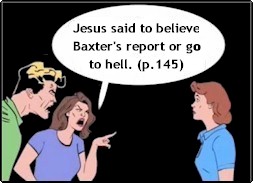
This review also contains satirical images which I use to make important points.
2. Baxter’s OBE Triggered By Prayer
One of Baxter’s claims is that Jesus Christ appeared to her in 1976 for 30 straight days while in prayer to give her out-of-body (OBE) guided tours of hell followed by 10 straight days of Jesus giving her guided tours of heaven. However, her depiction of the spirit world contradicts with descriptions of the spirit world as revealed by NDEs as this review will show. According to NDE and religious studies expert, Dr. Ken R. Vincent (Vincent, 2019), having 40 straight days of this type of religious, mystical, or spiritual experience is virtually unheard of in the literature (Vincent, personal communication, n.d.). Most people have one or two mystical experiences in a whole lifetime. Those who have multiple mystical experiences have them over time. The only person Dr. Vincent can recall as having a series of mystical experiences is Julian of Norwich (Encyclopaedia Britannica, n.d.) who in 1373 had 16 visions in a 12-hour period (Vincent, personal communication, n.d.).
Baxter provides only one description of her 40 alleged OBEs in her book (Baxter, 1993, p.14). Because of this, we can only evaluate her experience based upon this single OBE description. While the description of Baxter’s OBE has some resemblance to OBEs described in Moody’s book, there are serious problems. Baxter claimed her “soul” was “taken out of her body” by Jesus (p.14) through prayer. While spiritual practices such as prayer can produce altered states of consciousness (Newberg, 2014), OBEs are most often linked to physical and neurological conditions such as near-death, sleep, or neurological conditions, not prayer (Zingrone et al, 2010). Prayer and other religious practices can occasionally produce experiences that resemble OBEs but are not commonly identified as primary triggers. Given that Baxter claims she had 40 straight days of OBEs through prayer, her claim is very improbable. She was not near-death, nor on her deathbed, nor in a coma, nor was she under the influence of any actual trigger that would induce a real NDE or OBE. Baxter’s only description of her claimed OBEs is as follows:
“Instantly, my soul was taken out of my body. I went with Jesus up out of my room and into the sky… It was as though I had died and my body was left behind on the bed while my spirit was going with Jesus up through the top of the house” (Baxter, 1993, p. 14, emphasis mine).
But the above description by Baxter is mostly in third-person narrative. Actual experiencers of OBEs and NDEs describe their OBEs in first-person narrative (Williams, 2019c) such as in this manner provided by Raymond Moody:
“I had the feeling of being drawn up and of leaving my body, and I looked back and saw it lying there on the bed while I was going up towards the ceiling of the room… I was drawn up to the same position the light was in, and we started moving through the ceiling” (Moody, 1975, pp. 46–47, emphasis mine).
3. Baxter’s Book as a Counter to Raymond Moody’s Life After Life
a. Examining Baxter’s Claims in Light of Moody’s Book
Baxter claimed her journeys to hell began in 1976 which is one year after Moody’s book was published in 1975. Moody’s book presented a very positive portrayal of the afterlife with positive NDEs being the norm (Goodreads, n.d.). At that time, Christian skeptics of NDEs incorrectly believed Moody’s book claimed there was no hell or at least minimized it (Adventist Review, n.d.). Such critics incorrectly believe the NDE “Being of Light” (Williams, 2025) in Moody’s book who welcomes people into heaven was instead Satan masquerading as Jesus (citing 2 Corinthians 11:13-14) telling the world there is no hell to fear after death (Smith, 2013). And if there is no hell to worry, Christian NDE skeptics believe Moody’s NDE testimonies minimized Christ’s salvific work on the cross and opens the door for everyone to live an unchristian life (Hanegraaff, 2013/2015). After Moody’s book was published, Christian articles and books began to be published to counter Moody’s book and this perceived “New Age” threat (Gibbs, 1984). Because Baxter claimed her book was divinely inspired to testify to the reality of hell, it is easy to see how her testimony is just one of many counter-reactions to Moody’s book.
One version of Baxter’s commission from Jesus is particularly telling: “Kathryn, you have been chosen by the Father to accompany me through the depths of hell. I will show you many things which I desire the world to know about hell and about heaven. I will tell you what to write so that this book will be a true record of what these unknown places are really like. My Spirit will reveal secrets about eternity, judgment, love, death and life hereafter” (Baxter, 1993, p.156).
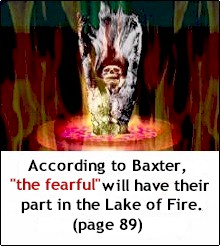
Baxter also gives an unusual warning to the reader which is also very telling, “What you are about to read will frighten you! I pray it will frighten you enough to make you a believer. I pray you will repent of your sins so you will not go to that awful place. I pray you will believe me, for I do not want this to happen to anyone else” (p.129). These words show Baxter possibly revealing her true motive for writing her book: to frighten the reader enough to make them believers of her theology and version of hell. But this is problematic because Baxter claims that Jesus told her, “Tell them that the fearful and unbelieving will have their part in the lake of fire” (p.89). This is curious because Baxter’s book contains the word “fear” and all its derivatives a total of 51 times. These include the following quotes about her fear during her visits to hell: “I was trembling with fright because of the danger and fear around us” (p.20). “Fear gripped my soul, and death took hold of me” (p.80). “Fear, the most awesome fear, gripped my soul” (p.81). “A fear like I had never felt before came over me” (p.83). “An enormous fear gripped my soul each time I remembered what happened to me there” (p.86). “I was so afraid of having to go back to hell that I was fearful to even have Jesus near me sometimes” (p.137).
b. Baxter’s Tunnels of Fear
 Baxter described traveling through “tunnels” (Baxter, 1993, p.15, 16, 17, 19, 20, 46, 47, 48, and 50). It was Moody who coined the term “tunnel” when describing NDEs (Greyson, 2000). However, Baxter described the tunnels as protruding out and above the Earth then looping back into the center of the Earth to hell. Baxter mentioned Jesus telling her that these tunnels are the “gateways to hell” (Baxter, 1993, p.15). One of the chapters of her book (Chapter 5, p.46) is entitled “The Tunnel of Fear” where she portrays these tunnels in an evil manner. Baxter claims she saw “great snakes, large rats, and many evil spirits” all running around in the tunnels (p.48). Baxter claims she heard screams filling the air in the tunnel (p.61). Elsewhere in her book, Baxter claims she saw evil spirits attached to the walls of the tunnel ready to be “spewed out on the Earth when Satan gives the orders” (p.16). Baxter claims she felt an “invisible, evil force moving inside the tunnels” (p.16) and “the worst odor I have ever smelled filled the air” (p.16). Baxter claims she saw “doorways about the size of small windows, opening and shutting very fast at the top of the tunnel” where demons were let loose upon the Earth (p.20).
Baxter’s description of the NDE tunnel is contradicted by the plethora of NDErs describing the tunnel experience as providing a sense of overwhelming warmth and peace as the experiencer is drawn to the light of God and heaven (Williams, 2019e).
c. Baxter’s Afterlife Movie Screens
Moody’s book mentions several instances where NDErs have a life review where a “Being of Light” (often identified as Jesus) displays every event of their life in detail on a heavenly “television” or “movie screen” (Moody, 1975, p.31, 60, 147, 150). This is curious because of the fact that Baxter also mentions “movie screens” in her book as Moody does; except in her case, it is Satan showing various events to demons (Baxter, 1993, p.57-58).
Another curious fact is how Baxter’s Satanic movie screen incident appears in the first edition of her book on hell (Baxter, 1993), but not in the second edition of her same book (Baxter, 1997). This is because Baxter removed pages 55-59 from the first edition and didn’t include them in the second edition. These removed pages describe what Baxter observed after Jesus told her, “My child, behold the works of Satan” (Baxter, 1993, p.55). Why Baxter removed such pages in her second edition on such an apparently important subject is curious.
4. Baxter’s Claim That God Needs Her Book to Save Souls
 Baxter claims Jesus told her that she was chosen by God to “to write and make a record” of the “reality of hell” so that “many may be saved, many will repent of their evil ways before it is too late” (p.10). Baxter claims Jesus told her that “it was for this purpose” she was born (p.12). But her claim of being chosen to tell the world that “hell is real” assumes the Bible doesn’t already contain the message of the reality of hell. Baxter’s book assumes the Bible is an insufficient revelation from God on this subject and that her book is a complete revelation. Baxter constantly portrays how urgently God and Jesus needs her testimony to save humanity (p.13). Baxter claims Jesus told her, “Some of my people do not believe that hell is real. You have been chosen by me to reveal these truths to them” (p.19). According to Baxter, Jesus needs her testimony to “turn many to righteousness” and to “bring the lost out of darkness and into the light of the gospel of Jesus Christ” (p.10). In other words, Jesus needs her testimony for people to believe the gospel.
According to Baxter, Jesus told her, “Remember to tell the people of Earth that hell is real. Millions of lost souls are here, and more are coming every day!” (p.28). However, Baxter also claims that Jesus told her that she would never have known for sure that “hell is real” unless she experienced it herself (p.85). But if this was true, how can anyone else know for sure “hell is real” unless they experienced what Baxter experienced for themselves? And if people can never know for sure “hell is real” unless they experience what Baxter experienced, then Baxter’s commission to warn people about hell to save them won’t work either unless they experience hell for themselves.
5. Baxter Claims We Must Believe Her or Go to Hell
In her book, Baxter described Jesus and “the Creator” of the universe speaking directly to the reader endorsing her book. She claims God told the reader, “Serve Me, the Creator, for I give life, not death. Arise from your evil and call upon Me, and I will heal and deliver you. The things you read in this book are true, and they will soon come to pass” (p.105, emphasis mine). She also claims Jesus told her, “What I have shown you, I want you to tell the world. Tell them hell is real. Tell them this report is real” (p.128, emphasis mine). Baxter describes Jesus speaking directly to the reader and giving a warning about Baxter’s “report” (book): “I love you (the reader) and do not desire that you should be lost. Believe this report and live. Choose you this day whom you will serve” (p.145, emphasis mine).
In another instance in her book, Baxter describes Jesus warning people to listen to “his prophetess” (i.e., Baxter) or be cursed: “You have not hearkened to the words of my servants, the prophet and the prophetess. Curses instead of blessing have come upon you” (p.101). In other words, if we don’t “hearken” to Baxter’s book we will be cursed. However, it took 17 years for Baxter to publish her 1976 experience in her 1993 book. Baxter claims that God and Jesus needed her to write a book to save souls “before it is too late” to repent (p.23-28, 33-39, 41, 44-47, 49, 51, 53-55, 59-60, 64, 67, 71-73, 75, 88, 92, 96, 98, 101-102, 105, 107, 109-111, 113-115, 126, 129, 138, 141-142, 144-145, 148, 150).
6. Baxter’s Mission to Save People From Going to Hell
Baxter constantly mentions having an obsession to save people from hell many times in her book (Baxter, 1993, p.10, 12, 14, 17, 36, 46, 50, 59, 86, 99, 129, 133, 134, 156). Baxter repeatedly pleads for the reader to believe her (p.15, 47, 73, 89, 128, 129, 145). She constantly begs the reader to repent of their sins (p.28, 34, 36, 44, 46, 47, 49, 55, 59, 60, 73, 75, 107, 113, 129, 137). Baxter used the word “repent” a total of 77 times in her book. Baxter described how she was terrified in hell, then added, “but I knew I had to go on to save souls” (p.86). She described how she fell asleep “praying for the salvation of all mankind” (p.127). She prayed, “O Lord, help me to warn the people. Give me power to stop hell from enlarging itself” (p.106) which is very telling. She also mentions many times how she was supposedly privy to secret information from Jesus of which Jesus told her not to divulge to the reader (p.73, 87, 103, 108, 121). During her entire tour of hell with Jesus, Baxter repeatedly portrays herself as being more compassionate than Jesus toward the lost people being tortured in hell. Baxter describes herself in a constant condition of sadness and tears, while depicting Jesus as indifferent toward those burning eternally in hell.
7. Baxter’s Unusual Depictions of Satan
Baxter couldn’t adequately describe Satan’s appearance which is curious. Although Baxter claims she spent 30 consecutive nights in hell – many of which she claims to observed Satan up close and personal – she is either unwilling or unable to give a complete description of Satan’s appearance. She is also inconsistent in her statement of seeing only Satan’s back (Baxter, 1993, p.76) which is reminiscent of Moses only being able to see God’s back (Exodus 33:18-23). Her only description of Satan is: (1) he has reddish-yellow flames with brown edges all around him (Baxter, 1993, p.76); (2) neither he nor his garments burn from the flames (p.76); (3) his evil laughter can be heard everywhere (p.76). But this is not a complete description of Satan. Nevertheless, the NDE literature reveals that Satan does not exist (Williams, 2019h). And because Baxter cannot provide complete descriptions of either Jesus or Satan, her testimony is questionable.
Baxter also describes Satan as confined hell within the center of the Earth (p.16, 53-54, 61-62, 65, 67-68, 71-77, 82-84, 134). But this is a contradiction of the Bible which shows Satan acting among people in the world trying to inflict whatever deception he can (1 Peter 5:8, Revelation 12:12). Baxter depicts Satan as a formidable threat to God who thinks he can overthrow and disrupt God’s plan (Baxter, 1993, p.71). But when we consider how unimaginably immense the universe is, and how enormous God is (Williams, 2019i) who transcends this immense universe, to believe in a being who could possibly be a threat to God is like believing in an ant that thinks it has the power to stop the sun from shining (to use an analogy). It just doesn’t make any logical or theological sense. Baxter also portrays Satan as being divided against himself because she portrays him in hell torturing people such as “workers of the occult” who “did his bidding” (Baxter, 1993, p.64, 71, 74-75, 116). Logically, if Satan tortures those who are working for him, instead of rewarding them, then according to Jesus, Satan’s kingdom is divided and cannot stand (Mark 3:22-26). Baxter also states that Satan has a “Fun Center” in hell (Baxter, 1993, p.74) where every form of torture is allowed including a special torture for “workers of the occult” where the demons pull apart the “bones” of their skeletons and play a very painful game of scavenger hunt with them (p.74). But the Bible clearly states that it is the demons in hell that are in torment (2 Peter 2:4).
Most of the souls whom Baxter encounters in hell are fallen Christians, which suggests that a person must be a “super-Christian” like her to avoid going to hell.
8. Baxter’s Unbelievable Reasons For People Residing in Hell
Throughout her book, Baxter gives many legalistic reasons for people residing in hell. Here are some examples:
Going to church just to “get men” (Baxter, 1993, p.35). Mocking Jesus (p.22-23, 67). Making fun of Jesus’ salvation (p.111). Flattery (p.100). Gossiping (p.39). Not being generous (p.142). Not forgiving someone when they hurt you (p.36, 39, 41). Being a homosexual (p.82, 92, 95, 113). Note: There is biblical evidence that homosexuality is NOT a sin (Williams, 2019j). Wanting the world and not Jesus (Baxter, 1993, p.27, 38, 42, 88). Not giving your heart to Jesus (p.45, 73). Not wanting to serve Jesus (p.25, 27, 35, 39, 53, 71, 72-73, 88, 105, 109-112, 145). Being a “witch” (p.64, 67, 70-71, 74, 77, 109, 114, 115-116, 118, 149). Being a “sorcerer” (p.64, 73-74, 110, 117). Being a “soothsayer” (p.70, 74, 109). Being a “worker of the occult” (p.64, 71, 74-75, 116). Being a psychic medium (p.64, 70-71, 74). Not listening to modern day prophets (p.101, 144). Being a Christian who didn’t repent of a sin before death (p.23-28, 33-39, 41, 44-47, 49, 51, 53-55, 59-60, 64, 67, 71-73, 75, 88, 92, 96, 98, 101-102, 105, 107, 109-111, 113-115, 126, 129, 138, 142, 144-145, 148, 150). Ministers who don’t teach “the Holy Ghost Baptism” (p.53). Ministers who don’t believe Jesus is returning again (p.32). Ministers who don’t teach there is a hell (p.32, 53). Ministers who “teach people to sin” (p.101).
9. Jesus’ Test for Recognizing False Testimonies
 How does one distinguish between true and false spiritual experiences? Are there any guidelines? Fortunately for Christians, Jesus mentioned a type of “smell test”. According to the gospels, Jesus was accused by religious leaders of performing miracles by the power of Satan. Jesus’ reply to his accusers was: “A tree is recognized by its fruit” (Matthew 12:33). Jesus was metaphorically referring to people as “trees” and their behavior, or works, as “fruit”. Earlier in the Book of Matthew, Jesus warned his followers about false testimony from false prophets:
“Watch out for false prophets. They come to you in sheep’s clothing, but inwardly they are ferocious wolves. By their fruit you will recognize them. Do people pick grapes from thorn bushes, or figs from thistles? Likewise, every good tree bears good fruit, but a bad tree bears bad fruit. A good tree cannot bear bad fruit, and a bad tree cannot bear good fruit.” (Matthew 7:15-18)
In the above verse, Jesus explained how the works (“fruit”) produced from someone claiming to be a prophet (a “tree”), whether the fruit is good or bad (or rotten), determines whether that prophet is a true prophet (a good “tree”) or a false prophet (a bad “tree”). The works or “fruit of the Holy Spirit” was described by the Apostle Paul: “But the fruit of the Spirit is love, joy, peace, patience, kindness, goodness, faithfulness, gentleness and self-control” (Galatians 5:22-23).
So we judge a person’s works (“fruit”) by comparing them to the “fruit” of the Holy Spirit (love, joy, peace, etc.). “Good” people, like good trees, don’t habitually bear “bad fruit” — say or do bad things. “Bad” people, like bad trees, don’t habitually bear “good fruit” — say or do good things (love, joy, peace, etc.). This is a profound insight and an excellent test for judging Baxter’s testimony. From this point on, I will refer to this test as “Jesus’ Smell Test.” In evaluating Baxter’s testimony, I have applied Jesus’ Smell Test extensively and have come to this conclusion – Baxter’s book doesn’t pass Jesus’ Smell Test at all on many levels. And because of this, I conclude Baxter to be a false prophet. Baxter always depicts Jesus as an uncaring, cold, judgmental, often angry, dogmatic, a walking “King James Bible” verse spouting, person who is able – but unwilling – to help repentant people being tortured in hell who are desperately crying out to him for help. Baxter’s book is filled with blood-curdling horror, evil, fear, sickening imagery, and is grossly lacking any of the fruits of the Holy Spirit. Practically everything coming from Jesus’ mouth in her book severely lacks any of the fruits of the Holy Spirit. Her book’s depiction of Jesus is highly dishonoring to the Jesus known in the Bible and numerous NDE testimonies.
10. Serious Errors In Baxter’s Book Proving God Couldn’t Have Said It Was True
 It took 17 years for Baxter to publish her book. Baxter claims God and Jesus desperately needed her to write a book about her supposed visits to hell to save souls from hell “before it is too late”. But Baxter’s book was released in 1993 which is 17 years after her supposed visits to hell in 1976. So despite Baxter’s claim of God and Jesus desperately needing her testimony to save people, the fact that her book took so long to be published and released shows a severe lack of urgency on her part and evidence her book was not needed by God or Jesus.
Baxter accidentally mentioned the exact same event twice on two separate days. On pages 30-31, Baxter mentioned she learned how “imps” and “devils” would leave hell through tunnels to do Satan’s bidding on the Earth. But then on a different day, on page 48, she wrote the same thing – of learning how “imps” and “devils” would leave hell through tunnels to do Satan’s bidding on the Earth.
Baxter claims to have seen “baby” Cherubim (angels) kissing the God’s face. On page 151 of her book, Baxter claims to have seen God on His throne which “was filled with baby cherubim, singing and kissing the Lord upon His face, His hands and His feet”. But this cannot be true because the Bible always describes cherubim as mature angels having a number of wing pairs, and four faces (one human). It is clear she plagiarized this idea from traditional Christian medieval art, when cherubim became associated with the “putto” and the Roman deity Cupid, resulting in the misconception that cherubim are small and plump winged boys. A putto is a Roman mythological figure in a work of art depicted as a chubby male child, usually nude and sometimes winged in form and are secular and represent non-religious passion. In Roman mythology, Cupid is the god of desire, erotic love, attraction and affection.
As previously mentioned, Baxter disobeyed God by removing Bible verses which God supposedly told her to include in her book. The Bible references listed in the back of the 1st edition of her book (pages 162-171) were deleted in the 2nd edition of her book. Baxter then tried to cover-up the evidence by deleted her words mentioning how God wanted the Bible references to be put there in the first place. Because Baxter mentioned how God wanted her to put these references in the 1st edition of her book, it makes me wonder why she decided not to put the references in her 2nd edition as well. My theory is she is trying to cover-up evidence in the 2nd edition of her plagiarizing Bible verses. Below is some of the evidence:
1st Edition: “Jesus said, ‘…Tell them that I will keep them from evil if they put their trust in me.’ Readers, please use the Bible references in the back of this book. God told me to put them there” (p.104).
2nd Edition: “Jesus said, ‘…Tell them that I will keep them from evil if they put their trust in me.’ Readers, please use the Bible references in the back of this book. God told me to put them there” (p.146).
Why Baxter removed these references when God told her to include them is certainly curious.
11. Baxter Plagiarized Many Bible Verses
Baxter claims Jesus gave her a special commission to “prepare the saints for his return” (p.13). But there are several problems with this. Baxter plagiarized from the Bible the same commission John the Baptist was given in preparing the saints for the coming of Christ. Here is the evidence:
John the Baptist: “…you will go before the face of the Lord to prepare His ways” (Luke 1:76b).
Mary Baxter: “I wish to give you a revelation to prepare the saints for my return” (p.13)
John the Baptist: “And you, child, will be called the prophet of the Highest; for you will go before the face of the Lord” (Luke 1:76).
Mary Baxter: “For this purpose you were born, to write and tell what I have shown and told you” (p.12).
John the Baptist: “To give knowledge of salvation to His people” (Luke 1:77).
Mary Baxter: “The book you write will save many souls from hell” (p.17).
John the Baptist: “To give light to those who sit in darkness” (Luke 1:79).
Mary Baxter: “I will manifest myself to you to bring people out of darkness into light” (p.10).
John the Baptist: “To hearken to the words of my servants the prophets, whom I sent unto you, both rising up early, and sending them, but ye have not hearkened” (Jeremiah 26:5).
Mary Baxter: “You have not hearkened to the words of my servants, the prophet and the prophetess” (p.101)
John the Baptist: A MESSAGE OF RECONCILIATION: “And he will turn many of the children of Israel to the Lord their God… to turn the hearts of the fathers to the children, and the disobedient to the wisdom of the just, to make ready a people prepared for the Lord” (Luke 1:16-17). “This man came for a witness, to bear witness of the Light, that all through him might believe” (John 1:7). “Make straight the way of the Lord'” (John 1:23).
Mary Baxter: A MESSAGE OF MARY BAXTER’S OWN FEAR: “I was trembling with fright because of the danger and fear around us” (p.20). “Fear gripped my soul, and death took hold of me” (p.80). “Fear — the most awesome fear — gripped my soul” (p.81). “A fear like I had never felt before came over me” (p.83). “An enormous fear gripped my soul each time I remembered what happened to me there” (p.86). “Tell them that the fearful and unbelieving will have their part in the lake of fire” (p.89). “”And I was so afraid of having to go back to hell that I was fearful to even have Jesus near me sometimes” (p.137).
Notice that Baxter says she was “so afraid of having to go back to hell” that she was “fearful to even have Jesus near me sometimes” (p.137). Baxter’s statement of being afraid of Jesus disqualifies her entire testimony in my opinion. A multitude of NDEs involving Jesus shows how those in his presence are overwhelmed with the amount of love, peace, comfort, strength he provides. Baxter’s claim of being fearful of Jesus only shows she was never in his presence. According to the Bible, there is no fear in love (1 John 4:18) because fear is a “bad fruit” which doesn’t pass Jesus’ Smell Test. The fact is that Baxter’s book contains the word “fear” and all its derivatives a total of 51 times. On page 129 in her book, Baxter states: “What you are about to read will frighten you! I pray it will frighten you enough to make you a believer.” Has Baxter revealed her ulterior motive for writing her obvious work of fiction? I believe so. On page 89 in her book, Baxter contradicts her own fear-mongering when she claims “the fearful” will “have their part in the Lake of Fire.“
Baxter arrogantly believes she is thee prophet preparing the saints for Jesus second coming in the same manner as John the Baptist prepared the way for Jesus at his first appearance. Baxter repeatedly claims God has anointed her with the gift of prophecy (p.100-103, 144, 149-156). But judging from the contents of her book, Baxter is only preparing the way for fear — all of which doesn’t pass Jesus’ Smell Test. For this reason, Baxter’s claim of visiting hell to prepare the way for Christ’s return does not ring true.
Baxter Has Jesus Misquote a Plagiarized Bible Verse From Paul
In Chapter 17 of her book named “War in Heaven”, Baxter describes a ridiculous vision where she was high above the Earth watching “witches, wizards, sorcerers, evil princes and powers of the air” come flying out of hell and reeking havoc on Earth. Baxter claims she told Jesus the vision was “too awful to behold.” Baxter then has Jesus misquote a plagiarized Bible verse from Paul’s epistle to Ephesians::
Jesus: “Put on the whole armor of God that you may be able to stand in the evil day, and having done all, to stand” (p.118).
Notice how using the word “stand” makes the sentence above nonsensical. Here is the correct Bible verse:
Bible: “Take up the whole armor of God, that you may be able to withstand in the evil day, and having done all, to stand” (Ephesians 6:13, New King James Version).
Bible: “Put on the whole armor of God, that you may be able to withstand in the evil day, and, having done all, to stand.” (Ephesians 6:13, World English Bible).
For Baxter to put words in Jesus’ mouth, especially having him misquoting Paul in this manner, should raise a red flag to all Bible-believing Christians.
Baxter Plagiarized One of Jesus’ Parables in the Bible
In her book, Baxter described an event in hell (p.23) which was obviously plagiarized from Jesus’ parable of Lazarus and the Rich Man (Luke 16:19-31) because of the number of word-for-word similarities to the parable. Below is the parable itself followed by a comparison of the parts of the parable Baxter plagiarized for her testimony. The phrases with a [bracketed number] assigned to them are the phrases in the parable Baxter plagiarized.
The Parable of Lazarus and the Rich Man (Luke 16:19-31)
 [Jesus said to his disciples:] “There was a certain rich man who was clothed in purple and fine linen and fared sumptuously every day. But there was a certain beggar named Lazarus, full of sores, who was laid at his gate, desiring to be fed with the crumbs which fell from the rich man’s table. Moreover the dogs came and licked his sores. So it was that the beggar died, and was carried by the angels to Abraham’s bosom. The rich man also died and was buried. And being in torments in Hades, he lifted up his eyes and saw Abraham afar off, and Lazarus in his bosom. Then he cried and said, ‘Father Abraham, have mercy on me, and send Lazarus that he may dip the tip of his finger in water and cool my tongue; for I am tormented in this flame.’
“But Abraham said, ‘Son, remember that in your lifetime you received your good things, and likewise Lazarus evil things; but now he is comforted and you are tormented. And besides all this, between us and you there is a great gulf fixed, so that those who want to pass from here to you cannot, nor can those from there pass to us.’
[1] “Then he said, ‘I beg you therefore, father, that you would send him to my father’s house, for I have five brothers, that he may testify to them, lest they also come to this place of torment.’
[2] “Abraham said to him, ‘They have Moses and the prophets; let them hear them.’
“And he said, ‘No, father Abraham; but if one goes to them from the dead, they will repent.’
[3] “But he said to him, ‘If they do not hear Moses and the prophets, [4] neither will they be persuaded though one rise from the dead.'” (Luke 16:19-31)
The phrase “this place of torment” in the parable above is a special phrase Baxter plagiarizes because it appears in the dialogue of 5 people in a total of 7 times in her book. However, she didn’t use the phrase in her plagiarized event which is curious because it shows she appears to be cautious in her plagiarism. Below is the comparison between the parts of Baxter’s testimony and the parts of Jesus’ parable she plagiarized. The underlined words are plagiarized words of particular interest.
Verses From Lazarus and the Rich Man That Baxter Plagiarized
 Bible: [1] “Then he said, ‘I beg you therefore, father, that you would send him (Lazarus) to my father’s house, for I have five brothers, that he may testify to them, lest they also come to this place of torment.” (Luke 16:27-28)
Baxter: The lost person said, “Lord, some of my people are coming here, for they also will not repent. Please, Lord, let me go tell them that they must repent of their sins while they are still on Earth. I do not want them to come here.” (p.23).
Bible: [2] “Abraham said to him, ‘They have Moses and the prophets; let them hear them.'” (Luke 16:29)
Baxter: Jesus said to him, “They have preachers, teachers, elders – all ministering the gospel. they will tell them. They also have the advantages of the modern communications systems and many other ways to learn of me. I sent workers to them that they might believe and be saved.” (p.23).
Bible: [3] “But he (Abraham) said to him, ‘If they do not hear Moses and the prophets…'” (Luke 16:31).
Baxter: Jesus said to him, “If they will not believe when they hear the gospel …” (p.23).
Bible: [4] “neither will they be persuaded though one rise from the dead” (Luke 16:31).
Baxter: “neither will they be persuaded though one rises from the dead.” (p.23).
Notice how Baxter misquotes Luke 16:31 in [4] by using the word “rises” instead of “rise.”
Baxter’s putting words from the King James Bible into Jesus’ mouth also doesn’t pass Jesus’ Smell Test.
Baxter’s Plagiarism of Jesus’ Parable Created a Serious Contradiction
By plagiarizing Jesus’ parable of Lazarus and the Rich Man (Luke 16:19-31), Baxter contradicted herself.
According to Baxter’s testimony, Jesus supposedly told her that if people don’t believe teachers and ministers, they won’t believe the gospel even if someone comes back from the dead (p.23).
But if Jesus actually said this to Baxter, it contradicts the commission he supposedly gave to Baxter which is to come back from the dead (hell) and give a testimony to the world about it (p.13).
How then will anyone believe her if no one will believe even if someone comes back from the dead?
12. Baxter Plagiarized from the Book of Revelation
Much of Baxter’s book concerning prophecy was plagiarized from the Book of Revelation in the following ways:
Baxter plagiarized Book of Revelation symbolism (p.59, 63, 65, 74, 79, 89, 90-94, 97-98, 100, 117, 122-126, 140, 143-145, 153).
Baxter plagiarized Book of Revelation phrases (p.62, 64, 73, 105, 116, 147).
Baxter plagiarized Book of Revelation entire verses (p.97, 105).
Baxter claimed Jesus appeared to her and give her a special commission (p.10, 12, 13, 156). But her description of it is suspiciously similar to John’s description of his encounter with Christ in the Book of Revelation. Here is a comparison:
John of Revelation: “…was in the Spirit” (Revelation 1:10).
Mary Baxter: “…was praying in the Spirit” (p.13)
John of Revelation: “His countenance was like the sun shining in its strength” (Revelation 1:16).
Mary Baxter: “A brilliant light illuminated the room” (p.13).
John of Revelation: “I AM the Alpha and the Omega, the First and the Last” (Revelation 22:13).
Mary Baxter: “I AM That I AM, [1] and there is none beside me” [2].
[1] Exodus 3:14; [2] Isaiah 44:6
John of Revelation: “What you see, write in a book” (Revelation 1:11).
Mary Baxter: “I want you to write a book and tell of the visions and of the things I reveal to you” (p.13)
John of Revelation: “These things says the Amen, the Faithful and True Witness” (Revelation 3:14).
Mary Baxter: “For these things are Faithful and True” (p.12).
John of Revelation: “Write the things which you have seen, and the things which are, and the things which will take place after this” (Revelation 1:19).
Mary Baxter: “Make a record of these things, which were and are and are to come” (p.13).
John of Revelation: “I fell at his feet as dead” (Revelation 1:17).
Mary Baxter: “A sweet and wonderful feeling came over me” (p.13)
As you can see, Baxter’s testimony above is remarkably similar to that of John the Revelator. The main difference is how John fainted and fell at Jesus’ feet “as though dead” when he saw the risen Christ in all his glory. On the other hand, Baxter had a “sweet and wonderful feeling.” Baxter’s relatively weak response to the risen Christ is enough compelling evidence of how her testimony is not true and doesn’t pass Jesus’ Smell Test. In fact, much of Baxter’s book concerning prophecy is remarkably similar to the Book of Revelation and her own unusual interpretation of it. But the real question is whether or not God really needs another Book of Revelation? The answer can be found by examining all the errors and problems found in her testimony proving it cannot be of God.
In Chapter 13 (1st edition), Baxter claims Jesus gave her a vision of the End Times while they were in hell. But her “vision” is suspiciously similar to the Book of Revelation which shows evidence of Baxter plagiarizing from the Book of Revelation; but with serious flaws. One of the plagiarized phrases of the Book of Revelation she deleted from the 2nd edition of her book is “for a season”. Perhaps she did this to not make her plagiarism so obvious. Here is the evidence:
Bible: An angel bound Satan and threw him into the bottomless pit where he will remain for “a thousand years.” When the thousand years is over, Satan will be let loose upon the Earth “for a little season” in one last attempt to deceive the world (Revelation 20:1-3).
Baxter: The man in front of the door to the bottomless pit “looked to be a thousand years old.” Baxter then told Jesus, “I’ll be glad when Satan is cast into the bottomless pit and all these evil things stop for a season” (p.98).
Baxter’s Suspicious Deletion of the Plagiarized Phrase “for a season”
1st Edition: “I’ll be glad when Satan is cast into the bottomless pit and all these evil things stop for a season” (p.98).
2nd Edition: “I’ll be glad when Satan is cast into the bottomless pit and all these evil things stop for a season” (p.137).
More Evidence of Baxter Plagiarizing From the Book of Revelation
Bible: An angel revealed to John “the judgment of the great whore that sitteth upon many waters” (Revelation 17:1) and is told, “The waters which thou sawest, where the whore sitteth, are peoples, and multitudes, and nations, and tongues” (Revelation 17:15).
Baxter: Baxter saw “a large woman” who had “multitudes, peoples and tongues beneath her” (p.95).
Bible: The woman sitting on a beast had “seven heads and ten horns.” (Revelation 17:3).
Baxter: The woman had “seven heads and ten horns.” (p.95). Notice that Baxter contradicts the Bible here. The Bible says it is the beast that has ten horns – not the woman.
Bible: On the woman was “written, Mystery, Babylon The Great, the mother of Harlots and abominations of the Earth” (Revelation 17:15).
Baxter: The woman had the words “Mystery Babylon” written on her and was “the mother of abominations on the earth” which “came from hell” (p.95). Notice how Baxter contradicts the Bible in what was written on the woman. Baxter also misquotes the verse in Revelation by using “on the Earth” instead of “of the Earth.”
Bible: John saw “the woman drunken with the blood of the saints” (Revelation 17:6).
Baxter: Baxter saw the woman “appeared drunk” (p.95) and “swayed back and forth as though she was drunk” (p.97). The Bible suggests the woman was symbolically “drunk” on blood; but Baxter’s plagiarized version states the woman only “appeared” drunk — and on alcohol rather than symbolically on blood.
Bible: An angel then told John, “The beast that thou sawest was, and is not; and shall ascend out of the bottomless pit” (Revelation 17:8).
Baxter: Baxter saw a large door with flames raging from it that was locked shut. Jesus supposedly told her, “Behind that doorway is the bottomless pit.” Then a “dark figure of a man” wearing a “long, dark cape” appeared in front of the door to the bottomless pit. (p.98). Baxter obviously had the above Bible verse, Revelation 17:8, in mind.
Bible: John is told, “The seven heads are seven mountains, on which the woman sitteth” (Revelation 17:9) and that “the ten horns which thou sawest are ten kings” (Revelation 17:12). Note that John’s prophecy fulfills the prophecy of Daniel, “The ten horns are ten kings who shall arise from this kingdom” (Daniel 7:24).
Baxter: The woman Baxter claims she saw was “sitting on a hill” (p.95). Previously, Baxter described seeing horns rising from hell to Earth (p.78). Jesus supposedly told Baxter these horns, “represent evil kingdoms on the Earth” (p.79). But this is a contradiction of the Book of Revelation and Daniel above which states “the ten horns are ten kings” and not ten evil kingdoms. More details are provided below.
Bible: John heard an angel say, “Babylon the great is fallen, is fallen” (Revelation 18:2).
Baxter: Referring to the “mother of abominations“, Baxter claims she heard Jesus call out, “In her time she shall be destroyed.” (p.97).
Bible: John heard a voice from heaven say, “Come out of her, my people, that ye be not partakers of her sins, and that ye receive not of her plagues” (Revelation 18:4).
Baxter: Baxter claims she heard Jesus call out, “Come out from her and be separate.” (p.97).
Bible: John learned Babylon represents a great city where “in her was found the blood of prophets, and of saints, and of all that were slain upon the Earth” (Revelation 18:24).
Baxter: Baxter wrote that the woman labeled “Babylon,” had: “in her was found the blood of the prophets, the saints and all that were slain upon the Earth” (p.97). Notice how Baxter plagiarized the verse word-for-word except for a single word “and” which is curious.
Baxter’s Contradictions About the Bible’s Prophecies of “the Horns”
In the 1st edition of her book, Baxter described seeing “what looked like large arms or horns rising from hell and into the Earth and over all the Earth” (p.78). Then she wondered if these were the horns mentioned in the Bible. Baxter claims Jesus agreed with her by saying they are the horns that Daniel saw and they “represent evil earthly kingdoms” But Baxter made a serious mistake here because the Bible says the ten horns are ten kings and not ten kingdoms claimed by Baxter.
Bible: “The ten horns are ten kings who shall arise from this kingdom” (Daniel 7:24).
So the horns Baxter writes about could not possibly be literal horns rising from hell. And the kingdom Daniel refers to is the final kingdom before Christ returns and is symbolized by:
Bible: “A fourth beast, dreadful and terrible, exceedingly strong. It had huge iron teeth; it was devouring, breaking in pieces, and trampling the residue with its feet. It was different from all the beasts that were before it, and it had ten horns” (Daniel 7:7).
So for these reasons, Baxter’s prophecy attributed to Jesus is untrue and places a falsehood on the lips of Christ.
Baxter Changed Her Plagiarized Vision in the 2nd Edition of Her Book
By adding the phrase “which is to” in reference to Baxter seeing the New Jerusalem “come down to Earth,” she changed her prophecy from the present tense to a future tense. The probable reason for adding this phrase is so that it agrees with the Book of Revelation and possibly avoiding God’s curse for adding or taking away from the Book of Revelation (see below).
1st Edition: “Before me was the New Jerusalem, the city of God come down to Earth” (p.140).
2nd Edition: “Before me was the New Jerusalem, the city of God, ADDED: which is to come down to Earth” (p.193).
Bible: “… city of my God, the New Jerusalem, which comes down out of heaven from my God” (Revelation 3:12).
God’s Curse For Plagiarizing the Book of Revelation
Bible: “For I (John) testify to everyone who hears the words of the prophecy of this book: If anyone adds to these things, God will add to him the plagues that are written in this book; and if anyone takes away from the words of the book of this prophecy, God shall take away his part from the Book of Life, from the holy city, and from the things which are written in this book” (Revelation 22:18-19).
13. Baxter Changed Jesus’ Words Significantly in the 2nd Edition
While writing a review of Baxter’s book, I encountered serious discrepancies between the first edition of her book and the same book (the second edition). Many of the biggest errors in the first edition of her book were corrected and covered up. In this section I expose these discrepancies.
For some bizarre reason, in the second edition of her book, all references from the first edition were removed describing Jesus asking the Father to have mercy on people in hell. One can only speculate why such an important revelation was suspiciously removed. My theory is if Jesus actually asked the Father to have mercy on people in hell, then it would be done because the Father always hears Jesus (John 11:41-42). Removing such words of mercy attributed to Jesus doesn’t pass Jesus’ Smell Test.
Baxter Removed Jesus’ Prayers For Mercy on People in Hell in the 2nd Edition
1st Edition: “Great sobs shook his (lost person’s) skeletal frame as he begged, ‘Please, Jesus, let me out!’ I (Baxter) looked at Jesus and saw that he too was crying. He looked up and said, ‘My Father, my Father, have mercy!’ ‘Lord Jesus,’ the man cried out” (p.22).
2nd Edition: “Great sobs shook his (lost person’s) skeletal frame as he begged, ‘Please, Jesus, let me out!’ I (Baxter) looked at Jesus and saw that he too was crying. He looked up and said, ‘My Father, my Father, have mercy!‘ ‘Lord Jesus,’ the man cried out” (p.28).
1st Edition: “If these had truly come unto the Father and repented, He would have forgiven them. Great tenderness covered Jesus’ face as he said, ‘My Father, have mercy.’ Again we walked among the flaming pits” (p.37).
2nd Edition: “If these had truly come unto the Father and repented, He would have forgiven them. Great tenderness covered Jesus’ face as he spoke, ‘My Father, have mercy.’ Again we walked among the flaming pits” (p.51).
1st Edition: “He (a lost person) fell into a small heap on the floor and continued to cry. Jesus cried, ‘My Father, my Father, have mercy.’ We walked on to another cell” (p.114).
2nd Edition: “He (a lost person) fell into a small heap on the floor and continued to cry. Jesus cried, ‘My Father, my Father, have mercy.’ We walked on to another cell” (p.160).
Baxter Removed Jesus Saying “My Word is True” in the 2nd Edition
Another odd removal of a phrase supposedly said by Jesus is “My Word is true” in the 1st edition of her book which was removed in the 2nd edition of her book. Her reason for removing this phrase may be because she claims Jesus said “My Word is true” a total of 5 times in the 1st edition (p.13, 33, 34, 79, 89). Baxter herself mentions the phrase 1 time. She may have realized it was too obvious of a phrase for Jesus to repeat so many times. Nevertheless, removing a statement of Jesus testifying to his Word as being true is highly suspicious and doesn’t pass Jesus’ Smell Test.
1st Edition: Jesus said, “Behind that doorway is the bottomless pit. My Word is true.” (p.98).
2nd Edition: Jesus said, “Behind that doorway is the bottomless pit. My Word is true.” (p.98).
More Examples of Jesus Saying Ridiculous or Ridiculously Self-Evident Statements
Baxter continuously portrays Jesus parroting spiritual truths that are too self-evident to pass through the lips of such a great wisdom teacher as Christ. These parroted phrases obviously came from someone at a grade school reading level. For example, Jesus supposedly told Baxter the following:
“Hell is real” (18 times in her book). “Heaven is real” (3 times in her book). “The judgment is real” (p.23). “Satan is real” (p.50). “Witchcraft is real” (p.70). “What you are seeing is real” (p.17). “The horrors of hell are real” (p.76). “Demon powers are real” (p.50). “The powers of darkness are real” (p.13, 50). “My Father’s mercy is just as real” (p.63). “These horrors were real” (p.63). “I am faithful and just” (p.34). “I have all power in heaven and Earth” (4 times). “My judgments are true” (p.13). “These things are true” (p.60,113). “The revelations are true” (p.100). “These things are faithful and true” (5 times in her book). “These prophecies you are about to read are true” (p.100). “The Lord is faithful” (p.119). “All unrighteousness is sin” (p.100). “Through my blood, there is forgiveness of sins” (p.34). “Sin results in death” (p.21). “My salvation is free” (p.77). “God is a Spirit” (p.92). “God is forgiving” (p.37).
The statements above resemble Baxter’s own manner of speech rather than the eloquent words of Christ.
Baxter Removed Jesus’ Words About “Boys and Girls” in the 2nd Edition
As mentioned earlier, Baxter often used a pet phrase “men and women, boys and girls” which she does a total of 3 times in her book – 1 time by Baxter and 2 times by Jesus. But she made some changes in her 2nd edition which are reflected below. I can understand why she chose to remove the first reference about Jesus’ Spirit departing if it is not wanted. It is utterly ridiculous to believe Jesus withdraws the Holy Spirit from Christians under any circumstances. And I can also understand why she chose to remove the second reference below about “boys and girls” marching into the flames of hell which is too ridiculous to believe. What I can’t understand is why she didn’t go all the way and delete the entire ridiculous sentence. It doesn’t pass Jesus’ Smell Test.
1st Edition: “I (Jesus) call different ones for different purposes in my body. If man or woman, boy or girl doesn’t want my Spirit, I will depart. Yes she did answer my call for many years” (p.40).
2nd Edition: “I (Jesus) call different ones for different purposes in my body. If man or woman, boy or girl doesn’t want my Spirit, I will depart. Yes she did answer my call for many years” (p.56).
1st Edition: “As the angels broke the seals, men and women, boys and girls marched straight into the flames. I watched in ghastly fascination wondering if she knew any of them” (p.89)
2nd Edition: “As the angels broke the seals, men and women, boys and girls marched straight into the flames. I watched in morbid fascination wondering if she knew any of them” (p.123).
In the 1st edition of her book, Baxter describes how she watched in “ghastly fascination” men and women, boys and girls marching into the flames of hell. In the 2nd edition of her book she deleted “boys and girls” and changed the wording to “morbid fascination“. But changing the wording from “ghastly” to “morbid” doesn’t change how bizarre it is be to fascinated by watching boys and girls – or men and women – actually marching into the fires of hell.
Baxter Removed Jesus’ Words About Satan Making More Jail Cells in the 2nd Edition
Baxter claims Jesus told her how Satan took over paradise when it was located “close to hell” before Jesus’ death and resurrection and is using it for his own evil purposes. Of course, this is untrue because Baxter got this idea from the Greek concept of “Hades” mentioned in the Bible as being the underworld where all souls, both pious and wicked, go after death. The Greeks believed Hades was located somewhere under the Earth and it appears Baxter believed it as well. Why she chose to delete the reference of Satan making more cells there is anyone’s guess.
1st Edition: “These cells were once in paradise; now Satan uses them for his evil purposes and made more” (p.75).
2nd Edition: “These cells were once in paradise; now Satan uses them for his evil purposes and made more” (p.101).
Baxter Changed Jesus’ Words About the Shape of Hell in the 2nd Edition
In the 1st edition of her book, Jesus described to Baxter how hell is located in the center of the Earth and has the shape of a body lying on her back with legs, arms, belly, jaws, etc.. But in the 2nd edition, Baxter removed the feminine connotation associated with hell’s shape.
1st Edition: Jesus spoke again, “Hell has a body, like a human form, lying on her back in the center of the Earth” (p.28).
2nd Edition: Jesus spoke again, “Hell has a body, like a human form, lying on its back in the center of the Earth” (p.36).
14. Baxter Covered Up Her Contradictions About Jesus in the 2nd Edition
 Baxter portrays hell as a place where Satan and his demons gleefully torture everyone there including those people who did his bidding in life. This means Satan is “divided against himself” and according to Jesus word’s in Matthew 12:26, Satan’s kingdom will not stand. So for Baxter to portray Satan torturing his human servants is a contradiction of Jesus’ words. But even more serious, in the 1st edition of her book, Baxter has Jesus contradicting himself by leaving Baxter in hell when he said he wouldn’t. Baxter mentioned that Jesus told her, “I’ll never leave or forsake you.” (p.78). But then Jesus does just that and leaves Baxter in the “heart of hell” to be tortured despite her repeated calls to him for help (p.80). Baxter’s depiction of Jesus contradicting himself leads to serious errors. Baxter caught this contradiction and made the following corrections for the 2nd edition of her book. The words after “ADDED“ are additions to Jesus’ words in the second edition of her book. The words in RED are words that were changed in the 2nd edition.
Baxter Put More Words in Jesus’ Mouth to Cover Up Her Contradiction
1st Edition: “I (Jesus) will also show you visions of heaven and other places and give you many revelations” (p.11).
2nd Edition: “I (Jesus) will also show you visions of heaven and other places and give you many revelations. ADDED: At times you will see me and at times you won’t, but I will be there with you through all of this. Remember, I am with you always, even to the ends of the Earth” (p.14)
Baxter Covered Up Her Original Statements of Jesus Abandoning Her
1st Edition: “I (Baxter) began to realize that I was lost without any hope at all. I sobbed and called out to Jesus over and over again” (p.81).
2nd Edition: “I (Baxter) began to think that I was lost without any hope at all. ADDED: Even though he had promised that he would never leave me or forsake me. I sobbed and called out to Jesus over and over again” (p.111-112).
1st Edition: “I (Baxter) cannot say how I knew, but I knew with all my heart that Jesus was gone. I felt very sad” (p.129).
2nd Edition: “I (Baxter) cannot say quite how I ‘knew’, but I felt with all my heart that Jesus was gone. ADDED: Even though he had promised that he would never leave me or forsake me, I could not sense him anywhere and was experiencing what a lost soul will experience forever. I was very sad (p.178).
Baxter Has Jesus and God Contradict Themselves But Covers Up Only One
Baxter has Jesus contradict himself again when he supposedly said to Baxter, “If you will humble yourselves and call upon me, I will hear you and bless you.” (p.101). But Baxter had already mentioned how Jesus ignored her calls from hell when he abandoned her there (p.80). However, this contradiction is one Baxter didn’t correct in the 2nd edition of her book.
Baxter did correct another contradiction. It was about God not being able to hear her cries when Jesus abandoned her in hell as described in the 1st edition of her book (p,134). Baxter must have later realized the contradiction when she was reminded how God can do all things, so she covered up her contradiction in the 2nd edition of her book as shown below:
1st Edition: “I (Baxter) cried, for I knew for sure I was in hell. God could not hear me” (p.134).
2nd Edition: “I (Baxter) cried, for I knew for sure I was in hell. ADDED: It seemed as if God could not hear me” (p.185).
Baxter Covered Up a Contradiction About Jesus Taking Her To Heaven in the 2nd Edition
Baxter claims to have spent 30 consecutive nights in hell with Jesus followed immediately by 10 consecutive nights in heaven. But in the 1st edition of her book, she says she was sick for many days after her last day in hell with Jesus (p.137). This means she would have been sick for at least some of these days in heaven which is a contradiction of her testimony. This is probably the reason the reference of being sick for many days was deleted from the 2nd edition of her book.
1st Edition: “I was sick for many days after I was left in the jaws of hell” (p.137).
2nd Edition: “I was sick for many days after I was left in the jaws of hell” (p.189).
15. Baxter’s Unbelievable Depictions of Hell
Baxter describes people in hell as having actual physical, flesh and blood bodies (p.53-54, 66, 95, 107, 146). Baxter also describes these bodies of people in hell as being actual skeletons with real bones (p.21, 22, 26, 32, 38, 39, 42, 66, 68, 83, 89, 97, 109, 111, 113, 130, 132, 133). Baxter also describes people in hell as having real flesh burning and decaying from their skeletons (p. 16, 21-23, 26, 32, 34, 38, 44, 61, 65-66, 68-69, 72-73, 76, 78, 80, 82, 83, 90, 109, 112, 130-131, 133, 135, 141). Baxter also describes people in hell having souls resembling “dirty-grey mists” which are “caged” within their skeletal bodies (p.21, 23, 24, 33, 37, 44, 52, 66, 111, 113, 130). Baxter also describes people in hell being tormented by real worms crawling within their bones (p.25, 28, 44, 50, 59, 90, 151, 155, 176-177, 180) and how these worms are not hurt by the flames. Baxter’s description of people in hell having flesh and blood bodies, not only contradicts hell in the NDE literature (Williams, 2019f), it contradicts the Bible which states: “I declare to you, brothers and sisters, that flesh and blood cannot inherit the kingdom of God, nor does the perishable inherit the imperishable” (1 Corinthians 15:50). In other words, souls do not have flesh and blood. Baxter also says that people with disabilities such as missing limbs in life are carried over into hell (Baxter, 1993, p.73).
According to Baxter, hell is located within the center of the Earth (p.27, 53, 67). Baxter describes hell as remarkably similar to Dante’s Inferno (Alighieri, 2003/1320) from Dante’s Divine Comedy complete with demons torturing people in pits of fire and jail cells. As with Dante’s Inferno, Baxter portrayed demons and Satan functioning as supervisors in hell who are responsible for inflicting pain (beyond the pain already inflicted by hell itself) on lost people under their charge (p.29-31, 42). Also, according to Baxter, an escalator brings demons up from hell to Earth. She describes how she saw a flight of stairs going down into the Earth and into hell which eventually became an escalator bringing demons up to Earth from hell (p.93). Baxter also claims that time exists in the afterlife and hell. She described a lost person who said he had been in hell for forty years (p.26). But according to NDE studies, the spirit world consists of many realms all of which are timeless (Williams, 2019g). Time is measured only in the physical realm (the universe) using entropy and the position of the Earth relative its movement around the sun.
All of Baxter’s claims about the nature of hell contradicts the NDE literature about hell (Williams, 2019a).
 Baxter’s testimony provides horrific descriptions of people being tortured to the extreme in hell. Yet, in a strange manner, she also described them as willing and able to be casually interviewed. These interviews give the reader very personal information about the sins each person committed that sent them to hell. Baxter’s description of these interviews is similar to descriptions of people standing up in church to give their testimonies of how they were saved. These very casual interviews of people while they are being horrifically tortured are obviously phony as you will see in the example below. And when you consider the phony dialogue in these interviews, Baxter’s motive for writing her book becomes crystal clear. These people in hell are Baxter’s mouthpieces created for promoting her particular brand of theology. For example, Baxter and Jesus came across a skeletal woman being horrifically burned and tortured in a pit with worms crawling in her bones. The lost woman’s interview is provided below.
A Burning, Tortured, Skeletal Woman In Hell Giving Her Testimony to Jesus and Baxter
“My soul is truly in torment. There is no way out. I know that I wanted the world instead of you, Lord. I wanted riches, fame and fortune, and I got it. I could buy anything I wanted; I was my own boss. I was the prettiest, best-dressed woman of my time. And I had riches, fame and fortune, but I found I could not take them with me in death.. I planned to serve you someday when I got ready. I thought you would always be there for me. But how wrong I was! I was one of the most sought-after women of my time for my beauty. I knew God was calling me to repent. All my life he drew me with cords of love, and I thought I could use God like I used everyone else. He would always be there. Oh yes, I used God! He would try so hard to get me to serve Him, while all the time I thought I didn’t need Him. Oh, how wrong I was! For Satan began to use me, and I began to serve Satan more and more. At the last I loved him more than God. I loved to sin and would not turn to God. Satan used my beauty and my money, and all my thoughts turned to how much power he would give me. Even then, God continued to draw me. But I thought, I have tomorrow or the next day. Then one day while riding in a car, my driver ran into a house, and I was killed. Lord, please let me out” (p.27-28).
There are a couple of phony aspects to this testimony Baxter provided. The casual and personal interview of this lost and tortured woman is typical of all the phony interviews in hell described by Baxter. Absolute proof the above interview is phony is how this lost woman used one of Baxter’s pet phrases “how wrong I was!” twice. Baxter herself used this identical pet phrase on page 48:
Baxter: “The tunnel cannot possibly be as bad as the pits. But how wrong I was!” (p.48).
This means 2 people used the same phrase “how wrong I was” a total of 3 times (p.27,28,48) in Baxter’s book which is strong evidence that the words of the burning, tortured woman in hell above were fabricated by Baxter. I should point out that Jesus’ only reply to this tortured woman was very cold, “The judgment is set” (p.28). Afterward, Baxter uses Jesus as her mouthpiece to promote her “hell is real” propaganda campaign by turning to her and saying the following:
Jesus: “Remember to tell the people of Earth that hell is real. Millions of lost souls are here, and more are coming every day. On the Great Judgment Day, death and hell will be cast into the lake of fire; that will be the second death” (p.28).
The phrases above about the “lake of fire” and “the second death” are phrases Baxter plagiarized from the Book of Revelation. See below. This is just one of many examples of plagiarism from the Bible in Baxter’s book.
Bible: “Then Death and Hades were cast into the lake of fire. This is the second death” (Revelation 20:14).
16. Everyone in Baxter’s Book Speaks Just Like Her
 Baxter unknowingly made the mistake of having all the people depicted in her book speak using the same unusual phrases, idioms, and specific religious jargon Baxter herself uses — that of someone at the reading level of a grade schooler. This proves all the words said by everyone in her book originated from a single source, Baxter herself, and not the many people she claims to have encountered and spoken with. For example, Baxter uses the phrase “on Earth” when referring to a person’s lifetime before they died. In fact, the phrase “on Earth” is used by 7 people (see below) a total of 38 times in her book. There are many alternative phrases people could use to refer to “life before death” than the unusual phrase “on Earth” including: “when I was alive”; “before I died”; “in life”; “during my life”; “when I was living in the world”, “in my former life”, etc. Because everyone in Baxter’s book speaks just like her, like a Charismatic Christian with a grade school level reading ability, it is clear evidence of Baxter’s deception and fraud.
7 People who use the phrase “on Earth” a total of 13 times (out of 38 times)
Baxter: “When you die on Earth, if you are born again by the Spirit of God, your soul goes to heaven” (p.73).
Baxter: “When souls die on Earth and are not saved from their sins, they come here” (p.134).
Jesus: “While she was on Earth, she had cancer and was in much pain” (p.25).
Jesus: “While he was on Earth, this man was a preacher of the gospel” (p.32).
Jesus: “While you were on Earth, I called you to come to me” (p.38).
Jesus: “While you were on Earth, I called and called for you to come to me” (p.44).
Jesus: “When they were alive on Earth, they deceived many… to follow Satan and to sin” (p.74).
Jesus: “But sinners must repent while still alive on Earth” (p.111).
Satan: “You did serve me well while on Earth” (p.72).
Lost Person #1: “They must repent of their sins while they are still on Earth” (p.23).
Lost Person #2: “I’m sorry that I didn’t repent while I was on Earth” (p.25).
Lost Person #3: “While I was on Earth, I didn’t believe there was a hell” (p.32).
Lost Person #4: “When I was on Earth, I worshiped the Hindu gods and many idols” (p.114).
Previously Analyzed Phrases Used By Many People in Baxter’s Book
Thus far, the following strange phrases used by many people in Baxter’s book have been analyzed.
For the phrase “on Earth“, Jesus used the phrase 17 times; Baxter used the phrase 16 times; Satan used the phrase 1 time; and 4 Lost Persons used the phrase 4 times.
For the phrase “this place of torment,” Baxter used the phrase 3 times; Satan used the phrase 1 time; and Lost persons used the phrase 4 times. For the phrase “how wrong I was!“, Baxter used the phrase 1 time; Lost persons used the phrase 2 times.
For the phrase “Holy Ghost“, Jesus used the phrase 4 times; God used the phrase 2 times; and Baxter used the phrase 2 times.
For the phrase “Holy Spirit“, Jesus used the phrase 2 times; and Baxter used the phrase 4 times.
Especially Unusual Phrases Used By Many People in Baxter’s Book
The large number of unusual phrases used in the dialogue of many people in Baxter’s book are statistically enough evidence to show how the dialogue originated from a single source — Baxter herself. This is especially true when you see the other 37 unusual phrases used by a large number of people in Baxter’s book which I have listed below. The evidence then becomes overwhelming proof of Baxter’s deception. There are several unusual phrases Baxter uses which are so unusual that I want to analyze them first. Consider the phrase below:
 Jesus: “Many boys and girls, men and women were forced against their wills” (p.96).
Jesus: “An army of holy men and women, boys and girls” (p.102)
Baxter: “As the angels broke the seals, men and women, boys and girls marched straight into the flames” (p.89)
The fact that 2 people, Jesus and Baxter, use the same phrase “men and women, boys and girls” a total of 3 times proves the dialogue in Baxter’s book originated from a single source – not two. Also, the phrase “men and women” alone is used by 4 people a total of 12 times. Jesus used the phrase 6 times; Baxter used it 4 times; 1 lost person in hell used it 1 time; and another lost person in hell uses it 1 time. Why use such an unusual phrase when a one or two words would suffice? Words such as: “people”, “adults”, “children”, “teenagers”, “youngsters”, “Christians”, “sinners”, “souls”, etc.? Consider the next unusual phrase::
Baxter: “She loves the Lord with all her heart, mind, soul, and strength” (p.8)
Jesus: “These are they who have turned to me with all their heart, soul, mind and strength” (p.102).
Would Baxter have us believe that 2 people, Jesus and herself, use almost the exact same phrase 2 times in describing those who love the Lord? Notice the first instance is on page 8 and the next on page 102. This is obviously more than a little coincidence. It is very, very suspicious. Consider the next unusual phrase::
God: “The things you read in this book are true” (p.105).
Baxter: “The things you have read in this book are true” (p.158)
Once again, Baxter would have us believe that 2 people, God and herself, would say almost the exact same phrase 2 times? Would Baxter have us believe that God Himself has endorsed her book as being true? True as the Bible? I find it very hard to believe.
Consider the next even more unusual phrase::
Jesus: “You are lost and forever undone” (p.45).
Baxter: “I felt lost and undone” (p.93).
A simple Google search for the phrase “lost and undone” only gives 18 results. This proves the phrase is statistically unlikely to appear anywhere on the Internet which means it is a phrase used by very, very, very few people. What are the odds of both Jesus and Baxter actually using this same unusual phrase? Extremely unlikely. However, I have evidence from all the research I have done on evaluating Baxter’s book and have concluded that she uses the New King James Version of the Bible. When I did a search for the word “undone” in this version of the Bible, I come up with only one relevant result. It is an event in the Bible when the prophet Isaiah sees the Lord and becomes a prophet. Isaiah wrote: “So I said: ‘Woe is me, for I am undone! Because I am a man of unclean lips, And I dwell in the midst of a people of unclean lips; For my eyes have seen the King, The Lord of hosts.” (Isaiah 6:5). But the vast majority of other Bible translations do not use “undone” but use “ruined”, “doomed”, “destroyed”, “lost”, or “dead” instead. So for Baxter to have us believe that Jesus “parrots” the narrow language from the New King James Version of the Bible as Baxter does is not only suspicious, it smells of deception, and reeks of fraud.
There is another sentence concerning the word “repent” which Baxter claims Jesus said in her book which stands out as very bizarre::
Jesus: “Repent,” he (Jesus) said, “for I am a jealous God.” (p.92).
Bible: “For I, the Lord your God, am a jealous God.” (Exodus 20:5)
The sentence above which Baxter claims she heard Jesus say has significant problems. It is a flat out plagiarized verse from Exodus 20:5. This is just one of a multitude of King James Bible verses Baxter plagiarizes and has Jesus and God parrot throughout her book as her mouthpieces to promote her narrow theology. And for many Christians, including myself, attributing Exodus 20:5 to Jesus as the “jealous God” of the Hebrew Bible is blasphemy.
More Serious Errors With the Dialogue In Baxter’s Book
Baxter constantly depicts Jesus “parroting” verses from the Bible. For example, Baxter claims she was brought before skeletal man burning in a pit who pleaded with Jesus, “Haven’t I suffered enough for my sins?” (p.22). Jesus replied to him:
Jesus: “It is written, ‘The just shall live by faith!” (p.22).
In this example, Baxter portrayed Jesus parroting a quote from Paul in the King James Bible (Romans 1:17). Notice also how Jesus’ reply to the lost person doesn’t even apply to his situation. Such portrayals of Jesus parroting Bible verses without reason is replete throughout Baxter’s book.
Baxter has Jesus misquote a verse plagiarized from the King James Bible. In one incident, Baxter claims to have seen a vision of terrible evil happening on Earth (p.117). Baxter then portrays Jesus erroneously misquoting from the King James Bible. According to Baxter, Jesus told her:
Jesus: “Put on the whole armor of God that you may be able to stand in the evil day, and having done all, to stand” (p.118).
But this is a misquote of Paul in his epistle to the Ephesians.
Bible: “Take up the whole armor of God, that you may be able to withstand in the evil day, and having done all, to stand” (Ephesians 6:13, New King James Version).
Bible: “Put on the whole armor of God, that you may be able to withstand in the evil day, and, having done all, to stand.” (Ephesians 6:13, World English Bible).
For Baxter to put words in Jesus’ mouth and portray him misquoting the Bible in this manner should raise a red flag to all Bible-believing Christians.
Everyone in Baxter’s book speaks in King James English. Everyone in Baxter’s book, including Jesus, God, Baxter, demons, and Satan speaks in King James English. The reason why Baxter uses King James English so frequently can only be guessed. I believe she uses such language to somehow give her book the same authority as the Bible. However, any Bible believing Christian can easily see through her deception. Below are some examples of this. Baxter claims Jesus said to her the following:
Jesus: “Many times My Spirit drew them, but they would not hearken or come unto Me to be saved” (p.77).
The King James English words “hearken” and “unto” are translated in modern English as “hear” and “to” respectfully. It would be really bizarre if Jesus actually talked this way considering he actually spoke the Aramaic language in life. As mentioned previously, in near-death experiences, communication is telepathic and no language is used. Baxter uses the word “hearken” a total of 2 times in her book and the word “unto” a total of 9 times.
Another King James word Baxter likes to use is the word “shall” instead of the word “will” although she frequently makes the mistake of mixing them up. One example is found in Chapter 18 titled “Open Visions from Hell” where Baxter claims Jesus told her:
Jesus: “The Lord said, ‘This vision is for the future, and it will come to pass. But I shall return to redeem My bride, My church, and they shall not see it. Awaken, O My people! Sound the alarm to the corners of the Earth, for I shall return as My Word has spoken.’ (p.121)
Baxter uses the word “shall” a total of 36 times in her book. Even demons in hell talk using this King James word. When Baxter claims Jesus left her in hell, a demon grabbed Baxter and asked Satan in King James English:
Demon: “What shall I do with her, Lord Satan?” the evil spirit asked.” (p.84).
Baxter also speaks in King James English:
Baxter: “I remembered that every eye shall behold Him and every knee shall bow before Him.” (p.148)
Other King James words Baxter likes to use are the words “behold” instead of the word “see” and the word “beheld” instead of the word “saw“. Baxter uses the word “behold” a total of 12 times and the word “beheld” a total of 5 times. Here are some examples:
Baxter: “I said, ‘Jesus, this is awful to behold.’ (p.117).
Baxter: “I looked, and behold there were rows upon rows of angel forces, with about 600 in each row.” (p.118).
Baxter: “I beheld the fiery serpent that was in the right arm of hell.” (p.121).
Everyone in Baxter’s book also speaks perfect American English. When everyone is not speaking in King James English, Baxter describes everyone speaking in perfect American English including lost people who have been in hell for hundreds of years, a lost person who once lived in an ancient era and had been in hell before the time of Christ, demons who don’t know Baxter and Jesus are there, Satan, and all the sign posts in hell.
Jesus: “It is not my will that any should perish, but have everlasting life. Sad to say, most will not repent of their sins before they die, and they will go to hell.” (p.72).
Baxter uses God as a mouthpiece to promote her political beliefs. In an especially ridiculous incident, Baxter claims God revealed to her what happens to aborted fetuses. It is also a shamefully obvious attempt by Baxter to use God as a mouthpiece to spout her narrow political belief using the same language and style as Baxter uses throughout her book. Referring to abortion, Baxter claims God revealed to her “a planet as large as the Earth” where angels supposedly bring the aborted babies to grow. Baxter claims God told her the following:
God: “I sent My Son to die on a cross so that no one needed to be lost. But,” He said with a smile, “I was about to show you the place I made for My children. I care greatly about all children. I care when a mother loses a child, even as the fruit of your womb, My child, was cast before its time. You see, I know all things, and I care. From the time there is life in the womb, I know. I know about the babies that are murdered while they are still in their mother’s bodies — the aborted lives that are cast off and unwanted. I know about the stillborn and those children who are born with crippling defects. From the time of conception, that is a soul. My angels go down and bring the children to Me when they die. I have a place where they can grow, learn and be loved. I give them whole bodies and restore whatever parts they are missing. I give them glorified bodies.” (p.72).
Baxter is wrong because God is not a man and does not smile. The beginning of the above sentence was previously analyzed to show how ridiculous it is to suggest that Baxter saw God smile when God is not a man (Numbers 23:19). Reading the paragraph above will convince you that the words and ideas behind it obviously originated from Baxter. God is light (1 John 1:5) and God is love (1 John 4:7-8) and God is life (1 John 5:20). So describing God as having a mouth to smile with is, of course, ridiculous and unbiblical.
Baxter is also wrong because the Bible approves of abortion. Concerning whether or not abortion is Biblical, the evidence shows that it is indeed Biblical as long as babies are not aborted near the time of birth. In Hosea 9:14-16, the prophet Hosea prayed to God to abort the fetuses of his enemies which God did. Also, according to Numbers 5:20-22, when a woman becomes pregnant by a man who is not her husband, God gave Moses “water that brings a curse” which the pregnant woman must be made to drink to induce a miscarriage. Therefore, it is evident that God approves of abortion as Biblical and legal.
Baxter Describes Jesus and God Using “Holy Ghost” and “Holy Spirit” Interchangeably
 Baxter made the mistake of having Jesus and God use the words “Holy Ghost” and “Holy Spirit” interchangeably. Although the King James Bible uses “Holy Ghost,” and modern Bible translations use “Holy Spirit,” they refer to the same thing – the Spirit of God. But the fact that Baxter described God and Jesus varying their speech phraseology from the King James “Holy Ghost” to the modern “Holy Spirit” makes her testimony highly suspect. Here are some examples:
Jesus: “Again I tell you, do not defile the marriage bed. Do not defile the body in which the Holy Ghost dwells” (p.102).
Jesus: “You are of your father the devil. All liars will have their part in the lake of fire. You have blasphemed the Holy Ghost” (p.111).
Jesus: “The Holy Spirit is revealing a great truth to you” (p.117).
God: “And then I heard the voice of the Father saying, ‘The Father, the Son, and the Holy Ghost are all one. The Father and the Son are one, and the Father and the Holy Ghost are one'” (p.138).
Baxter: “I will do it for the glory of the Father, the glory of the Son, and the glory of the Holy Ghost. May the will of God be done” (p.48).
A total of 6 people use the phrase “Holy Ghost” a total of 8 times in Baxter’s book (p.48, 53, 102, 111, 130, 138).
A total of 2 people use the phrase “Holy Spirit” a total of 6 times in Baxter’s book (p. 5, 10, 111, 117).
Baxter Depicts Jesus and God Speaking In Third-Person
 Baxter made the mistake of describing Jesus and God occasionally speaking in third-person throughout her testimony. Here are some examples:
Jesus: “You are to bring the lost out of darkness and into the light of the gospel of Jesus Christ” (p.14).
Jesus: “You talked about your brothers and sisters in Christ” (p.39).
Jesus: “Husbands, love your wives as Christ loved the church” (p.100).
Notice this is a verbatim quote from Paul in Ephesians 5:25.
Jesus: “They shall win many to Jesus Christ before the day the evil beast arises” (p.103).
God: “They will be cut off from the Lord God forever” (p.143).
God: “For many will be beheaded for trusting the Lord God” (p.144).
God: “The Father, the Son and the Holy Ghost are all one. The Father and the Son are one, and the Father and the Holy Ghost are one. I sent my Son to die on a cross so that no one needed to be lost. But,” He said with a smile, “I was about to show you the place I made for My children” (p.138).
Notice Baxter claims she saw the Father “smile”.
God: “Without faith it is impossible to please God” (p.119).
17. Everyone in Baxter’s Book Promotes Her Problematic Theology
Everyone in Baxter’s book, including Jesus, is a mouthpiece for affirming Baxter’s narrow brand of Charismatic theology. The biggest example of this is how everyone in her book affirms a doctrine called “Christian perfection.” This is the false belief that a true Christian must become completely free from their sinful nature and become perfectly holy; and if a true Christian commits a sin — no matter how insignificant it may be — if they don’t repent of it before they die, they are eternally damned to hell. Such a belief is associated with Charismatic denominations, the “Holiness Movement” and the Full Gospel Church of which Baxter belongs. Baxter constantly depicts Christians in hell who have committed a sin of which they didn’t repent (or it was “too late” to repent) before they died (p.23-28, 33-39, 41, 44-47, 49, 51, 53-55, 59-60, 64, 67, 71-73, 75, 88, 92, 96, 98, 101-102, 105, 107, 109-111, 113-115, 126, 129, 138, 141-142, 144-145, 148, 150). But “Christian perfection” is a contradiction of scripture. Becoming born again does not mean the Christian is no longer a sinner. A Christian’s sinful nature remains with them until death. Only Jesus is without sin (2 Corinthians 5:21). Even Paul mentions his own struggle with his sinful nature (Romans 7:15-24).Baxter’s entire theology can be refuted by the well-known quote below:
However, I would qualify this statement by saying, “No one is perfect but God; and God has already forgiven everyone.” To be clear, God does expect us to attain holiness as a goal; but God certainly knows only One is perfectly holy. Baxter’s theology is false because it assumes people can attain perfection and holiness on their own power, thereby making salvation a matter resting in their own hands. But if salvation is a matter resting in Christ’s hands, it can never be lost. See the Bible verse below.
Baxter’s “mouthpieces” promote Christian perfection by constantly referring to how sinners and Christians must repent of sins before they die; otherwise, it is too late. Christian perfection assumes if you commit a sin (an example from Baxter: gossiping) and do not repent, or forgot to repent, before you die, you will be sent to hell where it is “too late” to repent. In fact, the subtitle of her book is “Time Is Running Out.” Baxter makes sure this message comes through repeatedly through her mouthpieces. For example, as previously shown Baxter uses the phrase “too late” a total of 35 times in her book. Below are some examples:
Examples of People Parroting Baxter’s “Waited To Late” Theology
Jesus: “Tomorrow never came, for she waited too long.” (p.27).
Baxter: “But death has no mercy. He waited too late” (p.43).
Lord God: “Repent now before it is too late” (p.126).
Lost Person #1: “If only I had repented before it was too late!” (p.25).
Lost Person #2: “Why did I wait until too late?” (p.25).
Lost Person #3: “But I waited too long, and now it is too late” (p.113).
With Baxter and her mouthpieces constantly parroting it’s “too late” for people in hell to repent and be saved, the reader might wonder: “Why is it too late?” and “What prevents Jesus from rescuing repentant people in hell?” After all, even Baxter acknowledges Jesus as having the “keys” to hell and “all power in heaven and in Earth” (p.71). The Bible even mentions Jesus rescuing people from hell after his death – the so-called “Harrowing of Hell.” NDE research reveals Jesus continues to rescue people in hell who call out for him (a perfect example is atheist turned reverend Howard Storm and his NDE). A search for the phrase “too late” in the New King James Version of the Bible on the BibleGateway search engine gives 0 results. And considering the overwhelming evidence that Jesus and the Bible teach reincarnation and not eternal damnation, then Baxter’s narrow “too late” theology does not ring true.
Problems With Baxter’s Narrow Theology
Baxter’s problems with Christian perfection. As previously mentioned, Baxter constantly shows how a single unrepentant sin committed before death can send a Christian to eternal damnation in hell. Baxter is obvious unfamiliar with Bible references revealing how a true Christian can stumble into sin, but their salvation can never be lost. See Jesus’ parable of the Prodigal Son and [1] [2] [3] [4] [5] [6] [7] [8] [9] [10] [11]. This is not a complete list.
Baxter’s theology also leads to a ridiculous situation. It assumes all that is necessary to get to heaven is to accept Christ as savior before you die. Part of Baxter’s problem is her confusion about the process and order of salvation such as redemption, regeneration, repentance, justification, sanctification, glorification, etc. — all different stages of Christian spiritual growth. They will be briefly explained below:
The Proper Order and Process of Salvation at Odds with Baxter’s Faulty Theology
FOREKNOWLEDGE: God knew all his children before the world began. For Christian Universalists, this means God knew all of humanity before the world began.
PREDESTINATION: God chose all his children for salvation before the world began (Ephesians 1:4-6). For Christian Universalists, this means God has chosen all of humanity for salvation.
ATONEMENT: About 2,000 years ago, Jesus paid the karmic debt for all God’s children through his death and at-onement with God (1 John 2:2). For Christian Universalists, this means Jesus atoned for all of humanity at the cross.
CALLING: At the appointed time, God draws all his children toward himself and salvation through his irresistible grace (John 6:44). For Christian Universalists, this means God eventually draws all of humanity to Himself.
FAITH: Once God draws his children, God gives them the gift of faith unto salvation (Ephesians 2:8-9). For Christian Universalists, this means God eventually gives the gift of faith to all of humanity.
REGENERATION: Once God gives faith to his children, God gives them new spiritual life as well through God’s Holy Spirit (Titus 3:5). For Christian Universalists, this means God eventually gives new spiritual life to all of humanity.
REDEMPTION: With a new spiritual life, God’s children stand redeemed from sin and hell (Titus 2:13-14). For Christian Universalists, this means God has redeemed all of humanity.
RECONCILIATION: This is the result of redemption when God and his children become one and are reconciled (2 Corinthians 5:17-19). For Christian Universalists, this means all of humanity has been reconciled to God.
REPENTANCE: With a new spiritual life, God’s children are led to a life of rejection of sin and acceptance of repentance (2 Peter 3:9). For Christian Universalists, this means eventually all of humanity will repent.
JUSTIFICATION: Once redeemed, reconciled and repented, God considers his children to be in a state as if they’ve never sinned (Romans 8:30). For Christian Universalists, this means all of humanity has been justified.
ADOPTION: Now justified as righteous by God, his children are adopted into the “chosen people of Israel” (Galatians 4:4-5). For Christian Universalists, this means all of humanity will be adopted.
SANCTIFICATION: From the moment of justification to death, God helps his children become more and more holy (1 John 3:2-3; 2 Timothy 2:21). For Christian Universalists, this means eventually all of humanity will be sanctified.
DIVINIZATION: During the process of sanctification, God helps his children become transformed into his image (2 Corinthians 3:17-18; Psalm 82:6; John 10:30-36). For Christian Universalists, this means eventually all of humanity will be transformed.
PERSEVERANCE: The Father chose all his children before time began, the Son made atonement for them, the Holy Spirit gives them faith, and now that his children have eternal life, they have overcome death and, with God’s help, will persevere to the very end (Romans 8:38-39, Jude 1:24). For Christian Universalists, this means all of humanity will persevere to the end.
GLORIFICATION: This is the final step when God’s people attain their heavenly bodies (Romans 8:30). For Christian Universalists, this means all of humanity will attain heavenly bodies.
RESURRECTION: This step in the process is admittedly controversial because it is a belief system associated with early Judeo-Christian sects, Universalists, and religions of the East. Because God has predestined and justified all people, those who die without spiritual regeneration (“born again”) must undergo physical rebirth (reincarnation or “resurrected” in Biblical terms) until spiritual regeneration is attained. The evidence that Jesus taught reincarnation as resurrection is overwhelming. The history of the doctrine of the Resurrection of the Dead was mistakenly believed to be “dead bodies coming out of tombs” after Judgment Day, instead of “live babies coming out of wombs” after death to be reborn for another opportunity at spiritual rebirth.
Baxter’s problems with salvation
Baxter’s problematic theology contradicts the Bible concerning salvation. For example, Baxter described how a murderer in hell could have gone instead to heaven if only he had merely accepted Christ immediately before death (p.111-112). This contradicts the Bible where James, the brother of Jesus, declared a person is “justified by works and not by faith alone” (James 2:24) and “faith without works is dead (James 2:17). So faith alone is not enough for Baxter’s murderer to attain salvation. There must be regeneration, redemption, reconciliation, repentance, justification, etc.
Baxter’s problems with Christian sanctification
Judging by Baxter’s description of hell, most of the people in hell are Christians! Her theology suggests people must be perfect “super-Christians” like her to enter heaven. But the Bible declares how erroneous it is for anyone to claim they are without sin and not a sinner: [1] [2] [3] [4] [5] [6] [7] [8] [9] [10] [11] [12] [13] [14] [15]. Note that this is not a complete list. Read these Bible verses [1] [2] [3] [4] [5] for more information about how a Christian’s righteousness comes from Christ and not ourselves.
Baxter’s problems with God’s judgment
Baxter’s problematic theology contradicts mainstream Christian theology concerning God’s judgment. She describes God’s judgment is based upon legalism where sinners are convicted for individual sins instead of being a sinner. For example, Baxter said the following about one particular lost person: “I wondered what she had been charged with that she should be imprisoned here” (p.66). In another example, Baxter said this about another lost person: “I wondered what this soul had done that it should be lost and hopeless” (p.40). Baxter’s theology allows a person to be chosen by the Father, redeemed by Christ, given faith by the Holy Spirit, become justified and sanctified, and still commit a single sin at the last moment of life and be lost forever in hell. But mainstream Christians generally do not fear losing their salvation simply because they believe their salvation is in Jesus’ hands – not theirs – and no one can take them from Jesus’ hands. See also [1] [2] [3] [4] [5] [6] [7] [8] [9] [10] [11].
Baxter’s problems with eternal damnation
Baxter’s problematic theology of eternal damnation contradicts Universalist passages in the Bible which state God’s ultimate plan is to save all of humanity. For example, “All flesh shall see the salvation of God” (Luke 3:6). There are many other references in the Bible as well: [1] [2] [3] [4] [5] [6] [7] [8] [9] [10] [11] [12] [13] [14] [15] [16] [17] [18] [19]. Note that this is not a complete list. Baxter also contradicts a plethora of NDE testimonies showing Christ has been rescuing people from hell from the very beginning to this very day (see Reverend Howard Storm’s NDE for example). Universal salvation was a doctrine present from the earliest days of Christianity. Not only that, universal salvation was the dominant belief among early Christian sects for hundreds of years after Christ’s death.
Baxter’s problems with the nature of God
Baxter’s theology contradicts mainstream Christian theology concerning God. Baxter attributes words and actions to Jesus which should rightly be attributed to God. For example, she mentions Jesus proclaiming he is “a jealous God” (p.92). She depicts Jesus demanding people to worship him (p.92, 145, 156) which should only be done to God (Matthew 4:10). In Revelation 3:14, Jesus proclaimed himself to be “the Beginning of the creation of God.” Other Bible verses about Jesus being a man who was “anointed” with the fullness of the Holy Spirit include: [1] [2] [3] [4] [5] [6] [7] [8] [9] [10] [11] [12] [13] [14] [15] [16] [17] [18] [19] [20]. Note this is not a complete list. The Hebrew Bible (Old Testament) also contains verses revealing God is not a man, nor a Son of God, nor a Son of Man: [1] [2] [3] [4] [5] [6] [7] [8]. It was the mystery of the nature of this divine-human unity, specifically, the nature of Jesus, which was the subject of most of the debate during early Christianity. Was Jesus literally God in the flesh as the Church taught? Or was Jesus a man who had the fullness of the Holy Spirit — and if so — can everyone become like him as Jesus himself taught? (John 14:12)
18. Conclusion
So what are we to make of Baxter’s testimony considering there are so many errors, contradictions, dialogue problems, Biblical errors, and her own particular brand of theology? Baxter’s testimony doesn’t not pass Jesus’ Smell Test because it can be summarized this way:
Baxter’s testimony summarized
FEAR hell. FEAR God. FEAR Jesus. FEAR Satan and demons. FEAR being tortured in hell. FEAR for your salvation. FEAR this report of mine. Hell is real. Don’t go there. Believe me because I’m anointed and chosen. Repent! Come to Jesus, sinner. Be holy and without sin like me.
I also believe there is sufficient evidence to conclude that Baxter’s book was written by her to counter Raymond Moody‘s best-selling book Life After Life. I believe she used concepts from Moody’s book, used verses from the King James Bible (especially the parable of Jesus and the Book of Revelation), and possibly used concepts about hell from Dante’s Inferno and/or John Bunyan’s NDE.
From the multitude of severe problems with Baxter’s book, A Divine Revelation of Hell, this book review has so far presented only the most serious errors in her book because of limitations to the size of this web page. Baxter deleted, added, and changed contents in the 1st edition of her book for the 2nd edition of her book including the altering Jesus’ words. I believe this was partially due to her book being written as a counter to Raymond Moody’s book. It is apparent to me that parts of Baxter’s book came from other books such as the Bible and possibly Raymond Moody’s book. Baxter’s book also contains numerous Biblical errors. Her depiction of Jesus is highly dishonoring in my opinion and doesn’t pass Jesus’ Smell Test. The phony dialogue and actions by everyone in her book appears to have originated from Baxter’s own mind and imagination. For these reasons, I don’t recommend anyone reading her book except as a lesson in how Charismatic “visions” of heaven and hell should neither be trusted nor accepted as truth at face value.
According to NDE and religious studies expert, Dr. Ken R. Vincent, we have hundreds of accounts of non-Christians having positive NDEs, deathbed experiences, and after-death communications, as well as mystical experiences. These accounts come from all over the world. We also know Christians have reported finding themselves in hell during an NDE; but both Christians and non-Christians are rescued from hell when they call out to God or (in the West) Jesus. Dr. George Ritchie is a good example of someone who was personally given a tour of heaven and hell by Jesus Christ himself. He said that ALL the people in hell — no matter how lost they were — had Beings of Light above them, waiting to rescue them. Also, the 18th-century physician and lay minister, George DeBenneville, had an NDE which underscores universal salvation. Universalism is the ONLY theological position with solid support from 150 years of research into NDEs and other mystical religious experiences. See also [1] [2] [3] [4] and [5].
Baxter’s book presents itself as a divinely inspired account of the afterlife, but when examined closely, it raises serious concerns about credibility, consistency, and theological coherence. Baxter’s claims of prolonged, prayer-induced OBEs are not only unprecedented in the broader literature on mystical and NDEs, but they also lack the typical conditions or triggers associated with such phenomena. Her descriptions frequently contradict both established NDE research and key biblical principles she claims to uphold.
The internal inconsistencies between editions of her book, the removal of significant content, and the shifting presentation of key details further weakens confidence in her testimony. Additionally, the tone and repeated appeals to fear — along with assertions that belief in her account is necessary to avoid damnation — suggest a persuasive agenda that stands in tension with love-centered NDEs (Williams, 2019k) commonly reported in NDEs and emphasized in many spiritual traditions.
Taken together, these issues point to a narrative that is less a reliable account of the afterlife and more a reflection of particular theological assumptions, cultural influences, and possible reactionary motives in response to competing views such as those presented by Raymond Moody. While Baxter’s work may hold meaning for some readers within her faith context, it ultimately falls short as a credible or consistent depiction of the spirit world when evaluated against both NDE research and internal coherence.
For these reasons, I only recommend her book to learn more about the Pentecostal view of the nature of hell. I do recommend her corresponding book, “A Divine Revelation of Heaven (Baxter, 1998), for writing a critical book review.
19. References
Adventist Review. (n.d.). About the Adventist Review. Retrieved from https://adventistreview.org/cliffs-edge/after-death/.
Alighieri, D. (2003/1320). Inferno (A. Mandelbaum, Trans.). Bantam Classics.
Baxter, M. K. (1993). A divine revelation of hell. New Kensington, PA: Whitaker House.
Baxter, M. K. (1997). A divine revelation of hell. New Kensington, PA: Whitaker House.
Baxter, M. K., & Lowery, T. L. (1998). A divine revelation of heaven. New Kensington, PA: Whitaker House.
Baxter, M. K., & Lowery, T. L. (2001). A divine revelation of the spirit realm. New Kensington, PA: Whitaker House.
Baxter, M. K. (2020). A divine revelation of hell (audiobook overview). Whitaker House / Libro.fm. Retrieved from https://libro.fm/audiobooks/9781646890842-a-divine-revelation-of-hell.
Bible Gateway. (2026). BibleGateway.com: A searchable online Bible. Retrieved from https://www.biblegateway.com/.
Divine Revelations. (n.d.). Divine Revelations: A Christian library of divine encounters, testimonies, and revelations. Retrieved from https://www.divinerevelations.info/.
Divine Revelations. (n.d.). Mary K. Baxter: A divine revelation of hell. Retrieved from https://www.divinerevelations.info/mary_k_baxter_a_divine_revelation_of_hell.htm.
Encyclopaedia Britannica. (n.d.). Julian of Norwich. Retrieved from https://www.britannica.com/biography/Julian-of-Norwich.
Gibbs, J. C. (1984). Near-death experiences and Christian doctrine. Journal of Psychology and Theology, 12(2), 89–95. Retrieved from https://journals.sagepub.com/doi/10.1177/009164718401200203.
Goodreads. (n.d.). Life after life: The investigation of a phenomenon—survival of bodily death. Retrieved from https://www.goodreads.com/book/show/59598.Life_After_Life.
Goodreads. (n.d.). Readers who enjoyed A Divine Revelation of Hell also enjoyed. Retrieved from https://www.goodreads.com/book/similar/9913-a-divine-revelation-of-hell.
Greyson, B. (2000). Near-death experiences. In E. Cardeña, S. J. Lynn, & S. Krippner (Eds.), Varieties of anomalous experience. American Psychological Association.
Hanegraaff, H. (2013/2015). The contradictory recollections of near-death experiences. Christian Research Journal. Retrieved from
https://www.equip.org/articles/contradictory-recollections-near-death-experiences/.
Moody, R. A. (1975). Life after life: The investigation of a phenomenon – survival of bodily death. Mockingbird Books.
Newberg, A. B. (2014). The neuroscientific study of spiritual practices. Frontiers in Psychology, 5, 215.
Sierra, E. (2024). How a book about hell shattered my teenage faith. Medium (Backyard Church). Retrieved from https://medium.com/backyard-theology/how-a-book-about-hell-shattered-my-teenage-faith-f5257dd904a2.
Smith, B. (2013). Life after life – Examining near-death experiences. Verse By Verse Ministry. Retrieved from https://versebyverseministry.org/bible-answers/life_after_life_examining_near_death_experiences.
Vincent, K. R. (2019). The search for God and afterlife in the age of science. Near-Death Experiences and the Afterlife.
Vincent, K. R. (n.d.). Personal communication.
Williams, K. (2019a). Hell and the near-death experience. Near-Death Experiences and the Afterlife.
Williams, K. (2019b). A critique of Mary Baxter’s book “A divine revelation of hell.” Near-Death Experiences and the Afterlife.
Williams, K. (2019c). The out-of-body experience and the near-death experience. Near-Death Experiences and the Afterlife.
Williams, K. (2019d). Jesus Christ and the near-death experience. Near-Death Experiences and the Afterlife.
Williams, K. (2019e). The tunnel and the near-death experience. Near-Death Experiences and the Afterlife.
Williams, K. (2019f). Soul, spirit and the near-death experience. Near-Death Experiences and the Afterlife.
Williams, K. (2019g). Time and the near-death experience. Near-Death Experiences and the Afterlife.
Williams, K. (2019h). Satan and the near-death experience. Near-Death Experiences and the Afterlife.
Williams, K. (2019i). God and the near-death experience. Near-Death Experiences and the Afterlife.
Williams, K. (2019j). The biblical case supporting homosexuality. Near-Death Experiences and the Afterlife.
Williams, K. (2019k). Love and the near-death experience. Near-Death Experiences and the Afterlife.
Williams, K. (2025). The being of light and the near-death experience. Near-Death Experiences and the Afterlife.
Zingrone, N. L., Alvarado, C. S., & Cardeña, E. (2010). Out-of-body experiences and physical body activity and posture: Responses from a survey conducted in Scotland. Journal of Nervous and Mental Disease, 198(2), 163–165.