This site uses affiliate links to Amazon.com Books for which IANDS can earn an affiliate commission if you click on those links and make purchases through them.
1. Transformation After Suicide-Related NDEs
One of the most notable effects of near-death experiences (NDEs) in the context of suicide is the long-lasting psychological and spiritual transformation that often follows. Survivors frequently return from their experience with a dramatically different outlook on life. They describe a newfound appreciation for the value of life, a reduced fear of death, and a deeper spiritual understanding of existence.
Many report feeling more connected to others and more love toward themselves. The emotional pain and hopelessness that drove the suicide attempt may still exist, but the NDE often provides a sense of perspective and purpose that helps individuals cope with these feelings in a healthier way. Some individuals find that their NDE fosters a deeper engagement with spirituality or faith, regardless of their prior beliefs, while others develop a broader sense of interconnectedness with the world.
2. Dalyrada’s Suicide NDE
The following is Dalyrada’s suicide NDE testimony sent to Kevin Williams by email in her own words.
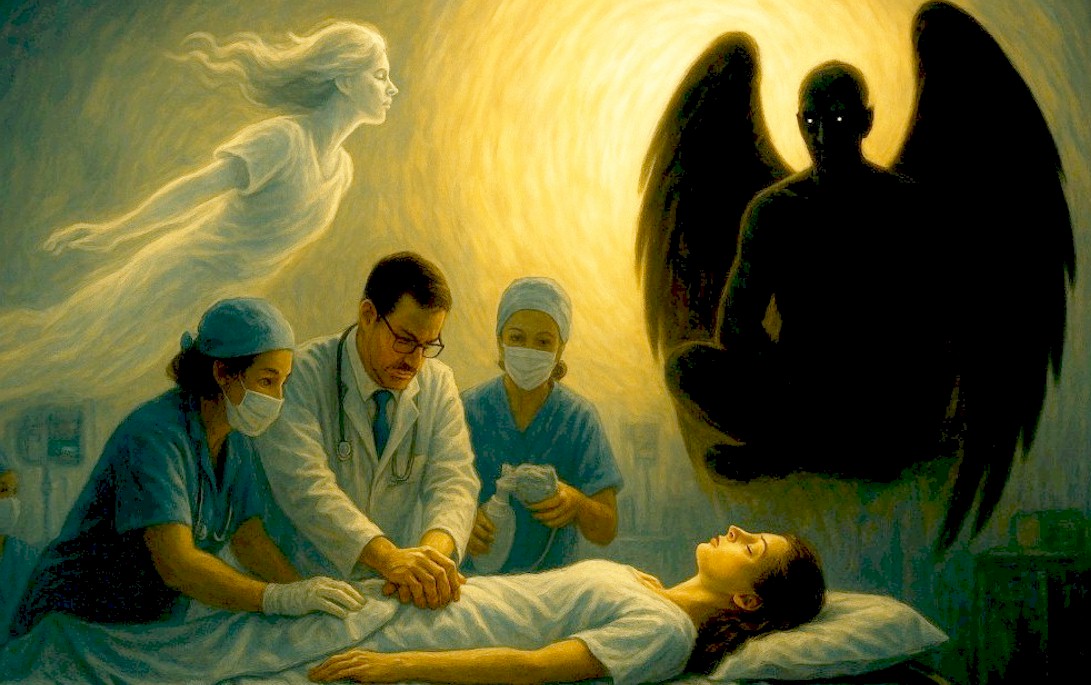
When I died I didn’t see a tunnel or a white light or any of that. I saw the Angel of Death sitting cross-legged in front of me.
My death was the result of a suicide attempt (and a damned effective one at that), and this Angel was very angry at me for trying to whack myself.
We argued for about eight hours (Earth time) before I grudgingly went back into my body.
During the out-of-body time it was made clear to me that the Angel of Death was:
(a) God’s messenger, and
(b) Frequently confused with, or assumed to be, Lucifer / Satan.
He looked fierce, made out of black shadows, humanoid form, angular face, glittering eyes, huge black wings pinioned behind him.
Although he looked it, he didn’t seem frightening, for whatever reason. The Lord (or Angel) of Death possesses a very wonderful sense of humor which nobody ever seems to comment on and he has a high level of compassion towards the beings that he “takes.” He is very self-aware and sees irony in his job.
Kevin, your mentioning the Lord of Death from the Tibetan Book of the Dead is, in my experience, a perfectly accurate description of who he is and what function he performs — at least in my experience.
3. Kevin Williams’ Response
a. Edgar Cayce and the Angel of Death
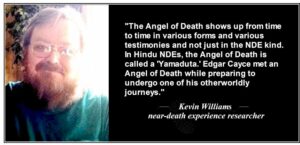
Very interesting testimony Dalyrada. The “Angel of Death” shows up from time to time in various forms and various testimonies and not just in the NDE kind. In Hindu NDEs, the Angel of Death is called a “Yamaduta.” Edgar Cayce met an Angel of Death also while preparing to undergo one of his otherworldly journeys. Cayce had lost consciousness and had a dream. Usually, he would travel through a tunnel toward the light. But in this instance, he met the so-called “Angel of Death” and learned about the silver cord. The following is his experience described in his own words:
As I went out, I realized that I had contacted Death, as a personality, as an individual or as a being. Realizing this, I remarked to Death:
“You are not as ordinarily pictured – with a black mask or hood, or as a skeleton, or like Father Time with the sickle. Instead, you are fair, rose-cheeked, robust – and you have a pair of shears or scissors.”
In fact, I had to look twice at the feet or limbs, or even at the body to see it take shape. He replied:
“Yes, Death is not what many seem to think. It’s not the horrible thing which is often pictured. Just a change – just a visit. The shears or scissors are indeed the implements most representative of life and death to man. These indeed unite by dividing – and divide by uniting.
“The cord does not, as usually thought, extend from the center – but is broken from the head, the forehead – that soft portion we see pulsate in the infant. Hence we see old people, unbeknowing to themselves, gain strength from youth by kissing there; and youth gains wisdom by such kisses.
“Indeed the vibrations may be raised to such an extent as to rekindle or reconnect the cord, even as the Master did with the son of the widow of Nain. For he did not take him by the hand (which was bound to the body as was the custom of the day), but rather stroked him on the head – and the body took life of Life itself!
“So, you see, the silver cord may be broken – but the vibration …”
4. Conclusion
Dalyrada’s NDE gives another unusual and thought-provoking view of suicide NDEs. Unlike many stories that include tunnels, bright heavenly light, or dead relatives, her experience focused on meeting what she believed was the Angel of Death. She described this being as powerful, compassionate, intelligent, and closely connected to God’s purpose. Even though the figure looked dark and frightening, Dalyrada said he was not evil or cruel. Her story suggests that in spiritual experiences, appearances may not show the true nature of the beings people meet.
Her experience also shows an important theme found in many suicide-related NDEs: the idea that life still has meaning and should not end too soon. The long argument she described with the Angel of Death showed a deep struggle between despair and continuing to live. Instead of being condemned, she met a being who seemed upset by her decision but still cared enough to send her back. This is similar to many other suicide NDE stories in which people return with a new understanding of suffering, purpose, and spiritual responsibility.
My comparison between Dalyrada’s experience and Edgar Cayce’s meeting with the Angel of Death expands the discussion by showing how similar symbols and beings appear in different spiritual traditions and mystical experiences. Cayce described death as a transition instead of something horrifying, and this closely matches Dalyrada’s belief that people misunderstood the Angel of Death. Both stories show that death is a part of a larger spiritual process guided by compassion and divine order.
In the end, Dalyrada’s story reminds readers that NDEs do not always follow the same pattern. Some are full of light and beauty, while others involve powerful symbolic beings and difficult truths. But underneath these differences is a message that appears in many NDEs: that even during moments of deep despair there may still be a greater spiritual purpose waiting to be understood.