This site uses affiliate links to Amazon.com Books for which IANDS can earn an affiliate commission if you click on those links and make purchases through them.
1. Introduction to the Reality of NDEs
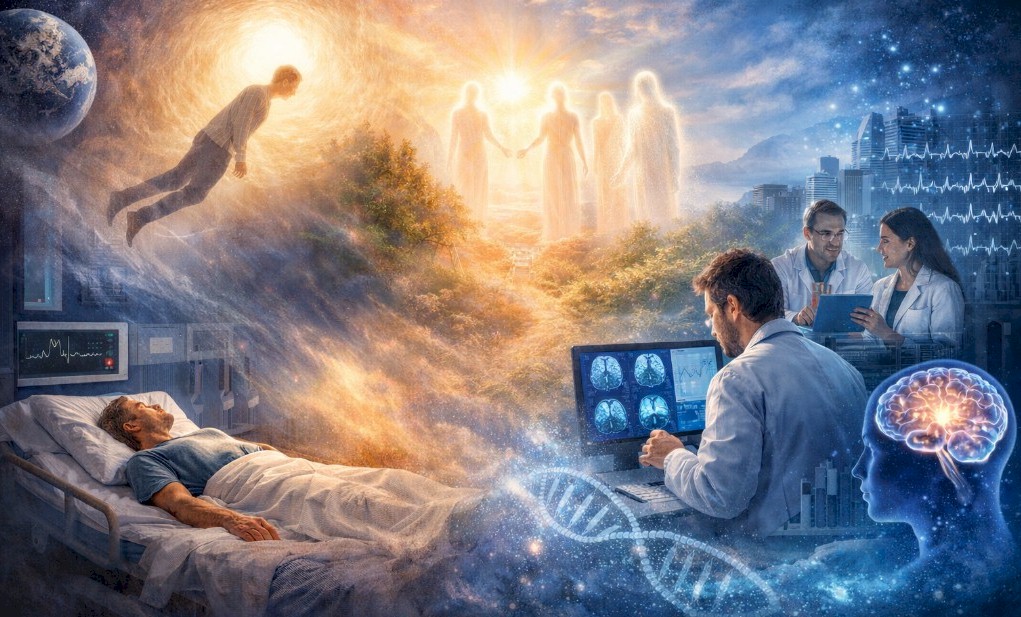
Near-death experiences (NDEs) raise a powerful question: are they simply brain events, or do they point to something more real beyond the body? For many people who have had an NDE, the answer is clear. These experiences are often described as more vivid, more meaningful, and more real than everyday life. People report seeing their bodies from the outside, entering other realms, or encountering beings of light – all with a strong sense that what they experienced truly happened.
This deep sense of reality is one of the most striking features of NDEs. It does not depend on a person’s culture, beliefs, or background. Across different ages and parts of the world, people describe similar events and come away changed. Many lose their fear of death and feel certain they have glimpsed something beyond physical life. Even when science offers possible explanations, those who have had these experiences often remain convinced that what they went through was real.
This article explores that sense of reality from two perspectives: the people who lived through NDEs and the researchers who have studied them. By looking at both personal testimonies and scientific viewpoints, we can better understand why so many believe NDEs are not illusions – but meaningful experiences that may reveal something true about consciousness and what happens at the edge of life and death.
Some of the NDE testimonies referenced in this article are drawn from firsthand accounts generously shared on the Near-Death Experience Research Foundation (NDERF.org) website. I gratefully acknowledge NDERF and its founders, Dr. Jeffrey Long and Jody Long, for their decades of dedication to collecting, preserving, and publishing the world’s most comprehensive archives of NDE testimonies.
2. People Who Are Convinced Their NDE Was a Real Afterlife Experience
a. Near-Death Experiencers
The following are testimonials from experiencers themselves about their conviction that their NDE was an out-of-body journey of life after death.
“As the two beings approached us, I could also feel the love flowing from them toward us. The complete joy they showed at seeing the Christ was unmistakable. Seeing these beings and feeling the joy, peace and happiness which swelled up from them made me feel that here was the place of all places, the top realm of all realms. The beings who inhabited it were full of love. This, I was and am convinced, is heaven.” (Dr. George Ritchie)
“At 4:13 p.m., I was transported from the physical realm, the realm of the body, to a spiritual realm. I knew I was in another world – a world that is as real as this world is to anyone reading this.” (Dr. Gerard Landry)
“Well, I felt myself leave my body. I just floated out of my physical form and I saw them cart my body away to the hospital. I went with it … I wasn’t frightened or anything like that because I was fine; and it was my body that was in trouble.” (Peter Sellers)
“I felt as if I were coming loose from my body! While I believed that my body was me, I knew instinctively that if I separated from it, I’d be dead! My soul and body started separating again and continued to separate until I felt a short, sharp pain in my heart, which felt as if something had been torn loose. Then slowly and softly I rose out through the top of my head.” (Arthur Yensen)
“I was aware that I, me, was on a journey and had left my body.” (Harry Hone)
“My next memory was quite a scene in the hospital emergency room. It was the most unique experience of my earthly life. Unique, because I was observing my own body in the emergency room and all the activity going on, except that I was not in my body. I was above it all – looking down. I was feeling no pain.” (David Goines)
“The decision to leave this world hung suspended in an extended moment of absolute quiet. Passionless, I watched my spirit leave my body as a feeling of “otherness” engulfed me. I felt a strange detachment from my physical body and the life I had created. I was no longer connected to a pitiful, suffering mass of flesh.” (Linda Stewart)
“On the eighth day of this misery, I seemed to just float right up out of my body. So, I’m looking down at my body lying in the bed still as a corpse, and I said, “Oh, I’ve died!!” I was basically unnerved by this. But in the next second, I thought to myself, “Hey, if I’m dead, who is thinking these thoughts??” (Skip Church)
“I also know that it was real! Actually, I could say that it was the only real thing that has ever happened to me.” (Joni Maggi)
“I am convinced my experience was real and valid. I could never have fictionized such an amazing experience.” (Lawrence H.)
“I believe the experience was real and has been relevant to my life up until now and will remain so until I die.” (Brent M.)
“I have heard scientific explanations about the thalamus and cortex of the brain shutting down and creating this experience. Maybe they are correct. However, it really doesn’t matter to me whether they are or not. I had such a great experience that if it is death and all an illusion… it does not matter. My experience was real to me and I feel I have purpose in living. What else matters?” (Jean R.)
“I know it was real because I lived through it. I will never forget that day, not ever.” (Laura B.)
“I know that it was real and no one can convince me that it wasn’t.” (Clyde S.)
“It was real and no one can ever tell me different. I was there in and out of my body but it was quite different from what I had ever heard and that was what made it so impossible to comprehend.” (Carole M.)
“I know it was real and I can’t ask anyone else to believe what I experienced. I wasn’t their experience.” (Sheryl)
“The experience was real in that I definitely went to the void – whether there is a ‘life’ after death or whether the void is part of the process of dying and the brain shutting down is a moot point – who cares? I don’t.” (Bonnie W.)
“I know it was real because of what I saw.” (Daniel H.)
“It was real and choosing not to believe it does not change its reality or truth.” (Marie W.)
“Without a doubt it was real even after 30 years of skeptics trying to convince me that under my duress state of mind I hallucinated to comfort myself during the last moments of my life. Sorry my friends you are never going to convince me of that one, my experiences were real and regardless of the outcome I am so ready to go back when it is my time to cross over for the final time!” (Philip S.)
“I believe it was real – no doubt in my mind or heart.” (Heidi C.)
“I believe 100% that what I experienced was real as real as my first kiss as real as the birth of my son and my first heart break. It is more vivid then anything I had and have experienced. It is the foundation of my life from that moment it was the only true reality I had known to that point.” (Theresa C.)
“I remember the experience more accurately than other life events that occurred around the time of the experience. It was more real to me than anything before or after. Life itself fades into insignificance in comparison.” (Robyn C.)
“It was real, more real than a dream or daydream, more real than life itself.” (Justin M.)
“[My] experience was definitely real. It was real. I could see and hear what was happening in the rooms when I was on the ceiling. I had a conversation that gave me an understanding far beyond what a 6-year-old could have been exposed to. I was not allowed to go further into the light and was sent back against my will. That was very real. And I had things said to me from a Being of Light that came true in the future.” (Evelyn D.)
b. Near-Death Experience Researchers
It is not just experiencers who believe that NDEs are veridical events that occur outside of the body, doctors who study them do as well.
“When asked if the NDE was a dream or hallucination, NDErs, almost to a person, answer negatively. They uniformly believe that what they experienced was real; it really happened to them, even though it is difficult to describe to nonexperiencers, and to comprehend, given our present paradigms of reality. NDErs often say their NDE was more real than what we experience as real in this life.” (William J. Serdahely)
“I remember looking down and seeing my body three-dimensionally for the first time. And it was such a shock, because we never see ourselves except in a one-dimensional mirror reflection, or a photograph.” (Dr. Liz Dale’s research)
Dr. Michael Sabom, an Atlanta cardiologist, was one who eventually became convinced that experiencers are actual separating from their bodies. After talking to patients, who claimed they had an NDE, Sabom said: “I came to the conclusion that these were occurring and they were rather frequent, but people usually didn’t talk about them unless they were approached in an open, understanding manner.” (Dr. Michael Sabom)
Dr. Karl Jansen, a member of the Royal College of Psychiatrists and the world’s leading expert on ketamine, has studied ketamine at every level. Jansen not only felt that NDEs and ketamine induced visions were the same, but became convinced that BOTH induced real visions of a real God.
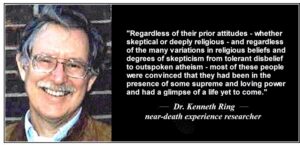
In 1977, Dr. Kenneth Ring was a brilliant young professor of psychology at the University of Connecticut who read Dr. Raymond Moody‘s book, Life After Life, and was inspired by it. However, he felt that a more scientifically structured study would strengthen Moody’s findings. He sought out 102 near-death survivors for his research. He concluded: “Regardless of their prior attitudes – whether skeptical or deeply religious – and regardless of the many variations in religious beliefs and degrees of skepticism from tolerant disbelief to outspoken atheism – most of these people were convinced that they had been in the presence of some supreme and loving power and had a glimpse of a life yet to come.” (Dr. Kenneth Ring)
Despite the strides in explaining NDEs through clinical investigation, some researchers believe that the physiological approach is insufficient. Dr. Bruce Greyson agrees:
“These are just armchair speculations. Finding a chemical change in the brain does not necessarily prove that it causes NDEs.” (Dr. Bruce Greyson)
For Greyson and others who view NDEs as mystical experiences, the skeptics in the lab are only solving a small part of the puzzle.
Jody Long is a researcher with NDERF.org who had this to say about the out-of-body phase of NDEs:
“Vivid NDE examples, also noted in the landmark NDE Dutch study by Pim van Lommel, contain memories during physical death of events categorized as ‘veridical perception‘. Experiencers were accurately reporting events they witnessed while in the out-of-body state during the time they coded. They couldn’t possibly know what the doctors, staff, or relatives were saying in the same or another room. Nonetheless, NDErs were privy to conversations and events.” (Jody Long)
“Immediately after the impact from falling forward onto the metal grating, I felt myself floating up, out of my body, and hovering above my body and all the people who were watching it, and who seemed paralyzed by shock and horror at what had happened. I think they pretty much assumed that I was dead.” (Dr. Liz Dale’s research)
Dr. Diane Komp, a pediatric oncologist at Yale, was transformed by witnessing children’s NDEs, such as that of an 8-year-old with cancer envisioning a school bus driven by Jesus, a 7-year-old leukemia patient hearing a chorus of angels before passing away.
“I was an atheist, and it changed my view of spiritual matters,” recalls Komp. “Call it a conversion. I came away convinced that these are real spiritual experiences.” (Dr. Diane Komp)
Dr. Timothy Leary, the late psychologist and 60’s guru who experimented with LSD, once described ketamine as “experiments in voluntary death.”
Psychiatrist, Dr. Stanislav Grof, stated: “If you have a full-blown experience of ketamine, you can never believe there is death or that death can possibly influence who you are.” Ketamine allows some patients to reason that “the strange, unexpected intensity and unfamiliar dimension of their experience means they must have died.” (Dr. Stanislav Grof)
3. Conclusion
In the end, the question of whether NDEs are “real” does not have a simple answer. What stands out most clearly is the powerful and consistent sense of reality reported by those who have lived through them. For experiencers, these events are not vague dreams or fading memories – they feel direct, meaningful, and deeply true. That conviction often stays with them for the rest of their lives, changing how they see death, life, and their place in the world.
At the same time, scientific research continues to explore possible explanations, from brain activity to psychological processes. While these approaches have helped explain certain common features of NDEs, they have not fully accounted for the clarity, consistency, and transformative impact of these experiences. This gap leaves room for ongoing debate – and for the possibility that our current understanding of consciousness may be incomplete.
By bringing together personal testimonies and scientific perspectives, we are left with a picture that is both intriguing and unresolved. NDEs challenge us to think more deeply about the mind, the brain, and what it means to be conscious. Whether they are entirely products of the brain or glimpses of something beyond it, they point to a mystery that science has not yet fully explained. And perhaps that is their greatest significance: they remind us that, at the edge of life and death, there is still much we do not yet understand.