This site uses affiliate links to Amazon.com Books for which IANDS can earn an affiliate commission if you click on those links and make purchases through them.
1. Introduction to Reincarnation in Early Christianity
In December, 1945, early Christian writings containing many secrets of the early Christian religion were found in upper Egypt, a location where many Christians fled during the Roman invasion of Jerusalem. Undisturbed since their concealment almost two thousand years ago, these manuscripts of Christian mysticism rank in importance with the Dead Sea Scrolls. These writings affirmed the existence of the doctrine of reincarnation being taught among the early Jews and Christians. These Christian mystics, referred to as Christian Gnostics, were ultimately destroyed by the orthodox Church for being heretics. Their sacred writings were destroyed and hidden with the belief that they would be revealed at an appropriate time in the future. The discovery in 1945 yielded writings that included some long lost gospels, some of which were written earlier than the known gospels of Matthew, Mark, Luke and John. Brian A. Bain, M.A., has this to say about the 1945 discovery:
“Long considered to be heretical, ancient Gnostic Christian texts unearthed this century display compelling similarities between Gnostic conceptions of life and death and modern near-death experiences. The Gnostic texts devoted extensive tracts to what readers could expect to encounter when they died. Other passages make numerous allusions to near-death-like experiences that can be realized in this life, most notably the human encounter with a divine light. The Gnostic Christian literature gives us one more example of NDEs and similar experiences in the ancient world.”
Another interesting insight comes from Edgar Cayce who affirmed that mystical Christianity was the highest form of Christianity whose structure and soteriology closely align with Christian Gnosticism, even though Cayce does not use that label.
The Christian Gnostics were regarded by some as a new Jewish sect who believed they had finally found the long-awaited Messiah and not a new religion. Some of the apostles became Gnostic and because of this, Christianity could well have grown up as a Gnostic religion had it not been for their eventual persecution by the Catholic Church centuries later.
2. The Secret Teachings of Jesus
An important Christian Gnostic teaching was the “Logos” which in Greek is translated as “the image of the Word.” It is an important concept found in the Gospel of John:
“In the beginning was the Word (Logos), and the Word was with God, and the Word was God.” (John 1:1)
Logos is the part of God that acts in the world. It is the perfect unity of the human and the divine. This is affirmed by John when he wrote that “the Word was made flesh and dwelt among us.” When John stated that Jesus is the Logos, he is stating that Jesus became the Logos, the Christ. The Logos is the “divine spark” of God within humans that needs to awakened. Everyone has the “image of the Word (Logos)” within them and it is for this reason that Genesis describes humanity as created “in the image and likeness of God.” The Logos is the divine Spirit in humanity. By using the Christian Gnostic idea of the Logos, John is not only affirming the pre-existence and divinity of Jesus, but he is affirming that all sons of God created in the “image of the Word” as Jesus was, preexisted in spirit before being born. In other words, every human is an incarnation of the Logos and every human has the potential of becoming like Jesus, a manifestation of the human-divine unity. Every human can attain “Christhood” and because of this, every soul will eventually be drawn back to God.
The Roman Church misunderstood what the Logos was in John and incorrectly concluded from this that only Jesus is divine – the Word made flesh. The orthodox Church either rejected or ignored this Christian Gnostic concept found in John. This may have been a factor when the Gospel of John was almost rejected from New Testament canon when it was being put together. This was during a time when Christian Gnosticism became an enemy of the organized Church. Nevertheless, it was the idea of the pre-existence of the soul and its corresponding doctrine of reincarnation that the Roman Church had great difficulty with:
“If anyone asserts the fabulous pre-existence of souls, and shall assert the monstrous restoration which follows from it: let him be anathema.” (Decree against reincarnation, Second Council of Constantinople)
The Christian Gnostics emphasized spiritual knowledge rather blind faith as the road to salvation. They indicated that they possessed secret knowledge (i.e., “gnosis” in Greek) concerning the hidden meaning of the “resurrection.” This was a part of the secret teachings of Jesus handed down to them by the apostles. This special knowledge was not given to people who were only given the public teachings of Christianity. They were given only to those initiated to receive these secret teachings. In contrast, the very term “Catholic” means “universal”, implying that anyone could become a member of the Church by adhering to the public teachings of faith and rituals. The Christian Gnostics were harsh critics of the orthodox Church and accused the Church of watering down the gospel in order to popularize it for the masses. The orthodox Church stressed salvation through faith alone and by the rituals of the Church.
This secret gnosis emphasized spiritual “resurrection” (i.e,. spiritual rebirth) and physical “resurrection” (i.e., reincarnation) as opposed to a resurrection defined as people sleeping in their graves until it is time for all corpses to come out of their graves on the Last Day. Christian Gnostics held the view that if spiritual resurrection was not attained in one lifetime, then the soul would be subjected to as many reincarnations as it takes until spiritual regeneration is attained.
One of the great Church leaders was Clement of Alexandria in Egypt (150-211 A.D.) who indicated that he possessed the secret teaching handed down from the apostles.
In the Gnostic text entitled the Secret Gospel of Mark, one of the Christian Gnostic texts discovered in 1945, describes Jesus performing secret initiation rituals. Before the discovery of this secret gospel, our only knowledge of it came from a letter written by Clement. Clement quotes from this secret gospel and refers to it as:
“…a more spiritual gospel for the use of those who were being perfected.” He also states, “It even yet is most carefully guarded [by the church at Alexandria], being read only to those who are being initiated into the great mysteries.”
Clement mentions elsewhere that Jesus revealed a secret teaching to those who were:
“…capable of receiving it and being molded by it” He also affirmed that, “The gnosis (secret knowledge) itself is that which has descended by transmission to a few, having been imparted unwritten by the apostles.” (Miscell. Book VI, Chapter 7)
The existence of a secret teaching can be found in the New Testament:
“He told them, ‘The secret of the kingdom of God has been given to you. But to those on the outside everything is said in parables so that, ‘they may be ever seeing but never perceiving, and ever hearing but never understanding.'” (Mark 4:11-12)
“He replied, ‘The knowledge of the secrets of the kingdom of heaven has been given to you, but not to them. Whoever has will be given more, and he will have an abundance.'” (Matthew 13:11-12)
“We do, however, speak a message of wisdom among the mature, but not the wisdom of this age or of the rulers of this age, who are coming to nothing. No, we declare God’s wisdom, a mystery that has been hidden and that God destined for our glory before time began.” (1 Corinthians 2:6-7)
“This, then, is how you ought to regard us: as servants of Christ and as those entrusted with the mysteries God has revealed.” (1 Corinthians 4:1)
“At that time Jesus said, ‘I praise you, Father, Lord of heaven and earth, because you have hidden these things from the wise and learned, and revealed them to little children. Yes, Father, for this is what you were pleased to do.'” (Matthew 11:25-26)
Paul wrote about teachings which are taught to spiritual “babies,” teachings about righteousness for the more mature, and then teachings for the spiritually mature. Paul reveals this fact immediately after equating Melchizedek to Jesus by stating:
“We have much to say about this, but it is hard to make it clear to you because you no longer try to understand. In fact, though by this time you ought to be teachers, you need someone to teach you the elementary truths of God’s word all over again. You need milk, not solid food! Anyone who lives on milk, being still an infant, is not acquainted with the teaching about righteousness. But solid food is for the mature, who by constant use have trained themselves to distinguish good from evil.” (Hebrews 5:11-14)
According to tradition, after the Roman invasion of Jerusalem, the author of the Gospel of Mark established a church in Alexandria, Egypt. Mark may also have been the author of a “secret gospel” containing more advanced teaching for those being initiated into the Christian mysteries. This secret gospel contains passages portraying Jesus teaching secret doctrines.
3. Origen: The Champion for the Secret Teachings of Jesus
As the orthodox church in Rome gained more and more political power the more it viewed secret teachings as a threat to their own public teachings. But the Church leader who made the final and greatest attempt to revive the secret teachings of Jesus within the orthodox teachings was the first Church Father named Origen (183-253 A.D.) of Alexandria in Egypt who was a disciple of Clement of Alexandria. Origen was the first person since Paul to develop a system of theology around the teachings of Jesus. His effort was the first within the orthodox church to systematize a theology on such a vast scale. Although Origen defended orthodoxy, he included in his system the wisdom of the Christian Gnostics. His theology was a perfect synthesis of “orthodox” and “gnostic” teachings and came the closest to reviving the “Lost Christianity” of the original sects, communities and schools, at a time when the Christian Gnosticism was falling into disrepute. Unfortunately, hundreds of years later, the Church declared him a heretic and his teachings as heresy mostly because they affirmed pre-existence and reincarnation.
Origen had this to say about the secret teachings of Jesus:
“[Jesus] conversed with His disciples in private, and especially in their sacred retreats, concerning the Gospel of God; but the words which He uttered have not been preserved, because it appeared to the evangelists that they could not be adequately conveyed to the multitude in writing or in speech and they saw what things were to be committed to writing, and how this was to be done, and what was by no means to be written to the multitude, and what was to be expressed in words, and what was not to be so conveyed.” (Contra Celsus, Chap. VI. 18)
Concerning these secret teachings, Clement stated:
“James the Righteous, John and Peter were entrusted by the Lord after his resurrection with the higher knowledge. They imparted it to the other apostles, to the seventy.” (Outlines Book VI)
4. The Theology of Christian Gnosticism
According to Gnostic theology, a series of “falling away” from “the Whole” (God) occurred in eternity which resulted in all that exists today. After the first “fall”, the divine consciousness descended to the level of the divided consciousness; now after another “fall”, it has fallen even further, into the depths of the unconscious; it has been “forgotten.” It is now humanity’s privilege to discover the potential realms of human existence and face the great challenge of the “ascension of consciousness” through the Man-God-Spirit transformation.
Once souls fell into the lower levels of consciousness, they became enamored of it and burned with the desire to experience the pleasures of matter. The souls then no longer wanted to disengage itself from these lower levels. Thus the world was born. From that moment souls forgot themselves. They forgot they original habitation, their true center and eternal being.
Gnosticism proceeds from one fundamental insight: this world in which we find ourselves is thoroughly and irretrievably less than holy. The soul is trapped in a prison of flesh, and the flesh is intrinsically less than divine. According to Gnostic theology, the creation of the cosmos came about as the result of a tragicomic mistake: the fall of the soul from God. Thanks to the advent of Christ in the lower realms of consciousness, the power of reconciling the fallen souls has been given to restore the One-ness and usher in the kingdom of light over the kingdom of flesh and matter. The unity of the Godhead is assured thanks to the introduction of the new uniting force, the Logos, the part of God who acts in the flesh and the material. It is important to distinguish the Logos (Christ) from the soul named Jesus. Any person has the potential of becoming a Logos but it was the soul known as Jesus who actually incarnated as a Logos and therefore became a Christ on Earth.
We, as humans, cannot comprehend the omnipotent power available to us until we utilize the Christ power. When we effectively use the divine “Christ awareness” we have the ability to help in the liberation of the imprisoned “sparks of divinity” from flesh and rejoin them to the Source. The divine plan of creation will become complete as the divine outpouring of Christ gnosis liberates humanity from ignorance. The result of this will be the redemption of all human beings.
The Christ power can only liberate souls through the call and revelation of Christ gnosis to, “Awake, remember who you are and where you come from!” But since the soul cannot by itself hear the gnosis, the Christ power resorts to elaborate strategies to create the conditions for which all souls will be saved.
Christian Gnostics felt that initiation into the Cosmic Christ gnosis is inseparable from “the light which lighteth every person coming into the world.” It is this light within, our Higher Self, which each individual must bring to at-onement with the divine Source if liberation is to occur.
As more and more people hear the call to “Wake up!” and attain the Christ gnosis and become liberated, their souls are received back into the bosom of Divine Consciousness. The soul becomes free from unholy flesh and from the cycle of birth and rebirth. Christian Gnostics seek to achieve this by cultivating the Higher Self within people to seek reunification with the Godhead. But each soul returning to its divine source must, after death, pass through the various levels of consciousness. Sometimes Christian Gnostics describe seven of these heavenly realms, other times ten.
5. Christian Gnostic Writings
Christian Gnostic writings describe salvation in a very different way than later traditional Christianity. Instead of declaring that people live one life on Earth and then face eternal reward or punishment, many Gnostic texts describe a repeating cycle of lives. In this cycle, the soul keeps returning to the physical world. This happens because of ignorance, forgetting who we really are, and the control of afterlife spiritual powers. In this view, freedom does not come from faith alone. It comes from gnosis – a direct, lived knowledge of one’s divine origin. Only this kind of knowing can stop the soul from coming back into the material world.
The passages gathered below show that after death, souls are judged and are given new bodies that match their moral and spiritual state. They are sent back into the world and are made to forget. This happens again and again until the soul is purified or awakened. Salvation means not returning to the material world again. It means not being thrown back into flesh. It means escaping the cycles, rulers, spheres, and brokenness of the material world.
Because of this, the passages below are not based on a few isolated quotes. It builds a cumulative case. The passages use the same special language over and over. Words like return, cast back, enter again, many circuits, many births, forgetfulness, another body, and not return again appear across different texts. These phrases only make clear sense if the authors believed in repeated physical lives. In some cases, the texts even apply this idea to well-known biblical figures. They directly identify rebirth across different historical people.
What follows is a collection of these passages, organized by text. Each one includes a short note explaining how it fits into Gnostic ideas about salvation. Taken together, these sources show that reincarnation was a core part of several early Christian Gnostic systems. This view also connects closely with themes found in Plato’s philosophy, Jewish mystical thought, and modern NDE testimonies.
- Read about Reincarnation in the Bible.
a. Pistis Sophia
The Pistis Sophia (Latin for “Faith Wisdom”) is a Christian Gnostic text discovered in 1773, and was possibly written between the 3rd and 4th centuries AD. One of the most striking features of Pistis Sophia is its explicit and repeated references to reincarnation.
“Souls which have not received the mysteries and have not been purified of their faults are taken back again into the world, and are cast into bodies which are suited to the sins which they have committed, so that they may be corrected through them.” (Pistis Sophia 1.32)
“They receive bodies according to their deeds.” (Pistis Sophia Book 1.36)
“It (the soul) returns until it is purified.” (Pistis Sophia 1.43)
“They enter the world once more.” (Pistis Sophia 2.86)
“If a soul hath not fulfilled the cycle of its changes, and hath not completed all the transformations which are appointed for it, it is brought again into the world, until it hath accomplished the whole number of changes which are ordained for it.” (Pistis Sophia 2.99)
“…poured from one into another of different kinds of bodies.” (Pistis Sophia 2.100)
“Another body shall be given to it.” (Pistis Sophia 3.102)
“He shall be cast back into the world again according to… the sins.” (Pistis Sophia 3.103)
“A sinful soul is brought back to birth… and cast into a body suited to the sins it has committed.” (Pistis Sophia 3.111)
“Souls come into the world in many circuits.” (Pistis Sophia Book 3.125)
“They wander through many forms.” (Pistis Sophia 4.126)
“If they have not yet completed their number of circuits in the changes of the body.” (Pistis Sophia 4.130)
“The soul of that man (i.e., perfected) cannot be cast back into the world, but will go to the Light of Lights, and will be with the immortals. I have turned Elijah and sent him into the body of John the Baptizer, and the rest also I turned into righteous [men], to help the receivers of the mysteries.” (Pistis Sophia 4.135)
“The soul which hath not found the mysteries, and hath not been purified of its faults, shall be brought again into the world, and shall be cast into a body suitable to the sins which it hath committed, so that it may be corrected through it.” (Pistis Sophia 4.141)
“They wander through many births.” (Pistis Sophia 5.136)
“They give it the cup of forgetfulness and cast it down into a body.” (Pistis Sophia 6.144)
“They shall not be cast back anew into the sphere.” (Pistis Sophia 6.147)
“They shall rest and return no more.” (Pistis Sophia 6.149)
b. Book of Thomas the Contender
The Book of Thomas the Contender is a Christian Gnostic text which was likely composed during the early 3rd century AD. The dialogue in the text is between Jesus and Judas Thomas, whom Jesus calls “my twin” and “my brother.” Scholars disagree on whether Judas Thomas is Thomas the Apostle, Jude the Apostle, and/or Jude, brother of Jesus. Judas is one of the brothers of Jesus named in Mark 6:3, and Thomas is Aramaic for “twin.” This text shows Jesus repeatedly teaching reincarnation.
The word “contender” as applied to Thomas refers to someone who is still in the world, but trying to transcend it. It means Thomas is not yet perfected, but is on the path. So “contender” marks a stage in the soul’s journey of not being ignorant anymore, but not liberated yet.
“Watch and pray that you may not be born in the flesh, but that you may leave the bitter bondage of this life.” (Book of Thomas the Contender 107-108)
“Those who have known and yet have turned back will be brought again to the visible realm.” (Book of Thomas the Contender 139)
“Blessed are you who have known yourselves… you will not return again into the flesh.” (Book of Thomas the Contender 138–140)
“You who love the sweetness of the body…. you will be reborn again.” (Book of Thomas the Contender 138–140)
“Blessed are you who have known yourselves, for you will not return again into the flesh.” (Book of Thomas the Contender 139–140)
“Those who have turned back… will be brought back to the visible realm.” (Book of Thomas the Contender 145)
c. Apocryphon of John
The Apocryphon of John, also called the Secret Book of John or the Secret Revelation of John, is a 2nd century Christian Gnostic text attributed to John the Apostle. It is one of the texts addressed by Irenaeus which places its composition before 180 AD. It tells of the appearance of Jesus and the imparting of secret knowledge (gnosis) to his disciple John which includes reincarnation.
“Again [they cast] them into (bodily) parts…” and “it is saved… [when] it does not enter another flesh… it is not cast into another flesh.” (Apocryphon of John 23:25-36)
“And the soul which does not know… is turned back by the powers.” (Apocryphon of John 24.25-25.5)
“They are thrown down again into the chains of forgetfulness.” (Apocryphon of John 25.10-20)
“The rulers (archons) examine them… and send them back.” (Apocryphon of John 26.1-10)
“This soul needs to follow another soul in whom the Spirit of life dwells, because she is saved through the Spirit. Then she will never be thrust into flesh again.” (Apocryphon of John 26.20-27.10)
“John said to the Savior: ‘Lord, what will the souls do who have not done these things [awakening], but upon whom the spirit of life has descended?’ The Savior answered: ‘If the spirit of life has descended upon them, they will be saved and become perfect. For the power will not leave them, but will be with them forever. But those upon whom the spirit has not descended, and who have not known, will be brought down into forgetfulness, and will be imprisoned (flesh as prison) again, and they will be bound to the works of the authorities. And they will receive their punishment wherever they are sent, until they awaken from forgetfulness and receive knowledge.'” (Apocryphon of John 27.15-28.5)
“She (the soul) will be saved… and will not be cast into another flesh.” (Apocryphon of John 28.5-15)
“And the rulers took counsel with one another and said, ‘Come, let us seize the soul which belongs to the light.’ And they bound it in a body that had been fashioned, and they cast it into forgetfulness, so that it might not know its origin. And thus the soul was made to wander through bodies, until it should awaken and remember the knowledge of the imperishable light. And when it awakens and acquires knowledge, it is released from the bonds and does not return again.” (Apocryphon of John 45.1–46.5)
d. Hypostasis of the Archons
Hypostasis of the Archons, also translated “The Reality of the Rulers,” is a Christian Gnostic text written in the 2nd or 3rd century AD. This text presents a worldview in which human souls are repeatedly trapped within the material realm by hostile cosmic powers called “archons.” These rulers govern fate, ignorance, and forgetfulness, and their chief strategy is to keep humanity bound to bodily existence through deception and enforced return to the world.
“They placed him in a body again, so that the soul might be imprisoned.” (Hypostasis of the Archons 20.7–21.15)
“And the rulers took counsel with one another and said, ‘Come, let us cause a deep sleep to fall upon Adam.’ And he slept. And they took his power from him and put it into the matter of the woman. And they fashioned a body for him again. And they bound him with a form of forgetfulness, so that he might not recognize his deficiency. And they placed him in a body again, so that the soul might be ensnared and the form might become a prison.” (Hypostasis of the Archons 87.24-89.17)
“They caused forgetfulness to come upon them.” (Hypostasis of the Archons 90.1–10)
“And when the soul awakens from the forgetfulness that is upon it and receives knowledge, it turns away from the rulers and their bonds. But as long as it does not awaken, it is brought back again into bodies, and it continues to wander in error, until it comes to know the truth and is set free.” (Hypostasis of the Archons 94.5–95.10)
e. Gospel of Philip
The Gospel of Philip is a Christian Gnostic gospel dated to around the 3rd century AD which was rediscovered in 1945. This text warns that those who do not attain resurrection (spiritual awakening) in this life will “receive nothing” after death – implying continued return to embodied existence. Resurrection is described not as the reanimation of a corpse at the end of time, but as an inner transformation that frees the soul from repeated embodiment.
“[Jesus said] Those who say that they will die first and then rise are in error. If they do not first receive the resurrection (i.e., spiritual awakening) while they live, when they die they will receive nothing.” (Gospel of Philip 67.27–68.5)
The above passage is part of Gnostic salvation (“resurrection now”) is the route to not being reincarnated. Resurrection is represented not as a future event after death. It is something that must be experienced now, while a person is alive.
“Those who say they will die first and then rise are in error… ” (Gospel of Philip 73.8–14)
In the Gospel of Philip, to “rise” means to wake up spiritually – to recover true identity through gnosis. Christian Gnostics believed that those who expect resurrection after physical death misunderstand salvation entirely. Death does not create enlightenment. Awareness does.
f. Gospel of Thomas
The Gospel of Thomas is a Christian Gnostic gospel discovered in 1945 whose origins have been traced by some scholars to 60 AD – the earliest gospel ever written. Instead of focusing on a single life followed by final judgment, the text frames salvation as awakening to self-knowledge now. Repeated warnings about being “born again,” returning to a lower state, or failing to recognize one’s true origin imply a cycle of embodiment driven by ignorance.
“Blessed is the one who came into being before coming into being.” (Gospel of Thomas, saying 18)
The above passage implies pre-existence prior to physical birth – an assumption that often accompanies reincarnation.
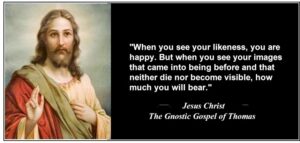
“When you see your likeness, you are happy. But when you see your images that came into being before and that neither die nor become visible, how much you will bear!” (Gospel of Thomas, saying 84)
The above passage is an explicit reference to prior images that predate the current body – one of the strongest references to reincarnation. The Gospel of Thomas assumes the soul descended from a higher afterlife realm whose embodiment is linked to ignorance and forgetfulness. Salvation is a spiritual awakening that occurs before death. Failure to awaken results in reincarnation.
g. Dialogue of the Savior
The Dialogue of the Savior is a Christian Gnostic text which was likely completed in 150 AD. The textual style resembles other Gnostic dialogues between the Savior and the disciples, such as the Gospel of Thomas. Unlike many other Gnostic texts, Dialogue of the Savior attributes the creation of the world to a benevolent Father rather than an evil or flawed gnostic Demiurge.
“Do not return to what you have left behind.” (Dialogue of the Savior 132.10–15)
In the above passage, “return” is literal within Gnostic cosmology. What has been “left behind” is the realm of bodily birth. The warning presumes that return to embodiment is a real post-mortem possibility.
“Whoever does not understand will go astray.” (Dialogue of the Savior 134.5–10)
In the above passage, “go astray” (planasthai) is standard Gnostic language for reincarnation.
“Whoever has found rest will not wander.” (Dialogue of the Savior 134.10-15)
In the above passage, “wandering” means continued descent into material embodiment. “Rest’ (anapausis) halts wandering. Wandering only makes sense if the soul otherwise continues returning. This is the same logic found in the Treatise on the Resurrection and Pistis Sophia.
“When you come to know yourselves… then you will be complete.” (Dialogue of the Savior 135.1-5)
In the above passage, “completion” ends something already ongoing. In Gnostic systems, that ongoing process is the cycle of return through bodies caused by ignorance.
h. Treatise on the Resurrection
The Treatise on the Resurrection is an ancient Christian Gnostic text thought to have been written in 150 AD. The following are references to reincarnation in this Gnostic text.
“Do not think the resurrection is an illusion. It is no illusion, but it is the truth. Rather, it is fitting to say that the world is an illusion, rather than the resurrection which has come into being through our Lord.” (Treatise on the Resurrection 45.14–46.3)
In the above passage, the text sharply separates resurrection from the physical world. The “world” is illusory, while resurrection is a present, spiritual reality. This sets the groundwork for multiple embodiments within an illusory realm.
“Nothing will be able to arrest him who has already risen… He has received the resurrection already.” (Treatise on the Resurrection 46.4–15)
In the above passage, resurrection is something one receives while alive, not after death. In Gnostic systems, this is precisely what prevents return to embodiment. If resurrection is already attained, the soul no longer cycles back into flesh.
“If you were not resurrected while you were alive, then when you die you will receive nothing.” (Treatise on the Resurrection 47.6–15)
In the above passage, it states that those who haven’t experienced spiritual awakening (resurrection) while alive will receive nothing at death. In parallel Gnostic texts, “nothing” means returning to the world with a new body. This aligns exactly with Pistis Sophia, Exegesis on the Soul, and Apocalypse of Paul.
“If you have the resurrection within you already, then you will not return to flesh.” (Treatise on the Resurrection 49.10–15)
The above passage is the strongest one concerning reincarnation in the entire text.
“Do not live according to the flesh… for you have already risen.” (Treatise on the Resurrection 50.1–6)
In the above passage, “the flesh” is something to cease returning to, not something to be reclaimed eternally. The text assumes the reader understands that returning to flesh is the default fate without gnosis.
i. Exegesis on the Soul
The Exegesis on the Soul is a Christian Gnostic text whose author and date are not certain, however is likely from between the 1st and 4th century AD. In the text, the female personification of the soul resembles the passion of Sophia, which is a theme pervasively found in Gnostic cosmology. The following are references of reincarnation in this text.
“But when she (the soul) abandons herself again to her lovers, she falls into bodies again and again, and is defiled.” (Exegesis on the Soul 132.10–15)
In the above passage, the soul falling “into bodies again and again” is explicit reincarnational language. The soul is not punished once, but re-enters bodily existence repeatedly due to ignorance and attachment.
“She (the soul) did not know how she came into the world, nor how she will depart. She remained in bodies and came to forget her true home.” (Exegesis on the Soul 133.5–15)
In the above passage, ignorance and forgetfulness are the mechanisms of returning to life, a standard reincarnation motif in Gnostic literature. The soul’s failure is not moral guilt alone but loss of memory, which results in continued embodiment.
“But when she (the soul) repents and turns back to herself, she receives again her own proper body, and no longer enters another.” (Exegesis on the Soul 134.1–10)
The above passage explicitly contrasts entering another body (reincarnation) versus no longer entering another body (liberation). Salvation is defined as the end of further embodiments.
“So long as she (the soul) is ignorant of her root, she is carried about into bodies. But when she comes to knowledge, she rests.” (Exegesis on the Soul 134.20–135.5)
The above passage provides a clear description of conditional reincarnation. Ignorance leads to the soul’s return to physical bodies. Gnosis leads to “rest” which is the end of returning to physical bodies. This mirrors the reincarnation logic found in Pistis Sophia, Book of Thomas the Contender, and Apocalypse of Paul.
“Then the soul receives her true bridegroom and rests in him eternally.” (Exegesis on the Soul 136.5–15)
In the above passage, “rest” follows cessation of bodily return, not a future reanimation of flesh. The bridal chamber imagery marks release from the cycle, not judgment after one life.
j. Concept of Our Great Power
The Concept of Our Great Power is a Christian Gnostic text dated from the middle of the 4th century AD. The following are references to reincarnation from this text.
“The souls that did not know the Great Power were cast back into bodies.” (Concept of Our Great Power 39.30–40.5)
In the above passage, failure of knowledge (gnosis) means a return to embodiment.
“Those who did not know the God of truth will be brought back again, since they did not know him, so that they may know him.” (Concept of Our Great Power 40.24–41.3)
In the above passage, the phrase “brought back again” refers to reincarnation. The purpose of the return is learning / knowing (gnosis), which fits the classic Gnostic corrective cycle of rebirth. There is no final bodily resurrection event described – only re-entry into embodied existence.
“They will be chastened and will return again to the places from which they came, until they are instructed.” (Concept of Our Great Power 41.10–18)
In the above passage, “return again” and “until” establishes a repeating process implying reincarnation. The phrase “the places from which they came” refers to the material realm. “Instruction” refers to gnosis – the knowledge that leads to liberation from reincarnation.
“They will descend again into the world, for they have not yet been perfected.” (Concept of Our Great Power 41.25–42.5)
In the above passage, “descend again” presumes a prior ascent, followed by another descent which is reincarnation. “Perfection” is deferred implying multiple chances across lives.
“But those who have received knowledge will not return again to the places of distress. They will not be brought back again into the flesh.” (Concept of Our Great Power 42.5–15)
The above passage is Gnostic language for gnosis leading to liberation from reincarnation.
“They will enter the age again, until the time when they awaken.” (Concept of Our Great Power 43.1–8)
In the above passage, the phrase “enter the age again” indicates re-entry into historical time and reincarnation. “Awakening” liberates the soul from this process.
k. On the Origin of the World
On the Origin of the World is a Christian Gnostic text which may have been written in the 3rd century AD. This text is based on its combination of Jewish, Manichaean, Christian, Greek, and Egyptian ideas. The following are references to reincarnation in this text.
“They created a counterfeit spirit, and they fashioned it in the likeness of the spirit which had descended, and they put it into bodies, so that they might enslave them.” (On the Origin of the World 102.10–25)
The above passage describes souls being placed into bodies by cosmic rulers (the Archons) as an ongoing mechanism of enslavement. The Gnostic language assumes a pre-existent soul repeatedly embodied within the material system.
“They took the man and placed him in Paradise… so that he might be deceived… and they bound him with many bonds.” (On the Origin of the World 103.1–15)
In the above passage, the “many bonds” are consistently interpreted in Gnostic literature as multiple embodiments. The passage mirrors other Gnostic texts where return to flesh is equated with bondage.
“They pursue the souls, saying, ‘Come, let us seize them again, so that they may not escape.'” (On the Origin of the World 106.30–107.10)
In the above passage, “seize them again” implies repeated capture which aligns with the Gnostic idea that souls are recycled into bodies until they attain gnosis.
“They cast forgetfulness upon them… so that they might not know where they came from.” (On the Origin of the World 107.20–30)
In the above passage, “forgetfulness” is a classic reincarnation motif, also found in Pistis Sophia, Apocalypse of Paul, and Plato. Forgetfulness only makes sense if the soul returns again to embodied life.
“Those who have knowledge will be liberated… they will no longer be detained.” (On the Origin of the World 114.5–15)
In the above passage, salvation is explicitly defined as no longer being detained – that is, no longer forced to return to embodiment. Liberation halts the reincarnation cycle.
“Each one will receive according to his deeds… until he becomes purified.” (On the Origin of the World 115.10–25)
In the above passage, punishment until “purified” implies a reincarnational process which matches the corrective reincarnation model seen across Gnostic literature.
“And they brought him into the shadow of death. And they bound him with forgetfulness. And he became fleshly. And they cast him into the world. And they rejoiced, because he was bound.” (On the Origin of the World 128.10–23)
In the above passage, continued binding to the world implies repeated worldly existence across lives. In Gnostic literature, “death” does not primarily mean physical dying. It means existence under ignorance, separation from divine knowledge. Entering the “shadow of death” is entering material life itself.
l. Zostrianos
Zostrianos is a Christian Gnostic text likely written in 200 AD. In the text, Zostrianos goes on a heavenly journey and receives divine knowledge from the aeons. The following are references to reincarnation in this Gnostic text.
“Those who have not received the knowledge of the living one will return again to the realm of generation, until they receive the revelation.” (Zostrianos 4.26–5.5)
In the above passage, “return again” (palin anastrephontai) plus “until” knowledge is received means repeated embodiment halted only by gnosis.
“But those who are ignorant of the knowledge are sent back again, since they have not yet been perfected.” (Zostrianos 7.13–21)
In the above passage, the soul that does not attain gnosis is sent back again.
“The rulers of the world of generation receive the souls and send them back again, binding them according to their ignorance.” (Zostrianos 10.7–19)
In the above passage, “archons” process souls and sends them back again into the material world.
“He who has received the seal will not return again to the world, but will remain in rest.” (Zostrianos 13.8–15)
In the above passage, salvation is explicitly defined as the cessation of bodily return – reincarnation.
“When they did not ascend completely, they descended again into division and multiplicity.” (Zostrianos 16.12–24)
In the above passage, “multiplicity” and “division” are standard Gnostic terms for repeated material embodiment.
“They were not yet purified, and therefore they were sent back again to receive instruction.” (Zostrianos 18.23–19.9)
In the above passage, “sent back again” refers to reincarnation until purification occurs.
“According to the measure of knowledge, some ascend, while others return again.” (Zostrianos 22.6–14)
The above passage is a clear reference to reincarnation where multiple outcomes imply multiple cycles.
“Only those who are completely perfected remain above and do not return again.” (Zostrianos 25.2–10)
In the above passage, if “not returning again” is a special achievement, returning again is the default condition referring to reincarnation.
“But those who have not received the knowledge will return again to the world of generation, until they receive the revelation.” (Zostrianos 129.10–15)
The above passage is one of the clearest reincarnational statements in the entire text. “Return again” is explicit re-embodiment. “World of generation” is a standard Gnostic term for embodied, material existence. Salvation here is not through forgiveness or belief, but termination of returning to life through knowledge – exactly the same structure found in Pistis Sophia and the Book of Thomas the Contender.
“Those who did not receive the knowledge are returned again to the world of generation, being bound there until the time when they receive the revelation… But those who have received the knowledge are not sent back again, for they have been freed from the bonds of generation and corruption.” (Zostrianos 131.15–20; 132.5–11)
Taken together, the above passage form a paired doctrinal statement. Ignorance means returning to embodiment referenced in “bondage in generation.” Receiving knowledge (gnosis) means no longer returning to embodiment. This passage presupposes repeated embodied existence as the default state for the unknowing soul.
“But as for those who have not been perfected, they will be sent back again to the world of generation, until they are able to receive the knowledge of the living one. For it is necessary that they return until they are purified.” (Zostrianos 134.15–25)
The above passage describes a regulated cycle of return that continues until purification and gnosis are achieved.
m. Apocalypse of Paul
The Apocalypse of Paul is a Christian Gnostic apocalyptic text written between the late 2nd century and the 4th century AD.
“And he said to me, ‘This soul was found wanting.’ And they seized it and cast it down again into the body which they had prepared for it… This is the soul which did not know God while it was in the world. Therefore it is returned to the world.” (Apocalypse of Paul 23.30-24.15; 24.20-25.5)
The above passage depicts a post-mortem judgment that results in a soul being assigned another body.
“It (the soul) is returned to the world, and they deliver it to the powers.” (Apocalypse of Paul 24.20–25.5)
In the above passage, the soul’s return to the material world is caused by ignorance (lack of gnosis). The soul is handed over to archons, who govern embodiment.
n. Second Treatise of the Great Seth
The Second Treatise of the Great Seth is a Christian Gnostic text composed around 200 AD. Despite the title, the word “Seth” never appears in the text. The title might refer to Sethian beliefs that the first incarnation of the Great Seth was the son of Adam and Eve, while the second manifestation of Great Seth was Jesus himself. The following are references to reincarnation in this text.
“Those who have not known me shall be cast back again into the world, since they are deficient in knowledge.” (Second Treatise of the Great Seth 50.20–51.10)
In the above passage, the phrase “cast back again into the world” uses the same return language found across Gnostic texts such as the Book of Thomas the Contender and the Pistis Sophia. The cause is lack of gnosis. The phrase presupposes prior embodiment, otherwise “again” is meaningless.
“Whoever has known the truth has not returned to what he was, but has received rest.” (Second Treatise of the Great Seth 52.15–25)
In the above passage, “return” is presented as the default fate. Knowledge (gnosis) ends this cycle. “Rest” is a standard Gnostic term for release from rebirth.
“They were led astray by the rulers, and they were clothed in bodies again, until they might know the truth.” (Second Treatise of the Great Seth 53.5–20)
In the above passage, “clothed in bodies again” is unambiguous reincarnation language. “Bodies” are like garments – temporary and replaceable. The process continues until knowledge is attained, indicating multiple embodiments.
“They (archons) thought they had done something great when they formed mortal bodies again and again.” (Second Treatise of the Great Seth 54.10–25)
In the above passage, the archons pride themselves on re-embodiment, which the text treats as oppression. “Again and again” removes any doubt that multiple lifetimes are intended. This aligns closely with the Apocryphon of John (recycling of souls) and the Hypostasis of the Archons (enslavement through generation).
“I did not return to what was mine, but I went to the place of my rest.” (Second Treatise of the Great Seth 55.1–15)
In the above passage, salvation is defined as not returning to life. This contrast only makes sense if “return” is the normal post-mortem outcome.
o. Apocalypse of Adam
The Apocalypse of Adam is a Christian Gnostic apocalyptic text whose date of origin is a point of scholarly debate. The text provides an interpretation of the Genesis account of creation, describes the descent of a heavenly illuminator of knowledge, and ends with an apocalyptic prophecy. The following are references of reincarnation within this text.
“They will punish the flesh of mortal man. They will rule over them harshly… and many generations will pass.” (Apocalypse of Adam 64.5–15)
In the above passage, the emphasis on “many generations” under the same archontic rule implies continued human return into embodied existence. In Gnostic cosmology, souls are trapped in repeated embodiments under archons until liberated by gnosis.
“They did not know the God of truth, and they served another god… therefore they were bound in ignorance.” (Apocalypse of Adam 67.20–68.10)
In the above passage, as the Gnostic literature confirms, “ignorance” is the primary cause of return. Souls who fail to awaken are not rewarded or punished eternally; instead, they remain bound – a condition elsewhere explicitly described as returning again into the world which can also be found in the Pistis Sophia and the Book of Thomas the Contender.
“These powers will rule over them… until the time when knowledge comes.” (Apocalypse of Adam 69.5–20)
In the above passage, rule “until knowledge comes” presupposes extended duration across lifetimes. Gnostic texts consistently portray salvation as an awakening that terminates the cycle of reincarnation.
“And they will be punished. They will be bound to the place where they were judged. And they will be cast down again. They will not be saved, nor will they escape, because they did not know the one who is from the exalted aeon.” (Apocalypse of Adam 82.20–30)
The above passage is one of the strongest implicit reincarnation texts in the Apocalypse of Adam. “Cast down again” is a reference to reincarnation. In Gnostic language, to be “cast down” means descent into the material world, embodiment under archontic control, and re-entry into the cycle of birth and forgetfulness. This language closely parallels explicit reincarnation formulas in the Pistis Sophia (“taken back again into the world”) and the Apocalypse of Paul (“cast down again into the body prepared for it’).
“But they will be taken away to the place where the angels of punishment are. And they will be chastised. And afterward they will be released again, and they will return to the world.” (Apocalypse of Adam 83.15–20)
Among passages in Apocalypse of Adam, the above passage is one of the clearest reincarnation formulas because it includes all four required elements of the Gnostic rebirth cycle: (1) post-mortem judgment; (2) corrective punishment; (3) release after punishment; and (4) an explicit return to the world. Returning to the world after judgment is a clear reference to reincarnation.
“And those people will come to know that they were mistaken. They will repent and sigh. But they will not find rest in that place. And they will return again to the world.” (Apocalypse of Adam 84.10–20)
The above passage removes any remaining ambiguity about what “return” means. “Return again to the world” is a clear reference to reincarnation. In Gnostic literature, “rest” means release from embodiment, escape from archontic cycles, and a return to the Pleroma. Failure to find rest means continued rebirth.
“And they will be forced to wander about. They will be subjected to every kind of suffering. And they will be confined again in the bonds of forgetfulness. And they will be brought back to the world.” (Apocalypse of Adam 85.5-15)
In the above passage, “forgetfulness” is the defining marker of rebirth in Gnostic thought. In Gnostic cosmology, souls forget their divine origin when entering flesh. Their memory loss occurs at embodiment. Forgetfulness is a condition of rebirth. The phrase “brought back to the world” is a clear reference to reincarnation.
p. Marsanes
Marsanes is a Christian Gnostic text believed to have originated during the 3rd century. The following are references to reincarnation within this text.
“But those who have not been perfected remain in generation, and they are bound by the measures and the times.” (Marsanes 7.13–18)
In the above passage, “generation” is not a single lifetime but the entire realm of repeated becoming. To “remain in generation” means to remain subject to bodily cycles governed by time and measure. Perfection is required to exit the cycle, implying more than one entry.
“For the soul that has not attained stillness is carried about by every movement, and it is divided among the things that come to be.” (Marsanes 8.6–12)
In the above passage, “stillness” (stasis) means liberation from embodiment. “Movement” (kinesis) means descent into material existence. The soul “carried about” by motion and divided among things that come to be is not finished with embodiment. This presumes repeated material embodiment.
“They measure the soul according to its knowledge, to see whether it belongs to the truth or to the deficiency.” (Marsanes 10.3–10)
The above passage is classic Gnostic post-mortem evaluation language which parallels the Pistis Sophia (“weighing of souls”) and the Apocalypse of Paul (judgment scenes). Measurement without finality implies corrective continuation – the soul returns until it no longer belongs to “deficiency.”
“Those who do not know remain below, bound to the things that perish, until they come to know.” (Marsanes 11.15–20)
In the above passage, “remain below” is cosmological language for remaining in the lower, perishable realms. Remaining “until they come to know” implies a duration across multiple embodiments.
“He who has known is released from the bonds, and he will not return again to the things that come to be.” (Marsanes 12.23–13.5)
The passage above is the clearest reincarnation-related statement in this text. The phrase “will not return again” only makes sense if return is otherwise normal. “Things that come to be” describes the realm of birth, decay, and rebirth. This is identical logic to the Pistis Sophia (“it returns until it is purified”) and the Book of Thomas the Contender (“they will be brought back to the visible realm”).
“Ignorance binds the soul again to what is composite, until it is dissolved through knowledge.” (Marsanes 13.6–10)
In the above passage, “Ignorance binds the soul again” indicates repeated embodiments. In reincarnation logic, binding “again” plus dissolution through knowledge (gnosis) leads to release which is the classic reincarnation pattern.
q. Second Apocalypse of James
The Second Apocalypse of James is a Christian Gnostic originally written in 150 AD. The following passages are references to reincarnation in this text.
“They will seize you and cast you into the midst of what you were before. And you will come to be in a body again.” (Second Apocalypse of James 56.10–20)
The above passage is one of the clearest reincarnational references in the text. The soul is returned to a bodily condition after death. The phrase “what you were before” implies a prior embodied state, suggesting re-entry into material existence. In Christian Gnostic literature, being cast down almost always means re-entry into the material realm, not annihilation or eternal damnation.
“Those who have not known themselves will not be saved, but they will return again to what they are.” (Second Apocalypse of James 57.1–10)
The above passage parallels other Christian Gnostic texts such as the Dialogue of the Savior and the Book of Thomas the Contender. Salvation is defined as escaping return, while ignorance results in repetition of existence – a core reincarnational logic.
“They will question you, and they will judge you. And if you are seized, you will be brought back again.” (Second Apocalypse of James 57.20–58.5)
In the above passage, judgment does not lead to an eternal hell, but to being “brought back again.” This matches the Gnostic pattern of corrective cycles of embodiment.
“Blessed is the one who has known beforehand, for he will not return again.” (Second Apocalypse of James 58.10–20)
The above passage assumes return is the default condition unless gnosis intervenes.
“The soul which is bound will be brought back into the body, because it has not yet known the one who is.” (Second Apocalypse of James 61.5–15)
In the above passage, the soul is re-bound to a body due to lack of knowledge. Resurrection is not about the reanimation of corpses; its about a spiritual awakening that leads to liberation from reincarnation.
6. The Suppression of Christian Gnosticism
The Christian Gnostics believed in reincarnation and the pre-existence of the soul. They refused to believe in a resurrection of corpses at the end of time. They emphasized meeting Jesus on a spiritual level to become liberated and attain permanent citizenship in heaven. The Church of Rome of the second century A.D., on the other hand, declared that those who deny a Last Day resurrection of corpses are heretics.
Many Christian Gnostics regarded themselves as part of the organized body of Christians of the early church. However, as the organized Church gained political control of the Roman Empire, the Christian Gnostics were persecuted by the organized Church and many were martyred. The Christian Gnostic tradition is one of many branches of early Christianity labeled as heretical by the early Church fathers. The Gnostic influences and writings were removed from official Church doctrines as heresy. Because of their suspected Christian Gnostic origins, the Gospel of John and the Book of Revelation were almost rejected from the New Testament. Nevertheless, the organized Church succeeded in hiding its Christian Gnostic doctrines.
It is not surprising that the orthodox Church bishops edited out the practical spiritual knowledge which were once an integral part of Christianity and was known and practiced by the apostle Paul. For these fathers, it was far more convenient and gratifying for their egos to assert that spiritual grace could only be attained through them as Christ’s representatives on Earth. To control the masses, the political organization of the church declared that salvation was attained only through the church rituals and through the priesthood. Salvation through a personal mystical experience with Christ apart from the organized church was cast away. In a move that is very likely to have met with the disapproval of Christ himself, the worldly political aspirations of a few priests won out over the spiritual enlightenment of the many.
And as it is with any religion or movement, the successors of its founder decided which things to keep and which to throw out. The organized Church discarded the spiritual knowledge of Christian Gnosticism as being too dangerous and kept the concept of blind acceptance of church doctrine.
Ultimately, the organized Church declared Christian Gnosticism a heresy and began killing those who adhered to its doctrines. Thus the powerful Roman Church began its crusade of eliminating all rivals to its authority. Christian Gnosticism was obliterated and relatively little historical and theological information was left to fully understand early Christian history. This all changed in 1945 with the discovery of the Gnostic Christian scriptures discovered in Egypt. Then in 1947, the discovery of the Dead Sea Scrolls of early Jewish writings occurred. Today, with many Christians wondering if the Second Coming of Christ is soon to happen, it may not be a coincidence that these secret writings have come to surface after two thousand years of being hidden.
7. Conclusion
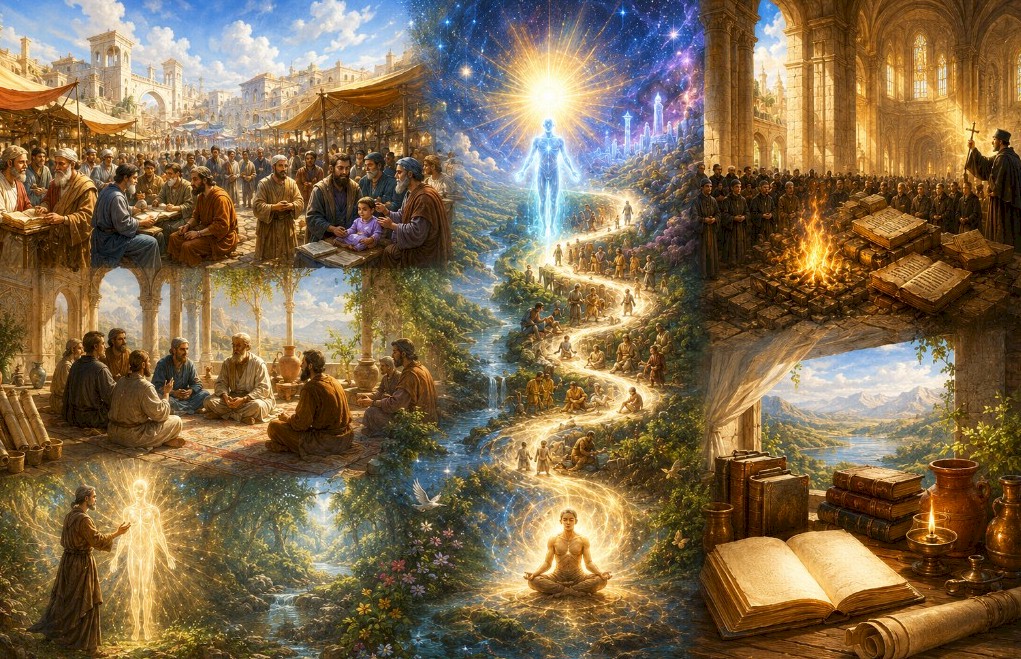
Early Christianity was not one single, unified system. It was more like a busy marketplace of ideas. Different groups argued about what Jesus really meant by salvation, resurrection, and the kingdom of God. Some groups taught openly. Others shared teachings only with initiates. Some focused on mystical experiences.
In the Christian Gnostic texts, salvation is not mostly about a one-time judgment after one lifetime. It is about a long process of being rescued from ignorance and forgetfulness. The soul descends into the world and becomes trapped in a body. It is judged and corrected. And if it does not wake up, it returns again. This happens again and again. Across many texts, the same ideas keep showing up: being sent back, entering the world again, receiving another body, wandering through many births, drinking forgetfulness, returning until purified. This language shows a worldview where reincarnation is how souls are taught and disciplined, and where divine knowledge is the way out.
This is why the idea of “secret teachings” is so important. If “resurrection” means an inner awakening that must happen now, while a person is alive, then resurrection is no longer something that happens at the end of time. It becomes the moment that prevents the soul from returning to the body. In this way of thinking, reincarnation is the basic structure behind moral growth, purification, and freedom. The soul returns because ignorance keeps it stuck. And the work of Christ – the divine light present within and among humanity – is not just about forgiving sins. It is about waking up what has fallen asleep. The final goal is not simply “going to heaven,” but escaping the reincarnation cycle entirely and entering rest, fullness, and reunion with the divine Source.
Seen this way, the later suppression of Christian Gnostic ideas was a fight over power and control. If salvation comes from direct knowledge and inner change, then no institution can fully control it. If the soul can return more than once, then fear based on a single-life deadline loses its force. And if resurrection is something experienced inwardly, then the Church’s control of grace through exclusive rituals becomes easier to question.
The modern rediscovery of these texts reopens a conversation that was buried for centuries. It shows what early Christians were able to believe, and what Christianity might have become. Whether someone believes reincarnation is true or not, these writings clearly show that many early Christian mystics taught it – a repeating cycle of life in the body, shaped by forgetfulness and cosmic forces, and broken only by awakening into divine knowledge. After almost two thousand years of silence, their voices are being heard again. Salvation is about an inner transformation that finally ends the soul’s reincarnation.