This site uses affiliate links to Amazon.com Books for which IANDS can earn an affiliate commission if you click on those links and make purchases through them.
1. Introduction to Temporal Lobe Epilepsy and NDEs
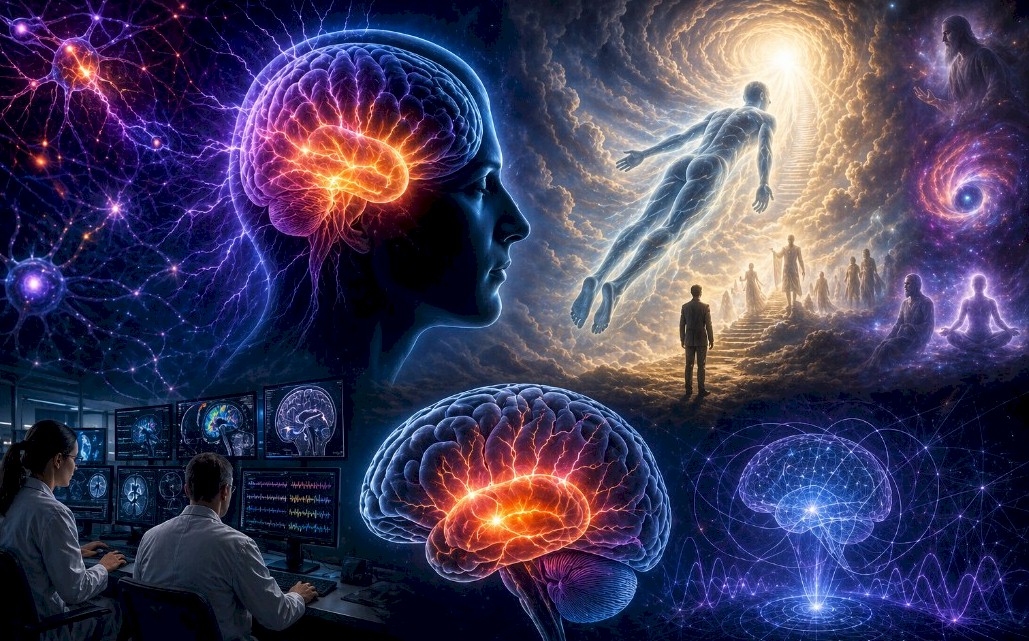
Temporal lobe epilepsy (TLE), a neurological condition that affects the brain’s temporal lobes, has been identified as a possible trigger for near-death experiences (NDEs) or NDE-like phenomena. Individuals with TLE sometimes report mystical or transcendental experiences during seizures, which bear striking similarities to the classic features of NDEs, such as out-of-body experiences (OBEs), feelings of euphoria, vivid visions, and encounters with spiritual entities or a sense of the divine.
The temporal lobes play a crucial role in processing emotions, memories, and sensory input, and they are closely linked to the brain’s management of consciousness and perception. During seizures, abnormal electrical activity in these areas can create intense altered states of consciousness that resemble NDEs. Some researchers propose that these episodes may give insight into how the brain processes experiences of life, death, and spirituality, potentially explaining why people undergoing actual near-death events report similar sensations.
The connection between TLE and NDEs suggests that the brain’s wiring may be involved in generating profound mystical or transcendental experiences, even in the absence of a life-threatening event. This link raises intriguing questions about the nature of NDEs, whether they are purely neurological in origin or if they point to a deeper, non-material dimension of consciousness. Understanding the relationship between TLE and NDEs offers valuable insights into how the brain functions during extreme states of consciousness.
Scientists researching the brain have examined the experiences of people suffering from temporal lobe epilepsy. Apparently the increased electrical activity in the brain resulting from seizure activity (abnormal electrical activity in the brain), makes sufferers more susceptible to having NDEs. This gives cause for researchers to examine the temporal area of the brain, the portion of the brain that researchers refer to as the God Spot.
2. NDE-Like Experiences From Temporal Lobe Epilepsy
The following is a first-person narrative drawn from a clinical report of TLE with ecstatic or experiential auras that closely resembles an NDE-like experience. Such accounts are documented in neurology literature (e.g., Picard & Craig, 2009; earlier case descriptions by John Hughlings Jackson), and are often cited in discussions within the Journal of Near-Death Studies.
“Without warning, everything changes. There is no fear – only a sudden, overwhelming sense of peace. It is as if the world becomes intensely real and, at the same time, distant.
“I feel a rising sensation, not in my body exactly, but in my awareness. Time seems to stop. There is no past or future – only a kind of eternal present.
“In that moment, I understand everything. Not in words, but in a complete and immediate way. It feels like truth – absolute and undeniable.
“I am no longer concerned with myself. There is no anxiety, no questioning. Everything is perfectly as it should be.
“The feeling is profoundly beautiful – more real than ordinary life. And then, just as suddenly, it is gone.”
The following is another first-person narrative drawn from a clinical report of TLE from a study by Dr. Bruce Greyson (2014) documented in his paper entitled “Out-of-body experiences associated with seizures.”
“It begins suddenly. I feel a shift, as if something inside me disconnects. My body is still there, but I am no longer fully inside it.
“I rise – effortlessly – and find myself looking down. I can see my own body from above, as if I am positioned somewhere near the ceiling. Everything appears unusually clear, almost more vivid than normal reality.
“There is no fear. Instead, I feel detached, calm, almost indifferent to what is happening below. My body seems like an object – something separate from me.
“Time feels strange. It slows or stretches, and the moment seems to last longer than it should. I am aware, observing, but not participating.
“Then, just as quickly, I am pulled back. The sense of separation collapses, and I am once again inside my body. The clarity fades, replaced by confusion and fatigue.”
Dr. Greyson’s study has shown that in a sample of epilepsy patients, over half reported subjective experiences during seizures, and a subset described OBEs. These OBEs were linked to seizure activity in the temporo-parietal region, a brain area involved in body awareness and self-location. This seizure-induced experience closely matches core features of NDEs. Neurologists note that such experiences can occur in temporal lobe or temporo-parietal seizure activity, suggesting a brain-based mechanism for at least some NDE features.
3. An NDE Resulting From Seizure After Drug Overdose
The following NDE testimony was sent to Kevin Williams and appears in his book “Nothing Better Than Death” (2002). This NDE happened to a woman named Lisa which was triggered by seizure. After months of depression and physical pain from systemic lupus, one day she took too many painkillers. Her twin sister found her in the morning in a seizure, half-flopped off of her bed. By the time she called 911, she had fallen on the floor and was in a full convulsive state, curling up her hands in a fetal position. Here is what she experienced in her own words:
“There was no tunnel or light. I awoke standing upright in the back of what looked like a large auditorium-type place, without the chairs. The wall were gold and had jewels embedded in them. I was far in the back at first and couldn’t figure out where I was. There were horns playing loud classical-type music and it was a very formal-type ceremony. There were dancers with beautifully colored flags dancing in a supernatural sort of way. I felt my presence coming in closer, but I didn’t feel legs moving underneath me.
“There was a long, wide aisle with 10-15 men seated on each side of the aisle. They were across the aisle from each other, facing each other. They had on robes and gold crowns, like they were kings or judges. The seats were tall, gold chairs and at the end of the aisle was an empty chair. My presence came in very close and then to the left side came a man in a long, white, toga-type robe. He had short brown hair and on his head was a wreath of holly leaves woven together with baby’s breath. He smiled and approached me with his right hand extended.
“He took my hand gently and said, ‘Hi, Lisa. I’m Peter, welcome to the festival.’
“With that, he opened a large door and I entered a large place that was mostly white space. There were large white cloth-covered tables with beautiful, succulent fruit and a large fountain of red wine. There were just a few people there, and they were dressed in normal clothing of today.
“Just then I flashed into a complete space of whiteness, but it was not disconcerting like a haze of fog would be. I was seated on the right leg of a very large, strong presence with huge, loving arms around me.
“A man’s low voice said in my right ear, ‘Lisa, they’re working on your body, you have to hurry. Do you want to go back? Your son needs you.’
“I remember feeling confused like I was not aware of what I had left behind.
“I didn’t say anything and then the voice said louder, directly in my ear, ‘Lisa, you have to hurry, they’re working on your body. Do you want to go back?’
“And even louder he added, ‘Ryan needs you.’
“He put great stress on my son’s name. I immediately realized I had left my 9-year-old son behind and then I woke up in the ambulance. They later told me that I said, ‘I wanted to be in paradise with Jesus‘.
“That’s my experience. I’d love to hear your comments. I’ve not read anything like this before. It was like a movie, almost sounds cliché, I know.”
4. Phenomenology and Consciousness of Temporal Lobe Epilepsy
The relationship between TLE and NDEs has generated sustained interest within neuropsychological and transpersonal research. Both phenomena involve alterations in consciousness, vivid perceptual experiences, and profound emotional or spiritual content. Empirical findings and theoretical models links temporal lobe dysfunction – particularly epileptiform activity – to NDE phenomenology. While similarities between TLE-related experiences and NDEs suggest a shared neurobiological substrate, important differences challenge reductionist interpretations. The evidence supports a nuanced view in which temporal lobe processes may contribute to, but do not fully explain, the NDE.
TLE is characterized by seizures originating in medial or lateral temporal structures, including the hippocampus and amygdala. Patients may experience auras involving déjà vu, intense emotions, auditory or visual hallucinations, and alterations in the sense of self. In some cases, these episodes include autoscopic phenomena – perceptions of observing one’s body from an external perspective.
Importantly, temporal lobe seizures can produce complex experiential states that resemble mystical or religious experiences. Neurologists have long noted that such seizures may evoke feelings of unity, significance, or transcendence, suggesting a neural basis for certain aspects of spiritual cognition.
5. Links Between Temporal Lobe Epilepsy and NDEs
A key link between TLEs and NDEs comes from studies examining temporal lobe activity in individuals who have reported NDEs. Research by Willoughby B. Britton and Richard R. Bootzin (2004) found that individuals with NDEs exhibited significantly greater temporal lobe epileptiform activity compared to control subjects.
These individuals also reported more symptoms typically associated with temporal lobe instability, suggesting a possible predisposition toward altered states of consciousness. Interestingly, the study found that such activity was not associated with pathology such as post-traumatic stress or dissociation, but rather with adaptive coping and positive psychological outcomes.
This study by Britton and Bootzin (2004) directly tested whether people who report NDEs show signs of temporal lobe instability similar to epilepsy. Individuals who reported NDEs showed significantly more temporal lobe epileptiform activity on EEG compared to controls. They also reported more symptoms associated with TLE, such as unusual perceptual and emotional experiences. The results suggest that altered temporal lobe functioning may contribute to NDE phenomenology. However, the authors themselves caution that their study is correlational, not proof that epilepsy causes NDEs. It may reflect a predisposition to altered states of consciousness, rather than pathology per se.
The similarities between TLE-related experiences and NDEs include: (1) Out-of-body experiences (OBEs): Both may involve a sense of leaving the physical body. (2) Altered time perception: Temporal distortion is common in both seizure auras and NDEs. (3) Intense emotional states: Feelings of fear, bliss, or cosmic significance occur in both conditions. (4) Imagery: Visual and auditory phenomena may appear highly realistic and meaningful. Such parallels have led some researchers to propose that NDEs are essentially seizure-like events occurring under extreme physiological conditions.
Despite these similarities, critical differences remain: (1) Narrative coherence: NDEs typically exhibit structured, meaningful narratives, whereas epileptic experiences are often fragmented and disorganized. (2) Aftereffects: NDEs frequently lead to long-term psychological transformation, including reduced fear of death and increased spirituality; such changes are not typical in TLE. (3) Contextual triggers: NDEs occur in life-threatening situations, whereas TLE episodes arise from chronic neurological conditions. As Dr. Bruce Greyson has argued, the fact that temporal lobe disturbances can mimic certain features of NDEs does not imply that NDEs are reducible to pathology.
Researchers (including Dr. Greyson) emphasize important distinctions: TLEs are usually of short duration (seconds to minutes vs. extended NDE narrative episodes). TLEs often lack structured elements like life review or encounters with beings. TLEs occur repeatedly in a medical condition, not just in life-threatening contexts. TLEs usually do not produce the same long-term transformative aftereffects.
The temporal lobe hypothesis occupies a middle ground between strictly physiological and purely transcendental interpretations of NDEs. It suggests that the brain – particularly temporal lobe structures – may act as a mediator or facilitator of these experiences rather than their sole cause.
From this perspective, TLE provides a valuable model for understanding how alterations in neural activity can generate experiences resembling NDEs. However, the depth, consistency, and transformative impact of NDEs indicate that additional factors – psychological, cultural, or possibly non-local – may also be involved.
The relationship between TLE and NDEs remains complex and unresolved. Empirical evidence supports a role for temporal lobe activity in generating aspects of NDE phenomenology, particularly perceptual and emotional features. However, significant differences in structure, meaning, and aftereffects challenge a purely neurological explanation. Also, seizure episodes do not fully reproduce the structured, meaningful narratives typical of NDEs. Dr. Greyson notes that NDE-like features are rare in actual temporal lobe seizures. Seizure experiences tend to be fragmented, not coherent narratives. This is one of the central arguments against reducing NDEs to epilepsy alone.
TLEs can simulate fragments of the NDE, particularly its emotional and perceptual intensity, but does not fully reproduce its narrative depth or lasting psychological impact.
Future research should integrate neurophysiological data with phenomenological and longitudinal approaches to better understand how brain processes interact with subjective experience in extreme states of consciousness. The study of TLE continues to illuminate the neural correlates of NDEs, but it does not fully account for their richness or existential significance.
6. Conclusion
The link between TLE and NDEs gives us a useful way to look at how the brain works during unusual states of consciousness. Studies show that seizure activity in parts of the brain called the temporal and temporo-parietal regions can create experiences that are very similar to NDEs. These can include feeling like you are outside your body, losing track of time, and having strong emotional or spiritual feelings.
But even though these similarities are important, they don’t fully explain NDEs. NDEs often have clear, detailed stories. They usually happen during real life-threatening events. They can also lead to lasting changes in how people think and feel afterward. Seizures alone do not fully explain all of this.
So instead of saying NDEs are just caused by brain problems, the evidence suggests something more complex. The temporal lobes may help shape or support these experiences, but they may not create them entirely on their own. TLE can help researchers study the brain parts involved, but it does not capture the full meaning or depth of NDEs.
To truly understand NDEs, we will likely need to study them from different angles. This includes neuroscience, psychology, and the study of personal experience. Both the brain processes and the deep personal meaning of these experiences matter.