This site uses affiliate links to Amazon.com Books for which IANDS can earn an affiliate commission if you click on those links and make purchases through them.
1. Introduction to Suicide and NDEs
Near-death experiences (NDEs) in the context of suicide reveal a fascinating and transformative side to these profound events. Despite originating from moments of deep despair, these NDEs often provide individuals with healing, insight, and a new appreciation for life. The vivid encounters with spiritual realms, life reviews, and emotional clarity offer survivors a way to reconnect with their purpose and emerge from the experience with a stronger will to live.
These experiences challenge conventional views of death and consciousness and suggest that even in the darkest moments, profound transformation and hope can arise. For many, an NDE during a suicide attempt becomes a turning point – one that not only reshapes their understanding of death but also deepens their connection to life.
2. Asher Elmekiess’ Suicide NDE
The following is Asher Elmekiess’ suicide NDE testimony sent to Kevin Williams by email in his own words.

I have an ex-life and a new life. My ex-life ended when I tried to take my own life with over 70 medicinal tablets, over 26 of which were aspirin 500 mg. That night I had a “before-death experience.”
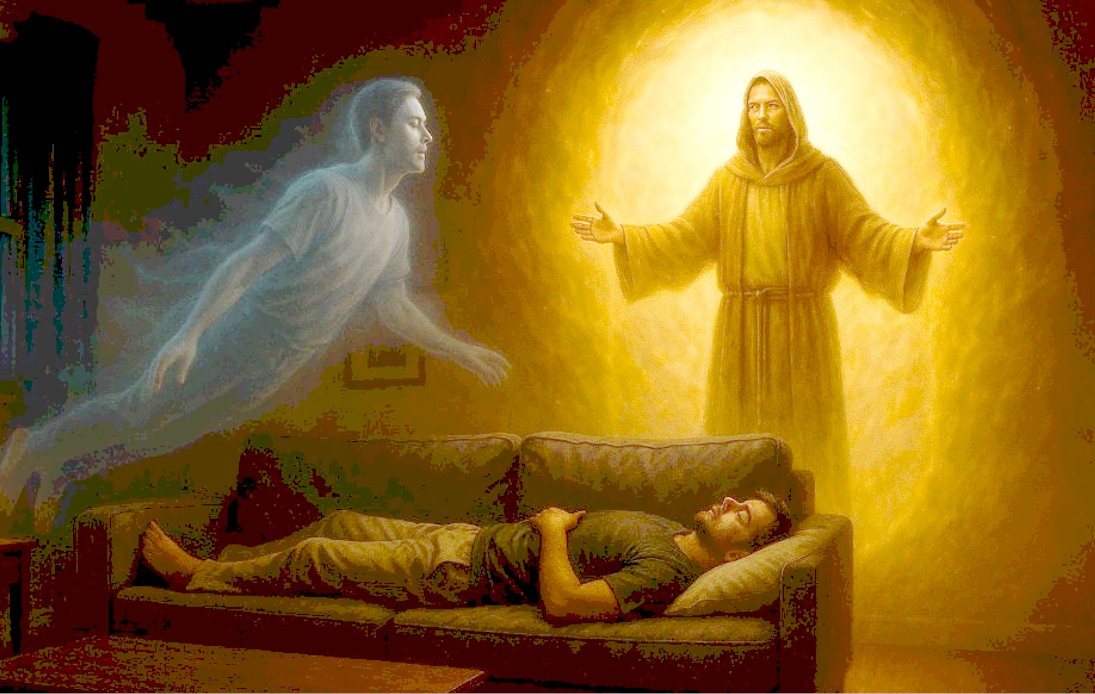
It was dark everywhere yet there were sparkles all around like little stars.
I was sitting (don’t know on what, it was like there was no ground or nothing beneath me) and was not breathing or feeling anything. When I tried to touch my body, my hand went right through it.
It was a place of so much love, peace and joy. I did not want to move or come back from there.
Then I saw one “Person” come to me. He was dressed with old brown clothing like cloak or gown. A rope was around his waist and he looked like a monk with a hood covering his head and straps on his sandals. He was what I would say a very Biblical looking person. There was something about him, as if he was the Peace, Love and Joy of that place.
Then he said to me without a voice or sound but in my innermost being, “You are going to go back!“
I wanted to say something like, “I do not want to,” but I could not say a thing. It was like absolute nothing to argue about.
Then he said to me the most amazing thing, “You will go to the Christians and they will show you and teach you how to be with me. We will be together soon.”
I wanted to say, “But I am Jewish.”
“Yes,” he said. “You weren’t thinking much about being Jewish when trying to commit suicide, weren’t you?”
There was deep shame in me for that action, as it is now, yet little did I know where I was heading from there.
Then I saw intensified Light and to my surprise I woke up. I was ok, just a little drowsy. So I phoned a doctor friend of mine. He said that it was very foolish of me and that he must phone an ambulance quickly.
At the hospital, the doctors told me the amount of aspirin I took should have killed me, yet they found no trace of drugs in my blood.
I was released from the hospital the next day as the doctors found no physical damage of concern to my body and concluded that I was just circumstantially depressed. I cried non-stop for three days as if it would not stop – that it would go on forever. I was a fool in my disastrous, but merciful failure to end my life because of my wife’s request to divorce me.
3. An Analysis of Asher Elmekiess’ Suicide NDE
Asher Elmekiess’ suicide NDE is a deeply emotional story about despair and personal change. Like many suicide NDEs, his experience began during a time of extreme hopelessness. But instead of finding punishment, fear, or condemnation, he described feeling overwhelming peace, love, and joy in a place beyond normal physical reality. This is something often reported in many suicide NDE stories, where people say they felt accepted and spiritually comforted even after trying to end their lives. Experiences like these challenge the common belief that suicide-related NDEs are always terrifying or filled with punishment.
One of the most powerful parts of Asher’s story is the contrast between the darkness around him and the sparkling lights he saw. Symbolically, this may represent the emotional darkness he was living through mixed with the continuing presence of spiritual awareness. He also described not being able to feel his body and seeing his hand pass through himself. These are common features in NDEs, where people feel separated from their physical body and enter a non-physical state of awareness. The lack of pain and the strong feeling of peace suggest the experience brought emotional healing, even though it came from tragic circumstances.
The mysterious figure Asher met is one of the most important parts of the experience. The being, who could be interpreted as being Jesus, wore simple Biblical clothing and communicated without speaking out loud. This is another common feature in NDE reports, where communication happens directly through thoughts or inner knowledge. More importantly, the figure seemed to represent the same peace, love, and joy that filled the entire realm. In many NDEs, spiritual beings are not just visitors in the environment. They seem deeply connected to the spiritual world itself.
The conversation between Asher and the being also brings up important ideas about identity and spiritual growth. Asher worried about being Jewish while being directed toward Christians. This shows how personal and sometimes difficult spiritual changes after an NDE can be. The experience did not reject his identity. Instead, it seemed to suggest that spiritual truth and healing may go beyond religious boundaries. The figure’s comment that Asher had not been thinking much about being Jewish during his suicide attempt carried moral meaning. It did not come across as harsh punishment. Instead, it seemed like a reminder that despair had separated him from his deeper spiritual values and sense of purpose.
Another important part of the story is the intense shame Asher felt afterward. Many NDE survivors say they return with a deeper understanding of the effects of their actions. In Asher’s case, the shame appeared to be part of a painful realization connected to his suicide attempt. This emotional response seems to have become part of his personal transformation and renewed appreciation for life.
The medical details of the experience also add to its impact. According to Asher, doctors could not explain why no traces of the drugs remained in his body despite the large amount he had taken. Experiences like this are often seen by NDErs as signs of divine intervention or a reason they were allowed to survive. The event clearly became a major turning point in his life.
Overall, Asher Elmekiess’ testimony reflects many of the main themes commonly found in suicide NDEs: deep peace beyond physical suffering, encounters with spiritual beings, and a renewed sense of life’s meaning. His experience suggests that even during moments of extreme despair, people may encounter experiences that inspire a deeper understanding of themselves and their spiritual journey.