This site uses affiliate links to Amazon.com Books for which IANDS can earn an affiliate commission if you click on those links and make purchases through them.
1. Introduction to Why the Fear of Death Is Irrational
The fear of death is often seen as a normal part of being human. It sits in the background of our daily choices. It shapes what people believe. It even affects areas like medicine and religion. But when we really look at it – through philosophy, psychology, and research such as near-death experience (NDE) studies – this fear starts to fall apart. What we naturally fear may not actually make sense.
At its center, the fear of death comes from a lack of knowledge. We may not know what happens after we die. We may not know what dying feels like. We may worry about losing who we are and everything we’ve experienced. We may worry about losing who we are, losing everyone, or losing everything we’ve experienced. But not knowing something doesn’t automatically mean we should fear it. When you break it down, there are only two real possibilities. Either consciousness stops completely, or it continues in some way. Both of these weaken the reason to be afraid. If consciousness ends, there is no pain, no loss, and no awareness of anything. If it continues, then death isn’t really the end – it’s more like a change or transition.
A lot of fear about death also comes from culture, not from logic. Over time, different religions and traditions have added ideas about judgment, punishment, or the unknown. These ideas often increase fear instead of easing it. They can hide a simpler truth: death is a natural part of life, just like birth. It’s part of a bigger cycle. Many hospice workers who know about dying say the experience of dying is pleasant – even wonderful. This weakens the idea that death is something to fear. Of course, we all fear pain; but this is where hospice medicine can help.
This article looks at the idea that fear of death is not just exaggerated, but irrational. By looking at logic, cultural beliefs, and real-life experiences, we can start to see death in a different way. Instead of seeing it as the ultimate danger, we can see that, in any likely case, there is no clear reason to fear it.
2. Actual Afterlife Experiences or Hallucinations?
Someone with death anxiety emailed to me the following question, “I am terribly afraid of death right now. I don’t really know why. I’ve never been afraid before. With so many different NDE versions, all claiming to be the one answer, how could any of them really be?”
My answer is that each person’s NDE testimony is their own personal experience of a reality that is far more dynamic than physical reality. Detectives know that if you ask several eyewitnesses of a robbery, for example, you will not get exactly the same story and some may even be contradictory or erroneous for various reasons. The reasons why NDEs are so different from each other are the same reasons why experiences in this world are different (although there are a large amount of similarities). I have an article that gives a more in depth discussion on why NDEs are different.
The question as it exists today is whether the NDE is an actual afterlife experience or dying brains mass hallucinating tunnels, light, and being told it isn’t time yet. Looking at this from a scientific view, which is somewhat limiting, the only conclusion is that there is no scientific proof that NDEs are actual afterlife experiences. Perhaps it is impossible to obtain such scientific proof.
Even if researchers scientifically confirm that people are actually seeing and hearing things far from their physical bodies, this only proves, in my opinion, that conscious awareness can expand from the body to witness remote events. It is not absolute proof that consciousness can survive death. And even if doctors began performing “flatline experiments” like in the movie “Flatliners” (where doctors voluntarily undergo clinical and brain death and be revived to recount their NDE) and scientifically verify that the experiencer was conscious while brain dead and observed events far from their body, I still don’t think this will be enough to call it “scientific proof” of an afterlife. The fact is the NDE of Pam Reynolds is probably the closest anyone has ever come to providing such proof.
Here is a good website from Victor Zammit entitled A Lawyer Argues For The Afterlife which presents very good evidence.
Although there may never be evidence that satisfies the minds of orthodox scientism, I believe much evidence (not proof) that will convince most people that consciousness survives bodily death.
This aside, the circumstantial evidence in favor of survival after death is so overwhelming that the proverbial ball is really in the skeptic’s court. We don’t have to explain anything. Millions of people having NDEs can’t all be wrong. It is the skeptics who must come up with proof that it is only a brain thing. So far, all the skeptics’ arguments do not fit the scientific facts.
I have the following articles that list some of the most fascinating evidence from NDEs that suggest they are much more than only a brain thing. Here they are:
NDEs and Science — NDEs and Quantum Theory — NDE Afterlife Evidence — Skeptic’s Corner
Personally, I am convinced that our consciousness survives bodily death. This is my belief which is based on a mountain of circumstantial evidence (see above). Not much faith is required when the circumstantial evidence is there. NDErs don’t need any scientific or circumstantial evidence to believe in an afterlife because they actually experienced it. I have never been to France, for example, but I know it exists because of what I have read and seen on TV. Perhaps it is the scientific method as applied to afterlife phenomena that needs questioning here.
As for the fear of dying, it is completely natural and valuable to have it because it is part of our “fight or flight” mechanism that has evolved over millions of years to help humans to be at the top of the food chain. However, there is a clinical affliction called “death anxiety” that some people have that can interfere with their life. This can be treated the same way that all anxieties are treated, that is, with medicine. There is a wealth of websites on death anxiety and they are worth visiting.
Of course, everyone is afraid of pain and suffering. Everyone is afraid of dying to some degree, but some people have death anxiety so bad that they have trouble functioning in life. It wouldn’t hurt to tell your doctor about it.
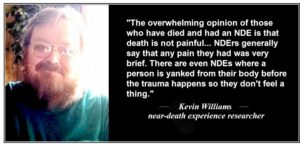
Also, the overwhelming opinion of those who have died and had an NDE is that death is not painful. I have reports from people who were shot, run over, drowned, drug overdose, committed suicide, illness, burns, etc.. and the overwhelming opinion is that trauma to the body immediately causes your brain to produce morphine-like chemicals that eliminates the pain. And NDErs generally say that any pain they had was very brief. There are even NDEs where a person is yanked from their body before the trauma happens so they don’t feel a thing. Read Norman Paulsen’s NDE. This phenomenon is not uncommon. It is my opinion that this phenomenon happens to people in deadly plane crashes and other very traumatic catastrophes.
3. The Cost/Benefit Analysis of Death
But even philosophically, having an unnatural fear of death is not rational. This is because there are only 2 options when it comes to death and both of them are good.
Option #1: There is no survival after death.
If this option is true, then at best you will not experience anything after death. This means death ultimately results in oblivion – the end of everything. And is this option so bad? Suppose at death there is no afterlife but absolute oblivion. Then, you won’t be around to fear it. It would be the “blessed end of everything.” This option only means that there is nothing gained after death. It is irrational, I think, to be sorrowful about something we were not given, in this case life after death. I think of life after death as being “the icing on the cake”. We should probably live our lives as if we were going to die tomorrow. And if it is the blessed end of everything, then we won’t be around to think about it. It is just that there is nothing gained and nothing lost.
Option #2: There is survival after death.
If there is survival after death, then we can have our cake and eat it too. If there is survival, the question is whether life after death will be heavenly or hellish. I am convinced that the same principle found in life also applies to the afterlife. Life is what you make it. We can kill someone and end up in prison. Or we can do good things and live contently. I believe this principle applies to heaven and hell. So, if any fear is justifiable, it would be the fear of going to hell. But, even then, NDE testimonies show that the experience of hell is only a temporary condition.
In conclusion, here is the cost-benefit analysis of death:
No survival —-> nothing lost and nothing gained
Survival ——–> nothing lost and something gained
This means that death is a “win/win” situation. Either option is a winner. Granted, the option of survival after death would be preferred. So, by this formula, there is no rational reason to fear death.
Concerning the need to have “faith,” faith implies the possibility of doubt and a state of doubt can be miserable. Knowledge implies certainty. And when it comes to NDEs, it is based on solid knowledge and facts rather than faith. If a million astronauts go to Mars and say that there’s Martians living there, I would be inclined to believe them. If a million people experience death and then say there’s life after death, I would be inclined to believe them just the same.
This said, it is still a good idea to keep an open mind on this and remain a true skeptic (holding to the agnostic “possibility” that there isn’t life after death). Probably the important thing about NDEs is how they impact society. The concept of unconditional love is certainly something the whole world should learn about. Everything else (religious, scientific, metaphysical dogma) is like debating “How many angels can dance on the head of a pin.” There is a lot of problems with dogma because, more often than not, they only create limits to an open mind.
For this reason, one can make the case that the only thing that is really important is loving others, loving life, and loving everything. Faith and knowledge can change, but love is worth keeping and cultivating. Even the Bible says that love is greater than faith. Having faith in religious dogma, instead of having a healthy skepticism, can lead to disaster, in my opinion. For example, that pastor named Paul Hill who was just executed for killing an abortion doctor. This guy was such a religious zealot that he turned into a devil.
My own religious experience has been one of constant evolution. I change my mind all the time. Being manic depressive, I mean this literally. The only thing that is constant is love. This is why I always council people to “follow your heart” because the head is subject to greater change in my opinion. Suppose a person believes there is no afterlife because of having a healthy skepticism. Such skepticism does not really change anything about life. It is this life that matters most and it is love that really makes the world go around. The problem is that some people are so sure there is no afterlife that they treat people badly. This kind of situation is probably the only real “sin.” But not believing in an afterlife shouldn’t change things.
A man named Don Morse wrote an excellent book about his death anxiety, NDE and research into the many theories and beliefs about the afterlife. It is entitled, Searching For Eternity and it is well worth reading.
4. Notable Quotes Concerning the Fear of Death
Here are some words of wisdom concerning the fear of death:
“To fear death is nothing other than to think oneself wise when one is not. For it is to think one knows what one does not know. No one knows whether death may not even turn out to be one of the greatest blessings of human beings. And yet people fear it as if they knew for certain it is the greatest evil.” (Socrates)
“Nothing in life is to be feared, only understood.” (Madame Marie Curie)
“In the light of the near-death experience, death is nothing more than the illusion of separateness and finality, and those who can believe in this vision of death, like near-death experiencers themselves, lose all fear of it, for how can you fear that which does not exist?” (Dr. Kenneth Ring)
“It is not death that we should fear. We should fear never having lived.” (Marcus Aurelius)
“He who fears he shall suffer, already suffers what he fears.” (Michel de Montaigne)
“The immortality of the soul is a postulate of pure practical reason; in other words, it is a necessary assumption for moral action.” (Immanuel Kant)
5. Book Review: “The Last Frontier: Exploring the Afterlife and Transforming Our Fear of Death”
By Cecile Brennan, Ph.D., PCC
Cecile Brennan, Ph.D., PCC, is an Assistant Professor of Counselor Education and Coordinator of the Counselor Education Program at John Carroll University. Correspondence regarding this review should be sent to Dr. Brennan at email: cbrennan@jcu.edu.
The Last Frontier: Exploring the Afterlife and Transforming Our Fear of Death by Julia Assante, Ph.D., Novato, CA: New World Library, 2012, 407 + xvi pp., $15.95 pb (ISBN 978-1-60868-160-0).
The following is a reprint by permission of the article “Book Review: ‘The Last Frontier: Exploring the Afterlife and Transforming Our Fear of Death‘” by Cecile Brennan, Ph.D., PCC published in the Journal of Near-Death Studies, 31(4), Summer 2013 © 2013 IANDS
a. About “The Last Frontier”
In her book The Last Frontier, Julia Assante (www.juliaassante.com) attempted to lay the foundation for a revolution. Her goal was to erase the line between life and death, replace it with an understanding that our essential humanness is immortal, and thereby affirm that our humanness continues to live after our bodies cease to function. What we perceive as life followed by death is just a transformation of our material bodies into an ethereal spiritual substance. Using the tools of the scholar, tools developed in her own doctoral work as a student of the ancient Near East, Assante has written a well-researched and amply documented text that aims to explore the afterlife and lessen our fear of death.
As a person who is skeptical by nature, I am not sure if I would have independently chosen this book to read. The author’s brief biographical statement indicated that she is a mystic and a scholar, a professional intuitive, a medium, and a past-life therapist. Most people I have experienced with who make such claims offer “readings” for $20 and have storefronts near major highways. Such are the prejudices with which I initially approached this book.
Two experiences led me to put aside my automatic dismissal of what I considered “flaky” pursuits to consider carefully and thoughtfully the author’s argument. The first experience was my earlier reading of another book that dealt with esoteric matters, Extraordinary Knowing. I had the good fortune to attend a lecture by the late author, Elizabeth Lloyd Mayer, a highly respected psychoanalyst. My first-hand knowledge of her intelligence, honesty, and psychological balance forced me to consider her perspective. After reading her book, I came to the conclusion that our conventional understandings are limitations that lock us into a worldview that is narrow and confining. Serendipitously, not long after reading Mayer’s book, I had a client who, after several sessions, told me she saw dead people. Using good counseling technique, I began to explore her experience non-judgmentally, yet initially on the lookout for signs of psychosis. Finding no such signs, I listened with openness as well as curiosity to her stories of seeing what she called spirits. As she narrated her experiences, there was no glamorizing of the events, no attempt to persuade or impress me. She seemed relieved to share an important part of her that she had long kept hidden for fear of being labeled crazy.
These two experiences fractured my knee-jerk skepticism and led me to read Assante’s book with an open, but still questioning, mind. An open mind is a prerequisite for absorbing and considering her perspective. I believe that living in a culture focused so totally on the reality of the material, the unreality of the spiritual, and the primacy of the scientific, purportedly objective, method leaves its members at a disadvantage when confronted with a very different orientation. Readers of this book need to be able to suspend, at least during their reading, ingrained presumptions about how the world works. If they are willing to consider as possible ideas and occurrences that are generally derided by our scientific culture, I think they will be amply rewarded. Assante assisted me in that process by writing in a conversational manner that was both well reasoned and engaging. She guided me through the intricacies of a painstakingly developed argument with a mixture of scholarly erudition, personal anecdotes, and numerous examples. The end result was, for me, challenging and, at times, unsettling.
The book is organized into four major parts: The Evidence for Survival; The Social Construction of the Afterlife; Dying, Death & Beyond; and All About Contact. This organization seems to place, quite intentionally, the most controversial material last; the author carefully constructed an argument that enabled me at least to consider that communication with the dead is possible. Each section was heavily footnoted with references to commonly accepted serious works as well as to more esoteric works by authors who have investigated past-life experiences, reincarnation, and appearances by the deceased.
b. Part I: The Evidence for Survival
The book’s first chapter, “Can Survival After Death be Proved?”, begins with an insightful analysis of the nature of the universe and of consciousness. Assante described how the materialist view of the universe has crumbled under the pressure of findings from quantum physics. The old dualisms of subjective and objective, matter and nonmatter, material and spiritual have given way to an interplay of waves spreading out in time and space. From this perspective individuals are not bound by time and space. Rather, they are able to transcend both by loosening the grip of the material on their consciousness. The universe is not a single static entity; it is an evolving multiverse with many dimensions and unceasing bifurcations. In presenting these findings from quantum physics, Assante began to loosen my hold on preconceptions about life and death and about this apparently material world and the world of the afterlife.
Chapter two, “How Real is Real?”, continued the development of a non-material view of the world. Using analogies, metaphors, case studies, and scientific findings, Assante attempted to demonstrate that what appears to be solid matter is not solid and what appears to be limited by time and space is not limited. Citing both reported incidents of remote viewing, the ability to see something happening even though not physically present, and tests of perception that indicate that people react to a stimulus before the brain has registered it, the author attempted to prove that consciousness is not stored in the physical brain. Quite to the contrary, consciousness consists of energy, and energy flows like a quantum wave that is not bound by time, space, or material substance. These insights began to open a door between the worlds of the living and the dead. If consciousness is not anchored by matter, then it should not be difficult to accept that consciousness might continue to exist after what is material has ceased to exist.
In the third chapter, “Near-Death Experiences”, by offering a compendium of accounts of these experiences, Assante continued to develop the argument that consciousness is not bound by the material. Whereas all these accounts are quite fascinating, those that appeal most to the more skeptical include some validating proof. For instance, one account tells the story of a woman who died in the hospital. While attempts were being made to resuscitate her, she found herself floating out of her body and out of the hospital. As she floated over the hospital she noticed a red shoe on the hospital’s roof. Later, she recounted her experience to her doctors. One enterprising resident decided to check and see if there was a red shoe on the roof. Indeed, the shoe was there.
Assante also described other aspects of NDEs. There are some commonly recurring themes – moving through a tunnel or over a bridge, being met by deceased relatives, undergoing a life review. Some scholars have viewed these commonalities as a validation of the experience, whereas others have attributed these occurrences to physical changes in the brain and body as the death process begins. Whatever the case, Assante asserted that NDEs prove that the mind continues to function outside the body.
Chapters four and five are the heart of this first part of the book. Starting with chapter four, “After-Death Communication” and continuing into chapter five “Reincarnation”, Assante presented evidence of survival after death. In chapter four the evidence presented came from experiences people have had with the deceased, usually loved ones and friends, but sometimes a deceased individual who shared similar interests or just sought to assist the living in some way. These experiences range from spontaneous encounters with the deceased, sometimes occurring in the form of a visual apparition and sometimes via an auditory communication, to encounters through an intermediary such as a medium or through what is referred to as instrumental communication – when a deceased individual seemingly uses devices such as tape recorders or radios to communicate with the living.
The chapter on reincarnation continued the author’s attempt to demonstrate that consciousness survives the death of the body. Citing the extensive literature on reincarnation, gathered anecdotally and more formally, including by Western trained scholars, Assante made a pressing case for past-life remembrances. Although reincarnation is widely accepted in many parts of the world, and was once a part of the Christian worldview, most modern-day Westerners view the possibility with skepticism, and often with intellectual disdain. Clearly, Assante hoped that the groundwork laid in the first two chapters would enable a reader to consider the possibility that an individual’s consciousness is not finite and bound to a single material entity.
c. Part II: The Social Construction of the Afterlife
Although I found this part of the text interesting, it seemed to digress from the main focus of the book on transforming readers’ fear of death. The first chapter, “A Comparative History of the Afterlife”, is a fascinating account of the development of various conceptions of the afterlife. Focusing primarily on cultures that have influenced Western notions of the afterlife, Assante drew on her own scholarly training about the cultures of the Near East to explain where the common conception of hell as fiery hot came from (the hot desert), and how the afterlife notions of Mesopotamia and Egypt have influenced Western perceptions today. From her study of these two cultures she concluded that views of the afterworld are social constructions that coincide with a particular culture’s experience and values. Indeed, hierarchical Egyptian society created institutional monopolies that structured the death process through prescribed rituals, and posited an afterlife that was accessible only after a period of trial and judgment. This view of the afterlife is in marked contrast to the more egalitarian afterlife in Mesopotamia: the Netherworld is where all the deceased ended up without a period of trial and judgment.
From her initial review of the belief systems of the Near East, Assante turned her attention to a review of the afterlife beliefs of Greece and Rome, Ancient Israel, Early Christianity, Roman Catholicism, and traditional societies. In each case she made the point that views about death and the afterlife arise out of a particular culture’s experience and values. In this way, notions about the afterlife are relativized: There is no single, true view; present conceptions are as socially constructed as those from the past.
In chapter seven, “The Genesis of Sin”, the author described how the judgmental approach of the Egyptians found its way into several of the world’s major religions. The notion of sin, from the misdeeds of Eve to the later development of the concept of Original Sin, reflects a dualistic outlook in which people conceptualize the world as a battle between good and evil. The notion of sin may serve to regulate behavior, but it also engenders a fear of death and of the afterworld. It is clear that Assante would readily abandon the notion of sin. She associated sin with coerced faith, belief, and actions that spring from fear rather than from love. She contrasted this belief system with real faith: a felt connection to all living things, and to the inherent goodness of creation.
The discussion of the afterlife and of sin is followed by a chapter that I find extremely difficult to categorize, and even more difficult to summarize. Chapter eight, “Spiritual Evolution, Nontime and the Ego”, is an analysis of the spiritualist movement, a defense of mediumship, a critique of some aspects of the New Age movement, an explanation of how linear time does not exist, and a defense of the ego as the carrier of each person’s uniqueness.
The three chapters of Part II of the text could easily be expanded into several fully developed separate books. Indeed, chapter eight itself could be developed into three books, one a critique of the notion of spiritual evolution, another an extended reflection on the non-linearity of consciousness, and the third a nuanced analysis of the necessity of accepting and working with the ego. Although I found the concepts discussed in Part II interesting, except for the notion of the social construction of the afterlife, I found they detracted from the main thrust of the text.
d. Part III: Dying, Death & Beyond
The three chapters of Part III offered a guidebook for approaching death. In chapter nine, “The Fear of Death: Causes and Cures”, Assante described the societal fear of death and the medical community’s complicity in supporting that fear by attempting to prolong life even when it is clear that death, always inevitable, is near. She asserted that in order to move beyond a fear of death, individuals need to become aware of the positive experiences of those who have had NDEs. Reflecting on these positive experiences begins the process of releasing fear about dying. This process can be accelerated by each person envisioning their own dying process and working through the issues that emerge as they begin to let go of life. Finally, Assante posited that one of the best ways to let go of fear about dying is to encounter someone who is already deceased. Through such an encounter death is experienced as a part of the continuum of consciousness. In the same way that travelling to another state is not be feared, neither is death to be feared. Being in the dying state is a change, often a change for the better where many of the limitations of an embodied existence are no longer present.
From letting go of the fear of death, Assante transitioned to how to die well. Chapter ten, “Preparing to Die”, provided an overview of the death process. Topics ranged from a consideration of the unfinished business family members may inflict upon the dying to the process of unconsciously orchestrating one’s own death. It was the author’s contention that most people know, albeit unconsciously, that the death process has begun. Citing numerous cases she detailed how the dying are aware of what is happening and to some extent plan their final hours. Oftentimes reconciliation between the dying and loved ones and friends occurs; frequently the dying wait for a family member to arrive at their bedside before they move on to non-material existence. Finally, she detailed encounters that the dying have with deceased family and friends, encounters that may occur in dreams or in more alert hypnogogic states. In general, dying persons experience these encounters as positive: Loved ones act as guides to assist them as they transition and to welcome them when they arrive in transmaterial domains.
In the final chapter of this part of the text, “Going Through the Threshold”, the author detailed the process of moving from the body into a disembodied state. Although she discussed some of the more common occurrences – moving through a tunnel or a dense fog, encountering familiar people there to assist, and encountering more ethereal, spiritual presences – Assante made the very strong point that it is best never to tell people definitively what they will experience when death occurs. They will draw largely on their own personal history, culture, and beliefs in constructing their after-death experience.
e. Part IV: All About Contact
The five chapters that constitute this final section of the text posed some of the most difficult material for me as a skeptical reader. Whereas Assante had not hesitated throughout the text to include her experiences as a medium, in this section those experiences moved to center stage. Beginning in chapter twelve, “It’s Ok to Talk to the Dead, But what Happens when the Dead Talk Back?”, and ending with chapter sixteen, “How to Make Contact”, the emphasis was on normalizing contact with the departed and providing a manual to assist those who want to contact them. She dealt in some depth with several subjects, such as ghosts, telepathy, automatic writing, and the subtle signs that indicate an encounter is occurring. Because there is no easy way to summarize the steps the author provides, suffice it to say that Assante offered an interested reader a clear method for attempting to enter into communication with the departed.
f. Conclusion
Assante concluded with a consideration of how people’s lives would be enhanced if they had a sense of their own immortality. She returned to the theme that began the book, overcoming the fear of death, by more than suggesting that people no longer need to fear death because death does not truly exist. Her conclusion flowed logically from the argument she had constructed and the material she had presented throughout her work.
Clearly, much of her argument rests on a worldview and an experience of being in the world that is very different than the conventional one. Many potential readers would automatically dismiss anything said by someone who purports to communicate with the dead. My own training in anthropology and psychology, and my inherent suspicion of a kind of group-think which has people accept as real only that which is conventionally agreed upon, makes me hesitant to simply dismiss her perspective and her personal experiences. On the contrary, I think the book offers many valuable insights that do not require a reader to agree with everything as it is set out. In particular, I found the early chapters in Part I fascinating and filled with interesting information and examples. Individuals interested in NDEs, and in an extended consideration of how present day conceptions of death have evolved, would benefit from reading this text. In addition, those willing to consider that individual consciousness is not tied to a material body would find much of interest in Assante’s more esoteric discussions.
If the book has an inherent shortcoming, I think it is that the author tried to do too much and cover too much territory. The chapters of Part II are a compendium of interesting but somewhat disparate information. Only tangentially connected to the main argument of the book, much of this information took me down some interesting conceptual roads, but did not seem to connect fully with the author’s main thesis.
If the goal of a book is to make a reader think, ponder, and question, then Assante has succeeded – certainly with me. In this regard at least, I am glad that this book was “forced” upon me for this review. My immediate take-away is a heightened sense that the world is not nearly as “cut and dry” as a conventional perspective would indicate. If physicists contend that the solid is not so solid, and philosophers understand the human take on reality as a social construction, then perhaps it is not so far-fetched to argue that there is no such thing as death.
g. References
Mayer, E. L. (2008). Extraordinary knowing: Science, skepticism and the inexplicable powers of the human mind. New York, NY: Bantam.
6. Conclusion
In the end, the fear of death begins to lose its force when we look at it clearly and honestly. As the article has shown, this fear is built mostly on uncertainty, cultural ideas, and assumptions rather than solid reasoning. When reduced to its simplest possibilities, death offers no logical basis for fear: either consciousness ends – bringing no awareness of loss or suffering – or it continues in some form, suggesting transition rather than extinction. In both cases, the outcome does not support the deep anxiety so often attached to it.
At the same time, the evidence from NDEs, philosophical reflection, and cross-cultural perspectives all point toward a more nuanced understanding of death – one that challenges the idea of it as something inherently terrifying. Even if absolute proof remains out of reach, the consistency of reported experiences and the limits of purely material explanations invite us to remain open-minded rather than fearful.
Ultimately, the most meaningful conclusion is not about proving what happens after death, but about how we choose to live in light of it. If fear of death is irrational, then clinging to it only distracts from what truly matters. What remains constant – regardless of belief, doubt, or knowledge – is the value of living fully and loving deeply. By letting go of unnecessary fear, we free ourselves to engage more fully with life, which may be the most rational and worthwhile response to death of all.