This site uses affiliate links to Amazon.com Books for which IANDS can earn an affiliate commission if you click on those links and make purchases through them.
1. Introduction to Extreme Meditation and NDEs
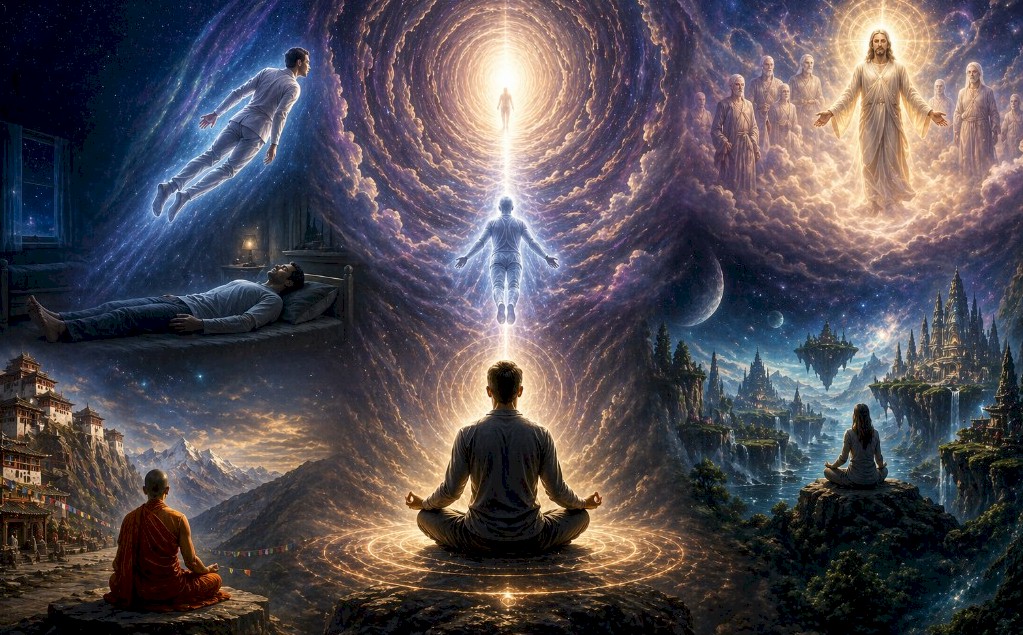
Extreme meditation, particularly in deeply altered states of consciousness, has been reported as a potential trigger for near-death experiences (NDEs) or NDE-like phenomena. While NDEs are traditionally associated with life-threatening events, some individuals who engage in prolonged or intense meditation practices describe experiences remarkably similar to those reported in near-death situations. These meditation-induced NDEs (MI-NDEs) may include sensations of leaving the body, traveling through a tunnel, encountering spiritual beings or a divine presence, and gaining profound insights into life, death, and the nature of existence.
In certain spiritual traditions, such as Tibetan Buddhism and Hinduism, advanced meditation techniques are believed to allow practitioners to access higher realms of consciousness, including states that closely resemble the experiences of those who have come close to death. These deep meditative states can sometimes blur the boundaries between the physical and spiritual realms, leading individuals to describe encounters with luminous beings, visions of otherworldly landscapes, or feelings of immense peace and unity with the universe.
The parallels between NDEs and MI-NDEs suggest that the mind’s ability to reach heightened states of awareness or transcend the body’s limitations may not be confined to near-death scenarios. Instead, through meditation, individuals can potentially access these transformative experiences, offering insights into the nature of consciousness and the profound depths of human perception.
2. Joni Maggi’s Meditation-Induced NDE
The following is Joni Maggi’s NDE in her own words triggered through meditation. Her experience also appears in Kevin Williams‘ book, Nothing Better Than Death.
“Close your eyes for a moment and try to imagine that you are face to face with the sun! What an extraordinary feeling! I thought to myself:
“‘How can I be face to face with the sun and not feel the burning heat?’
“This first thought shocked and puzzled me – to be thinking in the way I would normally think.
“It was literally so bright that I could not sustain the gaze so I turned away. At that moment I noticed a silver cord, attached around the navel area going down, down, down to a person I saw lying on my bed. It was me! I had a curious non-interest in it.
“Suddenly, I was in dark outer space, floating as it were on my back, in what I can only describe as total ‘bliss’ (one of a few words which I’ll explain later I had never understood before that point!)
“I’m not sure how long this ecstatic feeling lasted but it was what I suppose is called Cosmic Consciousness or cosmic bliss. I knew that: the Universe is upheld by love (though if you ask me now I would not be able to explain that!)
“I knew that the planets are alive and conscious. I knew that they would never bump into each other on purpose or cause any damage – there was no violence but rather a total harmony in their existence.
“I then looked down and could see the Earth – far far away and down in this dark sky. I knew that it was a place of violence, a realm shrouded in darkness and difficulties, so to speak.
“At one point I saw what I can only describe as a group of beings – perhaps Beings of Light would describe them best. I then zoomed over to them – literally willed myself over to them (swoosh!) and was there instantaneously.
“They were seated (?) in an oval circle and there seemed to be a leader of some sort at the head of the group.
“First of all, I felt the most overwhelming love coming from them! It cannot be compared to anything here on Earth. For one, I felt that it was an inclusive group – rather than an exclusive one. (Here on Earth we seem to have trouble letting new people into groups but there it was as if all of them at the same time were welcoming me!)
“I heard them – in my mind – say, ‘Welcome home! You have been on such a long journey!’
“I had the feeling that they were sharing life experiences and learning from each other, as if in a sort of classroom.
“I didn’t have time to find out because at this point I said to the leader, again telepathically, ‘I cannot stay! I have to bring up my son!’ with a real sense of urgency.
“At the time my son was 4 years old and I knew somehow that I had the absolute obligation to bring him up and take care of him. Years later, when I thought of this, I understood that we live in a “moral Universe“.
“I immediately started coming down again. And as I was coming down, I saw – as if written on the entire dark sky – this message:
“‘There is nothing worth worrying about! Not even death!’
“And again I knew – or understood in an instant that death is exactly like falling asleep.
“What happens is that you let go of daily consciousness and slip into another. Or for that matter, like waking up – you let go of sleeping consciousness and find yourself in our recognized reality. It was an incredible feeling of peace to know that there is no death!
“All of a sudden, I was awake and I literally ran to my table to write everything down because I knew that the ‘veils’ (another new word for me) were going to fall and that I would forget or lose the feeling of the experience. I had the feeling that a shaft of light had come down through the top of my head. The top of my head was literally tender!
“The third word I came to know was ‘grace’ (which up to that point I thought meant the prayer that Christians say at the dinner table.)
“I had been an atheist – or agnostic – up until my experience but after that, though the veils did fall down again, I have spent the last 20 years, trying to recapture that feeling, that absolute knowing. I feel closer and closer to it all the time now.
“I felt that I had been given a gift of tremendous value! I could not, and can not to this day understand how that works or what that means. I only know that I had been in a state of emotional crisis – I was living at the time in South America and undergoing a painful separation from my husband so I found myself alone, depressed and with a very young child. I had also been asking myself the question:
“‘What one thought gives peace?’ for a very long time.
“Somehow, I feel that my earnest and extremely deep need to find an answer to the ups and downs of life was answered in that unspeakably profound experience.
“This is the first time I am sharing my experience so openly with others because my family and friends, of course, at the time did not believe me or understand me. Plus the fact that I myself had lost contact with the light and only years later did I start to remember it and piece it together again coherently.
“Now, it is probably the most important thing I can do – to remember it and to share it with others. If it hadn’t been for the experience I probably would not have pursued the spiritual path with such relentless passion as I understand that there is a spiritual need which cannot be filled by any other thing than … how shall I call it? The ‘spirit.’
“I also know that it was real! Actually, I could say that it was the only real thing that has ever happened to me. At this point I cherish sharing my experience with others and hope to learn afresh from their experiences to continue to get a wider and wider appreciation and understanding of this phenomenon.
“I still have many unanswered questions:
“‘Why was I blessed with this experience?’ (I think it was because without it I never would have been able to go on, but even so, who ‘gave’ it to me or how did I receive it?)
“‘Why are other people not given the same experience, though some search for it so longingly?’
“And it has only whetted my appetite to know more – everything! – about our life purposes, life after death, etc!
“Unfortunately I cannot – as I mentioned, retrieve the feeling of it and sometimes I still forget and find myself in darkness and pain. But just remembering it and sharing it helps me – and who knows maybe others – to know more and more about it, especially now that these phenomena are coming more and more to light!”
3. An Analysis of Meditation as a Trigger for NDE-Like States
The NDE literature has examined both classical NDEs and related altered states of consciousness. While most NDEs are associated with life-threatening events such as cardiac arrest or trauma, a smaller but growing body of research explores MI-NDEs. These experiences challenge conventional assumptions about how and why such states occur.
Traditional NDE research emphasizes involuntary circumstances – accidents, illness, or physiological crisis. In contrast, MI-NDEs arise without physical danger, typically during advanced contemplative practice. A key longitudinal study by Van Gordon and colleagues followed experienced Buddhist meditators over three years and found that participants could intentionally enter states closely resembling NDEs.
Unlike Van Gordon et al’s 2018 research, no study has investigated the phenomenon of a MI-NDE that is referred to in ancient Buddhist texts. Given that some advanced Buddhist meditators can induce NDEs at a pre-planned point in time, the MI-NDE may make NDEs more empirically accessible and thus advance understanding into the psychology of death-related processes. Their study recruited 12 advanced Buddhist meditators and compared the MI-NDE against two other meditation practices (i.e. that acted as control conditions) in the same participant group. Changes in the content and intensity of the MI-NDE were assessed longitudinally over a 3-year period. Findings demonstrated that compared to the control conditions, the MI-NDE prompted significantly greater pre-post increases in NDE intensity, mystical experiences and non-attachment. Furthermore, participants demonstrated significant increases in NDE intensity across the 3-year study period. Findings from an embedded qualitative analysis (using grounded theory) demonstrated that participants (1) were consciously aware of experiencing NDEs, (2) retained volitional control over the content and duration of NDEs and (3) elicited a rich array of non-worldly encounters and spiritual experiences. In addition to providing corroborating evidence in terms of the content of a “regular” (i.e. non-meditation-induced) NDE, novel NDE features identified in the present study indicate that there exist unexplored and/or poorly understood dimensions to NDEs. Furthermore, the study indicates that it would be feasible – including ethically feasible – for future research to recruit advanced meditators in order to assess real-time changes in neurological activity during NDEs.
The MI-NDEs in Van Gordon et al’s study were not vague or dreamlike. Participants reported: (a) a clear sense of leaving the ordinary self; (b) encounters with non-physical or “otherworldly” realms; (c) a profound feeling of emptiness, unity, or transcendence; and (d) heightened clarity and awareness, rather than confusion. Importantly, these features closely parallel those documented in spontaneous NDEs reported in clinical settings.
Despite strong similarities, MI-NDEs differ in several important ways. Unlike typical NDEs, which occur unexpectedly, meditators often retain awareness that the experience is happening and can influence its duration or content.
MI-NDEs appear to deepen with practice. Over time, meditators reported increasing intensity, emotional depth, and spiritual significance. These experiences occur without trauma, hypoxia, or medical emergency, suggesting that extreme physiological stress is not required for NDE-like states.
Research indicates that MI-NDEs meet established criteria for NDEs, including scoring above the threshold on the Greyson NDE Scale in some participants.
Common shared elements include: (a) altered perception of time; (b) feelings of peace or detachment; (c) enhanced cognition or “hyper-lucidity”; and (d) transcendent or mystical insight. This overlap suggest that NDEs are not merely reactions to dying brains, rather they reflect a broader capacity of human consciousness.
Scholars publishing in the Journal of Near-Death Studies and related resources have proposed several interpretations. Neurophysiological Models: Some researchers suggest that both NDEs and deep meditation may involve reduced sensory input or altered brain activity, particularly in regions linked to self-processing. Psychological Models: From this perspective, MI-NDEs represent extreme forms of dissociation or absorption, where attention is withdrawn from the external world and directed inward. Transpersonal / Spiritual Models: Other researchers argue that the similarity between spontaneous NDEs and meditation-induced states points to a shared underlying dimension of consciousness, accessed either involuntarily (through crisis) or intentionally (through practice).
MI-NDEs are especially important because they provide a controlled setting for studying experiences that are otherwise unpredictable and difficult to replicate. They suggest that NDEs may not be limited to moments of physical death. They suggest that consciousness can enter NDE-like states under non-lethal conditions. They also show that the boundary between mystical experience and NDE may be less distinct than previously assumed.
Within the framework of the Journal of Near-Death Studies, MI-NDEs represent a compelling bridge between clinical, psychological, and spiritual research. They challenge the idea that NDEs are solely byproducts of a dying brain and instead open the possibility that such experiences reflect latent capacities of human consciousness – accessible not only at the edge of death, but also through disciplined inner practice.
4. Conclusion
MI-NDEs are an important and unique part of studying consciousness and NDEs. Stories from people like Joni Maggi, along with new research, show that these experiences are very similar to classic NDEs. People report leaving their bodies, seeing bright or glowing beings, feeling deep peace, and gaining powerful insights about life. But unlike typical NDEs, these happen without any physical danger. This suggests that the line between being close to death and being in a deeply changed state of awareness may not be as clear as we once thought.
Research is growing in this area. Studies that follow experienced meditators over time show that people can enter these states on purpose. They can stay aware during them and even go deeper with practice. This challenges the old idea that NDEs only happen because the brain is dying. Instead, MI-NDEs suggest that these experiences may be a natural ability of the human mind – something that can be reached under the right conditions, like strong focus and fewer outside distractions.
At the same time, MI-NDEs raise big questions. Are these experiences caused by brain activity, the mind, or something beyond both? Or are they a mix of all three? No single explanation fully explains them. But research from different fields is starting to point in the same direction – that our current ideas may be incomplete. Because of this, MI-NDEs don’t just give us something to study. They also push us to rethink what consciousness is, what the self is, and how we understand reality.
One of the most important things about MI-NDEs is that they can be studied in a more controlled way. Regular NDEs are hard to study because they happen suddenly and often during life-threatening events. But MI-NDEs can happen without danger, which makes them easier to observe and study in real time. This opens the door for scientists from different fields to work together and learn more. In this way, MI-NDEs act like a bridge. They connect medical studies of people near death with meditation traditions that have explored deep states of awareness for a long time.
In the end, no matter how you look at them – through science, psychology, or spirituality – MI-NDEs suggest that humans are capable of very deep and life-changing experiences, even without being close to death. They make us rethink what it means to come close to death. Maybe that boundary is not just an ending, but a kind of doorway – one that, in some cases, people can explore while still alive.