This site uses affiliate links to Amazon.com Books for which IANDS can earn an affiliate commission if you click on those links and make purchases through them.
1. Introduction to the Tibetan Book of the Dead and NDEs
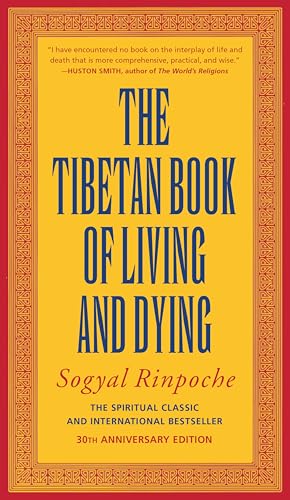
For centuries, human beings have tried to understand what happens at the moment of death. Long before modern medicine made it possible to revive people from the brink of death, spiritual traditions were already offering detailed descriptions of what lies beyond. Among the most profound of these is the Tibetan Book of the Dead, an ancient Buddhist text that serves as a guide for consciousness in the after-death state. At the same time, modern researchers such as Dr. Raymond Moody and Dr. Bruce Greyson have documented thousands of near-death experiences (NDEs), revealing consistent patterns reported by people across cultures and backgrounds.
At first glance, these two sources seem very different. One is a symbolic, religious text rooted in Tibetan Buddhism. The other is based on firsthand accounts from people who were clinically close to death and then returned. Yet when examined closely, both describe a surprisingly similar journey: a separation from the body, encounters with light, emotionally intense experiences, and a reality that appears shaped by one’s own mind.
The Tibetan text presents a structured map of the afterlife known as the “bardo,” a series of stages filled with visions, challenges, and opportunities for liberation. It teaches that these experiences are not external in the usual sense, but are projections of consciousness itself . Modern NDE reports, while often incomplete, echo many of these same themes – suggesting that people who come close to death may be entering the early phases of a process long described in spiritual traditions.
This article explores the deep parallels between these two perspectives. By comparing ancient teachings with modern experiences, we can begin to see how different cultures may be describing the same underlying phenomenon – one that challenges our assumptions about death, consciousness, and the nature of reality itself.
2. The Tibetan Book of the Dead
The Tibetan Book of the Dead, whose actual title is The Great Liberation upon Hearing in the Intermediate State or “Bardo Thodol“, is traditionally believed to be the work of the legendary Padmasambhava in the 8th century A.D. The book acts as a guide for the dead during the state that intervenes death and the next rebirth. He is considered to be one of the first persons to bring Buddhism to Tibet. The Bardo Thodol is a guide that is read aloud to the dead while they are in the state between death and reincarnation in order for them to recognize the nature of their mind and attain liberation from the cycle of rebirth.
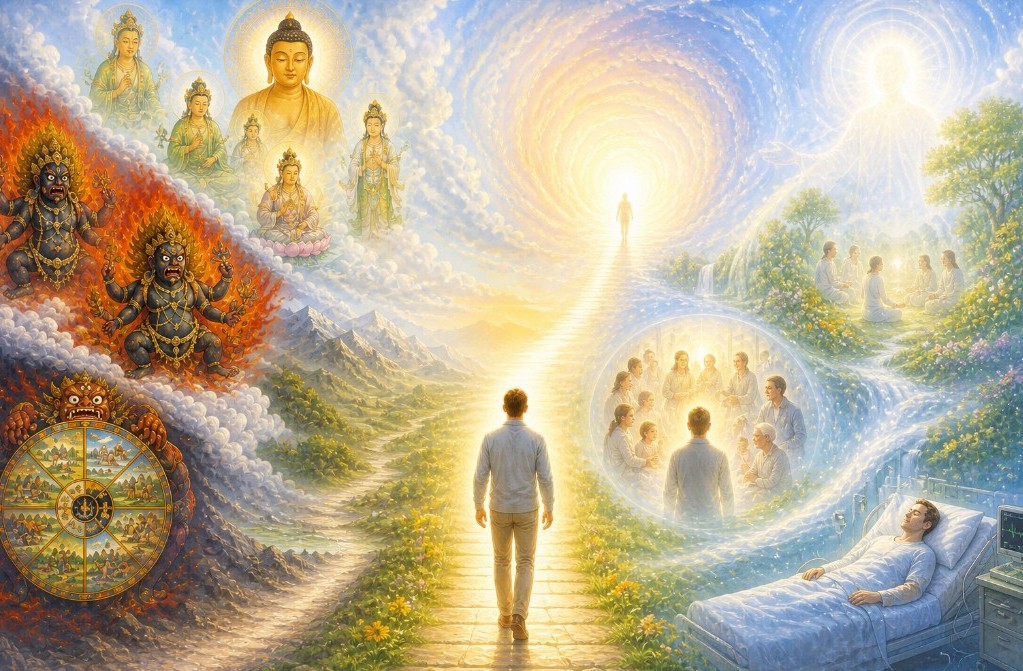
The Bardo Thodol teaches that once awareness is freed from the body, it creates its own reality as one would experience in a dream. This dream occurs in various phases (bardos) in ways both wonderful and terrifying. Overwhelming peaceful and wrathful visions and deities appear. Since the deceased’s awareness is in confusion of no longer being connected to a physical body, it needs help and guidance in order that enlightenment and liberation occurs. The Bardo Thodol teaches how we can attain Nirvana by recognizing the heavenly realms instead of entering into the lower realms where the cycle of birth and rebirth continue. The following is a description of the bardo realms that one travels through after death.
3. The First Bardo Afterlife Realm
The first bardo comes at the very moment of death, when there dawns the Clear Light of the Ultimate Reality. This is the very content and substance of the state of liberation, if only the soul can recognize it and act in a way to remain in that state. The instructions intended to be read at the moment of the person’s death are designed to help him do this. He is told, first of all, to embrace this supreme experience not in a selfish and egoistic way but rather with love and compassion for all sentient beings. This will aid him in the second step, which is to realize that his own mind and self is identical with the Clear Light, implying that he himself IS the Ultimate Reality, “the All-good Buddha”, transcending time, eternity, and all creation. If he can recognize this while in this supreme state at the moment of death, he will attain liberation — that is, he will remain in the Clear Light forever. This condition is called the “Dharmakaya“, the highest spiritual body of the Buddha.
Most souls, however, will fail to do this. They will be pulled down by the weight of their karma into the second stage of the first bardo, called the Secondary Clear Light seen immediately after death. At this point, there are separate instructions to be read according to the spiritual condition of the person while in life. For an individual advanced in meditation and other spiritual practices, there is repeated over and over the same instructions as at the moment of death, enjoining him to recognize himself as the Dharmakaya. For a person who was still at a student-level on the spiritual path, there is the injunction for him to meditate on his “tutelary deity“, that is, the particular god for whom he performed devotional practices while alive. Finally, “if the deceased be of the common folk”, unpracticed in any spiritual disciplines, the instruction is to “meditate upon the Great Compassionate Lord“, which is to say an “Avatar” worshiped by the multitude, equivalent to Jesus as conceived by the average Christian.
4. The Second Bardo Afterlife Realm
If the soul is still not liberated at this stage, it will descend into the second bardo, which is said to last for two weeks. The second bardo is also divided into two parts; in the first, the soul of the deceased encounters what are referred to as “the Peaceful Deities.” On each of the seven days, a particular Buddha-being will appear in radiance and glory, with a bevy of angelic attendants. At the same time, on each day in turn there will shine a light from one of the six worlds of the Buddhist universe, called “Lokas” (the basic meaning is “place”; our English words “location” and “locale” are derived from the same Sanskrit root).
On the first day of the second bardo, there appears to the soul the divine Father-Mother – that is, the supreme deity of the universe, transcending all dualities, including the division into sexes. The next step in the destiny of the soul is determined by his reaction to this God. If his life on Earth was well lived, he will now be in a state of purity and grace, and he will enter into the joy of the God and attain liberation. If on the other hand he has lived an ignoble and impious life, the effects of his bad karma will cause the intense radiant presence of the God to strike fear and terror in his heart, and he will be drawn instead to the softer light of the Deva-Loka, which has dawned along with this deity. This is still a fairly attractive fate, for the Devas are the Gods (or angels), and their Loka is equivalent to the Christian heaven; however, the Buddhist teaching is that even heaven is not the highest spiritual objective, because it is still only a temporary state in the manifest universe. Liberation is believed to be the only final and permanent resting-place for the soul, an un-manifest state beyond all existence.
On the second day, there appears the second-highest God in the Buddhist pantheon – in fact, he is actually the Second Person in the literal Buddhist Holy Trinity. At the same time, there dawns a smoky light from hell; and here we note that, just as the Buddhist heaven is not a permanent, eternal state, neither is its hell. Even the most wretched souls will eventually work their way out of even the deepest pit of hell, just as even the highest and purest souls will eventually lose their footing in heaven and descend again into the cycle of death and rebirth. Liberation is the only way out.
Once again, if the soul responds to the “dazzling white light” of the second God with the joy of a pure heart, he will be liberated thereby; but if he specifically reacts with anger from having indulged in this vice on Earth, he will recoil from the light in fear and be drawn into hell.
The pattern is repeated on the third day; this time it is the fault if egotism that will cause the soul to react to the God with fear, and he will be drawn to the human world, where his next incarnation will thereby take place. On the fourth day dawns the God of Eternal Life; if the soul has a negative reaction to him because of miserliness and attachment, he will be drawn toward rebirth in the Preta-Loka, a world of “hungry ghosts” who have huge stomachs and throats the size of pinholes, and so they wander about in a constant state of unsatisfied ravenous desire. On the fifth day comes God in the form of an Almighty Conqueror; this time it’s jealousy that will unseat the soul, and he will be born into the Asura-Loka, a world of fierce warrior-deities (or demons). On the sixth day all the deities return and dawn together, along with the lights from all six Lokas. On the seventh day there appear the Knowledge-Holding Deities, who are more fierce and demonic-looking than those that have previously dawned; and in fact they are sort of a transitional element to the next stage of the second bardo, where the soul encounters the wrathful deities. Meanwhile, if because of stupidity the soul cannot face the Knowledge-Holding Deities, he is drawn toward the Brute-Loka – that is, he will be reborn on Earth as an animal.
In the second week of the second bardo, the soul meets seven legions of Wrathful Deities: hideous, terrifying demons who advance upon him with flame and sword, drinking blood from human skulls, threatening to wreak unmerciful torture upon him, to maim, disembowel, decapitate and slay him. The natural tendency, of course, is for the soul to attempt to flee from these beings in stark, screaming, blood-curdled terror; but if he does, all is lost. The instructions at this stage of the Bardo are for the soul to have no fear, but rather to recognize that the Wrathful Deities are really the Peaceful Deities in disguise, their dark side manifesting as a result of his own evil karma. The soul is told to calmly face each demon in turn and visualize it as the deity it truly is, or else as his own tutelary deity; if he can do this, he will merge with the being and attain the second degree of Liberation, that lesser aspect of it which is now the best he can hope for here in the second bardo.
Furthermore, he is told to awaken to the fact that all these fearsome creatures are not real, but are merely illusions emanating from his own mind. If he can recognize this, they will vanish and he will be liberated. If he can’t, he eventually wanders down to the third bardo.
5. The Third Bardo Afterlife Realm
In the third bardo the soul encounters the Lord of Death, a fearsome demonic deity who appears in smoke and fire, and subjects the soul to a Judgment. If the dead person protests that he has done no evil, the Lord of Death holds up before him the Mirror of Karma, “wherein every good and evil act is vividly reflected.” Now demons approach and begin to inflict torments and punishments upon the soul for his evil deeds. The instructions in the Bardo Thodol are for him to attempt to recognize the Voidness of all these beings, including the Lord of Death himself; the dead person is told that this entire scene unfolding around him is a projection from his own mind. Even here he can attain liberation by recognizing this.
The soul who is still not liberated after the Judgment will now be drawn remorselessly toward rebirth.
The lights of the six Lokas will dawn again; into one of these worlds the soul must be born, and the light of the one he is destined for will shine more brightly than the others. The soul is still experiencing the frightening apparitions and sufferings of the third bardo, and he feels that he will do anything to escape from this condition. He will seek shelter in what appear to be caves or hiding-places, but which are actually the entrances to wombs. He is warned of this by the text of the Bardo Thodol, and urged not to enter them, but to meditate upon the Clear Light instead; for it is still possible for him to achieve the third degree of liberation and avoid rebirth.
Finally there comes a point where it is no longer possible to attain liberation, and after this the soul is given instructions on how to choose the best womb for a favorable incarnation. The basic method is non-attachment: to try to rise above both attraction to worldly pleasures and repulsion from worldly ills.
The final words of the Bardo Thodol are: “Let virtue and goodness be perfected in every way.”
6. Comparing the Tibetan Book of the Dead with NDEs
Long before modern medical resuscitation made NDEs widely reported, Tibetan Buddhist spiritual traditions were already mapping the terrain of dying. In recent decades, NDE researchers have documented thousands of NDEs. These modern accounts, while emerging from very different cultural contexts, show striking parallels with the ancient Tibetan text. Here we explore those parallels in depth – moving beyond surface similarities to examine how both traditions describe light, identity, judgment, fear, and transformation.
The Tibetan Vision of the After-Death State
The Tibetan Book of the Dead outlines an intermediate state between death and rebirth. It is not presented as a vague spiritual realm, but as a structured process. The Clear Light of Reality appears immediately after death. Peaceful deities emerge, representing enlightened aspects of mind. Wrathful deities follow, appearing terrifying but still mind-generated. Karmic visions arise, shaped by one’s past actions and habits. Rebirth impulses eventually pull consciousness back into a new life. The central teaching is radical: All experiences in the bardo are projections of one’s own consciousness. Recognition of this fact leads to liberation. Failure to recognize it leads to continued cycles of confusion and rebirth.
Modern NDE accounts follow a recurring – though not identical – pattern. A sense of leaving the physical body. Movement through darkness or a tunnel. Encounter with an intense, loving light or presence. A life review, often described as panoramic and immersive. Encounters with deceased relatives or spiritual beings. A decision or command to return to the body. Unlike the Tibetan system, NDEs are usually incomplete journeys. They appear to begin the process described in spiritual traditions—but do not reach its final stages.
The Encounter with Light
Perhaps the most striking similarity is the encounter with light.
In the Tibetan text, the Clear Light is described as the pure essence of reality – limitless, formless, and beyond individuality. It is not a being, but the ground of existence itself. In NDEs, experiencers frequently report encountering a Being of Light – radiant, intelligent, and deeply loving. This presence often communicates telepathically and conveys unconditional acceptance. At first glance, these seem different. One is impersonal; the other deeply personal. But the overlap is worth noting. Both are described as infinitely bright yet not blinding. Both evoke profound peace, clarity, and unity. Both seem to contain or reveal ultimate truth. A possible interpretation is that the same core phenomenon is being filtered through different cultural lenses. Buddhist practitioners interpret it as ultimate reality. NDErs interpret it as a loving presence or divine being.
The Life Review and Karmic Judgment
The Tibetan tradition does not describe a single “life review” in the modern sense. Instead, it emphasizes karma – the idea that one’s actions shape post-mortem experience. However, a deeper comparison reveals a strong functional similarity. In NDEs, the life review often includes reliving one’s actions, experiencing the emotional impact on others, and a sense of self-judgment, not external condemnation.
In the Tibetan model, one’s mental patterns and actions generate the visions encountered. There is no external judge – only the unfolding of one’s own mind. Fearful or peaceful experiences arise depending on one’s inner state.
In both systems, judgment is internal, experiential, and self-generated. This challenges traditional ideas of external reward and punishment, replacing them with a model of consciousness encountering itself.
Peaceful Versus Distressing Experiences
The Tibetan Book of the Dead famously describes peaceful and wrathful deities. Peaceful forms appear serene, luminous, and inviting. Wrathful forms appear terrifying, chaotic, and overwhelming. Yet both are said to be projections of the same underlying mind.
Modern NDE research reveals a similar pattern. Many people report blissful, heavenly experiences. Others report distressing or “hellish” NDEs involving fear, isolation, or darkness.
In both traditions, fear amplifies negative experiences. Recognition or surrender transforms the experiencer. A key insight emerges: What appears as “external reality” may reflect internal psychological and emotional states.
Thought-Responsive Reality
One of the most consistent features of NDEs is how responsive the environment is to thought. Movement occurs instantly by intention. Scenes shift based on expectation or emotion. Communication happens without speech.
This aligns closely with the Tibetan view in that the bardo is described as a mind-created realm. Thoughts immediately manifest as perceived reality. Habitual patterns determine what arises next.
Both suggest a fundamental shift: consciousness is not observing reality – it is participating in its creation.
The Role of Fear and Recognition
In the Tibetan text, the greatest danger is not punishment – it is misrecognition. If the Clear Light is recognized, liberation from reincarnation occurs. If it is feared or ignored, then there is a descent into more complex illusions.
Similarly, in NDEs, those who surrender often report peace and unity. Those who resist may experience confusion or distress.
This leads to a shared principle: awareness and acceptance determine the quality of the experience.
The Pull Back to Life Versus the Pull to Reincarnation
A major difference appears in how the experience ends. In NDEs, individuals are often told “it is not your time.” They return to their physical body.
In the Tibetan model, consciousness is drawn toward rebirth based on karmic tendencies.
However, the underlying mechanism may be similar. There is a pull toward embodiment; and a movement toward a new or existing physical form. The difference may lie not in the process – but in whether the transition is completed.
The Tibetan Book of the Dead and modern NDEs emerge from vastly different worlds – one ancient and symbolic, the other contemporary and experiential. Yet when placed side by side, they reveal a surprising convergence. Both describe: (1) a transition beyond the physical body; (2) encounters with light and powerful emotional states; (3) reality shaped by consciousness itself; and (4) the importance of awareness, recognition, and acceptance.
Where they differ, culture provides the language. Where they overlap, something deeper may be at work.
Taken together, they suggest that after death, human consciousness may enter a state that is structured, yet flexible, personal, yet universal, and are shaped by both mind and meaning. Whether interpreted as spiritual truth, psychological process, or something not yet fully understood, these parallels point to a profound possibility: the boundary between life and death may not be a sharp line – but a continuum of consciousness, experienced through the lens of who we are.
7. Tibetan NDErs Known as “Deloks”
In Tibetan culture, “deloks” refer to people who are believed to have died, journeyed into the afterlife, and then returned to life to share what they experienced. The word itself roughly means “one who has returned from death.” These accounts have been recorded for centuries and are closely tied to Tibetan Buddhist teachings about death, karma, and rebirth – especially those found in the Tibetan Book of the Dead.
Delok narratives follow a pattern that feels strikingly familiar when compared to modern NDEs, though they are shaped by Tibetan religious imagery and beliefs. A delok typically collapses or becomes unresponsive, sometimes appearing clinically dead for hours or even days. During this time, their consciousness is believed to leave the body. The delok travels through the bardo – a series of visionary states reflecting one’s own mind and karma. Many deloks report meeting spiritual figures, including peaceful and wrathful deities, as well as karmic judges. One commonly encountered figure is Yama, the Lord of Death, who reviews the individual’s life. Like modern NDEs, deloks often undergo a detailed life review. However, in Tibetan accounts, this process is frequently more formalized, involving judgments based on karmic deeds – both good and bad. Deloks may witness various realms – heavenly states, human rebirths, or hell-like conditions. These are not necessarily eternal destinations but temporary states shaped by karma. The delok is told – often by a spiritual authority – that it is not yet their time. They return to their body and revive, sometimes after several days.
Delok experiences are deeply rooted in Tibetan Buddhism. Unlike many modern Western NDEs, which are often interpreted in psychological or spiritual-but-not-religious ways, delok accounts are understood within a structured cosmology. The teachings of the Bardo Thodol play a central role in shaping how death and the afterlife are viewed. Delok stories often reinforce these teachings, serving both as spiritual testimony and moral instruction.
Delok Lingza Chokyi
Lingza Chokyi was a famous delok who lived in the sixteenth century. In her biography she tells how she failed to realize she was dead, how she found herself out of her body, and saw what she thought was a pig’s corpse lying on her bed, wearing her clothes. Frantically she tried in vain to communicate with her family as they set about the business of the practices for her death. She grew furious with them when they took no notice of her and did not give her a plate of food. When her children wept, she felt a “hail of pus and blood” fall, which caused her intense pain. She tells us she felt joy each time the practices were done, and immeasurable happiness when finally she came before the master who was practicing for her and who was resting in the nature of mind, and her mind and his became one. After a while she heard someone whom she thought was her father calling to her, and she followed him. She arrived in the bardo realm, which appeared to her like a country. From there, she tells us, there was a bridge that led to the hell realms, and to where the Lord of Death was counting the good or evil actions of the dead. In this realm she met various people who recounted their stories, and she saw a great yogin who had come into the hell realms in order to liberate beings.
Finally Lingza Chokyi was sent back to the world, as there had been an error concerning her name and family, and it was not yet her time to die. With the message from the Lord of Death to the living, she returned to her body and recovered, and spent the rest of her life telling of what she had learned. The phenomenon of the delok is not simply a historical one; it continued up until very recently in Tibet.
Delok Shro Lhamo
One of the most famous delok figures is Shro Lhamo, a woman who reportedly died and returned with vivid descriptions of the afterlife. Her account includes encounters with karmic judges, observations of suffering beings in lower realms, and messages urging ethical living and spiritual practice. Her story, like many delok accounts, was shared publicly to encourage compassion, moral behavior, and preparation for death.
For researchers and spiritual seekers alike, delok stories offer a compelling reminder: while the details of NDEs may differ, the core themes – transformation, moral reflection, and encounters with something beyond ordinary reality – appear again and again across human history.
8. Conclusion
When you compare the Tibetan Book of the Dead with modern NDEs, something really interesting stands out. Even though they come from very different cultures, times, and beliefs, they describe a very similar journey. In both, a person’s awareness leaves the body, goes through intense light and emotion, and moves through experiences shaped by the mind. This new state seems strongly affected by a person’s awareness, thoughts, and inner habits. The Tibetan teachings focus on recognizing what is happening and understanding its true nature. Modern NDE stories, even when they are incomplete, often show similar ideas through themes like letting go, accepting what happens, and going through personal change.
At the same time, the differences between the two shows how much culture matters. Culture helps shape how people understand and describe these experiences. Some talk about an impersonal “Clear Light,” while others describe a loving Being of Light. Some see karmic visions, while others have life reviews. Even so, the main parts of the experience point to a shared human encounter with something beyond normal reality.
In the end, these ideas push us to rethink what we believe about consciousness and its limits. They suggest that the line between life and death may not be fixed, but more like a smooth transition. Most importantly, they hint that how we live – our thoughts, actions, and awareness – could matter not just in life, but in whatever comes after.