This site uses affiliate links to Amazon.com Books for which IANDS can earn an affiliate commission if you click on those links and make purchases through them.
1. Introduction to Hindu Afterlife Beliefs
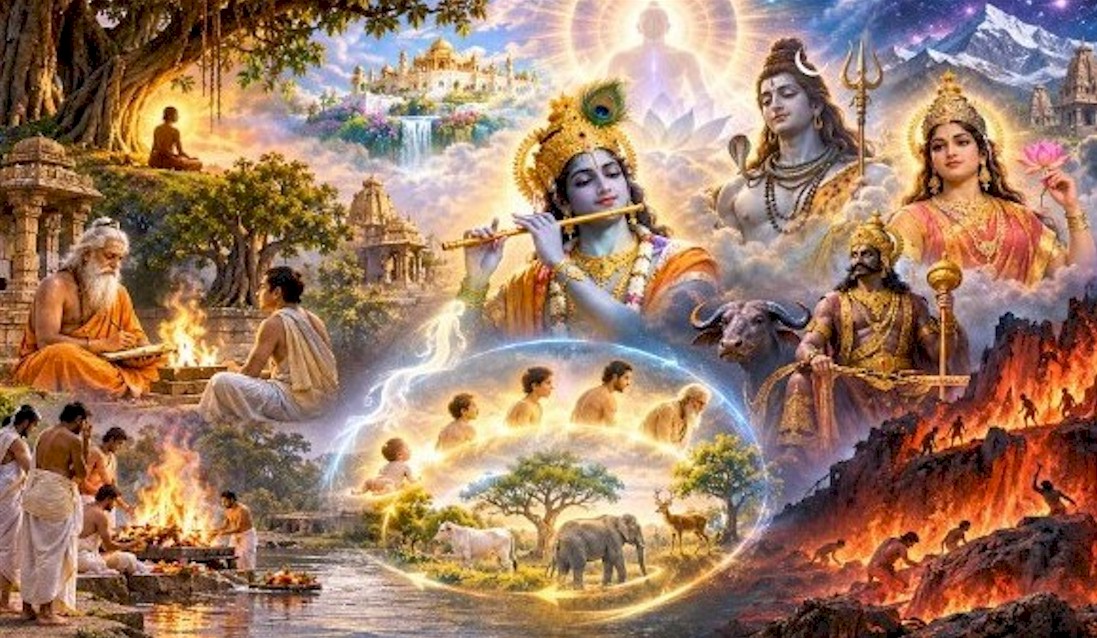
Hinduism possesses one of the world’s oldest and most sophisticated traditions concerning death, the soul, reincarnation, karma, liberation, and the ultimate destiny of human existence. Unlike religious traditions that emphasize a single earthly lifetime followed by eternal residence in Heaven or Hell, many Hindu traditions understand existence as a continuing cycle of birth, death, and rebirth known as samsara. This cycle is governed by karma, the moral and spiritual consequences of one’s actions, and can ultimately be transcended through moksha, liberation from rebirth.
Hindu afterlife beliefs have evolved over more than three thousand years, beginning with the funerary rituals and ancestral realms described in the Vedas, developing into the doctrines of reincarnation and liberation found in the Upanishads, and expanding through the philosophical systems, devotional movements, and sacred literature of classical and medieval Hinduism. These traditions have produced diverse interpretations of the soul’s journey, the nature of Heaven and Hell, the relationship between the individual self and ultimate reality, and the possibility of attaining eternal union or communion with the Divine.
Although Hinduism encompasses many schools of thought, several concepts have remained especially influential:
– Atman: The innermost self, understood in many Hindu traditions as eternal and distinct from the physical body.
– Brahman: The ultimate reality underlying existence, identified with the deepest self in some philosophical traditions.
– Samsara: The continuing cycle of birth, death, and rebirth.
– Karma: The principle that intentional actions produce consequences affecting present and future existence.
– Moksha: Liberation from samsara and the limitations of conditioned existence.
– Svarga: A heavenly realm of pleasure and reward, generally regarded as temporary rather than the ultimate spiritual destination.
– Naraka: A realm or condition of suffering associated with the consequences of harmful actions, generally understood as temporary in many Hindu traditions.
– Pitrloka: The realm of the ancestors, especially important in early Vedic religion and later ancestral rites.
The following timeline traces the historical development of Hindu afterlife beliefs from the Vedic period through contemporary Hindu spirituality, highlighting major scriptures, philosophers, religious movements, and changing understandings of what happens after death.
Historical note: Dates for ancient Indian texts are approximate and frequently disputed. Many scriptures developed through lengthy periods of oral transmission, compilation, and revision. Hindu traditions also preserve religious chronologies that differ from modern academic dating.
2. Early Vedic Period (c. 1500–1000 BCE): Death, Ancestors, and the Heavenly Realm
The earliest surviving Hindu religious literature, particularly the Rigveda, presents an understanding of death that differs considerably from the later Hindu doctrines of reincarnation and moksha. The early Vedic worldview emphasized the continuation of existence after death, the importance of proper funeral rituals, and the possibility of joining deceased ancestors in a heavenly realm. The dead were believed to travel along a path associated with Yama, an important figure who eventually became known as the lord of death and judge of departed souls.
Yama and the realm of the ancestors: In the Rigveda, Yama appears as a primordial mortal who discovered the path to the world beyond death. He became associated with the departed ancestors, known as Pitrs, who inhabited a realm where they could enjoy continued existence. Rigveda 10.14 describes the deceased traveling along the ancient paths taken by the ancestors and joining Yama in the world beyond. Funeral prayers invoke Yama and the ancestors, asking that the departed person receive a favorable destination. The afterlife described in these hymns is generally more positive than the later portrayals of Naraka. The righteous dead may experience reunion with their ancestors, freedom from earthly suffering, and enjoyment of divine blessings. The Rigveda also contains descriptions of heavenly existence associated with immortality, light, and fulfillment. In Rigveda 9.113, the poet seeks entrance into a realm where eternal light shines and where human desires are satisfied.
Funeral rituals and the transition after death: Cremation became an important feature of Vedic religious practice. Agni, the god of fire, was invoked to carry the deceased toward the ancestors and the divine realm. Rigveda 10.16 asks Agni to convey the departed person to the ancestors while treating the body appropriately. The hymn distinguishes between the physical remains and the continuing existence of the deceased. The early Vedic tradition also emphasized offerings to ancestors, establishing foundations for the later Hindu practice of shraddha, ceremonies intended to honor and support deceased family members.
Significance for Hindu afterlife history: The early Vedic period established several ideas that remained influential throughout Hindu history: death does not necessarily terminate personal existence, the departed may inhabit spiritual realms, rituals can assist the transition after death, and moral and religious conduct can influence one’s postmortem destiny. However, the fully developed doctrines of karmic reincarnation and liberation from samsara were not yet central features of the earliest Vedic hymns. Their systematic development occurred in subsequent centuries (Jamison & Brereton, 2014; Olivelle, 1998).
Primary sources: Rigveda 9.113, 10.14, 10.16, and 10.18.
3. Later Vedic and Brahmana Period (c. 1000–700 BCE): Ritual, Immortality, and the Destiny of the Dead
During the later Vedic period, religious thought became increasingly concerned with the relationship between sacrificial rituals, cosmic order, immortality, and the fate of the individual after death. Texts known as the Brahmanas expanded upon earlier Vedic hymns by explaining the symbolic and spiritual significance of sacrifices. Ritual performance was increasingly understood as a means of securing favorable conditions beyond earthly life.
Sacrifice and immortality: The Shatapatha Brahmana, one of the most important texts of this period, explores the connection between sacrifice, cosmic creation, and the possibility of overcoming death. The ritual sacrifice was understood as participating in the maintenance and renewal of the universe. Through proper religious action, individuals could seek heavenly rewards and a form of immortality. Yet this immortality was not necessarily identical to the later philosophical concept of moksha. Early ritual traditions often envisioned continued existence in a heavenly realm rather than complete liberation from the cycle of rebirth.
The emergence of questions about repeated death: Later Vedic literature also reveals growing anxiety about whether heavenly existence itself might be impermanent. The concept of punarmrityu, or repeated death, became significant in certain Brahmana and early Upanishadic discussions. The possibility that an individual could die again after reaching another realm raised profound questions about the permanence of ritual rewards. These questions helped prepare the intellectual foundation for the Upanishadic search for an existence beyond both birth and death.
Significance: The later Vedic period represents a transition from an emphasis on obtaining heavenly immortality through ritual toward the philosophical question of whether any condition within the cosmos can provide permanent freedom from death (Gonda, 1975; Olivelle, 1998).
Primary sources: Shatapatha Brahmana and other later Vedic ritual texts.
4. Early Upanishadic Period (c. 700–300 BCE): Reincarnation, Karma, and Liberation
The early Upanishads mark one of the most important turning points in the history of Hindu afterlife beliefs. Whereas earlier Vedic traditions emphasized heavenly existence and ancestral realms, the Upanishads increasingly explored the nature of consciousness, the eternal self, the consequences of actions, and liberation from repeated birth and death. The Brihadaranyaka Upanishad and Chandogya Upanishad, among the oldest principal Upanishads, contain foundational discussions of karma, rebirth, and the soul’s destiny.
The development of karma and reincarnation: The Brihadaranyaka Upanishad teaches that the condition of a person is shaped by actions and desires. In 4.4.5, the text associates a person’s future condition with conduct, desire, and intention. This passage helped establish the philosophical basis for the doctrine that one’s actions influence future existence. The Chandogya Upanishad 5.10 similarly describes different postmortem paths and the possibility of returning to earthly existence. According to this teaching, those whose conduct has been favorable may obtain favorable rebirths, while those whose conduct has been harmful may experience less desirable forms of existence. The significance of these teachings is considerable. Death is no longer understood simply as a passage into an ancestral or heavenly realm. Instead, it becomes one stage in a potentially recurring process of existence.
The two paths after death: The Chandogya Upanishad describes two major routes associated with the destiny of the deceased. The first is devayana, the path of the gods, associated with spiritual knowledge and a destination beyond ordinary return. The second is pitryana, the path of the ancestors, associated with ritual merit, heavenly experience, and eventual return to rebirth. These teachings suggest that heavenly existence, although desirable, is not necessarily permanent. The individual who follows the ancestral path may enjoy rewards and subsequently return to earthly life.
Atman and Brahman: One of the most influential developments of the Upanishadic period was the exploration of the relationship between Atman, the deepest self, and Brahman, ultimate reality. The Chandogya Upanishad famously declares tat tvam asi, commonly translated as “That thou art” (6.8.7). Within its philosophical context, this teaching identifies the deepest reality of the individual with the ultimate foundation of existence. Later Hindu philosophers interpreted this relationship differently. Advaita Vedanta emphasized the ultimate identity of Atman and Brahman, while other schools maintained distinctions between the individual soul and the Supreme Being.
The Katha Upanishad and the mystery of death: The Katha Upanishad presents a dialogue between Nachiketas, a young seeker, and Yama, the lord of death. Nachiketas asks whether a person continues to exist after death, a question that Yama initially describes as difficult even for the gods. The text ultimately teaches that the deepest self is not destroyed by physical death. In Katha Upanishad 1.2.18, the self is described as unborn and undying, unaffected by the destruction of the body. The dialogue also distinguishes temporary pleasures from enduring spiritual knowledge. Nachiketas rejects worldly rewards and seeks the knowledge that leads beyond death.
Moksha as the ultimate goal: The Upanishads increasingly identify liberation from rebirth as the highest spiritual achievement. Rather than seeking temporary residence in heaven, the spiritual aspirant seeks realization of the eternal self and freedom from the conditions that perpetuate samsara. This transformation represents one of the defining developments in Hindu religious history (Olivelle, 1998; Flood, 1996).
Primary sources: Brihadaranyaka Upanishad 4.4; Chandogya Upanishad 5.10 and 6.8; Katha Upanishad 1–2.
5. The Age of Asceticism and Philosophical Development (c. 600–200 BCE): Escaping the Cycle of Rebirth
During the middle of the first millennium BCE, Indian religious thought underwent a profound transformation. Ascetic movements challenged the assumption that ritual sacrifices alone could provide the highest spiritual achievement. These movements included early Buddhist, Jain, and other renunciant traditions, which developed alongside Brahmanical and Upanishadic teachings. Their interactions contributed to increasingly sophisticated theories of karma, rebirth, consciousness, and liberation.
Samsara as a problem to be overcome: In earlier Vedic traditions, continued existence after death was frequently regarded as desirable. In many ascetic traditions, however, repeated existence came to be understood as a condition involving suffering, impermanence, and attachment. The central religious question changed from how to obtain a favorable afterlife to how to escape the cycle of birth and death altogether. The human condition was increasingly understood as involving repeated experiences of birth, aging, disease, death, and renewed existence. Even heavenly pleasures could not provide permanent liberation if they remained subject to change.
Different paths toward liberation: Several approaches to liberation developed during this period. The pursuit of knowledge emphasized discovering the true nature of the self and reality. Ascetic disciplines sought to overcome attachment to bodily desires. Meditation aimed to transform consciousness, while ethical conduct helped prevent the accumulation of harmful karma. These approaches were not identical, and their philosophical foundations often differed. Nevertheless, they contributed to the growing importance of liberation as the highest spiritual goal.
Hinduism, Buddhism, and Jainism: Although these traditions shared concepts such as karma and rebirth, they disagreed about what continues after death. Many Hindu philosophical traditions affirmed an enduring self or soul. Buddhism generally rejected the existence of a permanent, unchanging self, while Jainism taught the existence of individual eternal souls bound by karmic matter. The historical relationship between these traditions remains debated. Some scholars emphasize the development of rebirth theories within non-Vedic ascetic cultures, while others stress their continuity with earlier Vedic ideas. Modern scholarship therefore cautions against presenting reincarnation as a doctrine that emerged suddenly from a single scripture or religious movement (Bronkhorst, 2007; Obeyesekere, 2002; Doniger O’Flaherty, 1980).
Significance: By the end of this period, karma, samsara, and liberation had become central subjects of Indian religious philosophy.
6. The Bhagavad Gita and Epic Period (c. 400 BCE–400 CE): The Immortal Soul and Divine Liberation
The Bhagavad Gita, incorporated into the Mahabharata, became one of Hinduism’s most influential scriptures concerning the soul, death, rebirth, and liberation. Its teachings appear in a dialogue between Krishna and the warrior Arjuna, who faces a profound moral and spiritual crisis before a great battle. Krishna explains that the physical body is temporary, while the deepest self cannot be destroyed by death.
The soul changes bodies: In Bhagavad Gita 2.22, Krishna compares the soul’s transition between bodies to a person changing worn-out clothing. The analogy expresses a central Hindu teaching: physical death is not the destruction of the enduring self but a transition from one bodily existence to another. In 2.20, Krishna teaches that the self is not born and does not die. In 2.23–24, he describes it as beyond destruction by weapons, fire, water, or wind. These passages became foundational for later Hindu interpretations of immortality.
Karma and the circumstances of rebirth: The Bhagavad Gita teaches that actions, desires, and the condition of consciousness influence future existence. Chapter 14 describes the three gunas, or qualities of material nature: sattva (clarity and harmony), rajas (activity and passion), and tamas (inertia and ignorance). These qualities influence behavior and spiritual development, and the text associates their predominance with different postmortem outcomes. In 14.14–15, those dominated by sattva are described as attaining higher realms, while those dominated by rajas or tamas experience other forms of rebirth.
The state of consciousness at death: In 8.5–6, Krishna teaches that the state of consciousness at death influences the soul’s destination. The text emphasizes that remembering the Divine at death can lead to union or communion with the Supreme. This teaching contributed to later Hindu devotional practices involving sacred names, mantras, prayer, and remembrance of God during the dying process.
Heaven is not the final destination: The Bhagavad Gita distinguishes temporary heavenly rewards from permanent liberation. In 9.20–21, Krishna explains that those who obtain heavenly enjoyment through religious merit eventually return to mortal existence when their merit is exhausted. Thus, even Svarga, the heavenly realm, remains within samsara. The highest spiritual goal is not temporary happiness in heaven but liberation from repeated birth and death.
Paths to liberation: The Bhagavad Gita integrates several major spiritual disciplines: karma yoga, the path of selfless action; jnana yoga, the path of spiritual knowledge; and bhakti yoga, the path of devotion to God. Rather than treating these as entirely incompatible, the text presents an integrated vision of spiritual life. Krishna promises that those who attain the Supreme do not return to the temporary world of suffering (8.15–16). The Bhagavad Gita therefore helped establish a comprehensive understanding of the afterlife in which reincarnation is governed by karma, heavenly rewards are temporary, and liberation is possible through spiritual realization and devotion (Flood, 1996; Zaehner, 1969).
Primary sources: Bhagavad Gita 2.13, 2.20–24, 8.5–16, 9.20–21, and 14.14–15.
7. Classical Hindu Philosophy (c. 200 BCE–600 CE): The Soul, Subtle Body, and Liberation
As Hindu philosophical traditions developed into increasingly systematic schools, the question of what survives death became a major subject of debate. Different schools accepted different explanations of the self, consciousness, karma, and liberation. Although many agreed that ordinary existence involves rebirth, they disagreed about the nature of the entity that reincarnates and the final state of liberation.
Samkhya – Liberation through discrimination: The Samkhya school distinguishes between Purusha, pure consciousness, and Prakriti, material nature. According to classical Samkhya, suffering and bondage arise because consciousness is mistakenly identified with material and psychological processes. The individual continues through samsara because of ignorance and the continuing activity of material nature. Liberation, known as kaivalya, occurs when pure consciousness is recognized as distinct from Prakriti. This state is not ordinarily described as residence in a heavenly realm or union with a personal deity. Instead, it represents complete freedom from identification with material existence.
Yoga – Liberation through spiritual discipline: The Yoga tradition associated with Patanjali developed a systematic approach to meditation, ethical discipline, concentration, and liberation. The Yoga Sutras describe karmic impressions that influence future experiences and rebirth. In 2.12–13, the text associates karmic residues with the conditions of future existence. Through disciplined meditation and the cessation of mental fluctuations, the practitioner seeks liberation from the processes that sustain bondage. Like Samkhya, classical Yoga identifies liberation with the freedom of consciousness from material entanglement.
Nyaya and Vaisheshika: The enduring individual self: The Nyaya and Vaisheshika schools developed philosophical arguments for the existence of enduring individual selves. They maintained that the self continues beyond bodily death and experiences the consequences of karma. Liberation was commonly described as freedom from suffering and the conditions producing rebirth, although the exact nature of liberated existence became a subject of philosophical debate.
Mimamsa – Ritual action and heavenly reward: The Purva Mimamsa tradition emphasized the authority of the Vedas and the significance of ritual action. Early Mimamsa thought devoted considerable attention to the relationship between sacrificial duties and their consequences, including heavenly rewards. Later Mimamsa thinkers also engaged with broader Hindu discussions of karma, rebirth, and liberation.
Vedanta – The relationship between the soul and ultimate reality: The Brahma Sutras, whose composition and dating remain debated, organized philosophical interpretations of the Upanishads. They became a foundational text for later Vedanta schools. One important question concerned the relationship between the individual soul and Brahman. Another concerned the manner in which the soul leaves the body, experiences the consequences of karma, and attains liberation. Later Vedanta philosophers developed different explanations of these questions, giving rise to some of Hinduism’s most influential afterlife doctrines (Flood, 1996; Potter, 1981; Medhananda, 2025).
Primary sources: Samkhya Karika; Yoga Sutras 2.12–13 and 4.7–11; Brahma Sutras, especially Book 3.
8. The Puranic Period (c. 300–1200 CE): Heaven, Hell, Yama, and the Journey After Death
During the first millennium CE, Hindu sacred literature increasingly developed elaborate descriptions of the afterlife. The Puranas, a large collection of religious narratives and teachings composed and revised over many centuries, expanded earlier concepts of karma and rebirth into detailed accounts of heavenly worlds, hellish realms, divine judgment, cosmic cycles, and the soul’s journey after death. These texts helped make complex philosophical doctrines accessible through stories, rituals, and vivid religious imagery.
Yama as the judge of the dead: In many Puranic traditions, Yama appears as the ruler responsible for administering the consequences of karma. The deceased may be brought before Yama’s court, where their earthly conduct is evaluated. Chitragupta, a figure associated with Yama, is frequently described as maintaining records of human actions. The purpose of these accounts is to emphasize moral accountability. Actions performed during earthly life have consequences beyond physical death.
Naraka – The Hindu hells: Puranic literature describes multiple hellish realms collectively called Naraka. The Bhagavata Purana, particularly 5.26, describes numerous hells associated with different forms of wrongdoing. These include punishments corresponding to cruelty, dishonesty, exploitation, violence, and other harmful actions. Unlike the eternal Hell taught in some religious traditions, Naraka is commonly understood in Hindu literature as a temporary condition in which the consequences of harmful karma are experienced. After those consequences have been exhausted, the individual may return to the cycle of rebirth. Descriptions vary considerably among texts, and not all Hindus interpret these realms literally.
Svarga and the heavenly worlds: Puranic cosmology also describes heavenly realms inhabited by gods, celestial beings, and spiritually meritorious individuals. Svarga is often associated with Indra and is portrayed as a realm of extraordinary pleasure, beauty, and enjoyment. Yet heavenly existence remains subject to impermanence. The individual may eventually return to earthly existence when the karma supporting residence in heaven has been exhausted. This distinction between temporary heaven and permanent liberation became a major characteristic of classical Hindu afterlife teachings.
The Garuda Purana and the journey of the deceased: The Garuda Purana, especially its Preta-khanda or Pretakalpa material in certain recensions, contains some of Hinduism’s most detailed descriptions of death and the postmortem journey. The text portrays the departed soul passing through an intermediate condition and encountering various experiences connected with its karma. Some accounts describe a difficult journey toward Yama’s realm, encounters with supernatural beings, and the importance of offerings performed by surviving relatives. The Garuda Purana also explains funeral observances and rituals intended to assist the deceased. The dating of its individual sections is uncertain, and its funeral-related materials underwent substantial development. Consequently, its descriptions should not be treated as a single, universally accepted Hindu doctrine originating at one particular date.
The preta state: In many Hindu traditions, a recently deceased person may be described as a preta, a departed being who has not yet completed the transition into the ancestral condition. Funeral ceremonies and offerings help mark and ritually facilitate this transition. The concept of preta became particularly important in the religious understanding of death rituals and the relationship between living family members and deceased ancestors.
The cosmic cycle of creation and destruction: Puranic cosmology also places individual death within immense cycles of cosmic creation, preservation, and dissolution. The universe undergoes recurring periods of manifestation and withdrawal, commonly associated with the concept of pralaya. These cosmic cycles reinforce the idea that even heavenly realms and divine worlds are part of a changing universe. Liberation is therefore distinguished from ordinary existence within the cosmic cycle, however exalted that existence may be (Doniger, 2014; Flood, 1996; Knipe, 1977).
Primary sources: Garuda Purana, Preta-khanda; Bhagavata Purana 3.30 and 5.26; Vishnu Purana, especially Book 6.
9. Hindu Funeral and Ancestral Traditions (c. 300–1200 CE, with Earlier Origins): Helping the Departed Soul
Alongside philosophical and mythological developments, Hinduism preserved an extensive tradition of rituals surrounding death. These practices draw on Vedic funeral customs, domestic ritual manuals, Dharma literature, and later Puranic teachings.
Antyeshti – The final rites: Antyeshti, meaning the final sacrifice or last rites, refers to Hindu funeral ceremonies. Cremation is customary in many Hindu communities, although burial is practiced in certain circumstances and traditions. Fire possesses profound religious significance because of its association with purification, transformation, and the transition between earthly and spiritual existence. Funeral rituals commonly include prayers, offerings, and the recitation of sacred texts or divine names. The precise procedures vary according to region, caste, sect, family tradition, and historical period.
Shraddha and offerings to ancestors: Shraddha ceremonies honor deceased ancestors and express the continuing responsibilities of the living toward the dead. These rituals often include offerings of food, water, and symbolic substances. Pinda-dana, the offering of rice balls or similar food preparations, is especially important in many traditions. Such offerings are understood in different ways: as assisting the deceased in the postmortem transition, sustaining the relationship between generations, or fulfilling sacred obligations to ancestors.
The first days after death: Many Hindu communities observe a sequence of mourning and ritual ceremonies during the days following death. Ten-day, eleven-day, twelfth-day, or thirteenth-day observances occur in different traditions. Some ritual systems describe the recently deceased as undergoing a transitional process before becoming established among the ancestors. However, Hinduism does not teach one universally standardized timetable for the soul’s journey.
Pitru Paksha: Pitru Paksha, an annual period devoted to honoring ancestors, reflects the enduring importance of the relationship between the living and the dead. During this observance, families may perform offerings and prayers for deceased relatives. The continuing significance of ancestral rites demonstrates that Hindu afterlife beliefs are not concerned exclusively with individual liberation. They also encompass family relationships, remembrance, gratitude, and obligations extending beyond physical death (Knipe, 1977; Sayers, 2013).
Primary sources: Vedic funeral hymns, Grihya Sutras, Garuda Purana, and relevant Dharma literature.
10. Advaita Vedanta and Adi Shankara (c. 8th Century CE): Liberation Through Realization of Brahman
One of the most influential developments in Hindu philosophy occurred through the teachings of Adi Shankara, traditionally dated to the eighth century CE, although his precise dates remain disputed. Shankara systematized Advaita Vedanta, a nondualistic interpretation of the Upanishads, the Bhagavad Gita, and the Brahma Sutras. His philosophy profoundly influenced Hindu understandings of consciousness, the soul, death, and ultimate liberation.
The identity of Atman and Brahman: Advaita Vedanta teaches that the deepest self, Atman, is ultimately identical with Brahman, the absolute reality underlying all existence. According to this philosophy, ordinary human beings mistakenly identify themselves with the physical body, personality, thoughts, and individual experiences. This mistaken identification arises from avidya, or ignorance of ultimate reality. Because individuals misunderstand their true nature, they experience themselves as separate beings subject to birth, death, suffering, and rebirth.
Reincarnation and the subtle body: Advaita distinguishes between the physical body and the subtle body, which includes the mind, senses, and psychological dispositions. At physical death, the subtle body associated with the individual continues according to the consequences of karma. The individual subsequently experiences another embodiment unless liberation has been attained. However, Advaita makes an important distinction between the empirical individual and ultimate reality. From the standpoint of ordinary experience, reincarnation occurs. From the standpoint of ultimate truth, Atman is never born, never dies, and never undergoes transformation.
Liberation as the end of ignorance: For Shankara, moksha is not primarily a journey to another location after death. It is the realization that one’s deepest nature has always been Brahman. The liberated person recognizes that the apparent separation between individual consciousness and ultimate reality is based upon ignorance. This realization can occur while a person is still physically alive. The state of liberation during earthly life is known as jivanmukti. After the death of a fully liberated individual, the distinction between the individual self and Brahman no longer persists in the ordinary sense. This condition is sometimes called videhamukti, liberation beyond embodiment. Advaita therefore offers a radically different interpretation of the afterlife from traditions emphasizing eternal residence in a heavenly realm. Its ultimate goal is realization of the timeless reality that transcends birth, death, and individuality as ordinarily understood (Deutsch, 1969; Flood, 1996).
Primary sources: Shankara’s commentaries on the Brahma Sutras, principal Upanishads, and Bhagavad Gita.
11. Ramanuja and Vishishtadvaita Vedanta (c. 11th–12th Centuries CE): Eternal Communion With God
Ramanuja (traditionally 1017–1137 CE) developed one of the most influential devotional interpretations of Vedanta. His philosophy, known as Vishishtadvaita or qualified nondualism, emphasizes the intimate relationship between individual souls and the Supreme Being, identified with Vishnu or Narayana. Unlike Advaita, which teaches the ultimate identity of Atman and Brahman, Ramanuja maintained that individual souls remain real and distinct, even while existing in complete dependence upon God.
The eternal individuality of the soul: Ramanuja taught that individual souls are eternal and conscious. Their bondage within samsara results from beginningless karma and ignorance. Through spiritual knowledge, devotion, and divine grace, the soul can attain liberation. However, liberation does not require the disappearance of individual identity. Instead, the liberated soul enters a state of perfect communion with God.
Vaikuntha – The eternal divine realm: In Sri Vaishnava theology, the liberated soul attains Vaikuntha, the transcendent abode of Vishnu. Vaikuntha is not equivalent to the temporary heavenly realms associated with ordinary religious merit. It is understood as an eternal divine realm beyond the cycle of birth and death. The liberated soul experiences divine presence, spiritual fulfillment, and loving service to God.
Divine grace and surrender: Ramanuja’s tradition emphasizes bhakti, loving devotion, and prapatti, surrender to God. Liberation depends not merely on intellectual understanding but also on the transformative relationship between the soul and the Divine. The development of this tradition established a major alternative to Advaita’s nondual understanding of liberation. For many devotional Hindus, the highest destiny is not the dissolution of individuality but everlasting loving communion with the Supreme Being (Carman, 1974; Lipner, 1986).
Primary sources: Ramanuja’s Sri Bhashya, Vedartha Sangraha, and Bhagavad Gita Bhashya.
12. Madhva and Dvaita Vedanta (13th Century CE): Eternal Distinction Between God and Souls
Madhva (traditionally c. 1238–1317 CE) developed Dvaita Vedanta, a dualistic school of Hindu philosophy. Madhva taught that God, individual souls, and the material universe are genuinely distinct realities. His theology emphasizes the absolute supremacy of Vishnu and the dependence of all souls upon God.
Individual souls remain distinct: According to Madhva, the soul does not become identical with Brahman after liberation. Instead, the liberated soul retains its individual identity and experiences the presence and bliss of Vishnu. The ultimate spiritual destiny is eternal devotion and communion with God.
Different spiritual destinies: A distinctive and controversial feature of Madhva’s philosophy is his classification of souls according to their ultimate destinies. His theological system distinguishes souls eligible for liberation, souls destined for continued transmigration, and souls destined for enduring darkness or suffering. This teaching differs from the widespread Hindu understanding that all souls may eventually attain liberation. Consequently, it would be inaccurate to claim that Hinduism universally teaches that every soul will ultimately achieve moksha.
Significance: Madhva’s philosophy demonstrates the considerable diversity within Hindu afterlife beliefs. Although Advaita, Vishishtadvaita, and Dvaita all accept karma, rebirth, and liberation, they offer significantly different explanations of the soul’s final relationship with God (Sarma, 2003; Flood, 1996).
Primary sources: Madhva’s Brahma Sutra Bhashya and Anuvyakhyana.
13. Medieval Bhakti Movements (c. 12th–17th Centuries): Divine Love as the Path Beyond Death
During the medieval period, devotional movements expanded throughout India, emphasizing personal relationships with God, the chanting of divine names, and the possibility of liberation through love and surrender. These movements drew upon earlier devotional traditions and included worship of Vishnu, Krishna, Rama, Shiva, and the Divine Mother. Important figures included Basava, Ramananda, Kabir, Mirabai, Surdas, Tulsidas, and Chaitanya Mahaprabhu.
Devotion and the afterlife: Many bhakti teachers emphasized that spiritual liberation was available through sincere devotion rather than ritual expertise or philosophical learning alone. The remembrance of God became particularly important in teachings concerning death. For devotees of Krishna or Rama, chanting the divine name was understood as a means of directing consciousness toward God. This teaching developed themes already present in the Bhagavad Gita, particularly the importance of remembering the Divine at death.
Krishna and Goloka: In several Krishna-centered Vaishnava traditions, the highest spiritual destination is Goloka, the eternal abode of Krishna. Goloka is portrayed as a realm of divine love, spiritual beauty, and intimate relationship with Krishna. In Gaudiya Vaishnavism, associated with Chaitanya Mahaprabhu (1486–1533), the highest spiritual fulfillment involves loving participation in Krishna’s eternal divine activities. The liberated soul does not simply disappear into an impersonal absolute. Instead, the soul experiences an eternal loving relationship with Krishna.
Shiva and liberation: Shaiva traditions developed their own understandings of liberation. Some emphasize the realization of one’s identity with Shiva, while others maintain a distinction between the individual soul and the Supreme Lord. Shaiva Siddhanta, especially influential in southern India, teaches that the soul is bound by impurities and karma and can attain liberation through Shiva’s grace. Liberation involves the removal of spiritual bondage and the realization of divine consciousness.
Shakta traditions: Shakta Hinduism identifies the Divine Mother, or Shakti, as supreme reality. Depending upon the tradition, liberation may involve realizing one’s identity with the Divine Goddess, attaining her presence, or transcending the limitations of ordinary consciousness through her grace. These traditions demonstrate that Hindu understandings of the afterlife cannot be reduced to one concept of heaven, reincarnation, or union with Brahman.
Significance: The medieval devotional movements helped make liberation an intensely personal religious goal. For many Hindus, the ultimate destiny of the soul became inseparable from love, devotion, divine grace, and the possibility of eternal relationship with a beloved deity (Hawley, 2015; Bryant, 2007).
Primary sources: Bhagavata Purana Book 10; Ramcharitmanas; Chaitanya Charitamrita; selected Shaiva and Shakta scriptures.
14. Tantra and Subtle-Body Traditions (c. 6th–17th Centuries): Consciousness, Spiritual Transformation, and Liberation
Tantric traditions developed across Hinduism, Buddhism, and other Indian religious movements. Within Hinduism, Tantra became especially influential in Shaiva and Shakta traditions. Tantric literature frequently explores the relationship between the physical body, subtle energies, consciousness, cosmic reality, and spiritual liberation.
The subtle body: Many Tantric and Yoga traditions describe a subtle dimension of human existence involving prana, vital energy; nadis, channels of subtle energy; and chakras, centers associated with spiritual transformation. These concepts are not identical across traditions, and their relationship to postmortem existence varies. Some teachings describe the subtle body as participating in the processes of karma and rebirth. Others focus primarily on transforming consciousness during earthly life.
Kundalini and spiritual awakening: In Kundalini-oriented traditions, spiritual awakening involves the transformation or ascent of divine energy within the practitioner. This process is often associated with expanded consciousness, profound spiritual realization, and liberation from ordinary limitations. The ultimate goal is not necessarily a postmortem journey through spiritual realms. In many nondual Shaiva and Shakta traditions, liberation involves recognizing that one’s consciousness is inseparable from divine consciousness.
Liberation while living: Tantric traditions frequently emphasize the possibility of attaining liberation during physical existence. This is important because it shifts the meaning of salvation away from an exclusively postmortem destination. The individual may realize ultimate reality while continuing to live in the world.
Death and spiritual practice: Certain Tantric traditions also employ practices involving cremation grounds, contemplation of mortality, and the recognition of consciousness beyond bodily identity. These practices are intended to overcome fear, attachment, and ignorance. Although some Hindu Tantric teachings concern postmortem states, it would be misleading to assume that all Hindu Tantric systems teach the detailed intermediate-state doctrines associated with Tibetan Buddhism. The traditions developed differently and contain distinct theological and ritual frameworks (Flood, 2006; White, 2000).
Primary sources: Selected Agamas, Tantras, and Kashmir Shaiva philosophical works.
15. Early Modern Hinduism (c. 16th–18th Centuries): Continuing Traditions of Rebirth, Devotion, and Liberation
During the early modern period, Hindu religious traditions continued to develop through regional devotional communities, temple worship, philosophical commentary, and the transmission of sacred literature. Rather than replacing earlier afterlife beliefs, these movements often combined Vedic, Upanishadic, Puranic, and devotional teachings.
Reincarnation and moral responsibility: Karma and rebirth remained central concepts in many Hindu communities. The circumstances of earthly existence were frequently interpreted within a larger moral and spiritual framework extending across multiple lifetimes. However, Hindu thinkers differed in how strongly they emphasized past-life karma as an explanation for present suffering. Many traditions also emphasized personal effort, divine grace, social duty, and the possibility of spiritual transformation within the present lifetime.
Regional devotional traditions: The religious literature of this period continued to celebrate liberation through devotion to Krishna, Rama, Shiva, and the Goddess. In many communities, the ideal afterlife involved reaching the divine abode of a chosen deity. Other traditions emphasized spiritual realization, freedom from ignorance, or participation in divine consciousness.
Funeral and ancestral practices: Traditional cremation ceremonies, ancestral offerings, and observances for the deceased continued to occupy an important place in Hindu religious life. These practices preserved elements of early Vedic religion even as philosophical interpretations of the afterlife became increasingly elaborate. The coexistence of ancient rituals and later theological doctrines remains one of Hinduism’s most distinctive historical characteristics (Flood, 1996; Hawley, 2015).
16. Nineteenth-Century Hindu Reform and the Bengal Renaissance (c. 1800–1900): Reinterpreting Immortality and Reincarnation
During the nineteenth century, Hindu religious thinkers encountered new intellectual challenges arising from British colonialism, Western philosophy, Christianity, modern science, and social reform. These encounters encouraged renewed interpretations of Hindu scriptures and the relationship between spiritual truth and religious tradition.
Ramakrishna (1836–1886): Ramakrishna emphasized direct spiritual experience and the realization of God through multiple religious paths. His teachings frequently employed the imagery of divine realization, spiritual transformation, and the relationship between individual consciousness and ultimate reality. Ramakrishna’s mystical experiences were interpreted by his followers as evidence that spiritual truth could be directly realized rather than merely accepted through scripture. He described different spiritual relationships with the Divine, including devotional dualism and nondual realization. His teachings therefore allowed for multiple ways of understanding liberation.
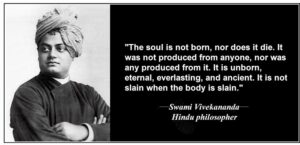
Swami Vivekananda (1863–1902): Vivekananda, a disciple of Ramakrishna, introduced Vedanta and Yoga to large international audiences. He strongly emphasized the immortality of the soul, karma, reincarnation, and the spiritual unity of humanity. Vivekananda interpreted reincarnation as part of a rational moral universe in which individuals experience the consequences of their actions and continue their spiritual development. He rejected the idea that the individual is fundamentally limited to the physical body. For Vivekananda, the deepest spiritual goal was the realization of the divine nature of the self. His interpretation of Vedanta helped establish reincarnation and spiritual liberation as prominent subjects in Western discussions of Hindu philosophy.
Dayananda Saraswati (1824–1883): Dayananda Saraswati, founder of the Arya Samaj, emphasized a return to Vedic authority. He accepted the immortality of individual souls, karma, and reincarnation. However, his understanding of liberation differed from that of many other Hindu traditions. Dayananda maintained that liberated souls could eventually return to embodied existence after an immensely long period of liberation. This position illustrates that even the permanence of moksha has not been understood identically by all Hindu thinkers.
Significance: Nineteenth-century Hindu reformers helped transform ancient afterlife doctrines into subjects of modern philosophical, ethical, and comparative religious discussion. Reincarnation was increasingly presented not merely as a traditional belief but as an explanation of moral continuity, human development, and the enduring nature of consciousness (Halbfass, 1988; King, 1999).
17. Twentieth-Century Hindu Spirituality (1900–2000): Universal Consciousness, Reincarnation, and Spiritual Evolution
During the twentieth century, Hindu ideas about death and the afterlife became increasingly influential beyond India. Teachers associated with Vedanta, Yoga, devotional Hinduism, and modern spiritual movements introduced reincarnation, karma, meditation, and liberation to international audiences.
Sri Aurobindo (1872–1950) – Rebirth and the evolution of consciousness: Sri Aurobindo developed an evolutionary interpretation of spiritual existence. He understood earthly life as part of a larger process through which consciousness progressively manifests and develops. In his writings, rebirth provides a framework for the soul’s continuing spiritual growth. Aurobindo’s concept of the psychic being describes an evolving spiritual individuality that develops through successive lives. His teachings differ from interpretations that regard earthly existence primarily as a condition to be escaped. Instead, spiritual evolution may involve the transformation of earthly life itself. In The Life Divine, Aurobindo explores the relationship between rebirth, spiritual evolution, and the manifestation of divine consciousness.
Ramana Maharshi (1879–1950) – Discovering the deathless self: Ramana Maharshi became known for his teachings on self-inquiry and the question “Who am I?” As a young man, he underwent an intense experience involving the fear of death. He later described realizing that the deepest self was not identical with the physical body and therefore could not be destroyed by bodily death. His teachings emphasize that the ultimate solution to the problem of death is not discovering what happens to the personality after death. Instead, it is realizing the true nature of the consciousness to which birth and death appear. Ramana’s interpretation closely resembles the nondual understanding of liberation associated with Advaita Vedanta.
Paramahansa Yogananda (1893–1952) – The soul’s journey and spiritual worlds: Paramahansa Yogananda introduced Kriya Yoga and Hindu spiritual teachings to large Western audiences. His Autobiography of a Yogi (1946) contains accounts of spiritual experiences, reincarnation, and the existence of nonphysical realms. One particularly influential chapter, “The Resurrection of Sri Yukteswar,” describes an encounter in which Yogananda’s deceased guru explains the existence of astral and causal worlds. According to this account, souls may inhabit subtle realms after physical death and continue their spiritual development. Yogananda describes a hierarchy of physical, astral, and causal existence, with liberation involving transcendence of the limitations associated with these levels. These descriptions represent Yogananda’s particular spiritual teachings and reported experiences, not doctrines accepted uniformly throughout Hinduism.
The continuing importance of bhakti: Twentieth-century devotional movements also emphasized the eternal relationship between the soul and God. The International Society for Krishna Consciousness (ISKCON), founded by A. C. Bhaktivedanta Swami Prabhupada in 1966, promoted teachings from the Bhagavad Gita and Bhagavata Purana. Its theology emphasizes the eternal nature of the soul, reincarnation, devotion to Krishna, and the possibility of returning to Krishna’s divine abode. For followers, the highest spiritual destination is a state of eternal loving service rather than impersonal absorption into Brahman.
Significance: Twentieth-century Hindu spirituality broadened international awareness of reincarnation and liberation while producing diverse interpretations of consciousness, spiritual evolution, and postmortem existence. Some teachers emphasized philosophical realization, others described subtle spiritual worlds, and still others emphasized eternal communion with a personal deity (Heehs, 2008; Yogananda, 1946; King, 1999).
18. Contemporary Hinduism (2000–Present): Reincarnation, Consciousness, and the Afterlife in a Global World
Contemporary Hinduism encompasses a vast range of beliefs and practices. Millions of Hindus continue to accept karma, rebirth, and moksha as central religious principles, but their interpretations differ according to philosophical school, devotional tradition, family background, and personal experience.
Traditional beliefs remain influential: Many contemporary Hindus understand physical death as a transition rather than the complete termination of existence. The individual soul may continue through rebirth according to karma, while liberation remains the highest spiritual goal. Funeral ceremonies, prayers for the deceased, and ancestral offerings remain important religious practices. Yet not all Hindus understand reincarnation, heaven, hell, or the soul in precisely the same way. Some interpret traditional descriptions of spiritual realms literally, while others emphasize their symbolic, philosophical, or psychological significance.
Reincarnation and modern research: Hindu beliefs about rebirth have also entered modern discussions concerning consciousness and survival after death. Researchers such as Ian Stevenson and Jim B. Tucker have investigated reports of young children who claim to remember previous lives. Some of these investigations have taken place in India and other societies where reincarnation is culturally familiar. Stevenson’s Twenty Cases Suggestive of Reincarnation (1974 edition) and Children Who Remember Previous Lives (1987) helped establish this subject as an area of systematic investigation. Such studies are sometimes interpreted as potentially relevant to Hindu teachings about rebirth.
Near-death experiences and Hindu afterlife beliefs: Near-death experiences (NDEs) have attracted attention because certain reported experiences resemble themes found in Hindu religious literature. Some Indian NDE accounts include encounters with messengers of Yama, mistaken identification of the deceased, evaluations of earthly conduct, and instructions to return to physical life. These accounts can be compared with Puranic descriptions of postmortem judgment and the journey of the soul. Researchers Satwant Pasricha and Ian Stevenson (1986) examined reports of NDEs in India and identified features that differed from commonly reported Western experiences. Later cross-cultural research has likewise emphasized that religious expectations, cultural background, and personal interpretation can influence how NDEs are described.
Contemporary spiritual interpretations: Modern Hindu teachers continue to present different understandings of death and liberation. Advaita-oriented teachers often emphasize the deathless nature of consciousness and the possibility of realizing ultimate reality during earthly life. Devotional traditions emphasize remembrance of God, divine grace, and eternal communion with the Supreme.
Yoga-oriented movements frequently discuss the subtle body, karmic impressions, and the relationship between consciousness and embodiment. Some contemporary Hindu thinkers also interpret reincarnation through the language of spiritual evolution or the continuing development of consciousness. These interpretations demonstrate the enduring adaptability of Hindu afterlife beliefs (Medhananda, 2025; Doniger, 2014).
19. Major Hindu Afterlife Beliefs: A Historical Comparison
The following table summarizes the major developments in Hindu afterlife beliefs across different historical periods.
1500–1000 BCE – Yama, the ancestors, heavenly existence, and funeral rites
1000–700 BCE – Ritual immortality, heavenly rewards, and concern about repeated death
700–300 BCE – Karma, reincarnation, Atman, Brahman, and liberation
600–200 BCE – Asceticism, samsara, and systematic approaches to escaping rebirth
400 BCE–400 CE – Immortality of the self, devotion, and multiple paths to moksha
200 BCE–600 CE – Philosophical explanations of the soul, subtle body, and liberation
300–1200 CE – Elaborate heavenly and hellish realms, Yama’s judgment, and postmortem journeys
8th century CE – Advaita Vedanta and liberation through realization of Brahman
11th–12th centuries – Ramanuja’s teachings on eternal communion with Vishnu
13th century – Madhva’s dualistic understanding of souls and their destinies
12th–17th centuries – Bhakti traditions emphasizing divine love and eternal spiritual realms
6th–17th centuries – Tantric approaches to subtle consciousness and liberation
1800–1900 – Modern reinterpretations of reincarnation, immortality, and Vedanta
1900–2000 – Global Hindu spirituality, subtle worlds, and spiritual evolution
2000–present – Continuing traditional beliefs alongside modern consciousness and NDE research
Periods overlap because Hindu religious traditions developed alongside one another rather than replacing one another in a single linear sequence.
20. Hindu Afterlife Beliefs and Near-Death Experiences
Hindu afterlife teachings provide a particularly rich framework for comparison with modern NDEs. Several recurring themes in Hindu religious literature resemble experiences reported by some individuals who have approached clinical death or experienced life-threatening conditions.
Encounters with supernatural beings: In certain Indian NDE reports, individuals describe encounters with beings interpreted as messengers of Yama. Some report being escorted to another realm, where an authority determines whether they should remain or return to earthly life. These experiences resemble aspects of Puranic narratives concerning Yama’s servants and the postmortem judgment of souls.
Mistaken identity and return to life: An unusual feature of some Indian NDE accounts involves the apparent mistaken identification of the person who was supposed to die. The experiencer may be told that the wrong person has been brought into the otherworldly realm and must return to the body. This motif was documented in the research of Pasricha and Stevenson (1986). Such experiences differ from many Western NDE narratives, which more commonly emphasize encounters with deceased relatives, luminous beings, or a boundary that the experiencer cannot cross.
Karma and the evaluation of earthly life: Hindu afterlife traditions frequently associate the destiny of the deceased with the moral consequences of earthly actions. Some NDE reports describe judgments, records, or evaluations of a person’s conduct. These accounts invite comparison with Hindu descriptions of karmic accountability. However, the detailed panoramic life review commonly discussed in Western NDE literature is not identical to every Hindu account of judgment.
The soul’s separation from the physical body: The Hindu distinction between the physical body and the enduring self offers a philosophical parallel to reports of out-of-body experiences. In some NDEs, individuals report perceiving themselves as separate from their physical bodies. Hindu traditions provide several possible interpretations of such experiences, including the distinction between Atman and the body or between gross and subtle forms of embodiment.
Liberation and encounters with ultimate reality: Some NDEs involve experiences of unity, transcendence, boundless consciousness, or overwhelming divine love. These descriptions can be compared with Hindu teachings concerning Brahman, samadhi, and liberation. In Advaita Vedanta, ultimate realization involves recognition of the nondual nature of consciousness. In devotional Hindu traditions, supreme spiritual fulfillment involves communion with a personal deity. The distinction matters because not all Hindu traditions interpret mystical unity in the same way.
Vasudev Pandey’s NDE: Vasudev Pandey nearly died from paratyphoid disease when he was 10 years-old. He had been considered dead and his body had actually been taken to the cremation ground. However, some indications of life aroused attention, and Vasudev was removed to the hospital where doctors tried to revive him, using “injections,” with eventual success. His NDE is described as follows: “Two persons caught me and took me with them. I felt tired after walking some distance; they started to drag me. My feet became useless. There was a man sitting up. He looked dreadful and was all black. He was not wearing any clothes. He said in a rage to the attendants: ‘I had asked you to bring Vasudev the gardener. Our garden is drying up. You have brought Vasudev the student.’ When I regained consciousness, Vasudev the gardener was standing in front of me. He was hale and hearty. People started teasing him saying, ‘Now it is your turn.’ He seemed to sleep well in the night, but the next morning he was dead.”
Chhajju Bania’s NDE: Chhajju Bania became ill with a fever and his condition deteriorated until he was thought to have died, at which time his relatives began preparing his body for cremation. However, he revived, and he gave the following account of his experience: “Four black messengers came and held me. I asked, ‘Where are you taking me?’ They took me and seated me near the god. My body had become small. There was an old lady sitting there. She had a pen in her hand, and the clerks had a heap of books in front of them. I was summoned. One of the clerks said, ‘We don’t need Chhajju Bania [the trader]. We had asked for Chhajju Kumhar [the potter]. Push him back and bring the other man. He [meaning Chhajju Bania] has some life remaining.’ I asked the clerks to give me some work to do, but not to send me back. Yamraj was there sitting on a high chair with a white beard and wearing yellow clothes. He asked me, ‘What do you want?’ I told him that I wanted to stay there. He asked me to extend my hand. I don’t remember whether he gave me something or not. Then I was pushed down [and revived].” Chhajju mentioned that he later learned a person named Chhajju Kumhar had died at about the same time that he (Chhajju Bania) revived.
The similarities between Hindu spiritual teachings and NDEs therefore provide opportunities for comparative research (Pasricha & Stevenson, 1986; Kellehear, 2009).
21. Conclusion: The Evolution of Hindu Afterlife Beliefs
The history of Hindu afterlife beliefs reveals an extraordinary development from the ancestral realms of early Vedic religion to the sophisticated doctrines of reincarnation, karma, liberation, divine communion, and spiritual consciousness found throughout later Hindu traditions.
Early Vedic texts emphasized the survival of the deceased, the importance of funeral rituals, and the possibility of joining the ancestors in a heavenly realm. During the later Vedic and Upanishadic periods, religious thinkers increasingly questioned whether heavenly existence could provide permanent freedom from death. These questions contributed to the development of samsara, karma, and moksha, which became foundational concepts in Hindu religious philosophy.
The Bhagavad Gita further developed these teachings by presenting the soul as eternal and the physical body as temporary. It integrated the paths of knowledge, selfless action, and devotion, teaching that liberation from rebirth is superior to temporary heavenly rewards. Classical Hindu philosophical schools subsequently developed different explanations of the self, consciousness, karmic continuity, and ultimate freedom.
Puranic literature expanded the religious imagination through elaborate descriptions of heavenly and hellish realms, Yama‘s judgment, and the journey of the soul after death. At the same time, funeral ceremonies and ancestral offerings preserved ancient religious practices that connected living families with their departed relatives.
Medieval Vedanta and devotional movements introduced further diversity. Advaita Vedanta emphasized liberation through realization of the ultimate identity of Atman and Brahman. Ramanuja and other Vaishnava teachers described eternal communion with a personal God, while Madhva maintained an enduring distinction between God and individual souls. Shaiva, Shakta, and Tantric traditions developed additional interpretations of divine consciousness and liberation.
During the nineteenth and twentieth centuries, Hindu teachers introduced these ancient concepts to international audiences, often interpreting reincarnation as part of spiritual development and liberation as the realization of humanity’s deepest spiritual nature. Contemporary Hinduism continues to preserve these teachings while engaging with modern philosophical debates and research concerning consciousness, reincarnation, and NDEs.
Despite their considerable diversity, Hindu afterlife traditions share an enduring concern with the relationship between earthly existence and ultimate spiritual reality. Death is frequently understood not as absolute annihilation but as a transition within a larger spiritual process. Yet the highest goal in many Hindu traditions is not merely continued existence after death. It is liberation from ignorance, suffering, and the recurring limitations of conditioned existence.
Ultimately, Hinduism offers several profound answers to the question of what happens after death: the soul may undergo rebirth according to karma, experience temporary heavenly or hellish conditions, enter into eternal loving communion with God, or attain liberation through the realization of ultimate reality. These different answers reflect a religious civilization in which the mystery of death has inspired more than three thousand years of philosophical inquiry, devotional practice, and spiritual exploration.
22. References
Bronkhorst, J. (2007). Greater Magadha: Studies in the culture of early India. Brill.
Bryant, E. F. (Ed.). (2007). Krishna: A sourcebook. Oxford University Press.
Carman, J. B. (1974). The theology of Ramanuja: An essay in interreligious understanding. Yale University Press.
Deutsch, E. (1969). Advaita Vedanta: A philosophical reconstruction. University Press of Hawaii.
Doniger, W. (2014). Death and rebirth in Hinduism. In On Hinduism (pp. 87–106). Oxford University Press. https://doi.org/10.1093/acprof:oso/9780199360079.003.0007
Doniger O’Flaherty, W. (Ed.). (1980). Karma and rebirth in classical Indian traditions. University of California Press.
Flood, G. (1996). An introduction to Hinduism. Cambridge University Press.
Flood, G. (2006). The tantric body: The secret tradition of Hindu religion. I.B. Tauris.
Gonda, J. (1975). Vedic literature (Samhitas and Brahmanas). Otto Harrassowitz.
Halbfass, W. (1988). India and Europe: An essay in understanding. State University of New York Press.
Hawley, J. S. (2015). A storm of songs: India and the idea of the bhakti movement. Harvard University Press.
Heehs, P. (2008). The lives of Sri Aurobindo. Columbia University Press.
Jamison, S. W., & Brereton, J. P. (2014). The Rigveda: The earliest religious poetry of India. Oxford University Press.
Kellehear, A. (2009). The study of dying: From autonomy to transformation. Cambridge University Press.
King, R. (1999). Orientalism and religion: Postcolonial theory, India and “the mystic East”. Routledge.
Knipe, D. M. (1977). Sapindikarana: The Hindu rite of entry into heaven. In F. E. Reynolds & E. H. Waugh (Eds.), Religious encounters with death: Insights from the history and anthropology of religions. Pennsylvania State University Press.
Lipner, J. J. (1986). The face of truth: A study of meaning and metaphysics in the Vedantic theology of Ramanuja. State University of New York Press.
Medhananda, S. (2025). Karma and rebirth in Hinduism. Cambridge University Press.
Obeyesekere, G. (2002). Imagining karma: Ethical transformation in Amerindian, Buddhist, and Greek rebirth. University of California Press.
Olivelle, P. (Trans.). (1998). The early Upanisads: Annotated text and translation. Oxford University Press.
Pasricha, S., & Stevenson, I. (1986). Near-death experiences in India: A preliminary report. Journal of Nervous and Mental Disease, 174(3), 165–170.
Potter, K. H. (Ed.). (1981). Encyclopedia of Indian philosophies: Vol. 3. Advaita Vedanta up to Samkara and his pupils. Princeton University Press.
Sarma, D. (2003). An introduction to Madhva Vedanta. Ashgate.
Sayers, M. R. (2013). Feeding the dead: Ancestor worship in ancient India. Oxford University Press.
Shushan, G. (2011). Afterlife conceptions in the Vedas. Religion Compass, 5(6), 202–213. https://doi.org/10.1111/j.1749-8171.2011.00275.x
Stevenson, I. (1974). Twenty cases suggestive of reincarnation (2nd ed., rev. and enl.). University Press of Virginia.
Stevenson, I. (1987). Children who remember previous lives: A question of reincarnation. University Press of Virginia.
White, D. G. (Ed.). (2000). Tantra in practice. Princeton University Press.
Yogananda, P. (1946). Autobiography of a yogi. Philosophical Library.
Zaehner, R. C. (1969). The Bhagavad-Gita, with a commentary based on the original sources. Oxford University Press.