

This site uses affiliate links to Amazon.com Books for which IANDS can earn an affiliate commission if you click on those links and make purchases through them.
1. Introduction to Jewish Afterlife Beliefs
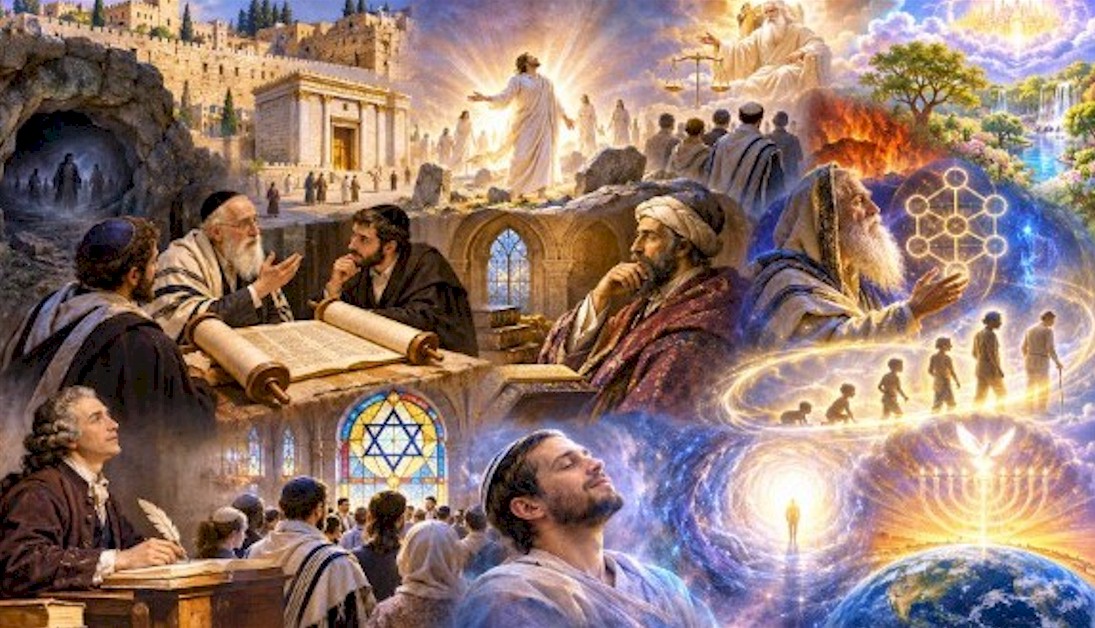
Jewish beliefs about death and the afterlife have undergone significant changes over more than 3,000 years. Unlike Christianity and Islam, which developed relatively defined teachings about Heaven, Hell, resurrection, and final judgment, Judaism has preserved a variety of interpretations concerning what happens after death. These beliefs include Sheol, the resurrection of the dead, the World to Come (Olam Ha-Ba), the Garden of Eden (Gan Eden), Gehenna (Gehinnom), the immortality of the soul, reincarnation (gilgul), and mystical union with God.
The earliest biblical writings generally portray death as a descent into Sheol, a shadowy realm where the dead exist without the fullness of earthly life. Later Jewish writings increasingly emphasize divine judgment, resurrection, and the possibility of reward or punishment beyond death. During the Second Temple period, Jewish groups developed different understandings of immortality and resurrection, influenced by interpretations of Scripture, apocalyptic expectations, and encounters with surrounding cultures.
Rabbinic Judaism subsequently developed teachings about the World to Come, the fate of the soul, and the eventual resurrection of the dead. Medieval Jewish philosophers debated whether immortality meant bodily resurrection, intellectual union with God, or continued personal existence. Jewish mystics introduced elaborate descriptions of heavenly realms, the soul’s spiritual journey, reincarnation, and the purification of souls after death.
Modern Judaism continues to reflect this diversity. Orthodox Judaism generally maintains traditional beliefs in resurrection and divine judgment, while Conservative, Reform, Reconstructionist, and other Jewish movements approach the afterlife in different ways, ranging from traditional supernatural interpretations to symbolic understandings of immortality.
An important distinction: Jewish afterlife beliefs did not develop through a single, uniform sequence in which each new teaching replaced the previous one. Different ideas often existed simultaneously, and many remain influential today.
2. Ancient Israelite Religion: Sheol and the Realm of the Dead (c. 1200–600 BCE)
The earliest surviving traditions of ancient Israel generally portray death as a descent into Sheol, an underground realm associated with darkness, silence, and separation from ordinary human existence. Sheol was not originally equivalent to the later Christian concept of Hell. It was usually understood as the common destination of the dead, regardless of whether they had lived righteous or wicked lives.
In Genesis 37:35, Jacob declares that he will descend to Sheol mourning for his son Joseph. Job 7:9–10 describes death as a departure from which a person does not return to ordinary earthly life. Psalm 88:10–12 portrays the dead as separated from the active praise of God, while Ecclesiastes 9:5–10 presents death as the end of conscious participation in earthly affairs.
These passages reflect a worldview in which the primary rewards for righteousness were often understood in earthly terms: long life, descendants, prosperity, peace, and continued remembrance among future generations. The Hebrew Bible frequently emphasizes God’s covenant with the living community rather than detailed descriptions of individual existence after death.
Nevertheless, the earliest Israelite beliefs were not entirely uniform. Biblical references to the Rephaim, or departed spirits, suggest that some Israelites believed the dead continued to exist in a diminished spiritual condition. Isaiah 14:9 depicts Sheol as stirring to greet a fallen ruler, while 1 Samuel 28 describes the medium of Endor summoning the deceased prophet Samuel. The latter narrative indicates that traditions concerning communication with the dead existed, even though biblical law condemned necromancy (Deuteronomy 18:10–12).
Scholars have also identified evidence of ancestor-related rituals and funerary practices in ancient Israel and Judah. Such practices suggest that popular beliefs about the dead could differ from the theological perspectives emphasized by biblical authors.
At this stage, there was no fully developed biblical doctrine of universal bodily resurrection, eternal heavenly reward, or everlasting punishment after death.
Principal sources: Genesis 37:35; 1 Samuel 28:7–20; Job 7:9–10; Psalm 88:10–12; Ecclesiastes 9:5–10; Isaiah 14:9–11.
References: Johnston (2002); Levenson (2006).
3. The Prophetic Period: Divine Victory Over Death and the Beginnings of Resurrection Hope (c. 800–500 BCE)
During the prophetic period, some biblical passages began expressing hope that God’s power extended beyond the grave. Although these passages did not yet establish a systematic doctrine of resurrection, they provided important foundations for later Jewish afterlife beliefs.
Hosea 6:1–3 uses the imagery of revival and restoration to describe Israel’s return to divine favor. Hosea 13:14 speaks of God’s power over death and Sheol, although its interpretation depends partly on how the Hebrew text is translated.
Isaiah 25:8 announces that God will ultimately destroy death, presenting divine salvation as a victory over humanity’s greatest limitation. Isaiah 26:19 contains an especially significant declaration that the dead will live and that those dwelling in the dust will awaken and rejoice.
The dating and interpretation of Isaiah 26:19 remain debated. Many scholars associate this passage with a later stage of the Book of Isaiah, rather than the eighth-century prophet himself. Nevertheless, its imagery became important for subsequent Jewish resurrection theology.
Ezekiel 37:1–14 presents the famous vision of the valley of dry bones, in which God restores lifeless skeletons to living bodies through divine breath. In its immediate literary context, the vision symbolizes the national restoration of Israel following exile. However, its vivid description of bodily reanimation contributed to later interpretations involving the resurrection of individual human beings.
These passages demonstrate a growing conviction that God’s creative power could overcome even death. They also reveal how the biblical expectation of Israel’s national restoration gradually became associated with the hope of individual resurrection.
Principal sources: Hosea 6:1–3; Hosea 13:14; Isaiah 25:8; Isaiah 26:19; Ezekiel 37:1–14.
References: Levenson (2006); Segal (2004).
4. The Babylonian Exile and Persian Period: Judgment, Restoration, and Possible Zoroastrian Influences (c. 586–332 BCE)
The Babylonian exile, beginning with the destruction of Jerusalem in 586 BCE, profoundly influenced Jewish religious thought. The destruction of the Temple, the loss of political independence, and the suffering of the Jewish people raised difficult theological questions concerning divine justice. If righteous individuals suffered while wicked rulers prospered, how could God’s justice ultimately prevail? One response, developed more explicitly in later Jewish literature, was that divine justice might extend beyond earthly existence.
After the Persian conquest of Babylon in 539 BCE, Jewish communities lived under the Achaemenid Empire, whose religious environment included Zoroastrian traditions. Zoroastrian eschatology came to include concepts of final judgment, resurrection, cosmic renewal, and the ultimate defeat of evil. Scholars have frequently proposed that contact with Persian religious ideas contributed to the development of Jewish resurrection and apocalyptic expectations. However, the precise direction, timing, and extent of this influence remain debated. Some relevant Zoroastrian traditions are documented in texts compiled substantially later than the Persian period, making direct historical connections difficult to establish.
Jewish thinkers also had internal biblical resources for developing resurrection beliefs, particularly prophetic traditions concerning God’s power over death and the restoration of Israel. During this period, the groundwork was laid for later distinctions between the present world and an age of divine redemption. Nevertheless, it would be misleading to suggest that a fully developed doctrine of Heaven, Hell, and resurrection had already become universal among Jews.
Principal sources: Isaiah 25–26; Ezekiel 37; later biblical apocalyptic traditions.
References: Segal (2004); Levenson (2006); Suriano (2012).
5. Second Temple Judaism: Resurrection, Immortality, and Final Judgment (c. 332 BCE–70 CE)
The Second Temple period witnessed one of the most important transformations in Jewish afterlife beliefs. Jewish communities developed increasingly detailed expectations concerning resurrection, judgment, heavenly rewards, and punishment after death. These developments were not uniform. Some Jewish writings emphasized the resurrection of bodies, while others favored the immortality of souls. Still others preserved older beliefs about death and Sheol.
The Book of Daniel and the Resurrection of the Dead (c. 167–164 BCE): Daniel 12:2–3 contains one of the clearest biblical descriptions of individual resurrection. It portrays people awakening from the dust, some to everlasting life and others to shame and enduring contempt. The righteous are described as shining like the stars. Most critical scholars date the final composition of Daniel to the second century BCE, during the persecution of Jews under Antiochus IV Epiphanes. The promise of resurrection addressed a major theological problem: righteous Jews who died defending their faith might never experience justice during their earthly lives. Resurrection provided hope that God would ultimately vindicate the faithful, including those who had suffered martyrdom. Daniel’s resurrection language therefore connects individual immortality with divine justice, the final judgment, and the transformation of the world.
The Books of Maccabees (2nd–1st Centuries BCE): Second Maccabees 7 describes seven brothers and their mother who endure torture and execution rather than violate Jewish law. Several brothers express confidence that God will restore their bodies and grant them new life. Second Maccabees 12:38–45 also describes prayers and offerings for deceased soldiers, reflecting the belief that actions performed by the living could benefit the dead in anticipation of resurrection. These passages demonstrate that resurrection had become an important source of hope among some Jewish communities before the emergence of Christianity.
The Book of 1 Enoch (c. 3rd Century BCE–1st Century CE): The composite work known as 1 Enoch contains elaborate visions of the heavenly world, angelic beings, divine judgment, and the fate of departed souls. In 1 Enoch 22, the dead are portrayed as awaiting judgment in separated compartments or regions. The righteous and wicked experience different conditions while awaiting their ultimate destinies. Other Enochic passages describe heavenly rewards, punishment, cosmic transformation, and the defeat of evil. These writings helped develop Jewish apocalyptic images that later influenced Christian descriptions of the afterlife.
The Wisdom of Solomon (c. 1st Century BCE–1st Century CE): The Wisdom of Solomon, probably composed in Greek-speaking Alexandria, presents a different emphasis. Wisdom 3:1–9 portrays the righteous as secure in God’s care even after physical death. The text strongly emphasizes the immortality and blessed destiny of the righteous, reflecting an intellectual environment in which Jewish theology interacted with Greek philosophical ideas concerning the soul. Unlike Daniel’s emphasis on bodily resurrection, Wisdom highlights the continued existence of the righteous beyond death.
These different approaches reveal two important currents within Second Temple Judaism: the resurrection of the dead and the immortality of the soul. Both would contribute to later Jewish theology.
Principal sources: Daniel 12:1–3; 2 Maccabees 7 and 12; 1 Enoch 22 and 90; Wisdom of Solomon 3:1–9.
References: Segal (2004); Nickelsburg and VanderKam (2012); Bakhos (n.d).
6. Jewish Sects and Their Different Afterlife Beliefs (c. 2nd Century BCE–1st Century CE)
By the first century CE, Jewish religious groups differed considerably in their understanding of life after death. The Jewish historian Flavius Josephus, writing in the late first century CE, provides important descriptions of these disagreements.
The Pharisees: The Pharisees generally affirmed the resurrection of the dead, divine judgment, and rewards and punishments beyond earthly life. Josephus describes the Pharisees as believing that souls survive death and that the righteous may experience renewed life. His language sometimes resembles Greek concepts of transmigration, but scholars caution against treating this as clear evidence that the Pharisees taught reincarnation in its later kabbalistic sense. The stronger historical interpretation is that Josephus was describing Jewish resurrection beliefs in language accessible to Greek and Roman readers. Pharisaic traditions contributed significantly to the development of Rabbinic Judaism after the destruction of the Second Temple.
The Sadducees: The Sadducees, associated especially with the priestly aristocracy, rejected resurrection according to Josephus and later sources. Their position appears to have emphasized the written Torah and to have rejected certain afterlife doctrines associated with the Pharisees. However, the exact extent of their beliefs concerning the soul remains uncertain because almost all surviving descriptions were written by outsiders.
The Essenes: Josephus describes the Essenes as emphasizing the immortality of the soul and the liberation of the soul from the physical body. His account includes descriptions of rewards for righteous souls and punishment for the wicked. These ideas resemble certain Greek philosophical traditions, although their Jewish religious foundations remain important. The Dead Sea Scrolls, associated by many scholars with an Essene-related community, contain expectations of divine judgment, angelic participation, and an ultimate victory of righteousness. Whether every text supports individual bodily resurrection is disputed.
The Jewish Philosopher Philo of Alexandria (c. 20 BCE–50 CE): Philo combined Jewish scriptural interpretation with Greek philosophical concepts, particularly Platonism. He emphasized the soul’s spiritual nature and the possibility of its liberation from bodily limitations. For Philo, the highest destiny of the righteous soul involved closeness to God and the contemplation of divine reality. His writings helped establish an intellectual approach to Jewish immortality that would influence later philosophical discussions.
Principal sources: Josephus, Jewish War 2.119–166; Antiquities 18.11–22; Philo, On the Creation and On Dreams.
References: Klawans (2012); Segal (2004).
7. Early Rabbinic Judaism: The World to Come, Resurrection, and Gehenna (c. 70–500 CE)
Following the Roman destruction of the Second Temple in 70 CE, rabbinic teachers developed a religious system centered on Torah study, observance, prayer, and communal life. Their discussions of the afterlife drew upon biblical, apocalyptic, and earlier Jewish traditions. These teachings were preserved in the Mishnah, the Talmuds, and collections of Midrash.
The World to Come (Olam Ha-Ba): One of the most important rabbinic afterlife concepts is Olam Ha-Ba, meaning the World to Come. Mishnah Sanhedrin 10:1 begins with the principle that Israel has a share in the World to Come, while also identifying categories of people excluded from it. The World to Come represented the ultimate fulfillment of divine justice and reward. However, rabbinic texts did not always agree about its precise nature. Some passages describe it as the future world following resurrection and judgment. Others use language suggesting a spiritual existence enjoyed by righteous souls after death. This ambiguity would later become central to debates between Jewish philosophers and mystics.
The Resurrection of the Dead (Techiyat Ha-Metim): Resurrection became a foundational doctrine in Rabbinic Judaism. The Mishnah identifies denial of resurrection as a serious theological error. Rabbinic literature also interprets numerous biblical passages as evidence that God will eventually restore life to the dead. The second blessing of the Amidah, a central Jewish prayer, praises God as the one who revives the dead. This liturgical tradition helped preserve resurrection belief within everyday Jewish religious practice. Nevertheless, rabbinic authorities differed about the details of resurrection, including the condition of resurrected bodies and the relationship between resurrection and the ultimate World to Come.
Gan Eden – Paradise for the Righteous: The biblical Garden of Eden gradually became associated with the spiritual destination of righteous souls. In some rabbinic teachings, Gan Eden represents a place or condition of peace, joy, and nearness to the divine presence. Berakhot 28b records Rabbi Yohanan ben Zakkai‘s concern about two possible destinations after death: Gan Eden and Gehinnom. Other texts describe the righteous enjoying divine radiance, suggesting a form of blessed spiritual existence beyond ordinary physical experience.
Gehinnom – Punishment and Purification: Gehinnom, or Gehenna, derives its name from the Valley of Hinnom near Jerusalem, a location associated in biblical literature with condemned religious practices. During the Second Temple and rabbinic periods, Gehinnom became a term for postmortem judgment and punishment. Unlike some later Christian doctrines of eternal Hell, many rabbinic traditions describe Gehinnom as a temporary period of purification. Mishnah Eduyot 2:10 refers to a twelve-month period of judgment for the wicked. Later Jewish customs concerning the recitation of the Mourner’s Kaddish are associated with the belief that judgment is ordinarily limited in duration. However, not all rabbinic texts describe Gehinnom as temporary for everyone. Some passages portray particularly wicked individuals as facing more severe or enduring consequences.
Judgment and the Soul’s Continuing Existence: Rabbinic writings contain accounts of souls being judged after death, receiving rewards or punishments, and awaiting future resurrection. Some teachings portray the soul as conscious apart from the body. Others emphasize the ultimate reunion of body and soul. Sanhedrin 91a–b presents a parable illustrating why body and soul must be judged together. The teaching reinforces the idea that human moral responsibility belongs to the whole person. Rabbinic literature therefore combined spiritual survival with bodily resurrection without always resolving the philosophical tensions between them.
Principal sources: Mishnah Sanhedrin 10:1; Mishnah Eduyot 2:10; Babylonian Talmud Berakhot 17a and 28b; Rosh Hashanah 16b–17a; Sanhedrin 91a–b.
References: Raphael (2009); Segal (2004); Bakhos (n.d.).
8. Late Antique Jewish Mysticism: Heavenly Ascents, Angels, and the Divine Throne (c. 3rd–8th Centuries CE)
Alongside Rabbinic Judaism, Jewish mystical traditions developed increasingly elaborate descriptions of the heavenly realms. These teachings are commonly associated with Merkavah mysticism, named after the divine chariot or throne described in Ezekiel 1. The Hekhalot literature, meaning writings about heavenly palaces, describes mystical journeys through celestial regions inhabited by angels and guarded by supernatural beings. Texts such as Hekhalot Rabbati, Hekhalot Zutarti, and 3 Enoch portray extraordinary heavenly visions, divine glory, angelic hierarchies, and the transformation of human beings who encounter the heavenly world.
In 3 Enoch, the biblical figure Enoch is associated with the exalted angel Metatron, who occupies a prominent position in the heavenly hierarchy. This tradition reflects speculation about the possibility of human transformation into an extraordinary spiritual state. Although these writings are primarily concerned with mystical ascent rather than ordinary experiences after death, they contributed to Jewish ideas about the structure of Heaven and the relationship between the human soul and the divine world. The heavenly ascent traditions also continued themes found in earlier Jewish apocalyptic literature, including the Book of Daniel and 1 Enoch.
These writings should not be interpreted as evidence that all Jews believed the soul traveled through heavenly palaces after death. They represent specialized mystical traditions rather than universally accepted Jewish doctrine.
Principal sources: Ezekiel 1; Hekhalot Rabbati; Hekhalot Zutarti; 3 Enoch.
References: Schäfer (2009); Himmelfarb (1993).
9. Medieval Jewish Philosophy: Immortality, Resurrection, and Intellectual Union with God (c. 9th–13th Centuries CE)
During the medieval period, Jewish thinkers increasingly attempted to explain the afterlife through philosophical reasoning. Jewish scholars living in Islamic and Christian societies encountered Aristotelian and Neoplatonic philosophies. These intellectual traditions stimulated debates about the nature of the soul, bodily resurrection, divine judgment, and the ultimate purpose of human existence.
Saadia Gaon (882–942 CE): Saadia Gaon defended bodily resurrection as an essential Jewish belief. In The Book of Beliefs and Opinions, he argued that the God who created human beings could restore their bodies after death. Resurrection was therefore consistent with divine omnipotence and justice. Saadia also distinguished resurrection from the final reward and punishment of souls. His writings helped systematize Jewish eschatology within a rational theological framework.
Maimonides (1135–1204 CE): Moses Maimonides, one of Judaism’s most influential philosophers, developed a distinctive understanding of immortality and the World to Come. His Thirteen Principles of Faith include belief in the resurrection of the dead. However, his description of the ultimate World to Come emphasizes spiritual rather than physical existence. In Mishneh Torah, Laws of Repentance 8, Maimonides describes the World to Come as a state in which righteous souls exist without physical bodies and enjoy intellectual knowledge of God. For Maimonides, the highest human fulfillment is not the continuation of bodily pleasures but the perfection of the intellect and its relationship to divine truth. His teachings generated controversy because some readers believed his emphasis on disembodied immortality weakened the traditional doctrine of bodily resurrection. In response, Maimonides wrote his Treatise on Resurrection, reaffirming his belief that the dead would physically rise again. Nevertheless, he continued to distinguish resurrection from the ultimate spiritual destiny of the righteous.
Nachmanides (1194–1270 CE): Moses Nachmanides, also known as Ramban, defended a different understanding of the final afterlife. In The Gate of Reward (Sha’ar Ha-Gemul), he emphasized bodily resurrection and the eventual transformation of human existence. Unlike Maimonides, Nachmanides regarded the resurrected condition as central to the ultimate World to Come. His interpretation gave greater importance to the enduring union of body and soul, although the resurrected body would exist in a transformed condition unlike ordinary earthly life. The disagreement between Maimonides and Nachmanides illustrates a fundamental question in Jewish theology: Is humanity’s ultimate destiny a purely spiritual existence, or a transformed existence involving both body and soul? Both approaches remained influential in subsequent Jewish thought.
Principal sources: Saadia Gaon, The Book of Beliefs and Opinions, Treatise 7; Maimonides, Mishneh Torah, Laws of Repentance 8 and Treatise on Resurrection; Nachmanides, The Gate of Reward.
References: Raphael (2009); Segal (2004).
10. Early Kabbalah: The Soul’s Journey, Spiritual Worlds, and Reincarnation (c. 12th–13th Centuries CE)
Jewish mysticism underwent a major transformation with the emergence of medieval Kabbalah. Kabbalists developed symbolic and mystical explanations of creation, divine emanation, the soul’s origin, and its destiny after death. Rather than viewing the afterlife simply as a place of reward or punishment, they often understood it as part of a larger spiritual process through which the soul returns toward its divine source.
The Sefirot and the Divine World: Kabbalah describes ten sefirot, or manifestations of divine activity, through which the infinite God, known as Ein Sof, relates to creation. The human soul is understood as having a profound relationship with these divine realities. Spiritual development involves restoring harmony between the human being, the divine world, and creation. Death does not necessarily complete this process. According to some kabbalistic teachings, the soul may require additional purification, spiritual ascent, or another earthly existence.
The Emergence of Reincarnation (Gilgul): Reincarnation, known as gilgul neshamot, became an important concept within certain medieval kabbalistic schools. The Sefer Ha-Bahir, generally associated with twelfth-century Provence, contains some of the earliest influential kabbalistic discussions interpreted as teaching transmigration of souls. In these traditions, a soul may return to earthly life because it has not completed its spiritual mission, fulfilled certain commandments, or corrected previous moral failures. Reincarnation thus became associated with divine justice and spiritual restoration. However, reincarnation was not universally accepted within Judaism. Some earlier Jewish thinkers, including Saadia Gaon, explicitly rejected transmigration. Even after its adoption by kabbalists, it remained controversial among Jewish philosophers and religious authorities.
The Soul’s Spiritual Development: Early Kabbalah increasingly described human existence as a journey of spiritual purification. The soul was not merely a passive recipient of reward or punishment. It participated in a cosmic process through which divine harmony could be restored. This approach gave Jewish afterlife beliefs a developmental dimension: the soul’s destiny could involve continued transformation rather than a single, final judgment immediately following death.
Principal sources: Sefer Ha-Bahir; early kabbalistic writings associated with Isaac the Blind and the Gerona school.
References: Scholem (1941); Idel (1988); Raphael (2009).
11. The Zohar: Heavenly Realms, Soul Purification, and Mystical Reunion (c. Late 13th Century CE)
The Zohar, one of the central works of Jewish mysticism, profoundly influenced subsequent Jewish understandings of the afterlife. Traditionally attributed to the second-century sage Rabbi Shimon bar Yochai, the Zohar is generally understood by modern scholars to have emerged in late-thirteenth-century Castile, with Moses de León playing a central role in its composition or circulation. The Zohar presents an elaborate spiritual universe in which the soul’s journey continues beyond physical death.
The Multiple Levels of the Soul: Kabbalistic traditions distinguish several dimensions of the human soul, particularly: (1) Nefesh: the vital or life-associated dimension of the soul. (2) Ruach: the spiritual and moral dimension. (3) Neshamah: the higher spiritual dimension associated with divine understanding. Later kabbalistic systems also discuss Chayah and Yechidah, representing still higher aspects of the soul. These distinctions allowed mystics to describe different experiences and destinies for the soul’s various dimensions after death.
The Soul’s Journey After Death: The Zohar contains descriptions of souls separating from their bodies, undergoing judgment, and entering spiritual regions corresponding to their moral and spiritual condition. Righteous souls may ascend through heavenly realms and experience increasing closeness to the divine presence. Other souls may require purification before entering higher spiritual states. In some passages, souls retain awareness of earthly events and maintain relationships with the living through prayer, dreams, or spiritual influence. These descriptions helped establish the idea that death begins a complex spiritual journey rather than immediately ending the soul’s development.
Reincarnation and Spiritual Correction: The Zohar also develops themes of reincarnation and spiritual restoration. Some souls return to earthly life to correct earlier failures or complete unfinished obligations. These ideas became especially important in later Lurianic Kabbalah, where reincarnation would receive a much more systematic explanation.
Union with God: The highest spiritual destiny in kabbalistic thought involves devekut, or cleaving to God. Although the meaning of devekut varies among Jewish mystical schools, it generally refers to profound spiritual attachment to the divine. It does not necessarily mean that the individual soul loses its identity or becomes identical with God. Jewish mystical teachings frequently preserve a distinction between the Creator and creation, even while describing extraordinary intimacy with divine reality.
Principal sources: Zohar, especially sections dealing with the soul, death, judgment, and reincarnation.
References: Scholem (1941); Matt (2004–2017); Idel (1988).
12. Lurianic Kabbalah: Reincarnation, Tikkun, and the Restoration of Souls (16th Century CE)
Jewish mystical teachings concerning the afterlife reached a new level of complexity in the sixteenth century, especially in Safed, in Ottoman Palestine. Rabbi Isaac Luria (1534–1572), known as the Ari, developed a mystical system that profoundly influenced later Kabbalah and Hasidic Judaism. His teachings were transmitted and organized primarily by his disciple Rabbi Chaim Vital (1542–1620).
Tikkun – The Spiritual Repair of Creation: Lurianic Kabbalah describes creation through a complex process involving divine withdrawal (tzimtzum), the breaking of the vessels (shevirat ha-kelim), and the scattering of divine sparks. Human beings participate in restoring cosmic harmony through tikkun, or spiritual repair. Religious observance, prayer, ethical conduct, and spiritual intention contribute to this process. The soul’s earthly existence therefore has significance beyond individual salvation. Its actions participate in the restoration of the divine order.
Reincarnation as Spiritual Correction: Luria’s teachings present reincarnation as a major mechanism of spiritual development. According to this system, souls may return repeatedly to earthly life to fulfill commandments, correct moral failures, or complete tasks left unfinished in previous incarnations. The process is described extensively in Sha’ar Ha-Gilgulim (Gate of Reincarnations), based on Luria’s teachings as transmitted by Chaim Vital. Reincarnation is not necessarily understood as punishment. It may also represent an opportunity for spiritual completion.
Ibbur – The Addition of Another Soul: Lurianic Kabbalah distinguishes ordinary reincarnation from ibbur, sometimes translated as soul impregnation or the temporary addition of another soul. In this teaching, a living person may receive assistance from the soul of a righteous deceased individual. The additional soul may help the person fulfill a spiritual mission, perform commandments, or attain greater holiness. This concept differs from reincarnation because the assisting soul does not necessarily enter the body at birth or replace the person’s original soul.
Dybbuk – Spirit Attachment: Later Jewish folklore and mystical traditions developed accounts of dybbuks, spirits believed to attach themselves to living individuals. Such accounts sometimes describe restless souls seeking correction, release, or reconciliation. Although dybbuk traditions became prominent in Jewish folklore, they should not be confused with universal Jewish doctrine.
The Ultimate Restoration of Souls: Lurianic Kabbalah presents the destiny of the soul within a broader cosmic process of redemption. The ultimate objective is the restoration of spiritual harmony and the completion of the soul’s divine mission. However, the precise destiny of every soul, including whether all souls must eventually achieve restoration, is interpreted differently among kabbalistic authorities. The system should therefore not be simplified into a universally accepted Jewish doctrine of inevitable salvation for all beings.
Principal sources: Chaim Vital, Sha’ar Ha-Gilgulim; Etz Chaim.
References: Scholem (1941); Fine (2003); Raphael (2009).
13. Hasidic Judaism: The Soul’s Divine Mission and Spiritual Attachment to God (18th–19th Centuries CE)
Hasidic Judaism emerged in eighteenth-century Eastern Europe, traditionally associated with Rabbi Israel ben Eliezer (c. 1700–1760), known as the Baal Shem Tov. Hasidism drew extensively upon Kabbalah, particularly Lurianic teachings, while emphasizing spiritual joy, prayer, divine presence, and the sanctification of everyday life.
The Divine Soul: Hasidic teachers emphasized that human beings possess a profound spiritual connection with God. In Chabad Hasidism, especially in Rabbi Shneur Zalman’s Tanya, the divine soul is understood as originating in God and seeking reunion with its spiritual source. Physical existence provides opportunities to reveal holiness through moral actions, prayer, and religious observance.
Reincarnation and the Soul’s Mission: Many Hasidic traditions accept the kabbalistic doctrine of reincarnation. The soul may return to earthly existence because it has a particular task or spiritual obligation to fulfill. This belief gives individual experiences a possible spiritual purpose, although it does not provide a reliable basis for claiming that a particular person’s illness, disability, or suffering was chosen or deserved because of a previous incarnation.
Devekut and Divine Presence: Hasidism places considerable emphasis on devekut, the experience of closeness or attachment to God. Some Hasidic teachings describe the soul’s ultimate fulfillment as participation in divine light and spiritual joy. Unlike purely philosophical accounts of immortality, Hasidic teachings often emphasize an intimate and personal relationship with God.
The Righteous After Death: Hasidic traditions also preserve the belief that exceptionally righteous individuals, known as tzaddikim, may continue to influence the spiritual lives of their communities after death. Stories concerning deceased Hasidic masters sometimes portray them as interceding for the living or providing spiritual guidance. These beliefs are especially important in certain Hasidic communities, although their interpretations differ.
Principal sources: Shneur Zalman of Liadi, Tanya; Hasidic teachings attributed to the Baal Shem Tov and later Hasidic masters.
References: Buber (1947); Scholem (1941); Raphael (2009).
14. The Jewish Enlightenment and Modern Philosophy: Reinterpreting Immortality (18th–19th Centuries CE)
The Jewish Enlightenment, or Haskalah, encouraged Jewish thinkers to reconsider traditional religious beliefs in light of modern philosophy, science, and European intellectual developments. Some Jewish philosophers sought to defend the immortality of the soul through rational arguments, while others emphasized the moral and spiritual significance of religious life without relying on detailed descriptions of the afterlife.
Moses Mendelssohn (1729–1786): Moses Mendelssohn, one of the leading figures of the Jewish Enlightenment, defended the immortality of the soul in his philosophical work Phaedon (1767). Drawing upon Platonic philosophy, Mendelssohn argued that the soul’s spiritual nature supported belief in its continued existence beyond bodily death. His approach differed from traditional rabbinic discussions because he attempted to establish immortality through philosophical reasoning rather than primarily through scriptural authority. Mendelssohn’s writings helped make the immortality of the soul an important subject in modern Jewish philosophical discussions.
The Emergence of Reform Judaism (19th Century): During the nineteenth century, Reform Judaism developed new interpretations of traditional Jewish theology. Many Reform thinkers emphasized the immortality of the soul while questioning or rejecting literal bodily resurrection. The Pittsburgh Platform of 1885 explicitly rejected bodily resurrection and traditional doctrines of postmortem reward and punishment in Gan Eden and Gehinnom, while affirming the immortality of the soul. This represented a significant departure from traditional rabbinic eschatology. Instead of emphasizing a future resurrection, Reform Judaism increasingly focused on ethical responsibility, spiritual progress, and humanity’s collective redemption.
The Continuing Orthodox Response: Orthodox Jewish authorities generally maintained traditional teachings concerning resurrection, divine judgment, and the World to Come. They regarded these beliefs as important elements of Jewish continuity, supported by classical rabbinic sources and traditional liturgy. The nineteenth century therefore witnessed a widening theological distinction between traditional supernatural understandings of the afterlife and modern philosophical or symbolic interpretations.
Principal sources: Mendelssohn, Phaedon (1767); Pittsburgh Platform (1885).
References: Raphael (2009); Segal (2004); Bor (2025).
15. Twentieth-Century Judaism: Existentialism, Immortality, and Religious Diversity (1900–2000 CE)
During the twentieth century, Jewish afterlife beliefs became increasingly diverse. The Holocaust, modern scientific developments, secularization, and new philosophical movements raised profound questions concerning suffering, divine justice, mortality, and the meaning of human existence. Jewish thinkers often shifted their attention from describing the afterlife to exploring the spiritual significance of life, death, and human relationships.
Martin Buber (1878–1965): Martin Buber emphasized the importance of authentic relationships, particularly the I–Thou relationship between human beings and between humanity and God. Although Buber did not construct an elaborate doctrine of the afterlife, his philosophy provided a framework for understanding spiritual existence through relationship rather than through detailed descriptions of heavenly rewards. For Buber, the encounter with the Eternal Thou gives human existence its deepest religious meaning.
Franz Rosenzweig (1886–1929): In The Star of Redemption (1921), Franz Rosenzweig explored creation, revelation, redemption, and the human confrontation with death. His philosophy begins with the reality of mortality and develops a theological understanding of human existence in relation to God and redemption. Rather than presenting a conventional picture of Heaven and Hell, Rosenzweig emphasized the transformative significance of divine love and the ultimate redemption of creation.
Mordecai Kaplan (1881–1983): Mordecai Kaplan, the founder of Reconstructionist Judaism, rejected many supernatural interpretations of traditional Jewish theology. His religious naturalism emphasized the importance of human fulfillment, communal continuity, and ethical development. Kaplan did not affirm traditional bodily resurrection or a supernatural afterlife as essential Jewish doctrines. Within Reconstructionist thought, immortality may instead be understood through the continuing influence of individuals upon their communities, future generations, and humanity.
Jewish Responses to the Holocaust: The Holocaust intensified Jewish theological questions concerning suffering and divine justice. Some Jewish thinkers continued to affirm the hope of resurrection and ultimate divine judgment, while others questioned whether traditional theological explanations could adequately address the destruction of millions of innocent lives. The Holocaust did not produce a single new Jewish doctrine of the afterlife. Instead, it deepened the diversity of Jewish responses to mortality, suffering, and redemption.
Principal sources: Buber, I and Thou (1923); Rosenzweig, The Star of Redemption (1921); Kaplan, Judaism as a Civilization (1934).
References: Raphael (2009); Bor (2025).
16. Contemporary Judaism: Traditional, Mystical, and Symbolic Afterlife Beliefs (21st Century)
Contemporary Judaism encompasses a broad spectrum of beliefs about death and the afterlife. Jewish religious movements differ not only in their official teachings but also in the beliefs of individual members.
Orthodox Judaism: Orthodox Judaism generally maintains belief in the resurrection of the dead, divine judgment, and the World to Come. Traditional prayers continue to affirm God’s power to restore life to the dead. Many Orthodox Jews also believe that the soul survives bodily death and may experience reward, purification, or punishment before the ultimate resurrection. Kabbalistic ideas concerning reincarnation are particularly influential within some Hasidic and Sephardic communities, although they are not accepted or emphasized equally by all Orthodox authorities.
Conservative Judaism: Conservative Judaism preserves traditional Jewish teachings while allowing considerable theological diversity. Its liturgy generally retains references to resurrection, although individual rabbis and congregants may understand these references literally, metaphorically, or in other ways. Some Conservative Jews affirm bodily resurrection, others believe in the immortality of the soul, and still others remain uncertain about what happens after death.
Reform Judaism: Reform Judaism generally allows individuals considerable freedom concerning afterlife beliefs. Many Reform Jews understand immortality in spiritual or symbolic terms rather than as literal bodily resurrection. The continuing influence of a person’s actions, relationships, and contributions may be regarded as an important form of enduring life. Nevertheless, individual Reform Jews may hold more traditional beliefs about the soul, Heaven, or resurrection.
Reconstructionist Judaism: Reconstructionist Judaism generally emphasizes naturalistic interpretations of religious experience. Traditional supernatural doctrines of resurrection and divine judgment are not central to its theology. Many Reconstructionist Jews emphasize the ways individuals continue to live through their influence upon family, community, culture, and future generations.
Jewish Renewal: Jewish Renewal draws upon Hasidism, Kabbalah, meditation, and contemporary spirituality. Some Jewish Renewal practitioners explore reincarnation, the soul’s spiritual development, mystical experiences, and the possibility of continued consciousness after death. However, Jewish Renewal does not possess a single universally binding doctrine of the afterlife.
Contemporary Jewish Mysticism: Kabbalistic and Hasidic teachings remain influential in contemporary Jewish spirituality. These traditions often describe the soul as having a divine origin, a spiritual mission during earthly life, and a destiny extending beyond physical death. Some accounts emphasize the soul’s ascent into higher spiritual worlds. Others describe reincarnation as a means of completing unfinished spiritual tasks. Certain contemporary Jewish writers also explore near-death experiences (NDEs), deathbed visions, and reported encounters with deceased individuals as possible subjects for spiritual reflection. Such experiences are interpreted differently across Jewish communities and do not establish a universally accepted doctrine concerning what happens after death.
References: Raphael (2009); Segal (2004); Bor (2025); My Jewish Learning (n.d.).
17. Jewish Afterlife Beliefs and Near-Death Experiences (Late 20th–21st Centuries)
Modern research into NDEs has introduced another perspective into discussions of Jewish afterlife beliefs. Some Jewish NDErs, such as Beverly Brodsky and Rene Turner, report encounters with light, deceased relatives, spiritual beings, or an overwhelming sense of peace and divine presence. These accounts sometimes resemble themes found in Jewish mystical and rabbinic literature, although the similarities do not establish that NDEs confirm any particular religious doctrine.
The Soul’s Separation from the Body: Some NDE accounts include the sensation of consciousness existing independently of the physical body. This resembles traditional Jewish teachings in which the soul survives bodily death, particularly those found in rabbinic literature, medieval philosophy, and Kabbalah. However, Jewish resurrection theology also emphasizes the ultimate importance of the body, distinguishing it from interpretations that regard permanent disembodied existence as humanity’s final destiny.
Encounters with Divine Light: Many NDE narratives describe an extraordinary light associated with love, peace, knowledge, or a sacred presence. Jewish mystical literature contains descriptions of divine radiance, heavenly illumination, and spiritual closeness to God. The kabbalistic concept of Ein Sof, the infinite divine reality, and the imagery of divine light provide possible interpretive parallels.
Life Reviews and Divine Judgment: Some NDE accounts describe panoramic reviews of earthly life, accompanied by a heightened awareness of the consequences of one’s actions. Jewish teachings concerning divine judgment likewise emphasize moral responsibility and the spiritual consequences of human conduct. The parallels are especially apparent in rabbinic and kabbalistic traditions that portray the soul as confronting the truth of its earthly actions after death.
Reincarnation and Spiritual Development: Some NDErs report receiving information about previous lives, future incarnations, or the purpose of earthly existence. These themes resemble the kabbalistic doctrine of gilgul, particularly its association with spiritual correction and unfinished obligations. However, reincarnation remains a disputed belief within Judaism.
Mystical Union and Divine Love: NDE accounts sometimes describe an overwhelming sense of unity with the divine or with all existence. Jewish mystical teachings concerning devekut offer a possible point of comparison, especially when they describe profound attachment to God. Yet Jewish mysticism generally interprets such experiences within a theological framework that distinguishes God from created beings. Overall, Jewish mystical traditions provide a rich framework for interpreting certain NDE themes.
References: Raphael (2009); Segal (2004); Greyson (2021); van Lommel et al. (2001).
18. Summary Timeline of Jewish Afterlife Beliefs
1200–600 BCE — Ancient Israel: Sheol, departed spirits, ancestral remembrance, limited descriptions of conscious existence after death
800–500 BCE — Prophetic traditions: Divine victory over death, national restoration, emerging resurrection imagery
586–332 BCE — Exilic and Persian periods: Developing expectations of divine justice, restoration, and future redemption
332 BCE–70 CE — Second Temple Judaism: Individual resurrection, immortality of the soul, heavenly rewards, punishment, final judgment
2nd century BCE–1st century CE — Jewish sects: Pharisaic resurrection, Sadducean rejection of resurrection, Essene emphasis on immortality
70–500 CE — Rabbinic Judaism: Olam Ha-Ba, Gan Eden, Gehinnom, resurrection, judgment, spiritual purification
3rd–8th centuries CE — Early Jewish mysticism: Heavenly palaces, angelic hierarchies, mystical ascents, divine throne visions
9th–13th centuries CE — Medieval philosophy: Immortality of the soul, bodily resurrection, intellectual perfection, union with God
12th–13th centuries CE — Early Kabbalah: Reincarnation, spiritual correction, divine emanations, soul purification
Late 13th century CE — Zoharic Kabbalah: Multiple soul levels, heavenly ascent, reincarnation, mystical attachment to God
16th century CE — Lurianic Kabbalah: Gilgul, ibbur, tikkun, cosmic restoration, completion of the soul’s mission
18th–19th centuries CE — Hasidism: Divine soul, reincarnation, devekut, continuing influence of righteous souls
18th–19th centuries CE — Jewish Enlightenment and Reform: Philosophical immortality, reinterpretation of resurrection, ethical and spiritual progress
20th century CE — Modern Jewish philosophy: Existential approaches to death, religious naturalism, symbolic immortality
21st century — Contemporary Judaism: Traditional resurrection, immortality, mystical reincarnation, symbolic interpretations, theological diversity
19. Conclusion
The history of Jewish afterlife beliefs reveals a remarkable evolution from the shadowy realm of Sheol in ancient Israel to the complex spiritual worlds described in Rabbinic Judaism, medieval philosophy, Kabbalah, and contemporary Jewish thought. Early biblical traditions generally emphasized earthly life, covenantal blessings, and the continuation of the community rather than detailed descriptions of individual immortality. During the prophetic and Second Temple periods, beliefs in resurrection, divine judgment, and the immortality of the soul became increasingly prominent, reflecting a growing concern with the ultimate vindication of the righteous and the fulfillment of divine justice.
Beginning in the early centuries of the Common Era, Rabbinic Judaism developed influential teachings concerning the World to Come, Gan Eden, Gehinnom, and the resurrection of the dead. Medieval Jewish philosophers subsequently debated whether humanity’s ultimate destiny involved bodily resurrection, spiritual immortality, or intellectual closeness to God. Jewish mystics expanded these traditions through elaborate descriptions of heavenly realms, multiple dimensions of the soul, reincarnation, and spiritual purification. In particular, Kabbalah introduced the understanding that souls might undergo repeated earthly lifetimes to complete their spiritual missions and participate in the restoration of divine harmony.
Beginning in the eighteenth century, Jewish Enlightenment thinkers and modern religious movements increasingly reconsidered traditional supernatural doctrines. While Orthodox Judaism generally preserved resurrection and divine judgment, other Jewish movements developed philosophical, symbolic, and naturalistic interpretations of immortality. Contemporary Jewish spirituality continues to encompass these different perspectives, including renewed interest in mystical experiences and reports of NDEs.
Throughout these historical developments, several enduring themes have remained influential: the sovereignty of God over life and death, the importance of moral responsibility, the hope that divine justice transcends earthly suffering, and the possibility that human existence has a significance extending beyond physical mortality. Rather than presenting one universally accepted description of the afterlife, Judaism preserves a diverse collection of teachings in which resurrection, spiritual immortality, divine judgment, reincarnation, and ultimate redemption coexist, sometimes in tension and sometimes as complementary expressions of hope.
20. References
Bakhos, C. (n.d.) “Death and the Next World in Ancient Judaism.” Posen Library of Jewish Culture and Civilization.
Bor, H. (2025). Death and afterlife. St Andrews Encyclopaedia of Theology.
Buber, M. (1947). Tales of the Hasidim. Schocken Books.
Chabad.org. (n.d.). Do Jews believe in an afterlife?
Chabad.org. (n.d.). The Resurrection of the Dead.
Fine, L. (2003). Physician of the Soul, Healer of the Cosmos: Isaac Luria and His Kabbalistic Fellowship. Stanford University Press.
Greyson, B. (2021). After: A Doctor Explores What Near-Death Experiences Reveal About Life and Beyond. St. Martin’s Essentials.
Himmelfarb, M. (1993). Ascent to Heaven in Jewish and Christian Apocalypses. Oxford University Press.
Idel, M. (1988). Kabbalah: New Perspectives. Yale University Press.
Jewish Virtual Library. (n.d.). “Eschatology.” In Encyclopaedia Judaica.
Johnston, P. S. (2002). Shades of Sheol: Death and Afterlife in the Old Testament. InterVarsity Press.
Klawans, J. (2012). Josephus and the Theologies of Ancient Judaism. Oxford University Press.
Levenson, J. D. (2006). Resurrection and the Restoration of Israel: The Ultimate Victory of the God of Life. Yale University Press.
Matt, D. C. (Trans.). (2004–2017). The Zohar: Pritzker Edition. Stanford University Press.
My Jewish Learning. (n.d.). Is there a Jewish afterlife?
Nickelsburg, G. W. E., & VanderKam, J. C. (2012). 1 Enoch: A New Translation. Fortress Press.
Raphael, S. P. (2009). Jewish Views of the Afterlife (2nd ed.). Rowman & Littlefield.
Schäfer, P. (2009). The Origins of Jewish Mysticism. Princeton University Press.
Scholem, G. (1941). Major Trends in Jewish Mysticism. Schocken Books.
Segal, A. F. (2004). Life After Death: A History of the Afterlife in Western Religion. Doubleday.
Suriano, M. J. (2012; updated 2015). Death, Burial, and the Afterlife. Oxford Bibliographies in Jewish Studies.
van Lommel, P., van Wees, R., Meyers, V., & Elfferich, I. (2001). Near-death experience in survivors of cardiac arrest: A prospective study in the Netherlands. The Lancet, 358(9298), 2039–2045.


