This site uses affiliate links to Amazon.com Books for which IANDS can earn an affiliate commission if you click on those links and make purchases through them.
1. Introduction to Karma and the NDE
Near-death experience (NDE) testimonies support the reality of karma and its related concept of reincarnation. Karma is an ancient Hindu concept that refers to an action – word, thought or deed – and its effect or consequences. In Eastern religions, karma mostly refers to the principle of cause and effect. In general, a person’s intent and actions (cause) influences their future (effect). Therefore, good intent and good deeds contribute to good karma and happier rebirths, while bad intent and bad deeds contribute to bad karma and worse rebirths. NDEs do not support the idea of karma as a system of punishment however. NDErs have come back convinced that karma is a law of love and learning which is built into the universe. Their encounters with Beings of Light, panoramic life reviews, pre-birth planning memories, and glimpses of past lives suggest that nothing we think, feel, or do is ever lost. Every intention leaves an imprint in a larger spiritual reality and eventually returns to us for educational purposes. Karma in the NDE testimonies in this article is described less like a cosmic courtroom and more like a perfectly tailored educational curriculum.
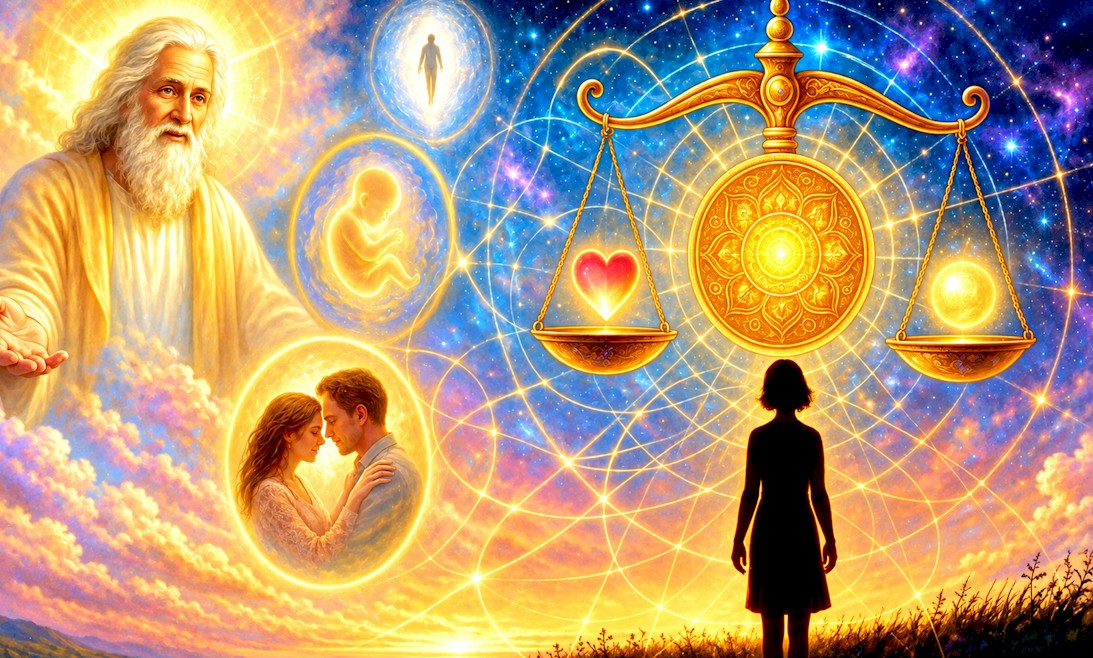
Karma and reincarnation exists as twin principles of spiritual growth. NDErs describe choosing their parents, life circumstances, and even the amount of karma they will “meet and settle” before birth. Some, like Arthur Yensen and Edgar Cayce, portray Earth as a school where difficult conditions are not random misfortune but carefully selected lessons. Others, like the subjects studied by Dr. Michael Newton, report pre-life memories with spirit guides and soul groups in which past actions are reviewed and future lives are planned. The goal is the healing of old wounds, balancing karmic debts, and advancing spiritual growth. Life reviews during NDEs reinforce this view: people relive their actions from the standpoint of those they helped or hurt, discovering that what they do to others, they truly do to themselves. Karma, in this context, is experienced as an impersonal but compassionate law of cause and effect. Karma, therefore, is the process of self-realization. The goal is to become so enlightened that all our negative karma is gone and we do not need to reincarnate to take on more karma and suffering.
These insights of karma from NDEs agrees with the world’s religious traditions. Hinduism and Buddhism have long taught that karma and rebirth govern the soul’s journey until enlightenment is reached. Jewish and Christian scriptures repeatedly affirm that we “reap what we sow,” that every deed returns to us, and that God‘s justice operates with exactness yet with mercy. Mystics, biblical scholars, and modern researchers – from Origen and Edgar Cayce to contemporary NDE researchers – have suggested that reincarnation and karma are the missing links that reconcile God’s love with the apparent injustices of life. These testimonies show how NDEs reveal karma as memory, responsibility, and opportunity. NDEs also show how free will interacts with destiny; and how, ultimately, karma itself is meant to be transcended through forgiveness and unconditional love.
Interestingly, both science and religion recognize the law of karma. In science it is often stated, “For every action there is an equal and opposing reaction.” Its religious counterparts are, “An eye for an eye, a tooth for a tooth“; “As you sow, so shall you reap”; and “As you do unto others, it will be done unto you.” Even today’s common knowledge expresses this principle in the saying, “What goes around, comes around.”
Many of the NDE testimonies referenced in this article are drawn from firsthand accounts generously shared on the Near-Death Experience Research Foundation (NDERF.org) website. I gratefully acknowledge NDERF and its founders, Dr. Jeffrey Long and Jody Long, for their decades of dedication to collecting, preserving, and publishing the world’s most comprehensive archives of NDE testimonies. Their ongoing research and stewardship of these testimonies make it possible for readers, researchers, and NDErs alike to deepen their understanding of the profound insights reported during NDEs.
2. Karma as Soul Learning
NDEs consistently portray karma as a purposeful system of spiritual learning woven into the fabric of the soul’s journey. NDErs report discovering that life is not assigned randomly and that souls actively participate in shaping the circumstances into which they are born. According to these testimonies, karma functions as a framework of spiritual growth: the consequences of past actions, lessons unfinished, and virtues still to be developed all help determine the challenges and opportunities of an incarnation into physical life.
Arthur Yensen says we chose our life and how much karma we would settle: “We choose the life we are going to live and how much karma we are going to meet and settle.”
Dr. Michael Newton revealed that karmic debts from past lives are evaluated for us to choose our next incarnation: “Eventually the soul is motivated to start the process of incarnation. While our spiritual environment is hard to leave, as souls we also remember the physical pleasures of life on Earth with fondness and even nostalgia. When the wounds of a past life are healed and we are again totally at one with ourselves, we feel the pull of having a physical expression for our identity. Otherworldly training sessions with our spirit guides and peer groups have provided a collaborative spiritual effort to prepare us for the next life. Our karma of past deeds towards humanity and our mistakes and achievements have all been evaluated with an eye toward the best course of future endeavors. Souls must now assimilate all this information and take purposeful action based upon three primary decisions: (1) Am I ready for a new physical life? (2) What specific lessons do I want to undertake to advance my learning and development? (3) Where should I go, and who shall I be in my next life for the best opportunity to work on my goals?”
According to Edgar Cayce, some people decide to be born into favorable conditions and some people decide to be born into unfavorable conditions. The choice has to do with satisfying divine justice and karma.
Edgar Cayce revealed the circumstances and conditions a soul chooses to incarnate into is usually made at conception, when a channel for a soul’s expression is opened by the parents. When this occurs, a pattern is made by the mingling of the soul patterns of the parents. This sets up certain karmic conditions. A soul whose own karma approximates these karmic conditions will be attracted to the opportunity presented. Since the karmic pattern created by the parents will not be exactly the same the incarnating soul’s own karma, the soul must take on some of the karma of the parents.
Reincarnation researcher Amber Wells states: “Our own desire to grow and learn leads us to be born in the physical realm.”
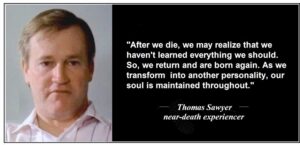
Thomas Sawyer learned that having “bad karma” means we have personal characteristics to deal with: “After we die, we may realize that we haven’t learned everything we should. So, we return and are born again. As we transform into another personality, our soul is maintained throughout. Our soul does not get bigger or smaller. We carry with us the characteristics of our former personalities. The phrase ‘burning off bad karma’ means that we have characteristics that we have to deal with.”
Gerry L. returned to life to pay karmic debts: “I felt like I was allowed to experience a speed of light but remembering like I was there forever awareness of the Source of All Existence and that also I had to go back to Earth to clean up my karma.”
3. Karma Revealed in the Life Review
NDE testimonies repeatedly show karma to be an intimate, lived reality revealed through the life review. NDErs describe being immersed in the feelings, intentions, and consequences of their actions toward others. They do not face judgment from an angry God; rather, they become the very people they helped or harmed, discovering that every thought, word, and deed reverberates through a shared spiritual reality. This deeply personal encounter with moral cause and effect is often described as the soul’s direct education in karma.
Ruth was given a life review which she described as karma: “I was shown all my life experiences, and I WAS the person whom I had hurt or helped so that I felt what they felt when I had erroneously acted against or helped them. A voice told me ‘you have been judged’… being the other person [that] I judged myself. Hard to explain, seems easiest for me to call it karma.”
Philip S. discovered that his life review is a karmic process: “I felt the positive and negative energy I gave to with the people I met. Almost like karma, if I had committed a good deed to a person, happiness would return to me. If I caused someone pain, their pain would return to me.”
Dr. Kenneth Ring states the life review is an immediate understanding of karma: “What you see with full awareness [in the life review] are the effects not only of your actions on others, but also the effects of every thought and every emotion, since they affect others, too, whether you have been aware of it or not. Needless to say, this can be a very humbling and painful experience, but it takes place, remember, in a context of compassionate understanding for why you have behaved as you did. And it is you who are doing the judging. And what you come to understand through this experience, as a number of writers on the NDE have already pointed out (e.g., Farr, 1993; Lorimer 1990; Reanney, in press; Sogyal 1993) is that there is only one person in the universe: you. You see that the Golden Rule is not merely a prescription for ethical conduct, it is how it works. Everything you do unto others you yourself experience, for in this state you become the very people you have hurt and the very people you have aided. It is, in short, an immediate intuitive understanding of the law of karma.”
Galadriel K. experienced a life review as a karmic process: “We discussed more and somehow got onto the topic of how my dad, in another life, was my best friend; and my mom was my wife in another life. They even said my brother and a few of my siblings were our children. I had the understanding that all of these other lives were interwoven with my current life. All of the actions in one life impacted the actions I took in another. I guess that could be considered karma. Though, I felt that the life review was me experiencing the consequences of my actions as well. So, I would argue that the life review is karma and seeks to help us balance our energy and gain understanding and wisdom.”
Roger C. learned his life review was like a credit/debit system: “I could feel the good and bad emotions I made them go through. I was also capable of seeing that the better I made them feel and the better the emotions they had because of me would give me some credits (karma) and that the bad ones would take some of it back – just like in a bank account, but here it was like a karma account to my knowledge. The more points (karma) I got would give me permission to access a better area or a better place somewhere. It was the knowledge I had then.”
Abby Jo O.‘s life review revealed opportunities to balance karma: “It (the life review) was a knowing in a general way that I had agreements, contracts for the future, obligations and also opportunities to balance karma, to heal myself.”
Jeff H. learned that karma is a force of balance: “I very much felt a sense of karma exists both here and there, mostly as a force of balance. My life review and the way that it made me feel about myself has made me want to be good to others, but here in this life I’m still human, and continue to make mistakes. Maybe this has made me more mindful. Geez…starting to sound like a Buddhist!”
Morgan A.‘s NDE gave him a better understanding of karma: “This gives me more understanding and awareness of karma and how it relates to us in general… What’s important is to know that your karma will bite you in the ass if you have it coming!”
Gary S. learned in his life review that humans are spiritually connected by karma from previous lives: “During my NDE of reliving my life, it was completely clear to me that everything happened for a reason, and that those reasons extended well beyond my 27-year-old life. In other words, we’re part of a web of interactions with others that could be interpreted as ‘past lives’ or as ‘karmically influenced.'”
Scott S. learned from his life review that his karma forced him to return to life: “Staying was not an option. I had karmas to live out and my ultimate, predetermined time of death was not due. I did not want to return once I saw my life preview and the horrors I would endure from my accident. Unfortunately, these are all coming true and it is difficult.”
Hindu life reviews involve karma rather than a final judgment. In Western NDEs, individuals often report undergoing a life review where they experience a review of their actions and their impact on others. This may be associated with feelings of judgment or accountability. In Hinduism, a similar life review might occur, but it may be more closely tied to concepts of karma and the consequences of one’s actions in future lives rather than a final judgment by a divine being.
Hindu NDEs involve karmic records being read to the NDEr. Hinduism’s vast spiritual tradition offers a rich interpretive framework for these NDEs. Concepts such as the atman, karma, reincarnation, moksha, and the many heavenly and hellish realms help explain why Hindu NDEs differ in imagery yet correspond in essence with universal patterns. Whether an NDEr meets Yama or a Being of Light, whether they hear their karmic record read aloud or witness a panoramic life review, the underlying elements of moral accountability, continued existence, and the possibility of spiritual progression remains the same.
Tibetan Buddhist teachings stress that by recognizing yourself as this Clear Light, you will attain liberation from the cycle of reincarnation. Many NDErs are convinced the Being of Light is their Higher Self. This is certainly in agreement with the Tibetan teachings. The life review appears again and again in NDE reports, and demonstrates so clearly the inevitability of karma and the far-reaching and powerful effects of all our actions, words, and thoughts.
Read more about the Life Review and the NDE.
4. Karma and Reincarnation
Across many NDE testimonies and wisdom traditions, reincarnation and karma appear as the universe’s tutoring system – how divine justice unfolds through time. In this view, nothing we think or do is lost; every intention leaves an imprint in a Universal Consciousness and returns to us as circumstance, lessons, and opportunities. The personality changes from life to life, yet the soul remembers, carrying forward tendencies, unfinished learning, and bonds of love. NDErs often describe life reviews that reveal a web of cause and effect stretching beyond a single lifetime – where spiritual growth, not condemnation, is the point. Compassion and unconditional love can transmute karmic debt, just as understanding can place a student beyond a course already mastered. Between lives, souls choose conditions suited to their next lessons for enlightenment. The testimonies below show that karma is the curriculum; reincarnation is the classroom; and love is the graduating test.
Arthur Yensen learned our Higher Self chooses how much karma we will pay in the next reincarnation: “Between lives, with the great knowledge of our oversouls, we choose the next life we are going to live and how much karma we are going to meet and settle. For example, if you abused animals, or people, in one life, your oversoul would probably cause you to reincarnate into a situation where you’d get abused to make you realize the misery you’ve caused others.”
NDE testimonies and reincarnation studies reveal that karma and reincarnation is a learning process. Earth functions as an accelerated school where love, wisdom, and free will are refined. Karma is the curriculum that returns our intentions to us for understanding. The life review is a compassionate system that clarifies our at-onement with the Light.
Edgar Cayce revealed current life circumstances is the result of karma. In time, we who are trapped in the cycle of birth and rebirth can once again come to know our original state and purpose, and regain our celestial birthright as a “companion” to God. In time we can again come to realize that the conditions in our current life is the result of our free actions and choices from past lives.
Stephen K. learned we resolve karma from previous lives: “I was aware that I was here to resolve karma from previous lives – which at this point I had failed to do.”
Edgar Cayce revealed how the soul reincarnates to “burn off” negative karma. A personality is only one facet of the soul. The soul may incarnate as any facet to express that particular portion of itself. As a soul approaches its completion of the cycle of reincarnation, the personality becomes more multi-sided and expresses greater facets of the soul. This is because each incarnation removes negative karma requiring less and less attention. Finally, the personality will become a complete expression of the soul and the cycle of reincarnation is finished for the soul.
Edgar Cayce stated that the law of forgiveness can nullify karmic debts. The law of karma demands that we meet every bit of our karmic debts. However, an even greater law exists, the law of forgiveness. If we wrong someone and that person forgives us, when the day comes that we approach God, we realize our memories which are incompatible with God, but forgiveness removes the barrier of separation. The law is so precise (what one gives one receives; no exceptions) that if we begin forgiving others, we begin to receive forgiveness upon ourselves. Unless, of course, we refuse to forgive ourselves.
In Hinduism, karma keeps a person trapped in the reincarnation cycle. What keeps us trapped in the samsaric cycle is the law of karma. In its simplest form, this law operates impersonally like a natural law, ensuring that every good or bad deed eventually returns to the person in the form of reward or punishment commensurate with the original deed. It is the necessity of “reaping one’s karma” that compels human beings to take rebirth in successive lifetimes. In other words, if one dies before reaping the effects of one’s actions (as most people do), the karmic process demands that one come back in a future life. Coming back in another lifetime also allows karmic forces to reward or teach through the circumstances to which one is born. Hence, for example, an individual who was generous in one lifetime might be reborn into favorable conditions in the next incarnation.
Thomas Sawyer learned that our karma can prevent us from merging completely with the light: “If a person dies and merges completely into the light, another reincarnation is improbable. However, it is more usual for people to have earthly attachments and not merge completely with the light. Such souls may have characteristics of their personality, which they do not want merged with the light.”
NDEs repeatedly suggest that reincarnation is remedial, not endless. In this view, Earth is a school where we develop love, wisdom, and free will – until we no longer need another lifetime to learn the same lessons. NDErs and researchers alike describe a process toward “graduation” which is merging more fully with the Light, where identity is clarified rather than erased, and where further growth can unfold without returning to the physical world.
This perspective reframes karma as education rather than punishment. Karmic debts are balanced through cause and effect, yet the higher law of forgiveness can transform what would otherwise require another incarnation. Many NDE testimonies also describe an intermediate realm – heavenly classrooms, councils, and training centers – where choices are reviewed and future paths are freely selected. In this realm, time can stretch. Some souls choose to serve others and attain spiritual growth without reincarnating at all.
What hinders “graduation” are unresolved attachments and misaligned desires that restrict the soul’s free expression. What advances it is the alignment of human will with divine will – love enacted in thought and deed – until the soul recognizes itself as part of God’s Light.
Testimonies from NDErs and researchers outline this pattern: why reincarnation occurs, how it can be transcended, and how forgiveness, free will, and spiritual maturation open the way home.
Cecil learned how to overcome reincarnation: “We are to live on Earth in such a way that we will not need to return to Earth after death.”
The NDEr and psychic Sylvia Browne revealed that severe negative karma leads to a temporary hell realm before reincarnation: “After death, people who accrued severe negative karma will enter a hellish realm for a short period. After they have reflected upon their actions, they will be allowed to reincarnate.”
Trisha S.‘s NDE was more inline with Eastern philosophies of karma and reincarnation: “I had been raised Lutheran and so always thought I had a more traditional expectation of what the afterlife was about. This was nothing like that. However, perhaps what I experienced is more in keeping with an afterlife taught in the Eastern philosophies of karma and reincarnation?”
Read more about Reincarnation and the NDE.
Read more about Reincarnation Beliefs Among NDErs.
Read more about Dr. Ian Stevenso0n’s Reincarnation Research.
5. Karma and Life’s Mission
NDE testimonies often describe karma as a learning framework built into the soul’s spiritual evolution. Many NDErs report that life’s challenges, relationships, and even moments of suffering were chosen before birth as opportunities to grow, repair past mistakes, and advance spiritually. These testimonies reveal a universe where every thought, word, and deed shapes future experience, and where personal responsibility and love are central to the soul’s journey. The following testimonies explore how individuals learned that karmic lessons, pre-birth choices, and the consequences of their actions are all part of a larger, purposeful design guiding each soul toward enlightenment.
Martine learned we chose our experiences in life before birth to pay for karma from past lives: “We know what our souls need to experience, in order to learn and evolve, and we choose our pathway, via birth parents, to experience and learn those lessons. We carry with us, to some degree, karma from past incarnations, and can work this off by how we live in our present physical life.”
Leea W. learned we choose before birth the karmic difficulties we will face in life: “We see hardship and difficulties as bad things. But in truth, they are our greatest teachers. These experiences are doorways, or a fork in the road. We can choose an opportunity to learn, grown, and make wiser choices. We create karma in all we think, feel, say, and do. This includes what we call good, bad, indifferent, etc.”
Angie Fenimore was taught profound spiritual lessons resulting from a suicide attempt such as: (1) Life’s hardships are necessary for spiritual growth; (2) Committing suicide has devastating ripple effects on her children, husband, sister, and even strangers; (3) Suicide would cause negative karma impacting millions indirectly through damaged relationships and broken futures; and (4) Hell is both a state of mind and a dimension, and that death simply reveals the spiritual condition a soul has cultivated during life. Willingness to seek the light was key to escaping spiritual darkness.
Leonardo learned that fulfilling his mission pays bad karma: “All the people that I had wronged and cheated in my life, I made it my mission to go and apologize to all of them. After doing so, I felt a heaviness lifted from my soul as if I had paid my karma.”
Arthur Yensen defined karma: “Karma is the totality of all our actions – good and bad – which determine our fate, or destiny. If we do only good things we will eventually run out of bad karma and only good things will happen to us, and vice versa. The purpose of karma is to force us to learn life’s lessons. Between lives, we choose the next life we are going to live and how much karma we are going to meet and settle. For example, if you abused animals, or people, in one life your oversoul would probably cause you to reincarnate into a situation where you’d get abused to make you realize the misery you’ve caused others.”
Amy J. learned karma helps us and others attain heaven: “We all need to help and be helped to reach that place, so get over all the silly stuff that we are hung up on. Karma. Karma. Karma.”
Duane S. learned karma is the overarching rule in earthly life: “There is only three basic things that we need do in our earthly life. We come here looking for a new series of adventures, as a new soul in the physical universe. We only have three purposes in coming here. Number one is to experience fun and excitement, defined in any way we choose, as we try to do the second thing we’re here for, that is to remember who we are. The third thing we are here to do is to help others remember who they are. The one overarching rule of the game is called karma. If you pat somebody in the back we get a pat on the back later. If we kick somebody in the butt, we get kicked in the butt later. Gradually over many lifetimes we come to realize that it’s better to pat people in the back than to get kicked in the butt.”
Catherine Ann M. learned that receiving help to complete a mission is because of karma from past lives: “I experienced a brief communication on the matter. Such as, an agreement that I had not achieved my mission yet… And other individual’s lives end, before they complete their divine mission. Why some people have helpers, who save them from death. Whereas others do not receive that assistance. I’ve been told this is because of good karma, acquired from past lives.”
Wan I. learned that karma is like the Butterfly Effect: “There are greater powers at play, which moves our destiny – I believe in what physics calls ‘The Butterfly Effect’, which is how some things or events within our lives are put into motion. Some religions call it destiny or fate, while others may call it karma, but it is interrelated. There are even a set of rules on how ‘hardships’ happens in our lives as each test given to us is normally targeted specific to our own behavioral weaknesses.”
Read more about Life’s Mission and the NDE.
6. Karma and Free Will
Edgar Cayce revealed that free will is greater than karma. Everyone’s life is shaped to some extent by their karma. But karma is not greater than free will because with free will, anything is possible.
Cayce revealed that karma is memory of past actions arising from free will. Reactions to past thoughts and actions become our fate, destiny, and karma. An individual’s fate is simply the rebounding effects of previous choices remembered by the soul. As companions of God, we are free to live and choose and grow almost as we desire, but not without being subject to the universal, spiritual law of karma. Through meeting our thoughts, words, and deeds we learn to discern wisdom from folly, lasting strength from weakness, and true life from illusion. In turn we become more able to fulfill our ultimate purpose for existing: to be a companion to the Universal Creator. The law is actually a magnificent tool for perfect learning. It is completely impersonal. Everyone experiences it equally and for the purpose of enlightenment.
Most karmic reactions, in fact, come from the individual’s own deep memory of what it has done. This is why karma has been described as memory. Karma is memory coming to consciousness again. What has occurred in the past is recalled and has an effect on the present. Now, the recollection may not surface to the conscious level; the personality may have no awareness of the memory, in fact. Yet, it exists at the deeper, soul level. Nevertheless, the soul sees through the same eyes as the personality and is reminded of its past use of free will and consciousness. Naturally, some of these memories will be compatible with the Universal Mind and some will not. Memory is an important concept in understanding how the law of karma works.
Edgar Cayce revealed that the free will of humanity is discovering how all roads to higher knowledge leads toward the same destination and conclusions. Scientific, theological, and philosophical knowledge, which has no desire to join forces, are approaching a point of merger. Skepticism faces destruction by its own hand.
Humanity is at all times the total of what they have been and done, what they have fought and defended, and what they have hated and loved. In the three-dimensional consciousness of every human, in every atom of the human body, is a reflection of the soul and a crystallization of their individuality. Their emotional and nervous structures, their mental abilities, aptitudes, aversions, preferences, fears, follies, ambitions, and character, are the sum of what humans have done with their free will. This makes every personality, as the earthly “cloak” of an individuality, is different from every other personality.
The law of karma, which is Earth’s law of cause and effect also makes humans different from one another in their joys and sorrows, in their handicaps, their strengths, their weaknesses, their virtues and vices, their appreciation of beauty, and their comprehension of truth. Transgressions that humans make in life must be corrected in life, if not in the same life, then in a future incarnation. The Earth’s natural law, not the law of humanity or God, demands an eye for an eye, a tooth for a tooth.
This same law applies to groups of people, as they act together. There is karma for families, for tribes, for races, and for nations. For example, when a nation of individuals started a war in a previous lifetime and are reincarnated, a war will be committed against that nation. Only when such a nation is defeated in humility by a nation with justice and mercy, will the karma of war be lifted from the defeated nation.
Every person’s life is shaped to some extent by karma: their own, their associates, their loved ones, their nation, their race, and the entire world itself. But karma is not greater than free will. It is what a person does with these influences and urges, how they react to them, which makes the difference in their soul development. Because of karma, some things are more probable than others, but as long as there exists free will, anything is possible.
Thus free will and predestination coexist within human beings. Their past experiences limit them in probability and incline them in certain directions, but free will can always “draw the sword from the stone.” The combination of free will and predestination means humans freely choose their own predetermined destiny to return to God.
Science has also affirmed the reality of karma. Researchers from the Max Planck Institute for Limnology in Germany staged a series of complex computerized social games with 114 students. Their results appear in science magazine Nature. Manfred Milinski and colleagues had the students play two types of games, both using money as an incentive. Each game had six players who were kept anonymous by using pseudonyms. The history of each game was on screen so that the players could see what everyone else was doing, but there was no risk of identification after the game (or when they collected their cash). The central issue in such games is how to sustain a public resource the “tragedy of the commons.” Without controls, individuals tend to use more than their share of the resource, destroying it for everyone. A common way of dealing with this is to punish the greedy people, which acts as an incentive for others to behave. The authors of the German study suggest positive reinforcement as an alternative. If people can see others performing good acts then they are more likely to behave in a publicly beneficial way. Read more about it at this news article.
Eleven of fourteen subjects in Dr. Kenneth Ring’s NDE reincarnation study believed in the concept of karma or at least were open to it. Five of the eleven, however, qualified their affirmation with further explanation of their beliefs:
“Yes, but not in that sense. We progress at our own rate to reach the light. If you do things that take you away from the light, then you are perpetuating your time here.”
“[I] don’t believe in karma as some people do – that it is pre-destiny. We have karma but we can change it.”
“Karma is misunderstood; it’s not just negative. Everything is karma, even thoughts.”
“Consequences carry over to some degree, but the emphasis is not so much on the physical act, but more on what is going on inside.”
NDEs reveal there is a process on the Other Side determining the number of destinies a soul can choose from and follow when the soul leaves the heavenly realm for residence on Earth. Destinies are based on a soul’s karma and are astrologically connected to corresponding heavenly and hellish afterlife realms.
7. Karma Is Ultimately About Love
NDE researcher Jody Long says unconditional love releases bad karma: “Karmic lessons are said to be over when the lessons are learned, and there is no more animosity or anger projected at the other person. The key is forgiveness. Karma is released when you love the other person unconditionally in spite of their shortcomings.”
Arthur Yensen learned unselfish love can lead to no more bad karma: “How are we saved? By unselfish love. If we do only good things we will eventually run out of bad karma and only good things will happen to us, and vice versa. The purpose of karma is to force us to learn life’s lessons whether we want to or not. The only way to bypass karma is to develop so much unselfish love that paying for bad karma will serve no purpose – much like a college student challenging a course he already knows. We evolve faster through unselfish love.”
Marta M. learned that good actions clear negative karma: “I’m very aware that whatever I see or even hear about a being needing help, I will go out of my way to help and that’s enough. It kind of taught me how to be a good person. I’m not a good person, but I act like one; and I know this is what is needed to be done to clear my karma.”
Arthur Yensen learned we take our karma with us at death: “We came into this world to have trouble and to learn from it. Unfortunately many people don’t realize this and complain about their bad luck and spend their lives chasing pleasure, fame and money. Then they die without making any spiritual progress. And so they waste life after life. It should be obvious that all we’ll take with us is our character, our karma and our abilities, and that we’ll have to live with people like ourselves. Therefore, our highest success would be to rise into the highest heaven through unselfish love.”
In NDE testimonies, self-love becomes the training ground for unconditional love – the kind that lightens karma, restores inner harmony, and aligns us with the God presence within.
Read more about Love and the NDE.
8. Karma Is Not Punishment
According to Edgar Cayce, karma is memory and not punishment. Karma is memory coming into consciousness again. What occurred in the past can be recalled and have an effect on the present. The recollection may not surface to the conscious level; the personality may have no awareness of the memory, in fact. Yet, it exists at the deeper, soul level.
However, there is a way that “bad karma” can be diminished. If a soul, knowing another soul has wronged it, forgives that soul and holds no lingering resentment perhaps has even forgotten the wrong in the depths of its forgiveness and understanding then it begins to take hold of the power of forgiveness. The more it forgives, the more it perceives and understands forgiveness. Then, when the soul approaches the Universal Mind and realizes it possesses memories that are incompatible with It, forgiveness is much more viable, removing the barrier of separation. Humans have became so encapsulated in the physical that we began to identify ourselves more with our bodies than with our consciousness. We began to think of ourselves as physical entities rather than a free, living consciousness. We began to think we were only physical beings and our heavenly origins began to be forgotten. The physical body is so substantial, so captivating that it is difficult to hold on to the more delicate reality of spirit-thoughts, pure point of consciousness in a Universal Mind.
Edgar Cayce understood karma not as punishment or fatalism in the traditional sense, but as a spiritual law of cause and effect that ensures growth, balance, and the soul’s return to God. Cayce portrayed karma as a compassionate, educational force woven into the fabric of existence – one that guides each soul toward healing, harmony, and remembrance of its true nature. Cayce repeatedly emphasized that karma is opportunity, not retribution.
According to Cayce, every thought, intention, emotion, and action generates an energy pattern that continues in the soul until it is resolved. This pattern becomes karma, a record of unfinished learning or unresolved consequences that the soul carries forward. He described it simply as principles such as (1) “Thoughts are deeds“; (2) “Mind is the builder”; and (3) “As you sow, so shall you reap” spiritually, mentally, and physically. Thus karma is not only about actions. Karma includes the motivations behind the actions. It includes the emotional energy attached to them, and the lessons the soul did or did not learn. Every soul creates its own karmic conditions based on the choices made in past incarnations.
The Edgar Cayce readings are emphatic that God does not punish. Karma is not divine wrath nor cosmic judgment. It is the soul encountering conditions it set in motion, so that growth may occur. He often stated that karma exists only to: (1) balance the soul; (2) teach missing lessons (especially love); (3) restore harmony; (4) complete spiritual growth, and; (5) bring the soul closer to its original wholeness. Even difficult karma is viewed as corrective and educational, not punitive.
Sara A. learned karma is not about punishment: “I awoke with a complete understanding of everything about our purpose here, about energy, and karma. However, ‘karma’ has become a corrupted word. It’s as close as humanly possible to describing what this energy is. ’Karma’ has a confusing human judgment or punishment now attachment to it.”
Alba Monn learned that difficulties in life are not punishment due to karma: “A hard fate is not a punishment due to karma, but rather an especially difficult test for the own life-balance, with the expectation to master these challenges well!! This means more work for eternity. That’s positive!”
Patricia B. learned karma is receiving what you give: “The older I become, the more I realize that karma is a reality. You definitely receive what you give, measure for measure.”
Maria TK believes her good karma allowed her to see the light: “I’m grateful that I had good karma and was sent to the Light, despite the fact that I wasn’t any kind of angel back then. And yet, God was merciful enough to let me explore him.”
9. Edgar Cayce on Karma
In Edgar Cayce‘s 2005 book “Reincarnation and Karma,” his amazing ability to read the Akashic Record, the so-called “Book of Life“, during his afterlife journeys provides us with some of the best insights into reincarnation and karma available today. Of the thousands of discourses Cayce gave, these on reincarnation (how and why it occurs, with hundreds of examples) and karma (the nature of karmic reactions and how to resolve them in your life) are the most profound, most popular, and most helpful.
a. Merging With the Light Has Karmic Possibilities
According to Edgar Cayce, everyone’s ultimate mission in life is to merge with the light which has karmic possibilities. As a soul draws closer to the Universal Mind, it becomes aware that some of its memories are not compatible with the Creator, and since its ultimate purpose for being is companionship with the Creator, it seeks out opportunities to resolve these incompatible memories.
Suppose a soul criticizes another soul among its peers and behind its back. As it becomes more aware of its true nature, it will recall this wrong and, because of its incompatibility with the Creator, will seek to correct it. Now, the resolution could take many forms. The soul might seek out an opportunity to work closely with the injured soul as a supporter, assistant, publicist, agent, or the like. Or perhaps it would seek to re-create the original scene putting itself in a position to criticize the other soul again in front of the same peers. The test would be to see if the soul would choose not to criticize this time, even if it meant a certain loss of position for itself. Throughout all this the soul grows wiser and more compatible with the Creator.
If, however, a soul has gotten so far away from its true nature that it has no conscience, then the law of karma can become a formidable obstacle to any further free will action. Such a soul becomes surrounded by its karma; everywhere it turns, it meets the terrible effects of its previous action and thoughts. Yet, even a soul who has gotten in this pathetic situation can return to perfection because there is no total condemnation from the Creator or the law. If the soul turns away from its self-centeredness and begins acting, reacting, thinking, and speaking like a companion to the Universal Mind, then the law is just as perfect as it is with error; and the reactions begin to build and establish a new destiny for that soul.
Karma is memory. As one recalls or relives situations, one meets self again, and a new decision point, or crossroads, is presented to the soul. In life, “good karma” would be equated with compatible, harmonious actions and thoughts which consider the needs and desires of others, along with self’s needs and desires. “Evil” would be equated with actions and thoughts that are motivated by a self-orientation that pays little or no attention to the needs and desires of others and the Whole. Metaphysically speaking, good results in oneness, and evil results in a sense of separation. Decisions in one’s life could be approached by evaluating which choices promote greater oneness and which promote separation.
Cayce revealed that everyone must meet every bit of their karma. However, there is a way that it can be modified or even alleviated. If a soul, knowing another soul has wronged it, forgives that soul and holds no lingering resentment perhaps has even forgotten the wrong in the depths of its forgiveness and understanding then it begins to take hold of the power of forgiveness. The more it forgives, the more it perceives and understands forgiveness. Then, when it approaches the Universal Mind and realizes it possesses memories that are incompatible with it, forgiveness is much more viable, removing the barrier of separation. The law is so precise (what one gives one receives; no exceptions) that if one begins having mercy on and forgiveness of others, one begins to receive mercy and forgiveness upon oneself. Unless, of course, one refuses to forgive oneself.
All of one’s karma has to be met. And yet, no soul is given more than it can bear to carry. This is the paradoxical blessing hidden in the limitations of time and space. A soul is given the time it needs to turn away from its selfish ways and, like the prodigal son, return home to a feast of joy and welcome from our Creator. Reincarnation is not a way to avoid judgment and responsibility. It is a way to allow the soul enough time to correct its mistakes and develop itself.
b. Karma and Resurrection
Edgar Cayce revealed that “resurrection” is not the rising of physical bodies from graves, but the awakening of the soul into higher consciousness – a spiritual transformation that happens both after death and within this life. Cayce said resurrection occurs when the soul leaves the physical body and awakens to its true nature as spirit.
In his readings, Cayce defined resurrection as: “The awakening to the consciousness of the soul body.” (Edgar Cayce Reading 1173-1) This “soul body” is the form you inhabit between incarnations.
Cayce repeatedly said that death itself is only a transition: “There is no death. Only the resurrection into the spirit.” (Edgar Cayce Reading 3744-4) Cayce revealed that as soon as the soul exits the physical body, it is alive, aware, and fully functioning in a higher dimension. There is no sleeping in graves nor waiting for a future end-of-time event.
Another surprising teaching from Cayce: resurrection is a daily event: “Resurrection is the rising of the Christ Spirit within.” (Edgar Cayce Reading 5159-1), In this sense, when someone awakens love, compassion, forgiveness, or spiritual awareness, they are “resurrecting” their true nature while still alive.
Cayce directly rejected the idea that dead physical bodies reanimate: “It is not the physical body that is resurrected” (Edgar Cayce Reading 262-109). Instead, he explained that the “body of resurrection” is a spiritual body, similar to what Paul describes as a “spiritual body” in 1 Corinthians 15. The physical body returns to dust; the soul continues in a more refined form.
Cayce said Jesus manifested his “resurrected body” as a spiritual body made visible, not a revived physical corpse: “He (Jesus) became the first to make the body of the soul manifest in the Earth plane” (Edgar Cayce Reading 2917-1). Jesus showed humanity what all souls experience after death, except he demonstrated it consciously and at will.
Cayce revealed that the “Resurrection of the Dead” is actually the final reunion with God. Cayce described a long-term spiritual evolution through many incarnations. The ultimate resurrection – what Christianity calls “the last day” is the soul’s final return to its Source: “The final resurrection is the return of every soul to the Creator” (Edgar Cayce Reading 5749-3). This is not a single event in history, but the destiny of every soul.
Cayce said humanity is entering a period of spiritual awakening in which many will “resurrect” to higher consciousness while still alive: “This is the age when the Christ Consciousness shall rise in the hearts of men” (Cayce Reading 2366-1). This collective rising is a form of resurrection on a global scale.
In summary, Cayce’s teaching on resurrection includes: (1) Resurrection is spiritual, not physical; (2) It is the awakening of the soul into its eternal body; (3) Everyone is “resurrected” immediately at death; (4) Resurrection also occurs within life when we awaken the divine within; (5) Jesus demonstrated the soul-body as a model for humanity; (6) The ultimate resurrection is the soul’s permanent return to God; and (7) Humanity is moving toward a collective resurrection in consciousness.
c. God’s Mission For Humanity
Edgar Cayce revealed God’s mission for humanity is for them to reverse negative karma through a limited series of reincarnations to attain a perfect human-divine as Jesus did. Cayce taught that God’s plan for fallen human souls is a limited series of reincarnations with periods in between of dwelling in other heavenly dimensions with increasingly righteous souls dwelling in higher afterlife realms while increasingly unrighteous souls dwelling in lower afterlife realms. Reincarnation would continue until a soul’s every thought and action of the physical body was in accord with the plan originally laid out for the soul (i.e., toward a human-divine unity, Christ consciousness). Accordingly, this plan of the conquest of the physical body that had trapped souls was fostered by a soul who had completed his experience of creation, attained Christhood, returned to God, and became a companion to God and a co-creator. This is the soul known as Jesus. The soul of Jesus was deeply concerned about the plight of his fellow souls trapped in Earth. Jesus realized it was necessary to give humanity a pattern by which they could follow in order to return to God. Jesus achieved this goal by incarnating and becoming victorious over the death of the physical body by laying aside the ego, and accepting the crucifixion of the body in order to return to God. Through the acts of leading a perfect life and becoming unjustly killed, Jesus reversed the negative karma which originated from Adam. When a person has successfully followed the pattern set by Christ and attained complete human-divine unity, its cycle of reincarnations finishes. The person’s soul is then liberated and merges with God in the highest heaven becoming a permanent citizen.
10. Karma and Religion
Karma is an ancient Hindu concept that refers to an action, work, or deed, and its effect or consequences. In Hindu religions, the term more specifically refers to a principle of cause and effect. A form of karma also appears in the world’s great religions.
a. Karma and Buddhism
NDE researcher Hawa Bangura says Buddhism teaches that karma is stored in a higher level of consciousness and afterlife: “Buddhism teaches that we have nine ‘levels of consciousness ‘ the first five are equivalent to our five senses, the sixth is the ‘mind’ which integrates information gathered from the five senses, the seventh is volition or ‘free will’ and sense of self, the eighth is the storehouse, where all our karma is recorded… and the ninth is Buddhahood or enlightenment, which is characterized as a state of compassion, profound wisdom, eternity, true self and purity. The storehouse, which cannot be accessed by our human senses, but becomes accessible upon death, also seems to correspond to the life review. The karma in the storehouse includes not only karma created in this lifetime but for prior lifetimes. Our karma also determines why our lives are the way they are ‘ i.e. whether we are reborn beautiful/ugly, wealthy/poor, healthy/sickly, male/female, black/white, have short lives or long ones, etc, etc. To a certain extent, we are also said to voluntarily assume the appropriate karma in order to fulfill our mission in this lifetime.”
Buddhists believe that upon death, there is rebirth to another life. Death is accepted as inevitable and not feared. The believer’s actions in this life will determine his or her level of rebirth. Karma is the force created by the actions of the individual – the effects of actions. Good karma, which is achieved by compassionate actions in this life, leads to a higher existence in the next life. Nirvana is reached by achieving an understanding of the nature of reality. This must be discovered through the experiences of other dimensions of human consciousness (Klein, 1991, p. 103).
According to Buddhist cosmology, numerous, hierarchically arranged heavens exist along with eight hot and cold hells. The individual spirit exists in one of these realms, based upon the karma created in the previous life, until reborn into another life. This cycle continues until the enlightenment of Nirvana is achieved (Klein, 1991).
Buddha accepted the basic Hindu doctrines of reincarnation and karma, as well as the notion that the ultimate goal of the religious life is to escape the cycle of death and rebirth. Buddha asserted that what keeps us bound to the death/rebirth process is desire, desire in the sense of wanting or craving anything in the world. Hence, the goal of getting off the “Ferris wheel” of reincarnation necessarily involves freeing oneself from desire. Nirvana is the Buddhist term for liberation. Nirvana literally means extinction, and it refers to the extinction of all craving, an extinction that allows one to become liberated.
The Tibetan Buddhist Book of the Dead (Bardo Thodol), composed in the 8th century by the guru Padmasambhava, describes what happen after death and the role of karma. The first period after death is called the “first bardo.” At the very moment of death, there dawns the “Clear Light of Ultimate Reality” which is the soul’s own mind and self. If the soul recognizes this fact and acts in a way to remain in this state, it has been liberated from the cycle of birth and rebirth on Earth and can stay in this condition in the highest dimension for eternity called Nirvana. If the soul does not recognize the Clear Light as one’s own mind and self, it is pulled down by the weight of its karma into the second stage of the first bardo, called the “Secondary Clear Light.” If the soul is not liberated at this stage, it will descend to the second bardo.
The second bardo is divided into two stages. In the first stage, the soul encounters a number of great peaceful light beings. When the soul encounters one of these light beings, if the soul is attracted to the light of one of these beings, it will inhabit the dimension associated with that light being. If at any time, the soul realizes the light is from the soul’s own mind and self, it will be liberated.
In the final stage, if the soul has not attained liberation, it encounters a number of great angry light beings. If the soul realizes these lights stem from the soul’s own mind and self, it will be liberated. If not, it will descend to the third bardo.
In the third bardo, the soul is judged by the “Lord of Death” who holds up to the soul the “Mirror of Karma” which reflects all the soul’s deeds. The soul can attain liberation here, as well, if it recognizes its oneness with the light. If not, the lights of the six dimensions of the universe appear again and into one of these dimensions the soul is reborn into the world.
b. Karma and Hinduism
Hinduism, one of the world’s oldest living spiritual traditions, contains a rich cosmology involving karma, reincarnation, the cycle of samsara, and numerous heavens, hells, and divine beings. These beliefs naturally shape how Hindu NDErs understand what happened to them during clinical death. Instead of tunnels of light or encounters with Jesus or angels – common elements in Western NDEs – Hindu NDEs may feature Yama, the god of death; celestial clerks reviewing karmic records; or messengers who escort the soul to other realms. Rather than a final judgment or a panoramic life review, the evaluation may revolve around whether the person was correctly “summoned” according to divine timing.
Dr. Ken Vincent describes karma in Hinduism: “Hinduism is very diverse, but all Hindus believe in the Law of Karma. Karma means that good actions bring good results and evil actions bring evil results, i.e., your actions in this life determine your fate in the afterlife and reincarnation. For Hindus, union of the soul (Atman) with the Most High God (Brahman) is the ultimate goal.”
NDE researcher Dr. David San Filippo describes the Hindu concept of karma: “According to Swami Adiswarananda (1991), in the Hindu religion, death comes as a break in the continued events of life and brings about a change in the form in which the spirit resides. Hindus believe the afterlife is a passage of time in a heaven or hell, dependent upon the karma built up in life. The judgment about one’s life is based upon the karma the individual created in his or her past lives. The rebirth of the spirit into the next life, through the transmigration of the soul, is determined by the developed karma and the individual’s last thoughts in the present life. An individual’s search for eternal happiness and immortality results in the rebirth of the spirit in different bodies until the spirit learns that happiness and immortality are not a result of the fulfillment of desires but are attained when all desires and needs are no longer important (Adiswarananda, 1991; Elb, 1906). According to some Hindus, the various religious faiths are “different paths to reach one and the same goal – union with God as ultimate Reality” (Johnson & McGee, 1991).
c. Karma and Christianity
Jesus Christ and Karma
The teachings of Jesus Christ and the concept of karma both speak to a universal moral order rooted in cause and effect. While originating from different religious traditions, Jesus and karma share a common message: our actions shape our spiritual growth and our future experiences. Jesus emphasized that we “reap what we sow,” pointing to a divine justice in which love, mercy, and personal responsibility guide the soul’s journey. Karma, likewise, teaches that every thought, word, and deed creates consequences that eventually return to the soul, offering opportunities for learning and transformation. When viewed together, the teachings of Jesus and the principle of karma reveal a harmonious vision of spiritual accountability, compassion, and the ongoing evolution of the soul.
According to all reincanationalist religions, reincarnation is not a goal to be achieved, rather reincarnation is something to be avoided. Reincarnation is something to be overcome through enlightenment and the performing of good works and good karma. Overcoming bad karma and overcoming the cycle of death-and-rebirth means obtaining eternal life. This is the true meaning behind the Christian idea of receiving “eternal life.” For example, Jesus told the believers of the Church of Philadelphia that once they overcome the world, they will never again have to leave heaven: “The one who is victorious I will make a pillar in the temple of my God. Never again will they leave it.” (Revelation 3:12)
Ian McCormack saw the glory of Jesus and the force of karma: “Paul was blinded by a glorious light on the road to Damascus, the glory of Jesus. And I was now standing there seeing this incredible light and glory. As I stood there, questions began racing through my heart; ‘Is this just a force, as the Buddhists say, or karma, or yin and yang? Is this just some innate power or energy source or could there actually be someone standing in there?’ I was still questioning it all. As I thought these thoughts a voice spoke to me from the centre of the light. The voice said ‘Ian, do you wish to return?'”
A person’s accumulation of “bad” and “good” karma determines which heaven or hell in God’s hierarchy of afterlife realms they dwell in between Earth lifetimes. As Jesus said, there are many abodes in his Father’s house (John 14:2), and there are many levels of heaven and hell. Everyone is on a path moving up God’s “corporate ladder of success” (see “Jacob’s Ladder“). Everyone’s goal is the highest heaven which is permanent citizenship there (Revelation 3:12). In fact, the physical universe is just one of the Father’s abode – one level of heaven – out of many. We are actually spirit beings having a physical experience which means we come from higher spirit realms with missions from God to further God’s Kingdom in the physical.
Reincarnation and karma are the missing links – the long lost doctrines – of Christianity. They are the keys to understanding the secret, mystery teachings of Jesus and his parables. A good example is the beginning of Jesus’ Parable of the Talents:
“It (the kingdom of heaven) is as if a man, going on a journey, summoned his slaves and entrusted his property to them; to one he gave five talents, to another two, to another one, to each according to his ability. Then he went away” (Matthew 25:14-15). In karmic and soul-development terms, this parable describes how souls are entrusted with spiritual resources – abilities, strengths, lessons, relationships, challenges, and opportunities – according to their level of spiritual development.
Jesus taught how his followers would reincarnate in the future with good karma. The following Bible verse is a promise Jesus made to those who have forsaken everything to follow him: “So Jesus answered and said, ‘Assuredly, I say to you, there is no one who has left house or brothers or sisters or father or mother or wife or children or lands, for my sake and the gospel’s, who shall not receive a hundredfold now in this time – houses and brothers and sisters and mothers and children and lands, with persecutions – and in the age to come, eternal life.” (Mark 10:29-30) Without reincarnation and pre-existence, this promise of Jesus is nonsensical and would be impossible to implement. For example, if people had only one life to live, these words of Jesus would mean those who leave their house and parents for Christ and the gospel’s sake would receive a hundredfold houses and parents in heaven. It is self-evident that this promise of Jesus is intended to be fulfilled in future lifetimes on Earth.
The following are more Bible verses of Jesus teaching karma:
“Do not judge, or you too will be judged. For in the same way you judge others, you will be judged, and with the measure you use, it will be measured to you.” (Matthew 7:1-2)
“For everyone who asks receives; the one who seeks finds; and to the one who knocks, the door will be opened.” (Matthew 7:8)
“So in everything, do to others what you would have them do to you, for this sums up the Law and the Prophets.” (Matthew 7:12)
“For the Son of Man is going to come in his Father’s glory with his angels, and then he will reward each person according to what they have done.” (Matthew 16:27)
“Woe to the world because of the things that cause people to stumble! Such things must come, but woe to the person through whom they come!” (Matthew 18:7)
“For those who exalt themselves will be humbled, and those who humble themselves will be exalted.” (Matthew 23:12, Also: Luke 14:11, Luke 18:14)
“Consider carefully what you hear,” he continued. “With the measure you use, it will be measured to you – and even more.” (Mark 4:24)
“And when you stand praying, if you hold anything against anyone, forgive them, so that your Father in heaven may forgive you your sins.” (Mark 11:25-26)
“Do not judge, and you will not be judged. Do not condemn, and you will not be condemned. Forgive, and you will be forgiven. Give, and it will be given to you. A good measure, pressed down, shaken together and running over, will be poured into your lap. For with the measure you use, it will be measured to you.” (Luke 6:37-38)
“On one occasion an expert in the law stood up to test Jesus. ‘Teacher,’ he asked, ‘what must I do to inherit eternal life?’ ‘What is written in the Law?’ he replied. ‘How do you read it?’ He answered, ‘Love the Lord your God with all your heart and with all your soul and with all your strength and with all your mind; and, Love your neighbor as yourself.’ ‘You have answered correctly,’ Jesus replied. ‘Do this and you will live.'” (Luke 10:25-28)
“Forgive us our sins, for we also forgive everyone who sins against us.” (Luke 11:4, Also: Matthew 6:12)
The brother of Jesus, James the Just, wrote this karmic verse: “Peacemakers who sow in peace reap a harvest of righteousness.” (James 3:18)
Jesus also taught how to stop and reverse the cycle of bad karma when it happens to you: “But to you who are listening I say: Love your enemies, do good to those who hate you, bless those who curse you, pray for those who mistreat you. If someone slaps you on one cheek, turn to them the other also. If someone takes your coat, do not withhold your shirt from them. Give to everyone who asks you, and if anyone takes what belongs to you, do not demand it back. Do to others as you would have them do to you. If you love those who love you, what credit is that to you? Even sinners love those who love them. And if you do good to those who are good to you, what credit is that to you? Even sinners do that. And if you lend to those from whom you expect repayment, what credit is that to you? Even sinners lend to sinners, expecting to be repaid in full. But love your enemies, do good to them, and lend to them without expecting to get anything back. Then your reward will be great, and you will be children of the Most High, because he is kind to the ungrateful and wicked. Be merciful, just as your Father is merciful.” (Luke 6:27-36)
The Apostle Peter described how Jesus practiced what he preached in stopping bad karma instead passing it along: “To this you were called, because Christ suffered for you, leaving you an example, that you should follow in his steps. ‘He committed no sin, and no deceit was found in his mouth.’ When they hurled their insults at him, he did not retaliate; when he suffered, he made no threats. Instead, he entrusted himself to him who judges justly.” (1 Peter 2:21–23)
The following list of Bible verses are more promises of how good karma (through good works) can ultimately lead to the end of reincarnation and the beginning of eternal life in God’s Kingdom:
“Blessed are the merciful, for they will be shown mercy. Blessed are the pure in heart, for they will see God. Blessed are the peacemakers, for they will be called children of God. Blessed are those who are persecuted because of righteousness, for theirs is the kingdom of heaven.” (Matthew 5:7-10)
“Use worldly wealth to gain friends for yourselves, so that when it is gone, you will be welcomed into eternal dwellings.” (Luke 16:9)
“A certain ruler asked him (Jesus), ‘Good teacher, what must I do to inherit eternal life?’ ‘Why do you call me good?’ Jesus answered. ‘No one is good – except God alone. You know the commandments: ‘You shall not commit adultery, you shall not murder, you shall not steal, you shall not give false testimony, honor your father and mother.’ ‘All these I have kept since I was a boy,’ he said. ‘When Jesus heard this, he said to him, ‘You still lack one thing. Sell everything you have and give to the poor, and you will have treasure in heaven. Then come, follow me.'”(Luke 18:18-22)
Jesus taught another way to overcome bad karma through simply not responding to bad behavior or through responding with righteous behavior. Here are some examples of these teachings:
“You have heard that it was said, ‘Eye for eye, and tooth for tooth.’ But I tell you, do not resist an evil person. If anyone slaps you on the right cheek, turn to them the other cheek also.” (Matthew 5:38-39)
“You have heard that it was said, ‘Love your neighbor and hate your enemy.’ But I tell you, love your enemies and pray for those who persecute you, that you may be children of your Father in heaven.” (Matthew 5:44-45)
Although all our actions have repercussions, not everything happening to us is the result of previous karma. Here is a good Biblical example presented by Christ: “Now there were some present at that time who told Jesus about the Galileans whose blood Pilate had mixed with their sacrifices. Jesus answered, ‘Do you think that these Galileans were worse sinners than all the other Galileans because they suffered this way? I tell you, no! But unless you repent, you too will all perish. Or those eighteen who died when the tower in Siloam fell on them – do you think they were more guilty than all the others living in Jerusalem? I tell you, no! But unless you repent, you too will all perish'” (Luke 13:1-5). In this verse, the people around Jesus assumed the Galileans were killed because of bad karma; but Jesus explained this was not the case. Bad things can happen because of bad karma, and bad things can happen without karmic origins. One thing we know for certain is that the persecution of those Galileans will result in their gaining good karma. And as for Pilate’s unjust actions, they will certainly result in his own bad karma.
In a different incident, Jesus did refer to how bad karmic actions can result in bad karmic consequences. After Jesus healed the invalid of thirty-eight years near the Sheep Gate pool, he later told him: “See, you are well again. Stop sinning or something worse may happen to you.” (John 5:1-15)
As previously mentioned, the law of karma is also called the law of cause and effect (causality). This law is so universal it can even be found in science. Isaac Newton (1642–1726) established the well known third law in physics: for every action there always opposed an equal reaction. What goes up must come down. In fact, the law of divine justice is very similar in principle to the law of gravity. Both laws are impersonal. Breaking both of these laws are like breaking the laws of nature. We cannot blame God for the apparent injustices happening to us in life. Like the law of gravity, if we go against the law of divine justice, it is completely our fault and due to our ignorance of divine justice. However, there are even greater divine laws which can overcome bad karma. They are God’s law of love, the law of forgiveness, and the law of grace.
Some Christians deny the law of karma based on certain passages in Paul’s epistles which emphasize salvation by faith and grace alone. Such Christians claim good works are no guarantee of salvation though they believe good works are an important part of Christian life. They claim we are not required to perform good works, such as seek forgiveness and pay restitution to those we’ve transgressed against, because Christ paid for all our transgressions. But Jesus taught differently:
“Settle matters quickly with your adversary who is taking you to court. Do it while you are still together on the way, or your adversary may hand you over to the judge, and the judge may hand you over to the officer, and you may be thrown into prison. Truly I tell you, you will not get out until you have paid the last penny.” (Matthew 5:25-26)
“In anger his master handed him over to the jailers to be tortured, until he should pay back all he owed. This is how my heavenly Father will treat each of you unless you forgive your brother or sister from your heart.” (Matthew 18:34-35)
“Whoever does not take up their cross and follow me is not worthy of me.” (Matthew 10:38, Also: Luke 14:27)
“Whoever wants to be my disciple must deny themselves and take up their cross and follow me.” (Matthew 16:24, Also: Mark 8:34, Luke 9:23)
Jesus mentioned several times of a judgment according to works. Here is a list of them:
“But I tell you that everyone will have to give account on the day of judgment for every empty word they have spoken. For by your words you will be acquitted, and by your words you will be condemned.” (Matthew 12:36-37)
“For the Son of Man is going to come in his Father’s glory with his angels, and then he will reward each person according to what they have done.” (Matthew 16:27)
“Look, I am coming soon! My reward is with me, and I will give to each person according to what they have done.” (Revelation 22:12)
According to NDE testimonies from the life review, “God’s judgment” after death is really self-judgment at which time we enter the light of God where all is made known. Having your true inner self revealed in the light can be “hell” for those who have been motivated mostly by negative forces and bad karma in life. Having your true inner self revealed can be “heaven” for those who have been motivated mostly by positive forces and good karma in life. Everyone’s true inner nature, their spirit, is a part of God – a “spark of the divine.” Everyone who enters the afterlife after death begins to realize their true inner nature. Those who lived a life against their inner self will find difficulties when entering into the light. This is the self-realization and self-judgment as revealed by Jesus:
“This is the verdict: Light has come into the world, but men loved darkness instead of light because their deeds were evil. Everyone who does evil hates the light, and will not come into the light for fear that his deeds will be exposed. But whoever lives by the truth comes into the light, so that it may be seen plainly that what he has done has been done through God.” (John 3:19-21)
Kevin Williams shares his views on karma and Christian salvation: “God’s law of divine justice, karma, universal salvation, pre-existence, Christian perfection, a ‘correcting judgment’ process and reincarnation are mentioned many times throughout the Bible. People who are not perfected must be reincarnated until they become perfected. The Bible mentions that Jesus needed to be perfected by suffering on the cross (Hebrews 5:8-9) implying he had a human nature subjected to reincarnation. The process of sanctification obviously takes more than one lifetime because the goal for everyone is to become like Christ – the perfect image of God within man.
“Only reincarnation offers continued personal identity and further spiritual growth after death. People are judged according to God’s law based upon their good and bad works. People who have not overcome their bad works must reincarnate until they do. The Bible repeatedly states that God’s law (the Ten Commandments) has never been abrogated and Jesus affirmed this fact. Paul apparently dismissed “the law”; but careful scholarship shows Paul was rejecting the following of the Jewish Mosaic law of mitzvah, which Jesus himself rejected, and was not rejecting the Ten Commandments.
Kevin Williams continues: “There are abundant Bible verses teaching salvation by soul growth through performing “good works of faith” according to God’s law – especially in the teachings of Jesus – and perfecting through the Holy Spirit. Salvation begins with repentance and the continual non-practice of sin. Those sinners who refuse to do so will not attain eternal life and will instead continue the cycle of reincarnation until they no longer practice sin. Everyone is working toward the goal of permanent citizenship in God’s highest heaven – eternal life – whether they are aware of it or not; and the method is through reincarnation. Jesus has shown us the way — the pattern to follow. Jesus is the way-shower. We must take up our own crosses and follow his example if we want to attain the highest heaven. The NDE life review experienced by millions of people prove how people are ‘judged’ by their deeds after death and that past lives are also reviewed after death. For all these reasons and more, reincarnation must now become a doctrine of Christianity as it was widely believed during the first hundred years of Christian history.”
The Apostle Paul and Karma
The Apostle Paul (5-67 AD) was a Pharisee; and according to the Jewish historian Josephus (37-100 AD), the Pharisees were believers in reincarnation and karma. Josephus, a Pharisee himself, repeatedly described the Pharisees as believing in the continued life of the soul, reward and punishment after death, and – most strikingly for modern readers – the transmigration (reincarnation) of souls into new bodies. According to Josephus, “They (Pharisees) say that every soul is incorruptible, but that only the souls of good men pass into other bodies, while the souls of the wicked suffer eternal punishment.” (Antiquities 18.1.3)
The fact that the Pharisees were believers in karma and reincarnation can be seen in the Epistles of Paul:
“Do not be deceived: God cannot be mocked. A man reaps what he sows. Whoever sows to please their flesh, from the flesh will reap destruction; whoever sows to please the Spirit, from the Spirit will reap eternal life. Let us not become weary in doing good, for at the proper time we will reap a harvest if we do not give up. Therefore, as we have opportunity, let us do good to all people, especially to those who belong to the family of believers.” (Galatians 6:7-10)
“Whoever sows sparingly will also reap sparingly, and whoever sows generously will also reap generously.” (2 Corinthians 9:6)
Only reincarnation can satisfy God’s divine justice of reaping what we sow; an eye for an eye; living by the sword and dying by the sword. This universal law of God explains why some people are born into favorable conditions and others are born into unfavorable conditions.
God’s law of divine justice of “an eye for an eye,” also known as “karma,” is the law of reincarnation and is mentioned throughout the Old and New Testaments, the gospels, Jesus’ parables, and the Epistles.
According to the biblical concept of “original sin,” Adam’s sin created “bad karma” for himself and for his descendants – spiritual death – which was “paid” by Christ at the cross (1 Corinthians 15:22). However, Christ’s atonement for sins and the redemption of sinners of “original sin” does not nullify karma.
Karmic debts against other people are separate from our karmic debts to God for sin because God’s law was not nullified at the cross (Matthew 5:17-20). God may forgive a man for killing another man; but God’s forgiveness of his sins doesn’t nullify the murderer’s obligation to seek forgiveness, pay restitution, and restore the karmic “balance” with his victims.
The Christian “mystery” of reincarnation is that a person’s accumulation of “bad” and “good” karma determines which level of heaven or hell in God’s hierarchy of afterlife realms they dwell in between Earth lifetimes.
Jesus taught people how to overcome and reverse the cycle of bad karma when it happens to them by “turning the other check when slapped” for example, and through good karma or good works, and through the greater divine laws of love, forgiveness, and grace.
Some people are born into unfavorable conditions because of “bad karma” from a previous lifetime. This can be seen in the story of Jacob and Esau as described by Paul:
“Just as it is written: ‘Jacob I loved, but Esau I hated.’ What then shall we say? Is God unjust? Not at all! For he says to Moses: ‘I will have mercy on whom I have mercy, and I will have compassion on whom I have compassion.’ It does not, therefore, depend on human desire or effort, but on God’s mercy. For Scripture says to Pharaoh: ‘I raised you up for this very purpose, that I might display my power in you and that my name might be proclaimed in all the Earth.’ Therefore God has mercy on whom he wants to have mercy, and he hardens whom he wants to harden. One of you will say to me: ‘Then why does God still blame us? For who is able to resist his will?’ But who are you, a human being, to talk back to God? Shall what is formed say to the one who formed it, ‘Why did you make me like this?’ Does not the potter have the right to make out of the same lump of clay some pottery for special purposes and some for common use?” (Romans 9:13-21)
By comparing the sovereignty of God over humans with the sovereignty a potter has with clay, Paul is also affirming both the pre-existence and karma of Jacob and Esau. The central point Paul makes is that God created Esau as an object of wrath because of his so-called “hatred” for him before he was even born. God must have “hated” Esau because of a past incarnation displeasing to Him which can only explain why God reincarnated him as an “object of wrath.” The opposite destiny of Esau was the destiny of Jacob. Because Jacob had led a previous life pleasing to God, Jacob was reincarnated as an object of God’s mercy. So the story of Jacob and Esau is rich with hidden knowledge concerning divine justice, the sovereignty of God, pre-existence, reincarnation, predestination, and free will.
Origen of Alexandria (185-253 AD) was one of the most influential figures in early Christian theology who taught karma and reincarnation. Origen also wrote of the “karma” of Jacob and Esau: “‘Is there unrighteousness with God? God forbid.’ (Romans 9:14) As, therefore, when the Scriptures are carefully examined regarding Jacob and Esau, it is not found to be unrighteousness with God that it should be said, before they were born, or had done anything in this life, ‘the elder shall serve the younger;’ and as it is found not to be unrighteousness that even in the womb Jacob supplanted his brother, if we feel that he was worthily beloved by God, according to the merits of his previous life, so as to deserve to be preferred over his brother.” (Origen, On First Principles 2.9.7)
The following is a list of more Bible verses by Paul on how to deal with the God’s just law of karma:
“Do not repay anyone evil for evil. Be careful to do what is right in the eyes of everyone. If it is possible, as far as it depends on you, live at peace with everyone. Do not take revenge, my dear friends, but leave room for God’s wrath, for it is written: ‘It is mine to avenge; I will repay,’ says the Lord.” (Romans 12:17-19)
“God is just: He will pay back trouble to those who trouble you.” (2 Thessalonians 1:6)
“For we must all appear before the judgment seat of Christ, so that each of us may receive what is due us for the things done while in the body, whether good or bad.” (2 Corinthians 5:10)
“For we know him who said, ‘It is mine to avenge; I will repay,’ and again, ‘The Lord will judge his people.'” (Hebrews 10:30)
Karma is described in the Hebrew Bible: “The law of divine justice (karma) reveals the case of John the Baptist as a reincarnation of the prophet Elijah. Elijah killed with a sword the prophets of Baal who were associated with the King’s wife Jezebel. And although Elijah may have repented and God forgiven him, divine justice demands “life for life, eye for eye, tooth for tooth” to satisfy divine justice (Exodus 21:23-25). So when Elijah reincarnated as John the Baptist, his life had to end by being killed by the sword. This law of divine justice, karma, is taught elsewhere in the Bible:
“All who draw the sword will die by the sword.” (Matthew 26:52)
“He who kills with the sword must be killed with the sword.” (Revelation 13:10)
This law of divine justice taught by Jesus is known by eastern religions as “karma” and is practically a universal religious concept. It is a law which implies reincarnation and can be found throughout the Bible. And in such cases as John the Baptist and Elijah, people who “kill with the sword” and do not “die by the sword” in their lifetime (as is often the case), must do so in a future lifetime. In fact, the law of karma IS reincarnation. Every action has an equal and opposite reaction according to the law of karma (causality). Karma is the law of cause and effect – action and reaction. There is in this universe a strict balancing process steadily at work which deals justly with everyone “according to their works.”
“Bad karma” is not the “sin” or transgression itself. Bad karma is a state of imbalance in the equilibrium of divine justice in the negative direction in a person’s life because of particular sins committed which have yet to occur to the sinner. According to the biblical concept of “original sin,” Adam’s sin created “bad karma” for himself and for his descendants – spiritual death – which was “paid” by Christ at the cross (1 Corinthians 15:22). Christ’s atonement for sins and the redemption of sinners does not nullify karma. Karmic debts against other people are separate from our karmic debts to God for sin because God’s law was not nullified at the cross (Matthew 5:17-20). God may forgive a man for killing another man; but God’s forgiveness of his sins doesn’t nullify the murderer’s obligation to seek forgiveness, pay restitution, and restore the karmic “balance” with his victims. Otherwise, it would be erroneous for people such as Adolf Hitler, for example, could have “accepted Jesus” as savior before he killed himself and it would be his “ticket” to heaven. Sure, God would have forgiven him. But what about the millions of people he ordered killed? Hitler has a lot of things to set right. And although God’s forgiveness could spare Hitler a very, very long time of purification in hell, everyone is still judged according to their works – both good and bad. It is easy for a God of infinite love and mercy to forgive even the worst of sinners, but unless the sinner seek (and get) forgiveness, pay restitution, and give good karma to his victims, then a karmic debt still remains. So the salvific work of Christ on the cross doesn’t necessarily nullify the effect of all sin or karma. To be sure, God has forgiven us of our sins – our sins against God unto death. God forgives the murderer for murdering his victims. But only the victims can forgive (or not forgive) the murderer for the murderous act against them. If, as Jesus taught, the victim is of a pious nature and forgives the murderer, then that karma is paid and ends there. Else, the cycle of karma continues and the murderer faces the possibility of being murdered in another lifetime.
Origen and Karma
According to Origen of Alexandria, this idea of God giving people varying amounts of abilities at birth – each according to his ability – is the heart of reincarnation and the law of divine justice. Origen used this very parable to teach pre-existence and reincarnation. Here is an excellent summary of Origen’s position on pre-existence and reincarnation based upon his work “On First Principles”:
“Every soul has existed from the beginning; it has therefore passed through some worlds already, and will pass through others before it reaches final consummation. It comes into this world strengthened by its victories or weakened by the defeats of its previous life. Its place in this world as a vessel appointed to honor or to dishonor is determined by its previous merits or demerits. Its work in this world determines its place in the world which is to follow.” (Hatch, Edwin, and A M. Fairbairn. The Influence of Greek Ideas and Usages Upon the Christian Church. London: Williams and Norgate. page 235)
“The soul, as we have frequently said, is immortal and eternal, it is possible that, in the many and endless periods of duration in the immeasurable and different worlds, it may descend from the highest good to the lowest evil, or be restored from the lowest evil to the highest good.” (Origen, On First Principles 3.1.21)
“If they (souls) had a beginning such as the end for which they hope, they existed undoubtedly from the very beginning in those (ages) which are not seen, and are eternal.” (Origen, On First Principles 3:5:4)
“The cause of each one’s actions is a pre-existing one; and then every one, according to his merits, is made by God either a vessel unto honor or dishonor… it is due to previous causes.” (Origen, On First Principles 3:1:20)
“At the consummation and restoration of all things, those who make a gradual advance, and who ascend (in the scale of improvement), will arrive in due measure and order at that land.” (Origen, On First Principles 3.6.9)
When Origen used the Parable of the Talents to refer to reincarnation and pre-existence, he was not introducing some foreign religious concept into Christianity. He was merely expressing what is described throughout the Bible and believed by early Christians to be one of the secret teachings of Jesus. At the end of the Parable of the Unforgiving Servant in Matthew 18:21-35, Jesus mentioned karmic divine justice which can also be viewed as a Universalist parable denying eternal damnation:
“In anger his master handed him over to the jailers to be tortured, until he should pay back all he owed. This is how my heavenly Father will treat each of you unless you forgive your brother or sister from your heart.” (Matthew 18:34-35)
As Paul taught, using the story of Jacob and Esau, knowing the divine justice of karma allows us to ask and answer, “Is God unjust? Not at all.” It also allows us to understand some of the apparent injustices in the Old Testament. Here is one of them: “‘Today you (God) are driving me (Cain) from the land, and I will be hidden from your presence; I will be a restless wanderer on the Earth, and whoever finds me will kill me.‘ But the Lord said to him, ‘Not so; anyone who kills Cain will suffer vengeance seven times over.’ Then the Lord put a mark on Cain so that no one who found him would kill him.” (Genesis 4:14-15)
Many Bible versions of verse 14 are translated as Cain saying “every one who finds me will kill me” suggesting Cain believed he would be killed by many people in many lifetimes implying reincarnation. God’s reply to Cain also implies reincarnation and karma when God declared “anyone who kills Cain will suffer vengeance seven times over” meaning the killer of Cain will have to be killed seven times implying seven lifetimes.
Consider the next apparent injustices in the Old Testament: “You shall not bow down to them (idols) or worship them; for I, the Lord your God, am a jealous God, punishing the children for the sin of the parents to the third and fourth generation of those who hate me.” (Exodus 20:5, Also: Deuteronomy 5:9)
“The Lord is slow to anger, abounding in love and forgiving sin and rebellion. Yet he does not leave the guilty unpunished; he punishes the children for the sin of the parents to the third and fourth generation.” (Numbers 14:18)
According to Strong’s Exhaustive Concordance 1755, the Hebrew word translated “generation” is “dor” meaning “a revolution of time” – also “a dwelling.” The latter is especially significant, as our human bodies are characterized in scripture as temporary dwellings. So with this understanding, it is consistent with sound interpretation to also translate this verse, “he punishes the children for the sins of the parents to the third and fourth reincarnation (bodily dwelling) of those who hate me.” A literal interpretation of the above verses describe God punishing the children and great-grandchildren for the sins of the parents. The obvious question again is: “Is God unjust?” The only answer can be: “Not at all.” And the reason is because of divine justice, karma, and reincarnation. God punishes the parent when they reincarnate as one of their own grandchildren or great grandchildren – the third and fourth generation. And it is common knowledge in reincarnation studies how people tend to reincarnate within their own families; for example, a father may reincarnate as their own grandchild or great grandchild.
Because a person’s karma carries over from one lifetime to the next, the question then arises, “Is there an end to reincarnation; and if so, how does it end?” Thankfully, the Bible has an answer for this question as well. The short answer is bad karma can be overcome through good karma or good works: “Whoever sows to please the Spirit, from the Spirit will reap eternal life.” (Galatians 6:8)
So while it’s true that people are saved by the grace of God, it means God’s grace allows us the time and space through reincarnation to follow Jesus, carry our own cross, and pay for our karmic transgressions against others as God has forgiven our transgressions against Him. As Paul stated: “You were bought at a price.” (1 Corinthians 6:19-20)
So Christ paid the karmic debt of Adam’s transgression as the great burden-bearer of our bad karma against God. But inherent in God’s grace is our obligation to follow Christ, take up our own cross, pay our karmic debts against others, become transformed into his image, and attain at-onement with God. And because of this, we can say along with Paul: “Now if we are children, then we are heirs – heirs of God and co-heirs with Christ, if indeed we share in his sufferings in order that we may also share in his glory.” (Romans 8:17)
God’s law of divine justice as the law of karma is mentioned many times throughout the Bible. The biblical teaching of universal salvation implies reincarnation and is also mentioned many times throughout the Bible. Reincarnation, universal salvation, and the law of karma are doctrines which can be found in the Old and New Testaments, the Gospels, the Epistles of Paul, the parables of Jesus, all Hebrew and Christian writings, the Dead Sea Scrolls, the Christian Gnostic gospels, the Torah, the Apocrypha, the Kabbalah and Zohar. The Bible teaches how bad karma can extend into multiple lifetimes; and how overcoming bad karma with good karma ultimately leads to eternal life – no more reincarnation and death. The Bible also teaches how God’s law of love, grace, and forgiveness overcomes bad karma. Reincarnation is God’s plan for people to “work their way up” through the afterlife realms immediately after death, through earning good karma and paying for bad karma on Earth, with the goal of becoming permanent citizens in God’s Kingdom. For all these reasons and more, reincarnation must now become an official doctrine of Christianity as it was widely believed during the first 500 hundred years of Christian history.
The Ten Commandments have always remained in effect, demanding bad karma among people be paid, and people be judged according to their works both good and bad. And a perfecting process exists where people are “saved” by good works whereby people spiritually evolve into Christ’s image through the Holy Spirit in a multiple-lifetime reality of reincarnation. The following are more Bible verses from Paul describing how people are judged according to their works both good and bad:
“God will repay each person according to what they have done.” (Romans 2:6)
“For we must all appear before the judgment seat of Christ, so that each of us may receive what is due us for the things done while in the body, whether good or bad.” (2 Corinthians 5:10)
“The one who plants and the one who waters have one purpose, and they will each be rewarded according to their own labor.” (1 Corinthians 3:8)
“If anyone builds on this foundation using gold, silver, costly stones, wood, hay or straw, their work will be shown for what it is, because the Day will bring it to light. It will be revealed with fire, and the fire will test the quality of each person’s work. If what has been built survives, the builder will receive a reward. If it is burned up, the builder will suffer loss but yet will be saved – even though only as one escaping through the flames.” (1 Corinthians 3:12-15)
d. Karma and Judaism
The Hebrew Bible (Christian Old Testament) is filled with references to karma; and therefore, reincarnation. Here is a list of some of them:
“Whoever sheds human blood, by humans shall their blood be shed; for in the image of God has God made mankind.” (Genesis 9:6)
“Cast your bread upon the waters, for you will find it after many days.” (Ecclesiastes 11:1)
“They sow the wind and reap the whirlwind.” (Hosea 8:7)
“Sow righteousness for yourselves, reap the fruit of unfailing love, and break up your unplowed ground; for it is time to seek the Lord, until he comes and showers his righteousness on you. But you have planted wickedness, you have reaped evil, you have eaten the fruit of deception.” (Hosea 10:12-13)
“As I have observed, those who plow evil and those who sow trouble reap it.” (Job 4:8)
“As you have done, it will be done to you; your deeds will return upon your own head.” (Obadiah 1:15)
“The wages of the righteous is life, but the earnings of the wicked are sin and death.” (Proverbs 10:16)
“Whoever seeks good finds favor, but evil comes to one who searches for it.” (Proverbs 11:27)
“Do not say, ‘I’ll pay you back for this wrong!’ Wait for the Lord, and he will avenge you.” (Proverbs 20:22)
“Whoever sows injustice reaps calamity, And the rod they wield in fury will be broken.” (Proverbs 22:8)
“Whoever digs a pit will fall into it; if someone rolls a stone, it will roll back on them.” (Proverbs 26:27)
“The one whose walk is blameless is kept safe, but the one whose ways are perverse will fall into the pit.” (Proverbs 28:18)
“The trouble they cause recoils on them; their violence comes down on their own heads.” (Psalm 7:16)
11. Conclusion
A case can be made that karma is the moral “physics” of a loving God and universe. Karma appears as memory, energy, and consequence woven into the soul’s journey – a law of cause and effect that returns our own thoughts, intentions, and deeds to us so we can understand, heal, and grow. Life reviews, pre-birth planning, soul agreements, and memories of past lives all point to a universe in which nothing is wasted, nothing is forgotten, and nothing is beyond redemption. What we send out does return – but in the hands of a compassionate God who seeks our awakening, not our destruction.
NDEs also show that karma and reincarnation are inseparable from free will. Souls are not randomly thrown into circumstances. Souls participate in choosing the lessons, relationships, and challenges that will best advance their spiritual growth. Earth emerges as a school where each lifetime is a course, each relationship a living education, and each decision an exam in love. Within this framework, harsh experiences are opportunities – sometimes very costly ones – to balance old karmic debts, repair broken human bonds, and discover a deeper identity as a Higher Self. And because free will is always active, karma is never a life sentence. At any moment, a change in attitude, behavior, or intention can begin to design our future.
Across Hindu, Buddhist, Jewish, and Christian traditions, it is taught that we reap what we sow. We meet what we have created. We are shaped by what we love or refuse to love. Eastern teachings describe karmic “akashic” records, “bardos,” and cycles of rebirth. Western scriptures speak of sowing and reaping, judgment according to works, and an afterlife where every hidden thing is brought to light. NDEs stand at the crossroads of these traditions, illustrating how the life review, karmic law, and God’s mercy work together. Self-judgment, in this context, is a confrontation with one’s own truth, in which the soul sees exactly how it has treated others and what still remains to be healed.
Within this larger pattern, forgiveness and unconditional love emerge as the “higher laws” that can transform karma. To forgive others is to lighten one’s own karmic load. To choose compassion instead of retaliation is to interrupt the chain reaction of cause and effect.