This site uses affiliate links to Amazon.com Books for which IANDS can earn an affiliate commission if you click on those links and make purchases through them.
1. Introduction to Veridical Dreams of the Dead
It sounds like a plot from a fictional Hollywood movie except it’s veridical (verifiably true). A man dies leaving all of his property to one of his four sons, excluding all his other sons. But one of the disinherited sons has a lucid dream in which the deceased father points the way to an unknown newer will which gives equal shares to all of his sons. The will is discovered exactly in the obscure location where the deceased father said it was located in the dream. The will is contested in probate; but the newer will of the deceased father wins in court. This case provides strong evidence in support of the Afterlife Hypothesis because of the obscure location of the newer will as referenced by the deceased father. This case is one of the more thoroughly researched and best attested indicating that the dead can sometimes return to correct an injustice. This case is known in parapsychology circles as the “Chaffin Will Case.”
Dreams about the dead are common, especially after the loss of a loved one. Accounts of veridical dreams – also known as after-death communications (ADCs) – have been reported across cultures and throughout history. In such dreams, the deceased may reveal the location of lost objects, communicate unknown facts, or even correct misunderstandings among the living. What makes these dreams especially intriguing is their apparent connection to real-world outcomes that can be checked and confirmed.
Researchers in fields like psychology, parapsychology, and consciousness studies have taken interest in these experiences. While some view them as coincidences or the result of subconscious processing, others see them as possible evidence that consciousness may extend beyond the brain and survive death. This article profiles the amazing details surrounding the Chaffin Will Case.
2. Where There Is A Will…
James L. Chaffin was a farmer in Davie County, North Carolina who had four sons. In November 1905, he made out a will leaving his farm and all assets to his third son, Marshall. He made no provision for his wife and three other sons, John, Pinkney and Abner.
In 1905, James wrote out and registered his will whereby:
“He gave his farm to his third son, Marshall, whom he appointed sole executor. The widow and the other three sons were left unprovided for.”
Why he wished to leave nothing to the rest of his family is not known. One theory is that Marshall’s wife, Susie, coerced James while he was staying with her and Marshall (as a result of a fire at his own home). Apparently Susie was a domineering person who terrified James. Then again, it could have been done out of a desire not to have his farm broken up. The existence of this document was known and recognized by all of the Chaffin family and, when James died suddenly in an accident from a fall in 1921, no one contested its validity.
That is, no one contested for four years; until it was challenged … by the ghost of James Chaffin himself!
How this happened is perhaps best told in the sworn testimony of the second son, Pinkney:
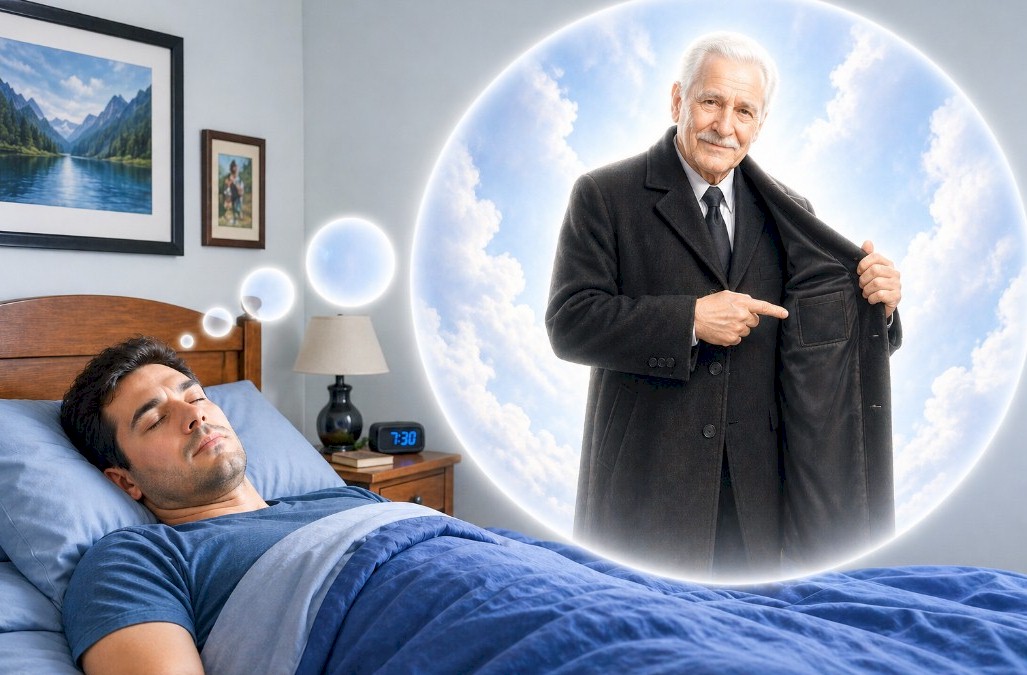
“In all my life I never heard my father mention having made a later will than the one dated in 1905. I think it was in June of 1925 that I began to have very vivid dreams that father appeared to me at my bedside but made no verbal communication. Some time later, I think it was the latter part of June, 1925, he appeared at my bedside again, dressed as I had often seen him dressed in life, wearing a black overcoat which I knew to be his own coat. This time my father’s spirit spoke to me, he took hold of his overcoat this way and pulled it back and said, ‘You will find my will in my overcoat pocket,’ and then disappeared. The next morning I arose fully convinced that my father’s spirit had visited me for the purpose of explaining some mistake. I went to mother’s and sought for the overcoat but found that it was gone. Mother stated that she had given the overcoat to my brother John who lives in Yadkin County about twenty miles northwest of my home.
“I think it was on the 6th of July, which was on Monday following the events stated in the last paragraph I went to my brother’s home in Yadkin County and found the coat. On examination of the inside pocket I found that the lining had been sewed together. I immediately cut the stitches and found a little roll of paper tied with a string which was in my father’s handwriting and contained only the following words: ‘Read the 27th chapter of Genesis in my Daddie’s old Bible.’
“At this point I was so convinced that the mystery was to be cleared up I was unwilling to go to mother’s home to examine the old Bible without the presence of a witness and I induced a neighbor, Mr. Thomas Blackwelder to accompany me, also my daughter and Mr. Blackwelder’s daughter were present. Arriving at mother’s home we had a considerable search before we found the old Bible. At last we did find it in the top bureau drawer in an upstairs room. The book was so dilapidated that when we took it out it fell into three pieces. Mr. Blackwelder picked up the portion containing the Book of Genesis and turned the leaves until he came to the 27th chapter of Genesis and there we found two leaves folded together, the left hand page folded to the right and the right hand page folded to the left forming a pocket and in this pocket Mr. Blackwelder found the [new] will.”
This will was dated January 16, 1919, which was more than thirteen years after the previous will was written and almost three years before the father’s death. It read as follows:
“After reading the 27th chapter of Genesis, I, James L. Chaffin, do make my last and testament, and here it is. I want, after giving my body a decent burial, my little property to be equally divided between my four children, if they are living at my death, both personal and real estate divided equal if not living, give share to their children. And if she is living, you all must take care of your mammy. Now this is my last will and testament. Witness my hand and seal. James L. Chaffin. This January 16, 1919.”
Apparently Chaffin later had a change of heart after reading the Genesis 27 in the Bible where it tells how Jacob deceived his father, Isaac, into giving him the birthright intended for his older brother, Esau.
Chaffin then took the will and hid it in his father’s old Bible — placing it in Genesis 27 — folding pages to form a pocket to hold the paper. For reasons unknown, he said nothing to anyone of his new will. It is possible that he intended to do so at an appropriate moment but was unable to follow through. Chaffin did write a note, however, which said:
“Read the 27th Chapter of Genesis in my Daddie’s old Bible.”
He rolled up the note, tied it with string and placed it in the inside pocket of his black overcoat. He stitched the pocket shut.
The cited section of the biblical book of Genesis concerns conflict between the two brothers over their inheritance from their father. Perhaps this is a clue as to why the new will was written, but no one can say for certain. As to why it was not simply announced when it was written perhaps James hoped to avoid a confrontation with Susie by postponing the revelation until he was on his deathbed. A hope dashed by his fatal accident.
On September 7, 1921 Chaffin died of injuries sustained in a fall. His 1905 will was probated, and the estate went to Marshall Chaffin. No one contested.
Four years later, in 1925, son Pinkney began having vivid dreams in which his father appeared at his bedside and stood in silence. In June 1925, the deceased Chaffin appeared by Pinkney’s bedside once again, dressed in his black overcoat. He took hold of his coat, pulled it back and said:
“You will find my will in my overcoat pocket.”
Then he vanished. The next morning, Pinkney awoke convinced that his father had communicated with him for the purpose of clearing up some mistake. He went to his mother’s home, where he found out that the overcoat was in the possession of his brother, John. On July 6, he visited John and found the coat. Upon examining it, James found the pocket that had been sewn shut. He opened it, found the note and read it.
Pinkney wisely found witnesses to accompany him back to his mother’s to retrieve the Bible in question. They included Thomas Blackwelder, a neighbor, Blackwelder’s daughter, and Pinkney’s own daughter. An eyewitness was needed, Pinkney said, because Pinkney’s father had told him he would find something very valuable hidden in an old family Bible. They found the Bible and discovered the will exactly where the deceased Chaffin said it would be.
Pinkney was elated. The document seemed to correct all the wrongs of the previous will, which had made provisions for only Marshall, who inherited all 102 acres of their father’s land, while the rest of the family was left out entirely.
3. A Ghost Goes To Court
About a week before the trial, the deceased Chaffin appeared again to Pinkney in an agitated state, saying:
“Where is my old will?”
Pinkney took this to be a sign that he would win the lawsuit.
In the fall of 1925, the will of James Chaffin was tendered for probate. A court would have to decide whether the newly-discovered will was valid. In court, Pinkney insisted that it was the ghost of his father who told him exactly where to find the document — with Blackwelder corroborating the fantastic tale.
Davie County Superior Court had never seen the likes of a probate case that had been spurred on by a ghost. Newspapers swarmed the courthouse and interviewed Pinkney, eager to hear details about how his father’s spirit had led him to the discovery of a second will.
Although he was willing to share stories of the visitations, Pinkney realized that pragmatism would win the day in court. He and his lawyers assembled ten former friends and associates of Chaffin’s, who could attest to the fact that the signature on the second will was legitimate. A jury wouldn’t necessarily need to believe in the afterlife if they took these witnesses at their word. But they wouldn’t even get that chance.
During a court recess, lawyers for both the Chaffin brothers and Susie agreed to a settlement. It’s likely Susie was advised that her chances of arguing against the validity of the second will were slim and that a jury ruling could leave her with nothing. (Even Susie agreed that the signature on the second will was legitimate.) Instead, she would accept one-quarter of the estate, leaving the rest to be divided equally among the brothers.
A judge made it official. The second will superseded the first.
The presence of Chaffin’s ghost in articles about the case led to attention from a number of outlets that had little or nothing to do with the judicial system. The following year, the Society for Psychical Research (SPR) dispatched a lawyer to interview the Chaffins to try and discern their sincerity. He found no evidence they — nor Blackwelder — were being deceptive.
Although there were no witnesses, at that time in the State of North Carolina a will was considered valid if it was entirely written in a hand that was incontestably that of the signatory. Three lawyers represented the three plaintiffs and ten witnesses were prepared to testify that the will was written in the father’s handwriting.
4. Aftermath
The Chaffin Will Case, as it came to be known, was widely reported in the U.S. and even in Canada. A Canadian member of the Society for Psychical Research was so intrigued by the case that he hired a lawyer, Mr. J. M. Johnson of Aberdeen, North Carolina, to research the case. Johnson interviewed several principals in the case (including Pinkney’s wife, daughter, and mother) and obtained sworn statements from two of them (the one given above and a collaborating one from the neighbor, Mr. Blackwelder. In his conclusions, Johnson stated that he was:
“…much impressed with the evident sincerity of these people, who had the appearance of honest, honourable country people, in well-to-do circumstances.”
The collaborating statement from Mr. Blackwelder reads as follows:
“My name is Thomas A Blackwelder. I am 38 years old and the son of H. H. Blackwelder. My home is on a farm in Callihan township about one mile from the place where James L. Chaffin died in 1921. I think it was on July 6, 1925, that Mr. J. P. [Pinkney] Chaffin, the son of James L. Chaffin and a neighbor of mine came to my house and asked me to go with him to his mother’s home and at the same time stated that his father had appeared to him in a dream and instructed him how he could find his will. Mr. Chaffin told me at the same time that his father had been dead about four years and had appeared to him in a dream and made known to him that he should look in the breastpocket of his old overcoat and there he would find something of importance. Mr. Chaffin further stated that he had gone to this overcoat and found a strip of paper in his father’s handwriting and he wanted me to go with him to his mother’s and examine the old Bible. I went with him and we made a search for the Bible and after some time we found it in a bureau drawer in the second story of the house. We took out the Bible which was quite old and was in three different pieces. I took one of the three pieces of the book and Mr. Chaffin took the other two pieces but it happened that the piece I had contained the Book of Genesis. I turned the leaves until I came to the 27th chapter and there found two leaves folded inward and there was a paper writing folded in these two leaves which purported to be the last will of James L. Chaffin.”
“I was fully convinced,” Pinkney said in his statement, “that my father’s spirit had visited me for the purpose of explaining some mistake.” Having had his message received, Pinkney said he was never contacted by his father again.
The Chaffin Will Case resembles a similar case that occurred near Ionia, Iowa, in 1891. That case, too, involved a farmer, Michael Conley, who was found dead in an outhouse. Upon hearing of his death, Conley’s daughter fell into a faint. Upon reviving, she said he had appeared to her and told her there was a large sum of money sewn inside a pocket inside the shirt he was wearing at the time of his death. She also described in detail his burial suit, including satin slippers that were of a new design, and which she could not have seen before. The clothes Conley had been wearing at the time of his death had been thrown away. They were recovered, and $35 (a large sum back then) were found sewn shut in an inside shirt pocket. This case also provides strong evidence of the Afterlife Hypothesis.
5. Other Veridical Dreams
Researchers distinguish between ordinary dreams about deceased people and dreams containing potentially verifiable (veridical) information. A dream in which a deceased mother says she is happy may be emotionally meaningful, but her statement cannot be independently verified. However, a dream in which she reveals the location of a hidden document that is subsequently found offers a claim that can be investigated.
Several historical cases illustrate this distinction.
A Deceased Father Reveals Family Photographs
Lucid dreaming researcher Robert Waggoner described several dreams that occurred after his father’s death. In these dreams, his father repeatedly drew attention to a suit hanging in a closet. Waggoner sensed that his father wanted him to look inside one of its pockets.
Initially, Waggoner did not investigate because he did not want to disturb his grieving mother. However, his niece later reported having a similar dream involving his deceased father and the closet.
This unexpected agreement encouraged Waggoner to search the remaining clothing. Although much of his father’s wardrobe had already been donated, a few suits remained.
Inside one of the pockets, he discovered a collection of treasured family photographs.
The case is noteworthy because two family members independently reported dreams that appeared to direct attention toward the same location. The photographs provided a physical discovery corresponding to the dreams.
Source: Hernandez, R., Schild, R., Grosso, M., Klimo, J., & Long, J. (Eds.). (2022). A greater reality: The new paradigm of nonlocal consciousness, the paranormal & the contact modalities (Vol. 2). Consciousness & Contact Research Institute.
A Deceased Woman Reveals Hidden Letters
Another case, described in research on encounters with the deceased, concerns a woman named Priscilla who reportedly communicated information about letters hidden in a trunk.
According to the account, the letters were discovered after the dream-related communication and contained evidence that helped resolve a child custody dispute.
The importance of this case lies in the practical nature of the information. The reported communication concerned physical documents that could be located and examined, rather than a general message of reassurance.
Source: Puhle, A. (2022). Encounters with the Deceased. Psi Encyclopedia. Last updated: 7 September 2026.
A Dream Reveals an Unexpected Death
NDE researchers Peter and Elizabeth Fenwick investigated reports in which people appeared to learn of a death through an unusual dream or other experience.
One case involved a woman who dreamed about her former husband on the night he died by suicide. The experience was so convincing that she canceled her work appointments the following morning, explaining that a death had occurred.
She subsequently went to her former husband’s home, where she discovered his body and contacted the police.
The case is significant because the woman’s reported actions occurred before she discovered the death. Such behavior can provide evidence that the dream was not simply reconstructed afterward.
Source: Pearson, P. (2015). Phenomena Related to Danger, Death, and Bereavement. Psi Encyclopedia. Last updated: 13 April 2026.
Two Siblings Receive the Same Message from Their Deceased Father
Peter and Elizabeth Fenwick also documented a case involving two siblings whose father died suddenly in August 1988.
Following his death, one sibling experienced disturbing dreams about the possibility that their father had been buried alive. These nightmares continued until a different dream occurred.
In the new dream, the father appeared healthy and happy. He reassured the dreamer that he was doing well and was staying with his uncle. The nightmares stopped.
Months later, during a Christmas visit, the dreamer learned that a sister had experienced similar nightmares. She also described a reassuring dream in which their father appeared and gave essentially the same message about staying with his uncle.
The siblings believed that their reassuring dreams might have occurred on the same night.
This is an example of a shared dream involving a deceased person. The matching message is potentially significant, although the father’s reported circumstances in the afterlife could not be independently verified.
Source: Puhle, A. (2022). Encounters with the Deceased. Psi Encyclopedia. Last updated: 7 September 2026.
Scientific Research on Dreams of the Deceased
Research suggests that dreams involving deceased loved ones are widespread and often deeply meaningful.
A 2026 systematic review published in Sleep Medicine (Mamat et al, 2026) examined research on dreams of deceased people. The researchers identified 110 publications for their scoping review and 76 for their mixed-methods review.
The findings showed that these dreams frequently involve comfort, guidance, communication, and feelings of continued connection. Some dreamers describe the deceased as appearing unusually vivid or real.
The review also discussed research by Puhle and Parker involving 80 lucid dreams of deceased individuals. Most involved relatives, and many participants considered their dreams meaningful.
These findings establish that dreams of the deceased are an important subject for psychological research.
Source: Mamat, Z. et al (2026). Dreams of the deceased: A scoping and mixed-methods systematic review. Sleep Medicine.
Shared Dreams
Shared dreams, also called mutual dreams or collective dreams, occur when two or more people report having the same dream or remarkably similar dreams. In some cases, the dreamers describe meeting each other, communicating, or participating in the same events while asleep. What makes these experiences especially interesting is that the dreamers sometimes report details that appear to match, even though they were sleeping in different locations and had no ordinary way of communicating during the dream.
Some people report meeting deceased loved ones in dreams that other family members also experience. Others describe visiting the same unfamiliar places, witnessing the same events, or having conversations that both dreamers later remember.
One particularly interesting type of shared dreaming occurs when two people independently describe a dream in which they encounter each other. For example, one person might dream of meeting a friend in a beautiful garden, where they discuss a personal problem. The following morning, the friend might report dreaming about the same garden and remembering a similar conversation. When the accounts contain unusual matching details, the experience raises questions about whether the similarities are coincidental or reflect some form of shared experience.
In a 2017 scientific study published in the journal Dreaming, researchers Patrick McNamara, Luke Dietrich-Egensteiner, and Brian Teed examined 102 reports of mutual or shared dreams. These are dreams in which two or more people report experiencing remarkably similar dream content. The researchers wanted to understand whether shared dreams were connected to emotional relationships and people’s desire to feel closer to one another.
Source: McNamara, P., Dietrich-Egensteiner, L., & Teed, B. (2017). Mutual dreaming. Dreaming, 27(2), 87–101.
In their study, Dream Sharing: A Case Study (Davis & Frank, 1994), researchers W. Jackson Davis and Marcos Frank investigated the possibility that two people could experience similar dreams during the same night. The researchers examined a couple who reported having shared dreams. By comparing dream reports that the participants recorded independently, they found significant similarities in the dreams’ content. These similarities raised questions about whether dreams might sometimes involve a form of shared experience rather than being entirely private events.
Source: Davis, W. J., & Frank, M. (1994). Dream sharing: A case study.
In her article Future Tech: Shared Dreaming (Shor, 1993), published in Dream Network Journal in 1993, Barbara Shor explores the possibility that two or more people can consciously share the same dream. Drawing on her experiences with experimental dream groups, Shor describes how participants attempted to meet one another in dreams and later compared their memories. These experiments sometimes produced similarities involving people, places, events, symbols, colors, and emotions. Shor believed these connections suggested that dreams might involve a shared level of consciousness rather than being entirely private experiences.
Source: Shor, B. (1993). Future tech: Shared dreaming. Dream Network Journal, 7(4). Reprinted in The Art of Dream Sharing and Developing Dream Groups, pp. 44–46.
6. Conclusion
Dreams in which deceased people appear to provide accurate information are among the most intriguing reports studied by psychical researchers. Cases involving hidden wills, family photographs, unexpected deaths, and other discoveries raise questions about how the dreaming mind obtains information.
For those who believe consciousness survives bodily death, these experiences may suggest that deceased loved ones can sometimes communicate through dreams. Others interpret them through memory, coincidence, unconscious perception, or the possibility that reports have changed during later retelling.
The most persuasive cases are not necessarily those containing the most emotional or spiritual messages. They are the cases in which specific information is reported before its accuracy is established.
Although no single case proves that consciousness survives death, reports of veridical dreams continue to invite investigation into the nature of dreams, memory, consciousness, and the possibility of communication beyond death.
7. References
Allen, Miles Edward (2012). “Where There’s a Will,” in The Afterlife Confirmed, Survival Top 40 — Case #73.
“Case of the Will of James L. Chaffin,” Proceedings of the Society for Psychical Research, Vol. 36, 1928, pp. 517-524.
“Chaffin Will Case,” Occult-World.com, Retrieved May 6, 2021.
Davis, W. J., & Frank, M. (1994). Dream sharing: A case study.
Guiley, Rosemary Ellen (2007). The Encyclopedia of Ghosts and Spirits, Facts on File; 3rd ed. edition.
Hernandez, R., Schild, R., Grosso, M., Klimo, J., & Long, J. (Eds.). (2022). A greater reality: The new paradigm of nonlocal consciousness, the paranormal & the contact modalities (Vol. 2). Consciousness & Contact Research Institute.
Matlock, J. G (2018). Announcing and Departure Dreams. Psi Encyclopedia. Last updated: 7 October 2026.
Matlock, J. G (2019). Dreams and Past-Life Memory. Psi Encyclopedia. Last updated: 6 September 2026.
McNamara, P., Dietrich-Egensteiner, L., & Teed, B. (2017). Mutual dreaming. Dreaming, 27(2), 87–101.
Pearson, P. (2015). Phenomena Related to Danger, Death, and Bereavement. Psi Encyclopedia. Last updated: 13 April 2026.
Puhle, A. (2017). Lucid Dreaming. Psi Encyclopedia. Last updated: 20 September 2026.
Puhle, A. (2020). Dream Incubation. Psi Encyclopedia. Last updated: 6 September 2026.
Puhle, A. (2022). Encounters with the Deceased. Psi Encyclopedia. Last updated: 7 September 2026.
Mamat, Z. et al (2026). Dreams of the deceased: A scoping and mixed-methods systematic review. Sleep Medicine.
Roach, Mary (2006). Spook: Science Tackles the Afterlife, W. W. Norton & Company; 1st edition
Rossen, Jake (2017). “The Time a Ghost Had His Day in Court,” MentalFloss.com, Retrieved May 6, 2021.
Saunders, D. (2015). Dreams and ESP. Psi Encyclopedia. Last updated: 6 September 2026.
Shor, B. (1993). Future tech: Shared dreaming. Dream Network Journal, 7(4). Reprinted in The Art of Dream Sharing and Developing Dream Groups, pp. 44–46.
Society for Psychical Research, T. (2016). Dream ESP Reports (list). Psi Encyclopedia. Last updated: 6 September 2026.
Wehrstein, KM and McLuhan, R. (2023). Maimonides Dream Telepathy Research. Psi Encyclopedia. Last updated: 20 September 2026.