This site uses affiliate links to Amazon.com Books for which IANDS can earn an affiliate commission if you click on those links and make purchases through them.
1. Introduction
Despite four decades of systematic study, most published research has been conducted in Western settings – especially North America – leaving open questions about how culture may shape near-death experience (NDE) content and aftereffects (Sleutjes et al., 2014; Kellehear, 2009). Evidence from non-Western contexts suggests broad similarities with Western accounts, alongside culturally inflected elements (Kellehear, 2009; McClenon, 2005, 2006; Pasricha & Stevenson, 1986; Young, 2016). Muslim NDEs, however, remain comparatively under-documented. Early difficulty locating Muslim cases led to speculation that such experiences might be rare (Kreps, 2009), whereas subsequent reports identified multiple Muslim NDEs whose content resembled Western narratives (Nahm & Nicolay, 2010; Fracasso et al., 2010). Within Iran specifically, survey research with Shiite Muslim NDErs indicated both the frequency of NDEs and their thematic overlap with Western findings, and at least one distressing NDE has been described in depth (Ghasemiannejad et al., 2014; Ghasemiannejad & Imaninasab, 2018). Yet most of this literature is quantitative, offering limited insight into the lived texture – the phenomenology – of these experiences.
This study addresses this gap by qualitatively examining the phenomenology of Iranian NDEs among Shia Muslims, focusing on both experiential content and perceived aftereffects. Seventeen Iranian NDErs participated in in-depth, semi-structured interviews conducted in Farsi; transcripts translated into English were analyzed using inductive thematic analysis to identify recurring and noteworthy themes. This design permits participants’ own language and meanings to guide theme development, minimizing the imposition of Western-derived frameworks.
Guided by comparative concerns in the NDE literature, this study asks: (1) Which core experiential elements do Iranian Shia Muslim NDErs report? (2) What aftereffects – attitudinal, religious/spiritual, and social – do they attribute specifically to their NDEs? and (3) Which themes appear culturally particular (e.g., figures and symbols salient in Shia Islam) versus cross-cultural (e.g., light, OBE, altered time, tunnels, life review)?
By situating Iranian narratives within the broader research record, this study contributes to ongoing debates about universality and cultural specificity in NDEs. Anticipating our findings, we report a predominance of themes long familiar from Western research together with culturally specific features, supporting the view that while NDEs are interpreted through cultural lenses, they also include elements that may be independent of culture (Kellehear, 2009; Sleutjes et al., 2014).
2. About This Article
ABOUT THE AUTHORS: Alinaghi Ghasemiannejad Jahromi, PhD, is a researcher at Kermanshah University Medical Sciences, Kermanshah, Iran, and is an Imago relationship therapist in private practice in Isfahan, Iran, where he also conducts research in the Department of Near-Death Studies that he founded. His primary area of scholarly inquiry is research on the nature, content, and aftereffects of near-death experiences. Jeffrey Long, MD, is founder of the Near-Death Experience Research Foundation (nderf.org). His primary area of scholarly inquiry is evidence regarding the reality and spiritual content of NDEs. The Authors wish to thank all Iranian NDErs who took part in this study and provided valuable information about their experiences. The authors also thank Habib N. Nobakht for his helpful suggestions and constructive feedback on the manuscript for this article and Janice Miner Holden for extensive assistance in editing and revision. Correspondence regarding this article should be sent to Dr. Ghasemiannejad at email: ali.ghasemian@ymail.com.
ABOUT THE JOURNAL: The Journal of Near-Death Studies from the International Association for Near-Death Studies (IANDS.org) is the only peer-reviewed scholarly journal devoted exclusively to the field of the study of NDEs. To access the latest issues from the previous three years and receive new issues of the quarterly journal, you must subscribe to the journal simply by joining and becoming a member of IANDS. The Journal of Near-Death Studies also encourages submission of articles. Basic information about the journal is available.
ABOUT IANDS: Your IANDS membership helps provide the financial support for IANDS to pursue their mission of encouraging independent research into NDEs and educating the world about near-death and similar experiences – and their effects and implications. In return, IANDS will give you special access to members-only sections of their website including the Index to the Periodical NDE Literature from 1877 through 2011, their Vital Signs newsletter, annual IANDS conference and educational offerings. Other important links to IANDS include: NDE Accounts – NDE Archives – Store – Support – Publications – Brochures – Facebook – Twitter – YouTube.
The following is a reprint by permission of the article “The Phenomenology of Iranian Near-Death Experiences” by Alinaghi Ghasemiannejad Jahromi and Dr. Jeffrey Long published in the Journal of Near-Death Studies, 38(3), Fall 2020 © 2020 IANDS
3. The Phenomenology of Iranian NDEs
By Dr. Alinaghi Ghasemiannejad Jahromi and Dr. Jeffrey Long
ABSTRACT: NDEs can be described as profoundly life-changing, subjective events that typically manifest during a life-threatening event often severe enough to include loss of consciousness. Over the past four decades, the majority of NDE research has been conducted in Western cultural contexts, with few studies in non-Western cultures. Thus, it has been difficult to determine the possible role that culture may play with regard to NDE content and aftereffects. The focus of the current study was to investigate the phenomenology of NDEs – both self-reported content and aftereffects – among Iranian Shia Muslims. Seventeen participants took part in in-depth semi-structured interviews in Farsi. Using transcriptions translated to English, we used thematic analysis to identify recurring or otherwise seemingly important themes. Findings showed predominant similarity between themes regarding the content and aftereffects of our participants’ NDEs and themes typically reported in Western NDEs, with some culturally-specific features among NDEs from both cultural settings. Based on these results, we conclude that NDEs may be culturally influenced or interpreted but may also incorporate elements independent of culture.
KEYWORDS: phenomenology, near-death experiencers (NDErs), near-death experiences (NDEs), Iran, thematic analysis
NDEs are among the most dramatic experiences humans can have (Holden et al., 2009). Often reported as profoundly life-changing subjective events, NDEs typically manifest in those who have been considered clinically dead or who experienced a close brush with death (Belanti et al., 2008; Greyson, 2014; Moody, 1975; Tassell-Matamua, 2014). Reported NDEs are usually characterized by one or more features such as an out-of-body experience (OBE), movement through a tunnel, seeing and entering a light, having a life review, meeting deceased relatives and/or a mystical being, and a sense of being “sent back” (Zingrone & Alvarado, 2009).
The vast majority of NDE research has been conducted in the West, particularly in North America (Sleutjes et al., 2014). A few researchers of non-Western cultures found NDEs with characteristics similar to those reported in the West (e.g., Kellehear, 2009; McClenon, 2005, 2006; Pasricha & Stevenson, 1986). Given the concentration of studies in North America, the current understanding of NDEs has somewhat excluded insights from non-Western NDEs regarding potential culturally-based elements that may be evident in the phenomenology of the experience, as well as potential causation and aftereffects (Young, 2016). With the available research, it is reasonable to develop theories regarding Western NDEs. However, theories about NDE universality can best be developed when greater numbers of NDEs from non-Western cultures are researched (Kellehear, 2009; Sleutjes et al., 2014).
Relatively few Muslim NDEs have been documented so far in the professional literature. In 2009, Joel Ibrahim Kreps was unable to find NDE accounts either from traditional media and Internet solicitations or from field solicitations following an earthquake in Kashmir, Pakistan; he concluded that NDEs may be rare or non-existent in the Muslim population. However, in 2010, Michael Nahm and Joachim Nicolay reported eight Muslim NDEs; they made the preliminary observation that the content of these NDEs was similar to the content of Western NDEs and that, contrary to Kreps’s conclusion, Muslim NDEs appeared to occur with similar frequency as Western NDEs. Also in 2010, Cheryl Fracasso and colleagues reported on 19 Iranian NDEs identified through a solicitation announcement in four Iranian university classes. In 2014, Ghasemiannejad and colleagues conducted a survey of 20 Shiite Muslim NDErs; similar to other researchers since Kreps, this research team found that NDEs were common in frequency and similar in content to Western NDEs. In 2018, Ghasemiannejad and Imaninasab reported a case of a Shia Muslim’s distressing NDE, indicating that this type of experience occurs among Iranians as it does among Westerners
Except for the 2018 case study, the other studies of Muslims’ NDEs involved primarily quantitative methodology. These studies seemed to establish that, indeed, Muslim NDEs are common. However, the cultural richness of Muslim NDEs had not yet been explored through qualitative investigation. Given the dearth of this cultural perspective in NDE research, we undertook to more thoroughly explore the phenomenology of Shia Muslim Iranian NDEs – both their content and aftereffects. In doing so, we hoped to provide further insight into the question of comparison of Western and non-Western NDE phenomena and, therefore, whether NDE phenomena are culture-specific or universal.
4. Method
Participants and Procedures
Our procedure for identifying participants is detailed elsewhere in the context of a previous research study (Ghasemiannejad et al., 2014). To summarize briefly, participants had responded to a solicitation on an Iranian website written in Farsi to educate people about NDEs (www.DNDSI.ir). Each participant completed the Persian NDE Scale and met the criterion for a bona fide NDE. Of the 20 participants from the original study, we were able to locate 17 who agreed to participate in the current study. Participants were 10 males and 7 females, all identified as Iranian; aged 23-63 years old; with education levels 6 high school diploma and 8 bachelor’s, 1 master’s, and 2 doctoral degrees; and all self-identified religiously as Shia Muslim. Each participant experienced their NDE in the context of a life-threatening event and was living in Iran at the time of both their NDE and the interview for this study. Seventeen participants was a suitable number for this type of research, as guidelines for determining nonprobabilistic sample sizes employ the concept of “saturation,” the point at which no new information or themes are expected to be observed in the data (Creswell, 2007; Curtis, & Curtis, 2011).
To collect data, Ghasemiannejad (the interviewer) conducted semistructured interviews in his and participants’ native language, Farsi. He recorded the interviews and subsequently transcribed them for analysis. Prior to interview commencement, he provided each participant with a consent form and acquired their informed consent.
At each participant’s discretion, the interview was held in either the researcher’s or the participant’s home. Each interview lasted at least 30 minutes. The interview protocol consisted of five initial questions; based on a participant’s responses, the interviewer asked follow-up questions to enable the participant to clarify and deepen their responses. Following are the five initial questions, translated by the interviewer into English:
(1) As briefly as possible, explain who you were leading up to your close brush with death. For example, your age, the circumstances of your life, and your predominant values and goals at the time.
(2) Again, as briefly as possible, explain the circumstances of your close brush with death.
(3) In as much detail as possible, describe what you remember during your close brush with death.
(4) In as much detail as possible, describe any changes in yourself that you attribute to your NDE – not to the physical situation of surviving a close brush with death but specifically to your NDE.
(5) Anything else about your NDE or its aftereffects?
Data Analysis
The data were analyzed by the thematic analysis method. Thematic analysis is a technique for recognizing, examining, and disclosing themes or patterns discovered within data. If utilized accurately and effectively, thematic analysis can develop comprehensive descriptions of data (Braun & Clarke, 2006; Curtis & Curtis, 2011). Thematic analysis is also one of the few qualitative analytic methods not bound to any specific ontological or epistemological position. Thematic analysis is widely acknowledged for its flexible nature (Braun & Clarke, 2006; Moss, 2015).
Due to the varying content and aftereffects of NDEs, we used a process of inductive thematic analysis. Inductive thematic analysis, sometimes described as a bottom-up approach to data analysis, is a process by which identified themes are intimately connected to the data. An inductive or ground-up approach to data analysis reduces the likelihood of the researcher unconsciously fitting uncovered themes into a preconceived framework. As we read each transcript, we identified themes related to NDE content and aftereffects. We retained a theme in our results if it (a) appeared in more than one transcript, or (b) was noteworthy for the field of near-death studies even if it appeared in only one transcript.
5. Results
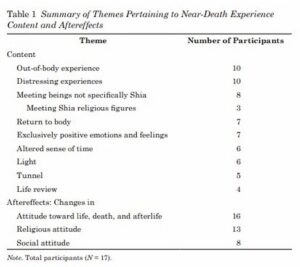
Analysis of the semi-structured interviews revealed participants spoke readily about their NDEs and aftereffects. It also revealed similarities regarding NDE content and aftereffects as well as noteworthy features specific to Shia Muslim beliefs. Findings are summarized in Table 1, organized by how frequently we found each theme in the transcripts, from most to least frequent.
Below are sample excerpts from NDErs’ interviews that illustrate each of the themes that appear in Table 1. Ghasemiannejad translated the excerpts from Farsi to English. We numbered our participants Subject (S) 1–17 and indicate Subject number following each excerpt.
6. NDE Content
a. Out-of-Body Experience
Ten of our participants described the experience of their consciousness functioning apart from their physical body. In each case, the NDEr could see their body and what was happening around it. For example:
“I was near the ceiling. I could see doctors and nurses who were doing surgery on my body. One of them dropped his scissors and picked it up.” (S8)
“I saw myself for a moment from above. I saw my mom and dad and even myself on the bed. I realized that the soul was separated from my body. I saw the nurse who was trying to resuscitate me. Then, while I was watching, I stared at the sign on my right on the wall: Keep Silence!” (S17)
b. Distressing Experiences
Ten participants reported distressing feelings or experiences during their NDEs, including fear, torture, homesickness, torment, loneliness, regret, and confusion. For instance, two of them said:
“There was an overwhelming sense of loneliness along with my fear. I was very scared and kept thinking about where to go and what to do. I felt like I had nothing except loneliness.” (S13)
“[In context of a life review], I was sorry and regretful for all the moments in my life and for everything I remembered.” (S9)
Three NDErs described severe punishment and torture. For example
“I realized that everything became dark. A curtain appeared behind me, which I passed through. The space behind the curtain was very unpleasant and horrible. Until that moment, I had never seen such things with my own eyes. Behind the curtain was a space where the hands and feet of the people were bound with shackles and manacles. Anyone who entered this place would be pushed forward. I also wanted to put myself into these shackles and manacles to go along with others.” (S5)
One participant described the return to his body as a terrible experience:
“When I wanted to go back to my body, I endured a severe torment that I will never forget. It was a very painful return. It was as if they put me in a press and crushed me back into my body.” (S3)
c. Meeting Beings
Eight participants described the presence of other beings within their NDEs. Two NDErs gave a description of meeting with their deceased relatives:
“The first thing I remembered was that my head was on my grandmother’s feet. My grandmother died a few years ago. She was wiping blood droplets from my forehead. Then I saw my brother. My brother was a martyr in the Iran-Iraq war. I also had an aunt who had passed away 20 years before I was born, and I had no image or memory of her. I had a brief meeting with her in my experience, and I was told that ‘She is your aunt.’ She loved me so much. When I came back and explained her appearance to my mother, she confirmed that she was my aunt.” (S1)
“I saw some wooden boxes that looked like coffins. They were open, and I could see people in them. I felt like I knew them. Three more coffins caught my attention. One of them was my [physically deceased] dad. He was dressed in white, and his face was bright. I was telling myself, “What is my dad doing here!” I saw him getting up and coming toward me. He was brighter, younger, and more attractive and handsome than the last time I had seen him.” (S10)
One participant described the beings that they encountered as angels:
“I noticed the presence of two very beautiful angels. They didn’t enter the house… As soon as I saw those angels, I said to myself, “How magnificent!” It was as if I realized they were coming to accompany me. They had wings.” (S14)
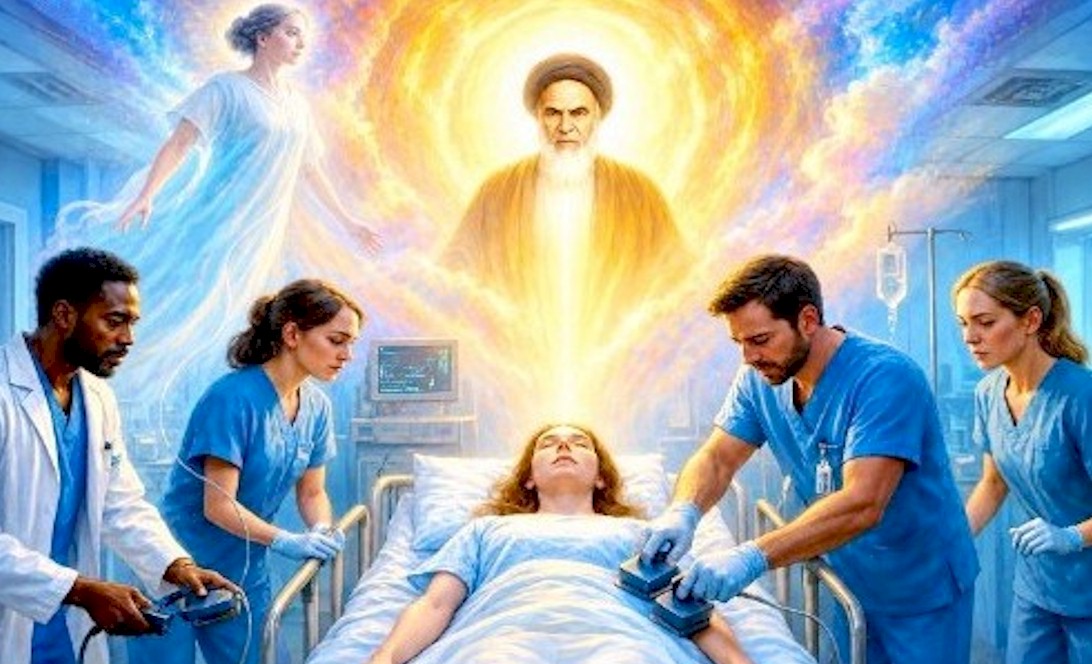
Others said that in their NDEs they either met or experienced a clear reference to spiritual and religious leaders. Interestingly, one of them described meeting Ayatollah Khomeini, who actually was physically alive at the time of the NDE. This participant’s experience occurred during combat in a war in which many soldiers felt a kind of spiritual connection to the Ayatollah and wished deeply that they could meet him:
“I saw in my experience Ayatollah Khomeini who was alive at that time. He was sitting in the library room with his robe. I went forward, put my head on his feet, and cried from the bottom of my heart.” (S2)
Another participant described meeting and communicating with Imams, who are Shia spiritual leaders. He was reluctant to share details about some those encounters:
“I visited with some religious figures and imams in my experience that I don’t want to say much about them and these visits.” (S1)
However, he said one encounter involved not a meeting with but a clear reference to a religious figure: the reappearance of Imam Mahdi, who is The Savior in Shia Islam. This reference occurred in the context of the only NDE in our sample that included a preview of personal and global events:
“They [spiritual beings] showed me a lot of events from the future – about my own future and the future of the world. One of the events that I was told is the numerous wars that will take place before the reappearance of Imam Mahdi in the world and in the Middle East.” (S1)
Yet another participant said that he visited someone who might be an Imam, but he was not sure:
“That luminous face didn’t introduce himself to me. I just felt that he might be one of the imams.” (S5)
d. Return to Body
Three participants indicated they were involuntarily “sent back” to their physical bodies though they did not want to return:
“At the end, they forced me back.” (S3)
“There were some people standing in line for several hours. The queues were too long. I didn’t like standing in the queue or going back to my body. I said, “Let me go with the rest of people who are going to the other side.” They came to me and said, “No! You have to go back.” Again, the luminous person came and took my hand and returned me to my body.” (S5)
Four Iranian NDErs stated that they had the authority to make decisions about returning to their bodies voluntarily. They decided to return to their worldly lives for some particular reason, including family ties:
“My brother gave me a choice to go back or stay there. He told me if I come back, I’ll regret it. However, he also insisted on [me] returning because of our mother who was very dependent on me. So I decided to return.” (S1)
e. Positive Emotions and Feelings
Seven participants communicated the peaceful nature of their NDEs. Several participants described this quality in terms of relief from physical pain while out-of-body. For example:
“I said to myself, “Why I don’t feel pain anymore? What happened to my severe, fatal physical pain? Where are the pains? Where did they go?” I looked up at the sky. I was sure I was dying or moving to another world. I was incredibly happy with the tranquil, pleasantly calm, and quiet atmosphere.” (S12)
A sense of peace occurred for some participants while meeting beings during the NDE. For instance:
“I remember the angels hugging me, and we peaked with indescribable joy. I was so happy and relieved, as if I was back where I belonged.” (S14)
One NDEr described the peace as a result of meeting the light:
“The encounter with the light was very nice and pleasant. It was a very quiet, safe, and secure place.” (S11)
f. Altered Sense of Time
Six participants described an altered sense of time during their NDEs. One participant described time that seemed to go slower than usual:
“The next point was that the speed of time was slower than usual. It was something like pondering on things deeply at a very, very slow pace.” (S2)
Five participants said that time seemed accelerated with everything happening very fast or all at once. One of them said:
“I was certain that time in that environment did not have any meaning. I reviewed 15 or 20 years of my life in perhaps two seconds. All my actions came to my eyes, perhaps in two seconds. But it’s just what I say with earthly words, because time had no meaning at all there.” (S9)
g. Light
Experiencing a bright light was a feature that six participants described. Two participants described the light as something they couldn’t really explain, but they were drawn towards it:
“Suddenly, I accelerated upwards where a light from a valve could be seen. As I went up, the colors of the light became much brighter, more beautiful, and shinier. I even saw colorful, beautiful particles of light.” (S4)
“When I got out of my body, I saw the light channel. This channel was not something I wanted to get into. It was just like a vacuum cleaner. I don’t know how to express it. I was dragging myself towards him, and it all happened immediately. There was no other choice, like a vacuum cleaner. There was no distance. I can’t describe this space. It’s hard for me to explain.” (S3)
Two participants specifically described meeting the light as a very pleasant and unique experience:
“The meeting with the light was very nice and pleasant. It was a very quiet, safe, and secure place.” (S11)
“We went to a star that had a bright light. A light that didn’t bother me at all. On the contrary it was very charming and full of strange love that I did not even experience in my mother’s arms. I had never experienced this before.” (S14)
h. Tunnel
Five participants explicitly identified a tunnel as a feature of their NDEs. For instance:
“Then a clear tunnel appeared to me that was neither wide nor narrow. My guess is now that I was dragged into the tunnel and had no choice.” (S1)
“At one point I entered the blue tunnel like water. It was beautiful, relaxing and safe, and almost indescribable. It was very transparent and beautiful and very comfortable. I was moving in the tunnel at a very, very fast pace. In the tunnel I was going at a great speed. I said to myself, “What a great place! I wish I could stay here and not come back.'” (S11)
“On the bed I felt sick and I couldn’t remember anything. I just remember entering a tunnel as if it were connected to the sky from the ground. At a very high speed, I was moving vertically in the tunnel towards a very wide white light.” (S15)
i. Life Review
Four participants described an evaluative review of their actions throughout their lives. All of them described their life reviews like watching movies, except that they were able to experience the emotions associated with their behavior:
“At one point I felt that my whole life was being shown to me with all the things I had done: the sins I had committed and the severe psychological torments that appeared to me after these sins. I felt like my soul was pulling back like a movie and feeling all my behaviors. The torments were all psychological including feeling ashamed before God and the martyrs.” (S5)
The life review of one participant included seeing his birth:
“The moment I was dying I saw my whole life. All my life passed before my eyes. It’s like a movie in seconds; all the events, even those that were forgotten, even in the womb. I remember right now I was in my mother’s womb feeling like I was in a bag. All I had to do during my staying there was to keep my mouth and nose closed.” (S7)
7. NDE Aftereffects
In addition to describing the content of their NDEs, participants also described any changes in themselves that they attributed specifically to their NDEs. In this regard, we found three themes.
a. Attitude Toward Death, Life, and Afterlife
All but one of the participants expressed the idea that, following their NDE, they did not fear death. They also obtained a new appreciation and understanding of death, life, and afterlife:
“Now I have no fear of dying. Death is really beautiful. The world is no more than a passing place. It’s not a place to reside.” (S1)
“Death is neither the end nor bitter. Rather, it is God’s special mercy and His gift to creatures, and in particular to humans.” (S3)
“Death is the most beautiful feeling in the universe.” (S11)
Two Iranian NDErs described how their NDEs changed the way they look at life:
“I’m not afraid of death anymore. But I will do my best to enjoy every hour of my life. I love living in the world very much. Love it so much. I even love its misfortunes and tragedies. Because I feel like I am a traveler who must live well.” (S4)
“Contrary to many who say the world is everything or many others who consider the world worthless, I see the world and life valuable, and I have the utmost respect for the world with all its components, but my goal is not the world.” (S3)
Although participants were Shia Muslims who, prior to their NDEs, believed in an afterlife, as a result of their NDEs they became much more confidant and faithful regarding the afterlife:
“I believed in God and afterlife, but after my NDE I became more and more confident.” (S1)
“Now I really believe in the afterlife.” (S4)
“[As a result of my NDE] I believed and understood that there is a world other than this.” (S13)
One participant communicated that although he is not afraid of dying, he is worried about what will happen to him after death:
“I’m not afraid of dying. I’m afraid of being alone after death. I’m afraid to be alone when I die. I am afraid there will be no compassion there.” (S8)
b. Religious Attitude
Changes in religious attitudes and practices were described by 13 participants. Eight Iranian NDErs expressed that they became more religious after their NDEs. For example:
“Now, I recite the Quran a lot. Before my experience, I didn’t read Quran so much. I pray five times each day now.” (S6)
“Now, I am a permanent member of the congregation and mosque. Before the experience, I would pray very rarely, but now, I do all my prayers on time.” (S5)
Other participants described changes in their perspectives toward religion, religious rituals, and spirituality as a result of their NDEs:
“My understanding of religious beliefs has become more realistic, deeper, and more meaningful after my NDE.” (S2)
“My prayers and other religious practices are not the same as before. I worship with a special feeling of love. It is as if God is getting closer and closer to me.” (S1)
“Before my experience, spirituality for me was prayer and fasting, worship. I prayed not to go to hell. But now, I believe that being religious and spiritual is all about making a better world and home.” (S4)
c. Social Attitude
Some participants stated that after their NDEs, significant changes had occurred in their relationships with others. Two participants reported the tendency to be isolated and lonely following their NDEs. They said that they don’t like to have relationships with others except close family members or friends:
“I don’t like to go outside. I want to get rid of social interactions. However, for the sake of my kids and family, I really can’t.” (S8)
“After my experience, I do not like to interact with anyone. I became very uncommunicative; however, I value and respect my mother very much. I do not become very comfortable and intimate with others like before, maybe only saying hello and greeting.” (S5)
By contrast, other NDErs became more engaged in social relationships and communities. They were more compassionate and kinder toward people and society following their NDEs:
“I get more involved in charitable activities and social affairs.” (S12)
“I easily get along with everyone. No matter who they are: friends, relatives, family members, strangers.” (S3)
“I was very isolated before my NDE. But now I have become more social and go out more.” (S1)
8. Discussion
As of 2009, the field of near-death studies had existed for over 30 years, and hundreds of studies about NDE content and aftereffects had already been published. At that point, researchers undertook a comprehensive review of research findings to date (Holden et al., 2009). Every theme in the current study was referenced in the comprehensive review, regarding both content (Bush, 2009; Zingrone & Alvarado, 2009) and aftereffects (Bush, 2009; Noyes et al., 2009) of Western NDEs. Thus, the results of this study show that the phenomenology of Iranian Shia Muslim participants’ NDEs and aftereffects appear broadly consistent with those reported in typical Western accounts. As is the case with Western NDEs, the content of NDEs in this study showed a number of culturally specific elements. The presence of these elements may be a product of the participants’ interpretations of the NDE but also may play a role in the development of the NDE. In the following discussion, we address more specifically how the themes we found relate to existing research, including in some cases how they play into controversies that have arisen regarding NDEs.
Just over half of our participants mentioned in their NDE descriptions that they had an OBE, that is, that they experienced their consciousness functioning apart from their physical body, perceiving the physical world in the vicinity of their body. Research has shown that NDErs have often reported that they could see things from perspectives outside of their physical bodies, that objects were no longer barriers, that their senses were heightened, and that they had feelings of being weightless and invisible to others (Rodabough & Cole, 2003). They often described that they were able to move about close to their physical body and could see their physical body from another point in space (Greyson & Stevenson, 1980). In various studies, 27–90% of NDErs have reported an OBE (Green & Freidman, 1983; Lindley et al., 1981; Sabom, 1982; Schwaninger et al., 2002; van Lommel et al., 2001). Typically, the features of visual perception during the NDE both include and exceed the features of physical visual perception – for example, both seeing and seeing through a wall (Holden, 1988). All of these OBE-related features were mentioned among our participants.
Although some NDErs in predominantly Western studies have reported distressing experiences – dominated by feelings such as terror, horror, or guilt – such reports have been less common than reports of experiences dominated by pleasurable emotions such as peace, joy, and love (Greyson & Bush, 1992). Based on a review of the literature, Nancy Bush (2002) asserted that one out of five reported NDEs may be predominantly distressing. Examining the emotional valence of the content of our sample of NDEs, we found that 7 involved exclusively pleasurable, 7 predominantly pleasurable (mostly pleasurable with some distressing), 1 about equally pleasurable and distressing, 1 predominantly distressing (mostly distressing with some pleasurable), and 1 exclusively distressing content. Thus, our findings reflect the tendency for pleasurable emotions to be more frequently reported in NDEs. However, the presence of at least some distressing content in just over half of our participants appears to far exceed Bush’s (2002) estimate. One possible explanation is that Western researchers to date have categorized NDEs only as either predominantly/exclusively pleasurable or predominantly/exclusively distressing – in which case our finding of 2 predominantly/exclusively distressing NDEs compares favorably with Bush’s (2002) estimate. Another possibility is that distressing elements may actually have been more common in our participants’ NDEs, perhaps because of the Islamic religious community emphasis on teachings about hell. Thus, the seemingly high incidence of NDErs in this study who reported distressing feelings may be due to the effect of culture and religion on Iranian Shia NDEs.
Our participants reported that during their NDEs they met beings: spiritual beings including angels, as well as deceased relatives and friends. Western NDE researchers have found most beings that NDErs encountered were deceased persons whom the NDErs had known personally from their earthly lives (Kelly, 2001). Consistent with the findings of Western NDE research, the participants of this study most commonly reported meeting beings that they knew; only one participant encountered a being that he had not previously known. Kelly (2001) also found within Western NDE reports that only 39% of NDErs had emotionally close relationships with the beings they encountered during their NDEs. She also found that Western NDErs were much more likely to encounter a being or beings who were deceased rather than still physically alive. Similarly, only two participants in this study encountered beings who were alive at the time of their NDEs.
Meeting others, spiritual or non-spiritual, has been regarded as a cross-cultural feature of NDEs (Kellehear, 2007, 2009; Noyes et al., 2009). This claim is supported by the finding of this study. This finding could provide support for the argument that NDEs themselves are a cross-cultural, universal phenomenon. At the same time, the appearance of Shia Imams among our participants’ spiritual beings – but not among Western NDErs’ spiritual beings – indicates that NDEs contain culturally specific content – influenced by and/or interpreted according to cultural beliefs and expectations. These two aspects – cross-cultural and culturally specific – may be interpreted as contradictory, but they need not be: It may be that the presence of spiritual beings in NDEs is a universal feature and that the identities of those beings may be culturally-related.
Study participants reported being sent back to life either voluntarily or involuntarily. These findings align with those of Western NDErs (Long, 2011; Rodabough & Cole, 2003). Some of our participants felt a responsibility to their living close family members as an important factor in their decision to return to their earthly life, another theme reminiscent of Western NDErs’ narratives (Noyes et al., 2009).
Altered sense of time is another common element in typical Western NDEs. NDErs have reported that time sped up or slowed down sharply, that events seemingly occurring simultaneously, and or that time seemed to stop or lose all meaning (Lange et al., 2015; TassellMatamua, 2013; Zingrone & Alvarado, 2009). Six Shia Muslim NDErs reported an altered sense of time – findings consistent with typical Western NDE reports.
Between 16–63% of Western NDErs report having encountered an exceptionally bright light (Rodabough, & Cole, 2003) that they often describe as a being consisting of love and warmth; a smaller number – between 10–18% – have reported actually entering the light (Green & Freidman, 1983; Lindley et al., 1981; Schwaninger et al., 2002; van Lommel et al., 2001). Similarly, six Shia Muslim NDErs reported light as a figure of love that communicated telepathically through thoughts with them – though none of our 17 participants reported actually entering the light.
Both tunnels and life reviews were reported in the NDEs of our participants. Whereas some researchers have claimed that neither of these features are likely to be present within the NDEs of nonWestern cultures such as Shia Islam (Belanti et al, 2008; Kellehear, 2007, 2009), others found evidence of tunnels in non-Western NDEs (Long, 2011). In support of the latter assertion, 5 of our 17 participants reported a tunnel, and 4 reported a life review. The study participants’ descriptions of tunnels and life reviews seemed similar to descriptions in typical Western NDEs (Zingrone & Alvarado, 2009). The presence of tunnels and life reviews might be attributed to a Westernizing influence in more recent Shia Muslim NDEs. However, this conjecture calls for future research to clarify the possible influence of Westernization on Shia Muslim NDEs.
The life reviews reported by participants in this study were consistent with those reported by Western NDErs. Researchers have found that the specific form of Western NDErs’ life reviews may involve a panoramic display of memories in chronological order but may also deviate from that form, appearing out of chronological order and/or not panoramically (Stevenson & Cook, 1995). Supporting this finding, the life reviews in this study did not occur panoramically or in chronological order.
In this study, we found consistencies between the aftereffects of our participants and commonly reported aftereffects of Western NDErs. These aftereffects included a loss of the fear of death, a new approach toward life, and changes in religious and social attitudes. Some NDErs in both this study and in previously published Western NDE reports described a continuing fear of the dying process, albeit with a loss of the fear of death itself (Noyes et al., 2009; van Lommel et al., 2001). Consistent with that finding, although some of our study participants stated that they were no longer afraid of death, they continued to express a subtle fear of the dying process and their lack of control over it. Also consistent was that some of our study participants described a new appreciation for life and the universe coupled with a respect for death as a phenomenon.
Another commonly reported aftereffect of Western NDEs is a heightened sense of spirituality (Morse, 1992; Noyes et al., 2009; Sutherland, 1990). NDErs may refuse to describe themselves as religious following their NDEs, but instead describe themselves as spiritual, sometimes going so far as to reject organized religion entirely following their NDEs and to identify solely as spiritual – although a minority of NDErs have reported that they became more religious (Greyson, 2006; Sutherland, 1990). None of the participants in the current study said that they became less religious following their NDEs. However, most of them expressed that their definition of spirituality and religious practices were altered following their NDEs. Among those who became more religious, the meaning of worship – including prayer, fasting, and other types of worshiping Allah in Islam – was profoundly altered, with increased participation in religious activities.
A final note involves the phenomenon of veridical perception in NDEs, whereby based on what the NDEr knew going into the NDE, as well as the condition and position of the physical body during the NDE, information they acquired during the NDE that they could not have gotten as a result of normal perceptual processes are later verified as accurate (Rivas et al. 2016). Although we did not identify veridical perception as a theme, per se, we noted that three of our participants reported this phenomenon. One was Subject 8 who, from a position outside of his body, saw a member of his medical team drop and pick up a pair of scissors; he later confirmed that his perception was accurate. Another was Subject 17 who was physically unconscious before, during, and after the time his body was being resuscitated in a particular room; from his out-of-body position, he saw a sign that said “Keep Silence” and later confirmed the accuracy of that perception. A third was Subject 1 who was told in his NDE that one of the beings he encountered was his aunt, someone who had died prior to his birth; when he subsequently described her appearance to his mother, she confirmed that his description matched his aunt’s appearance. These cases indicate that, similar to other features of NDEs, veridical perception appears to be a cross-cultural phenomenon.
9. Conclusions
In the debate between the universality vs. cultural specificity of NDEs, the findings of this study provide support for both theoretical positions: that NDEs are similar across cultures and that NDEs contain content consistent with shared cultural beliefs as well as uniquely individual variations – as, consistent with findings regarding Western NDEs, no two NDEs among our participants were identical. These findings might be understood to indicate that NDE content reflects three “levels”: a deep structure level – frequently recurring general features such as perception of the physical world from a position outside the body, light, passageways such as tunnels, beings, a border or barrier, and a sense of return to the physical body – along with surface structures at two levels: cultural – such as the appearance of beings usually associated with a particular religion, such as Christ in Christianity and Imams in Shia Islam, and individual – features of the NDE unique to each NDEr (Holden, 2020). From this perspective, universal/cross-cultural features appear along with cultural and individual expressions of those features, affirming the co-existence of all three levels in any NDE.
In other words, from the findings of this study, we suggest that NDEs may be cross-cultural in nature and both developed and interpreted both culturally and individually. For example, the possible role of Shia Islamic teachings on the NDEs of our participants, and the high similarity between the features reported by participants of this study and the features reported by NDErs of Western culture, suggest that NDEs may be consistent with both existing perspectives: that NDEs are cross-cultural in nature but also that aspects of NDEs can be developed and/or interpreted in relation to the cultural conditioning and individual psychology of the NDEr. The aspects of the NDE that are developed culturally may be dependent on those aspects that are most integral to the culture. This dynamic appears to be the case in the current study. The role of the Shia Imams within Shia culture is fundamental to the Shia worldview and way of life. It is therefore not surprising that some of our participants reported meeting Shia Imams in their NDEs.
A combination of the existing theories about NDE development can explain both similarities and differences between NDE reports from people of varying religions, beliefs, and cultures. In other words, it helps to explain the consistencies of NDEs across and within cultures as well as variations among NDEs from different cultures.
10. References
Belanti, J., Perera, M., & Jagadheesan, K. (2008). Phenomenology of near-death experiences: A cross-cultural perspective. Transcultural Psychiatry, 45(1),
121–133.
Braun, V., & Clarke, V. (2006). Using thematic analysis in psychology. Qualitative Research in Psychology, 3, 278–293.
Bush, N. E. (2002). Afterward: Making meaning after a frightening near-death experience. Journal of Near-Death Studies, 21, 99–133. https://doi.org/10.17514/JNDS-2002-21-2-p99-133.
Bush, N. E. (2009). Distressing Western near-death experiences: Finding a way through the abyss. In J. M. Holden, B. Greyson, & D. James (Eds.), The handbook of near-death experiences: Thirty years of investigation (pp. 63–86). Praeger/ABC-CLIO.
Creswell, W. (2007). Qualitative inquiry and research design: Choosing among five approaches. Sage.
Curtis, B., & Curtis, C. (2011). Social research: A practical introduction. Sage.
Fracasso, C., Aleyasin, A., Friedman, H., & Young, S. (2010). Near-death experiences among a sample of Iranian Muslims. Journal of Near-Death Studies, 29, 265–272. https://doi.org/10.17514/JNDS-2010-29-1-p265-272.
Ghasemiannejad, A., & Imaninasab, A. (2018). Distressing near-death experience: An Iranian Shia Muslim case. Journal of Near-Death Studies, 36, 161–171. https://doi.org/10.17514/JNDS-2018-36-3-p161-171.
Ghasemiannejad, A., Long, J., Noori, F. & Farahnakian, K. (2014). Iranian Shiite Muslim near-death experiences: Features and aftereffects including dispositional gratitude. Journal of Near-Death Studies, 33, 30–42. https://doi.org/10.17514/JNDS-2014-33-1-p30-42.
Green, J. T., & Friedman, P. (1983). Near-death experiences in a Southern California population. Anabiosis: The Journal for Near-Death Studies, 3, 77–95. https://doi.org/10.17514/JNDS-1983-3-1-p77-95.
Greyson, B. (1983). The Near-Death Experience Scale: Construction, reliability, and validity. Journal of Nervous and Mental Disease, 171, 369–375.
Greyson, B. (2003). Incidence and correlates of near-death experiences in cardiac care. General Hospital Psychiatry, 25, 269–276.
Greyson, B. (2006). Near-death experiences and spirituality. Zygon, 41(2), 393–414.
Greyson, B. (2014). Near-death experiences. In E. Cardeña, S. J. Lynn, & S. Krippner (Eds.), Varieties of anomalous experience: Examining the scientific evidence (2nd ed., pp. 333–367). American Psychological Association.
Greyson, B., & Bush, N. E. (1992). Distressing near-death experiences. Psychiatry, 55, 95–110.
Greyson, B., & Stevenson, I. (1980). The phenomenology of near-death experiences. American Journal of Psychiatry, 137, 1193–1196.
Holden, J. M. (1988). Visual perception during naturalistic near-death out-of-body experiences. Journal of Near-Death Studies, 7, 107–120. https://doi.org/10.17514/JNDS-1988-7-2-p107-120.
Holden, J. M. (2020, March). The faces of near-death experience. Paper presented to the Psychology Program faculty of Massey University, Palmerston North, New Zealand.
Holden, J. M., Greyson, B., & James D. (Eds.). (2009). The handbook of near-death experiences: Thirty years of investigation. Praeger/ABC-CLIO.
Kellehear, A. (2007). Culture and the near-death experience: Comments on Keith Augustine’s ‘Psychophysiological and cultural correlates undermining a survivalist interpretation of near-death experiences’. Journal of Near-Death Studies, 26, 147–153. https://doi.org/10.17514/JNDS-2007-26-2-p147-153.
Kellehear, A. (2009). Census of non-Western near-death experiences to 2005: Observations and critical reflections. In J. M. Holden, B. Greyson, & D. James (Eds.), The handbook of near-death experiences: Thirty years of investigation (pp. 135–158). Praeger/ABC-CLIO.
Kelly, E. (2001). Near-death experiences with reports of meeting deceased people. Death Studies, 25, 229–249.
Kreps, J. I. (2009). The search for Muslim near-death experiences. Journal of Near-Death Studies, 28, 67–86. https://doi.org/10.17514/JNDS-2009-28-2-p67-86.
Lange, R., Greyson, B., & Houran, J. (2015). Using computational linguistics to understand near-death experiences: Concurrent validity for the near-death experience scale. Psychology of Consciousness: Theory, Research, and Practice, 2(1), 79–89.
Lindley, J. H., Bryan, S., & Conley, B. (1981). Near-death experiences in a Pacific Northwest American population: The Evergreen Study. Anabiosis: The Journal for Near-Death Studies, 1, 104–124. https://doi.org/10.17514/JNDS-1981-1-2-p104-124.
Long, J., with Perry, P. (2011). Evidence of the afterlife: The science of near-death experiences. Harper Collins.
McClenon, J. (2005). Content analysis of a predominately African-American near-death experience collection: Evaluation the ritual healing theory. Journal of Near-Death Studies, 23, 159–181. https://doi.org/10.17514/JNDS-2005-23-3-p159-181.
McClenon, J. (2006). Kongo near-death experiences: Cross-cultural patterns. Journal of Near-Death Studies, 25, 21–34. https://doi.org/10.17514/JNDS-2006-25-1-p21-34.
Moody, R. (1975). Life after life: The investigation of a phenomenon – the survival of bodily death. Mockingbird Books.
Morse, M., with Perry, P. (1992). Transformed by the light: The powerful effect of near-death experiences on people’s lives. Villard.
Moss, S. (2015). Analyzing, researching and presenting. Tilde.
Nahm, M., & Nicolai, J. (2010). Essential features of eight published Muslim near-death experiences: An addendum to Joel Ibrahim Kreps’s “The Search for Muslim Near-Death Experiences.” Journal of Near-Death Studies, 29, 255–263. https://doi.org/10.17514/JNDS-2010-29-1-p255-263.
Noyes, R., Fenwick, P., Holden, J. M., & Christian, S. R. (2009). Aftereffects of pleasurable Western adult near-death experiences. In J. M. Holden, B. Greyson, & D. James (Eds.), The handbook of near-death experiences: Thirty years of investigation (pp. 41–62). Praeger/ABC-CLIO.
Pasricha, S., & Stevenson, I. (1986). Near-death experiences in India: A preliminary report. Journal of Nervous and Mental Disease, 174, 165–170.
Rivas, T., Dirven, A., & Smit, R. H. (2016). The self does not die: Verified paranormal phenomena from near-death experiences (W. Boeke, Trans., J. M. Holden, Ed.). International Association for Near-Death Studies.
Rodabough, T., & Cole, K. (2003). Near-death experiences as secular eschatology (Vol. 1). Sage.
Sabom, M. (1982). Recollection of death: A medical investigation. Harper & Row.
Schwaninger, J., Eisenberg, P. R., Schechtman, K. B., & Weiss, A. N. (2002). A prospective analysis of near-death experiences in cardiac arrest patients. Journal of Near-Death Studies, 20, 215–232. https://doi.org/10.17514/JNDS-2002-20-4-p215-232.
Sleutjes, A., Moreira-Almeida, A., & Greyson, B. (2014). Almost 40 years investigating near-death experiences: An overview of mainstream scientific journals. Journal of Nervous and Mental Disease, 202(11), 833–836.
Stevenson, I., & Cook, E. W. (1995). Involuntary memories during severe physical illness or injury. Journal of Illness and Mental Disease, 183, 452–458.
Sutherland, C. (1990). Changes in religious beliefs, attitudes, and practices following near-death experiences: An Australian study. Journal of Near-Death Studies, 9, 21–31. https://doi.org/10.17514/JNDS-1990-9-1-21-31.
Tassell-Matamua, N. (2013). Phenomenology of near-death experiences: An analysis of a Maori case study. Journal of Near-Death Studies, 32, 107–117. https://doi.org/10.17514/JNDS-2013-32-2-p107-117.
Tassell-Matamua, N. (2014). Near-death experiences and the psychology of death. Omega, 68(3), 259–277.
van Lommel, P., van Wees, R., Meyers, V., & Elfferich, I. (2001) Near-death experience in survivors of cardiac arrest: A prospective study in the Netherlands. Lancet, 358(9298), 2039–2045.
Young, H. (2016). The phenomenology of near-death experiences in northland Maori of New Zealand (Master’s thesis). Massey University, Palmerston North Campus, Manawatuˉ, New Zealand.
Zingrone, N. L., & Alvarado, C. S. (2009). Pleasurable Western adult near-death experiences: Features, circumstances, and incidence. In J. M. Holden, B. Greyson, & D. James (Eds.), The handbook of near-death experiences: Thirty years of investigation (pp. 17–40). Praeger/ABC-CLIO.