This site uses affiliate links to Amazon.com Books for which IANDS can earn an affiliate commission if you click on those links and make purchases through them.
1. Introduction to Ancient Chinese NDEs
People have described near-death experiences (NDEs) across many cultures and long periods of time. But these stories are often shaped by religion, myths, and later ideas. This makes it difficult to know what the person actually experienced and what was added by their culture. Because of this, early stories from outside the Western world — and stories not tied to one religion — are very important. They let us look at NDE accounts that were written down long before modern science, popular NDE story themes, or global religions shaped what people expected to see when they were close to death.
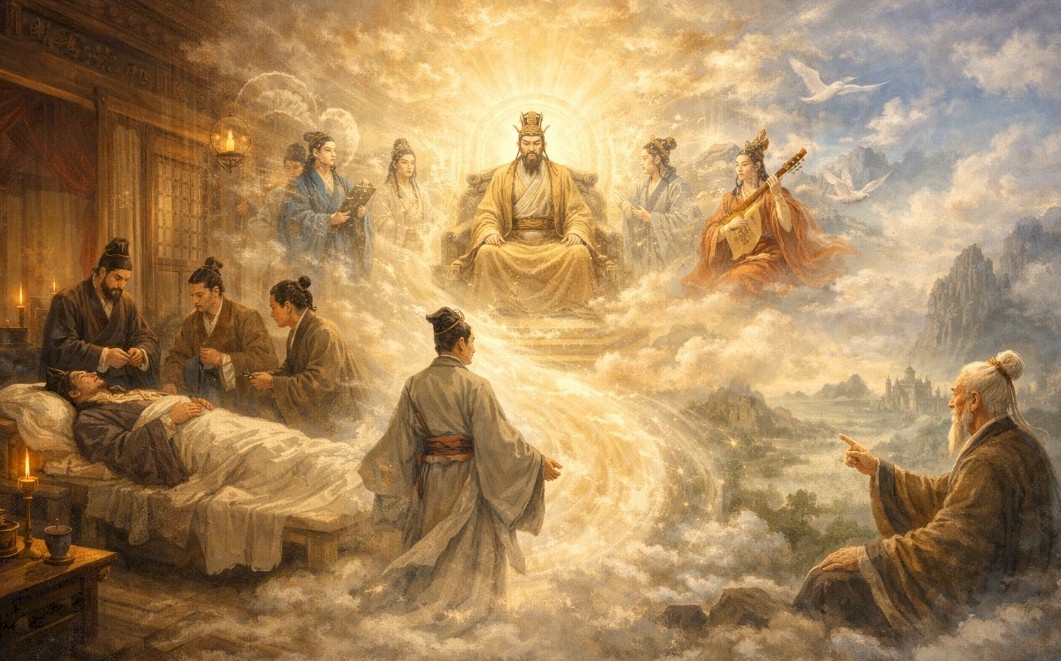
This article looks at two very interesting stories that not many people talk about. They come from the Historical Records written by Si Ma Qian around 90 B.C. These stories appear in his account of the famous doctor Bian Que, who lived around 500 B.C. In these passages, we read about Duke Mu of Qin and Zhao Jian Zi of Jin. Both men were said to be unconscious for several days. When they woke up, they described powerful experiences. They spoke of great joy, meeting “the supreme being” (Di), seeing spirits, hearing music, and receiving important information. If the dates and records are correct, these may be the oldest known medical-style NDE accounts still preserved in history. They are remarkable not just because they are ancient, but because they were recorded during medical emergencies, with witnesses present, and noted carefully by a physician.
The historical setting is important. China during the Zhou period, before Buddhism arrived, was fairly secular in public life. There was no strong religion focused on saving souls. There was no large priesthood. Later ideas about judgment after death, hells, and detailed afterlife systems had not yet developed. Because people at that time did not share a fixed picture of the afterlife, these stories are especially helpful. They raise a key question in NDE research: Are NDEs shaped mostly by culture, or do they come from experiences that are similar across different cultures?
To explore this question, the scholar Matthew Richardson, BA, LLB translates and studies the key passages. He places their images and ideas within early Chinese thought. He also compares them with NDE reports from the Middle Ages and from modern times. Along the way, he looks at where these stories came from and how reliable they may be. He explains why Si Ma Qian’s work as a historian matters. He discusses what we can and cannot conclude from the prophecies in the stories. He also addresses why some earlier scholars misunderstood or ignored these accounts. His goal is not to squeeze an ancient Chinese story into modern categories. Instead, he presents these cases clearly for what they seem to be: early medical-style reports of unusual experiences. This way, near-death researchers can study them fairly and include them in a truly cross-cultural discussion.
2. About This Article
ABOUT THE AUTHOR: Matthew Richardson, BA, LLB, is an antiquarian scholar, history editor, and author living in the Blue Mountains of New South Wales, Australia. He is an Honorary Associate of La Trobe University in Melbourne and an Associate of the Australian Centre for Public History, University of Technology Sydney. His published books include The West and the Map of the World (Melbourne University Press, 2010) and Once a Jolly Swagman (Melbourne University Press, 2006). In 2017, he delivered La Trobe University’s 12th annual John Furphy Memorial Lecture entitled “How Minds Began.” His work as a publisher at Halstead Press in Sydney, especially on John Spooner’s (2016) The Afterlife: The Evidence of Near Death Experiences, led him to write this article. Correspondence regarding it should be sent to Mr. Richardson at email: halstead@halsteadpress.com.au.
ABOUT THE JOURNAL: The Journal of Near-Death Studies from the International Association for Near-Death Studies (IANDS.org) is the only peer-reviewed scholarly journal devoted exclusively to the field of the study of NDEs. To access the latest issues from the previous three years and receive new issues of the quarterly journal, you must subscribe to the journal simply by joining and becoming a member of IANDS. The Journal of Near-Death Studies also encourages submission of articles. Basic information about the journal is available.
ABOUT IANDS: Your IANDS membership helps provide the financial support for IANDS to pursue their mission of encouraging independent research into NDEs and educating the world about near-death and similar experiences — and their effects and implications. In return, IANDS will give you special access to members-only sections of their website including the Index to the Periodical NDE Literature from 1877 through 2011, their Vital Signs newsletter, annual IANDS conference and educational offerings. Other important links to IANDS include: NDE Accounts – NDE Archives – Store – Support – Publications – Brochures – Facebook – Twitter – YouTube.
The following is a reprint by permission of the article “Revelations From Near-Death Experiences of Two Ancient Chinese Coma Patients” by Matthew Richardson, BA, LLB published in the Journal of Near-Death Studies, 37(1), Spring 2019 © 2019 IANDS.
3. Revelations From NDEs of Two Ancient Chinese Coma Patients
By Matthew Richardson, BA, LLB
ABSTRACT: In this article, narratives of NDEs quoted in Si Ma Qian’s Historical Records (ca. 90 B.C.) are translated from Chinese and examined. Si Ma Qian presented them in his account of the career of Bian Que, an eminent medical practitioner of circa 500 B.C. Textual evidence is examined which tends to corroborate the dating, suggesting these are the world’s earliest extant medically documented NDEs. Examination reveals contrasts that distinguish these ancient Chinese NDEs from those of medieval and modern cultures — but also some striking resemblances. After considering the historical context, I conclude that some elements in these reports probably cannot be accounted for by religious upbringing and cultural background. I suggest that although NDEs may have been sources of religious belief amongst religiously oriented peoples, amongst the relatively secular Chinese they were treated as a medical phenomenon. I argue that because these accounts were produced when China was still isolated from other civilizations and religious cultures, they are valuable additions to scholarly material in the field of near-death studies.
KEY WORDS: China, Si Ma Qian, near-death experience, ancient near-death experiences, Bian Que, Wang Chong
The aim of this article is to take readers back over 2,500 years to the bedsides of patients who evaded death in an isolated society that had not yet heard the teachings of international religions. Allan Kellehear (2001) observed that the “reporting of ancient accounts of NDEs, especially from non-Western areas, constitutes an important cultural resource for near-death studies because most of these accounts predate current research and popular ideas” (p. 31). Outside the realms of myth and scripture, the NDEs that befell Duke Mu and Zhao Jian Zi in China are, I believe, the most ancient non-Western accounts on record. If Kellehear is right, they warrant serious attention in the NDE studies community. Because China was isolated from Judaeo-Christian thought when it generated the oldest surviving medical records of NDEs, they may be useful in evaluating cultural influence on the content of NDEs. If they contain observations of the realm of the dead or the afterlife that are more consistent with modern or Western expectations than with ancient and Chinese expectations, the similarity cannot be due to cultural transmission. Christianity and Islam did not yet exist in the 7th to 5th centuries B.C. when these NDEs are said to have occurred. For centuries to come, East Asia would exhibit no extant signs of influences of Judaism, Buddhism, or any other Indian or Western teaching.
Officially, the Zhou (pronounced Jo) dynasty presided over China, but its King had no authority. Power was in the hands of local dynasties and high officials ruling a multitude of independent states. Knowledge and ideas were spread by teachers and experts who travelled around this fragmented and isolated region. Among them were Confucius (551–479 B.C.) and his less famous contemporary, Bian Que (pronounced Bien Chiaw).
4. Bian Que and Si Ma Qian
Bian was a doctor who built a reputation for success with patients close to death. Long afterwards, inconsistent fables about him circulated, and medical authors incorporated his name in their book titles. In doing so they followed a characteristic tendency of Zhou China. There, if an eminent early individual had become a household name, that person’s name might be attached to an array of later writings and exploits. Famous examples include the early statesmen who are credited with the trigrams and text of the Yi Jing, and Lao Zi — author of the Dao De Jing. An extreme specimen of this confusing ancient practice is Huang Di Nei Jing (The Yellow Emperor’s Classic of Internal Medicine; trans. Veith 1939/1972). Assuming that Huang Di, the Yellow Emperor, actually existed — which some historians deny, he lived about 2,000 years earlier than the medical knowledge and literary style of the book that bears his name.
Bian Que’s august name was appropriated to various persons and exploits over several lifetimes. Si Ma Qian (pronounced Szu Ma Chien), ancient China’s most accomplished historian, rejected almost all this lore that had accreted to Bian Que’s name and gave a short account of his career. Writing a sweeping history of China, Si Ma Qian was guided by a conviction that monarchs, ministers, and generals are not the only people who make history. His book, Historical Records (1982 Zhong Hua Shu Ju ed.), completed circa 90 B.C., contains chapters on thinkers, writers, entrepreneurs, gangsters, and humourists. The quotations that follow I have translated from chapter 105 (vol. IX, pp. 2786–2787), which deals with influential medical men. For the purpose of this article I treat that account as the only trustworthy information available on Bian.
Although chapter 105 had not been published in English translation, NDE researchers who took up comparative studies of Asian accounts in the 20th century were not entirely unaware of the reports examined here. They were known thanks to an extract that had been translated into English in Jacob de Groot’s (1901) monumental study, The Religious System of China. De Groot’s extract came from chapter 43, containing NDE testimonies in very similar wording to that of the corresponding passage in chapter 105, but without the background information about Bian Que. James McClenon (1991) referred to them as “Taoist NDEs,” although in fact, the reports do not belong to Taoism. Kellehear did not consider them suitable for counting in his census of non-Western NDEs (Kellehear, 2008), and they were not examined closely in Gregory Shushan’s review of pre-Buddhist Chinese materials (Shushan, 2009), although Shushan there acknowledged that Duke Mu’s experience “may be the world’s first contextually factual NDE narrative” (p. 168). It may be de Groot’s (1901) tendentious presentation that masked their actual character or content and led to the neglect that I hope now to remedy. De Groot was vastly knowledgeable and good at unlocking meanings in ancient texts. But a prejudiced insistence on the superstitious simplicity of Chinese thought led him to represent his materials in a disparaging tone. He did not mean “nice” in the nice way when he wrote that…
“ever since, this nice specimen of early historiography has passed in China for a standard proof of the reality of dreams, and the gods ghosts and spirits of Kien-tsze’s [Jian Zi’s] vision have always been believed as actually met by his roving soul.” (de Groot, 1901, p. 116)
He described Si Ma Qian’s report of the NDEs as characteristic of Chinese ideas about dreams, despite which I can find elsewhere in ancient sources no accounts resembling it.
5. Duke Mu’s and Jian Zi’s Experiences
Around 500 B.C., or soon after, Bian the doctor was called to the sick bed of Zhao Jian Zi (pronounced Jao Jien Dzu), a senior minister in the large northern state of Jin, centered in what is now Shanxi province. This patient had lain unconscious for days, while his government colleagues fretted.
Bian Que went in to examine Zhao’s medical condition. When he came out, Dong An Yu asked him about it. Bian Que said, “The pulse is well adjusted. And how strange is this? In the past Duke Mu of Qin [pronounced Chin] had much the same thing — seven days and then he awoke. On the day he awoke he announced to Gong Sun Zhi and Zi Yu:
“I have been to the supreme being and it was very blissful. My reason for taking such a long time is that I was fortunate enough to be given knowledge. The supreme being announced to me, ‘The state of Jin experiences great disorder: for five generations there is no peace. Afterwards they face usurpation and none of them dies of old age. A contender’s son also commands, and deals indiscriminately with the country’s men and women.”
Gong Sun Zhi copied this down and hid it away. It comes from the Qin records.”
After pointing out historical parallels with Mu’s observations, Bian went on:
“Now his lordship is suffering with the same condition. If for three days he has not come out of it, it must ease. When it eases, he is bound to have something to tell.” After two and a half more days, Jian Zi came around and spoke to all the high officials:
‘I have been to the supreme being, and it was very blissful. I travelled with hundreds of spirits through the turning heavens. There was far sounding music in nine renditions with a myriad dances. It wasn’t music of any kind known under the three dynasties. The sound of it invigorated my mind. There was a bear that wanted to take hold of me, and the supreme being instructed me to shoot it. I hit my target, and the bear died. Then a mottled bear came at me, and I also shot at that, and hit it, and that bear died. The supreme being was overjoyed and bestowed two caskets on me, each with aids. I noticed a child who was at the supreme being’s side.
‘The supreme being entrusted me with a Di dog, saying, “You’ve come here, but your children will flourish, so I am giving you these.” The supreme being announced to me: “The state of Jin’s dynastic line declines and with seven generations is gone. The Ying family will bring great destruction to the Zhou people in the west of Fan Guei but be unable to hold it.'”
Dong An Yu took these words down in writing and filed them away.
6. Commentary on Duke Mu’s Experience
Duke Mu reigned over Qin from 658 to 620 B.C. His experience over 100 years earlier than Jian Zi’s is the less valuable of the two to researchers, because Bian knew it only at second hand, and the version on record is seemingly truncated and influenced in its wording by Jian Zi’s testimony.
All that Duke Mu’s experience appears to have in common with Jian Zi’s are the feeling of bliss, the presence of and communication with the supreme being, and the imparting of information. The most distinctive point is the Duke’s implication that he elected or needed to be away a long time because of his good fortune in being given knowledge. It would be a frugal yield from so much time with the supreme being if the Duke got only the knowledge repeated in chapter 105. There is information about Jian Zi’s state of Jin, but nothing about the Duke’s own country. The quoted passage appears to be an extract, or a précis designed to evince parallels. Those awaiting Jian Zi’s recovery could look back on events and know whether the Duke had summarized the fate of their country accurately.
Predictions should be compared with the outcomes whenever prophecy is part of NDE reports. There is particular need in this case of very ancient material, because such a comparison will help to determine whether the report is authentic and whether the dating is correct. If a prophecy is very neatly borne out by subsequent events, the text comes under suspicion, lest the text or the predictions were invented or tweaked after the events, to make the speaker seem impressively prescient. And where dateable historical events are concerned, the predictions will assist in establishing the approximate actual date of the text. A further reason for care about dating is my assertion that the cases predate any influence of international religions. In due course I will come back to the topic of predictions.
7. Commentary on Jian Zi’s Experience
In this section I discuss each main element of Jian Zi’s experience with reference to Chinese culture contemporary to Jian Zi and to modern, primarily Western NDE accounts.
Meeting the Supreme Being is an exceptional testimony to find from pre-Buddhist China. The Chinese had the most secular of ancient civilizations. Before Buddhism was introduced, there were no scriptures and virtually no priesthood. The rudimentary indigenous religion consisted of little more than divination, funeral practices, and local sacrifices to honor or propitiate minor deities and patron ancestors (Fitzgerald, 1976; Yu, 2016). Although in English translation those are sometimes designated “gods,” they do not resemble Almighty God, the supreme being professed by major monotheistic religions. Di — here cautiously translated as “supreme being” — is a word the Chinese could use to identify God in that loftier sense. Only the legitimate ruler of China was entitled to offer Him sacrifices; for everyone else God or di was a concept rather than an object of worship. It was virtually unheard of to report a verbal message from Him or have an individual relationship with Him. Yu Ying-shih (2016) — whose incisive study of Chinese conceptions on the fate of souls at death encompassed the times of Jian Zi and Si Ma Qian — did not discover a single indication in texts and archaeological remains of an encounter with anyone who might be identified with God or the supreme being. The two NDEs in Historical Records are the only exception I have discovered. The occurrence in those NDEs of personal encounters with a supreme being, considering that such encounters are absent from the mainstream of early Chinese culture, suggests that cultural influences cannot account for consistency in ancient and modern NDE accounts.
A state of bliss in heaven is another part of Jian Zi’s experience that is otherwise not explicit in Chinese culture until well after Jian Zi’s time. Again, Yu’s (2016) work contains no such example, although Shushan (2009) wrote of an early poem from the Shi Jing in which Heaven was identified as the “happy kingdom” — referring, I believe, to a poem in the ninth chapter, no. 113 in the conventional Mao order, corresponding to 276 in Waley’s (1937) rearrangement. It is customary to read meanings between the lines of the Shi poems, so this proposal that “happy kingdom” means Heaven is a plausible interpretation but impossible to prove.
However in reporting the invigoration of his mind, and attributing it to music, Jian Zi testified to a more characteristically Chinese experience. The Chinese in ancient times repeatedly spoke of the profound effects of music on the psyche (see for instance Confucius, Analects (Leys trans. 1997, VII. 13; VIII. 3; XIII. 1; XIV. 42).
As far as Jian Zi’s reference to spirits is concerned, the ancient Chinese have left no teachings I can find that distinguished angels, saints, and devils. A Chinese patient confronted by apparitions that in other cultures might be identified with specific labels, had neither vocabulary nor cultural expectations calling for such discrimination. It is consistent with Jian Zi’s background that he made no reference to the character of the spirits he had perceived.
In reporting that he travelled through the heavens, Jian Zi used the verb ao, which means travelling at ease, not in haste or under pressure. “The heavens” could equally be translated as “Heaven,” because the text does not specify singular or plural.
As far as I can tell, music and dance are not mentioned in other Chinese references to heaven extant from Jian Zi’s time or before. Over 600 years later, around 130 A.D., the Han dynasty poet Zhang Heng imagined a visit to the heavens and described music there in his long poem, To Analyse a Profound Mystery (Richardson, 2003, pp. 106–107):
By flapping frenetically
we’ve gradually arrived
In a supernatural radiance
of flaring, glaring light.
I call the celestial porter forward
to open wide the door,
Let me in to Heaven’s overlord,
his palace built of quartz.
I hear nine parts of music sound abroad
— outpouring, rolling forth
in sequence aesthetically —
it demonstrates to me
chaos, and order restored,
in pitchpipes tuned to scale.
the keynote registered first,
at last still in my thoughts.
“Nine parts of music” calls to mind the “nine renditions” Jian Zi professed to hear. Although it is possible that Zhang borrowed the concept of heavenly music from Jian Zi’s NDE, both men may have adopted a conventional numerical term to label heavenly music. For students of the Classical West, Zhang Heng’s journey will also call to mind Cicero’s Dream of Scipio (book VI, ch. 18; trans. Hardingham 1884, reproduced in Richardson, 2003, p. 35), an imaginary deep sleep visit to the heavens in which Scipio notices the music of the spheres: the celestial harmony produced by nine concentric spheres. It is one of the multitude of contemporaneous likenesses between Western and Chinese civilization that cannot be explained by cultural contacts.
Like Cicero, Zhang Heng was a creative writer, imagining fictional excursions rich in allegory and metaphor. Jian Zi was just a patient, ostensibly giving an unvarnished account of actual experience. Comparing NDEs with works like theirs tempts one to wonder how much of the striking imagery that Classical cultures made available to great authors came from NDEs such as Jian Zi’s.
The “three dynasties” denoted all of history, including Zhou. Si Ma Qian asserted that no precise dating of events is trustworthy earlier than 841 B.C. Instead the three dynasties may be dated, unreliably, by the following approximations: Xia (Hsia) 2100–1700 B.C., Yin 1700–1100 B.C., and Zhou 1100–256 B.C. In Historical Records, Si Ma Qian narrated a pre-dynastic period, before Xia, in which the rudimentary Chinese state was forming. But in conventional parlance “three dynasties” meant the entire timespan of civilization — embracing the most perfected music known to humankind. Each had its own music style, and the point is that no music on Earth is like what he heard.
Because it was not reported that Jian Zi when he regained consciousness was clutching caskets and a dog, the ostensibly tangible gifts presented to him must have appeared as mere tokens of what he was actually getting. Ignorance of the man and his society prevent me asserting what the caskets, aids, and dog might have signified. A dog coming to someone unexpectedly was a sign of impending good fortune, but this dog is a particular kind: Di, which might have had associations of its own. Di, meaning the supreme being, is not spelled with the same character as Di, the kind of dog. The dog spelling was also used for names of places, including a pond and suburb in the royal capital of Zhou. A different interpretation that Jian Zi himself later gave it is discussed below.
A bear of an ordinary species, along with another conjecturally translated as “a mottled bear,” is specified. Although bears were common in ancient China, they do not occur often in iconography or literary symbolism. To an individual in those times, they might perhaps have represented what was alarming or threatening; as some people in modern Western culture speak of slaying their demons, shooting one’s bears could have been a step towards happy self-adjustment. Little interpretive assistance is provided elsewhere; in 531 B.C., when a bear appeared in a dream to the Duke of Jin, invading his room, people were unsure what to make of it (Zuo Zhuan, Chinese Classics series, trans. Legge 1872, vol. 5, p. 617). There is a comparable passage in the Old Testament of the Bible: “When Daniel’s nocturnal vision revealed to him the Ancient of Days, a bear was among four alarming beasts that emerged. One of them was slain, but not the bear” (Daniel 7:3 [King James version]). [Webmaster note: During Anke Evertz’s NDE described in her book “Nine Days of Eternity,” Evertz encountered the Being of Light for which Evertz asked, “Who are you?” the response was both simple and profound: “I can be anything you want me to be.” The Being of Light then transformed into various entities such as Jesus, the Buddha, a Native American chief, and a bear.]
Another element for which I can present no ancient Chinese parallel is the child at the supreme being’s side. Nothing else is said about this child — not the sex, the age, nor whether he or she is the child of the supreme being or an earthly mortal. Not only is the image unlike anything else transmitted from ancient China, even throughout the literature of the entire ancient world a parallel is difficult to find. In polytheistic imagery, gods may be accompanied by children, even their own children, such as Cupid with Venus. But the supreme being, Di, God with capital G, is not a member of any anthropomorphic pantheon. The idea of the supreme being having a child is rare except in Christianity. The closest parallel in ancient texts comes when the Gospels quote Christ: “Ye shall see the Son of man sitting at the right hand of power, and coming on the clouds of heaven” (Matthew 26:65; Mark 14:62).
The final element in Jian Zi’s account is the information passed on to him. After NDEs people often report that they received information during the experience, although in present day NDEs when the information is about the future, it often concerns the experiencer’s private life and personal contacts rather than long-term affairs of state. In fact affairs of state were personal in Jian Zi’s unusual situation. As a senior minister of China’s most populous state, he was one of the most powerful and ambitious men in the known world. He and those around him dedicated their lives to politics, statecraft, and leadership. A few decades after his death, his family would be one of a few that carved up the state of Jin for themselves. Conceivably with the future distribution of power uppermost in his mind, it became part of his NDE. Perhaps to impress contemporaries he tacked onto his NDE a divine program intended to advance his ambitions for greater power.
The same NDE is duplicated in chapter 43 of Historical Records, the history of Jian Zi’s family, the Zhaos, and of the state they ruled after the fragmentation of Jin. Chapter 43, which was de Groot’s source, added that on a later day a stranger demanded an audience with Jian Zi. Jian Zi sent everyone else away and spoke with him privately. Afterwards Jian Zi reported that this person claimed to have been present in the NDE. The stranger declared that in difficulties to beset the state of Jin, Jian Zi would take charge; that the supreme being had ordained the death at Jian’s hands of two dignitaries who were descendants of bears. The presentation of two caskets, Jian was told, signified that his son would take over two states in the Di region. This son was the child at the Supreme Being’s side; the Di dog was the forbear of a people whom his descendants would rule. Jian wrote all this down, and the stranger conveniently vanished.
This episode has none of the assurances that inspire confidence in the veracity of Jian Zi’s earlier NDE account. That account had been given as soon as he was able to speak upon regaining consciousness — to multiple witnesses, one of whom copied it down and one of whom was a medical practitioner. But in this later encounter, Jian got rid of all witnesses and wrote his own statement, ostensibly licensing plans to take power. Critical readers will conclude that he fabricated the stranger’s explanations once he had an opportunity to concoct a self-serving reading of his NDE. Nor is it very plausible that he originally perceived his own son at the supreme being’s side: A father certainly would have recognized his own son and, on regaining consciousness, would likely have reported seeing him — without requiring the help of a stranger on another day.
Researchers have pointed out that thanks to the improved powers of modern medicine to bring patients back from impending death, NDEs have become more common (van Lommel, van Wees, Meyers, & Elfferich, 2001). Si Ma Qian’s Chapter 105 went on to identify pharmaceutical, physiotherapeutic, and surgical resuscitation techniques (vol. IX, p. 2789). But medicine in the 5th century B.C. clearly did not possess many of the resuscitation methods available today. Furthermore, China had only a small population. It would hardly have been surprising if there were no sign that doctors then had knowledge or experience of NDEs. It is remarkable therefore that Bian anticipated that his patient might “have something to tell” — as though NDEs were a known phenomenon. Working with patients closest to death, he may have had opportunities to hear NDE testimonies like those some medical staff remark on in a similar line of work in current times. As indicated, he also knew of the old case affecting Duke Mu.
8. Discussion
Trust and Reservations
I hope the observations in this section help readers to assess the authenticity and trustworthiness of Si Ma Qian’s report, which comes from so much longer ago than most others commanding the attention of near-death researchers. This matter is of some importance, because many accounts from more recent periods present an appearance of being partly fictional.
Centuries after the two cases, in Si Ma Qian’s time, China under the Han dynasty was enjoying a long age of unity, stability, and strength. In 126 B.C., an explorer found a way westwards through the Pamir Mountains, and into countries east of the Caspian Sea that were ruled by Greek speaking governments. It was East Asia’s first direct contact with another civilization. In Chapter 123, Si Ma Qian reported the establishment of relations with the West (vol. X, pp. 3157–3180). Almost immediately, trading ventures were launched, and diplomatic links were established with the West. But back in those days Western civilization had no religion it was trying to export — and there is no evidence of alien influence on East Asian thought until the introduction of Buddhism to China over a century later. If the historian made up near death stories, he was writing too early to do so under the influence of international religions. Even if parallels with foreign faiths and inconsistencies with Chinese culture can be found in the NDE testimony in his book, there are no grounds for doubt that it is authentically and exclusively Eastern in origin.
Si Ma Qian’s method indicates he did not make information up. When he had a perspective or opinion of his own, he brought it in under a special heading. The rest of Historical Records keeps closely to the sources he selected, as noted by, inter alia, Watson (1962) and demonstrated by at least three characteristics of the text: (a) where an identifiable source is extant, comparative reading reveals that although Si Ma Qian deleted some material, he did not fill gaps or supply details with speculation or deduction; (b) changing patterns of diction indicate that in parts where the sources are no longer discoverable, he adopted the vocabulary, the spelling, and even to some extent the literary expression, of sources he drew on; and (c) for pre-Han times, if sources failed him, inopportune gaps in narrative and analysis signify that he was not prepared to fill in with informed deduction or imaginative reconstruction. Sometimes he drew attention to this problem. This left Si Ma Qian with just a few pages of disconnected episodes in Bian’s career — furnishing some grounds for confidence in the story.
Because there is only Si Ma Qian’s text to authenticate the quoted passages as near-death recollections of the patients named, their claim to authenticity rests entirely on three foundations. One is the author’s credibility, based on signs he has provided of being a critical and methodical historian with a great deal of source material. Second is the exceptional character of the two episodes, which resemble each other but have no other pre-Han parallels. The lack of bears, Di dogs. and children in the imagery of the times, the absence of mentions of bliss in the afterlife or Heaven, and the silence of God in other Chinese ears deny to these accounts any appearance of having been built up from existing lore or learning. They read as spontaneous descriptions of surreal or numinous perceptions rather than as accounts derived from tradition.
These weighty considerations cannot be decisive. Modern authors have not been able to fault Si Ma Qian’s method nor show distortion or errors in Historical Records except in regard to trifles. However they do not always recognize his authority because they do not like to accept the word of a historian who worked so long ago. Because his sources have mostly perished — along with any notes and citations he might have written, it is often impossible to verify his accounts. And the conclusion that the NDEs are exceptional depends on the negative criterion of finding nothing similar. Because the remains available to search are a small fraction of the original output of the culture, a negative finding comes at best from the realm of probability.
On the other hand, anyone who denies the authenticity of these accounts must confront the existence of the passages themselves — passages radically unlike any other in the 10 volumes of Historical Records — and point to a more plausible explanation. Without such an explanation, a claim that they are anything different in character to the NDE testimony they appear to be stretches credulity. Jian Zi could have fabricated part of his account. But if he was fabricating entirely, his case represents an authentically early and very peculiar product of imagination attributed to a near-death patient and not easily or plausibly explained away by another process.
Thirdly, the text itself furnishes reassurance in its authenticity and dating, in the form of the prophecies it appears to contain. Had the testimony been fabricated later, the writer could have taken advantage of hindsight to fit the forecasts impressively to actual events, so readers would see divinely inspired rescience in the patient’s words. “We need hardly assert,” de Groot (1901) scornfully remarked, “that a further perusal of Sze-ma Ts’ien’s history of that princely family shows that all those predictions were fulfilled to the very letter” (p. 116).
In fact a comparison of “predictions” with recorded events reveals no impressive correlation. I take the history of Jin during and after Duke Mu’s time from two sources: relevant parts of chapters 39 and 43 of Historical Records (vol. V, pp. 1635–1689, vol. VI pp. 1779–1832), and an earlier work that was one of Si Ma Qian’s sources: Zuo’s Commentary (Zuo Zhuan; trans. Legge 1872, books VI–XII). Elements in the forecast turn out unambiguously correct, but those are general outcomes an informed observer would have foreseen. It is only possible to square the more precise predictions with subsequent events by exploiting the elasticity with which texts can be read. The decline of Jin’s ruling house was already well begun when Jian Zi predicted it. Si Ma Qian introducing the episode points out that the marquises of Jin had lost supremacy in their state by Chao’s reign (530–524 B.C.). Jian Zi worked under Ding (510–473 B.C.). After just one more generation — not seven — the Marquis of Jin lost the throne and fled the country. Jin was broken into three states soon afterwards. However a second cousin had been appointed marquis in a puppet capacity, and four after him inherited the hollow title, which was extinguished in 375 B.C. These still do not comprise seven generations, because both the fugitive marquis and his puppet replacement were great grandsons of Chao. But the word shi, meaning “generations.” can also denote periods of unfixed length. To make the prophecy correct, one would have to read shi to mean “reigns.” In name at least there were six marquises after Ding, and seven can be comprised by counting in Ding himself. Had the prophecy specified one generation or 10, or most numbers in between, a creative interpreter could have found a way to vindicate it.
The predicted destruction visited on the Zhou people by the Ying family demands more ingenuity for its vindication. The fall of the house of Zhou would already have been widely anticipated. The surprising thing is how long the dynasty’s extinction took. In 256 B.C., Zhou was finally snuffed out by Qin, whose ruling family was originally named Ying — but not in the west of Fan Guei, nor with great destruction. A solution is offered by Zhang Shou Jie of the Tang dynasty (618–906 A.D.), in his Shi Ji Cheng I (orthodox readings of the Historical Records [published with Si Ma Qian’s Historical Records], p. 2787). Zhang pointed out that Ying was also a surname of Jian Zi’s own family, the Zhaos, one of whom commanded a destructive incursion into the state of Wei, and that one can identify Wei’s ruling house as “Zhou people” by its ancient descent from the royal house of Zhou. In fact, though, most of China’s senior aristocracy had Zhou ancestry. Because both Qin and the Zhaos were repeatedly attacking their states, no special insight was needed to envisage the predicted destruction. A modern Western parallel is the many pundits who did not need divine inspiration to foretell the violent breakup of Yugoslavia.
Turning to the Duke of Qin’s testimony, not one of the specific statements about Jin tallies with events following his reign. Bian Que plausibly explained these statements as observations on certain Jin rulers who in fact reigned before and during the Duke’s lifetime — in particular on the marquis Xian, whose disturbed reign extended from 675 to 651 B.C.; the marquis Wen (634–627 B.C.) who claimed his seat after years in exile, and could therefore be the one who “faced usurpation;” and his debauched successor Xiang (626–620 B.C.) who would thus be the one who dealt “indiscriminately with men and women” (Si Ma Qian, vol. IX, p. 2786). Hence the Duke was commenting on his neighbors rather than foretelling the future. Those scholars, like de Groot, who considered the matter later on, assumed that Duke Mu’s NDE preceded the outcomes he described. It is chronologically possible that some of the period he outlined came after he spoke, but if his NDE occurred in the last five or six years of his life, then everything that Bian said the Duke intended had actually already occurred. In translating the final sentences of his testimony, I have chosen English words that leave open this identification with the facts Bian Que enumerated. Otherwise they could be rendered in a way that defies historical matches during and after the Duke’s life, and his message would read as failed prediction rather than truthful commentary.
Because the prophecies attributed to Jian could have been framed without hindsight, their formulation can be dated early in the period they purport to describe, or before. Because the commentaries attributed to Duke Mu can at best be likened to events that preceded his death, it is unlikely that they were invented subsequently by someone else.
However, the conclusion that the reports are genuinely early, although it may frustrate the skeptic, should also disappoint the most credulous reader. Just as hindsight is not evident in the prophecies, neither is there evidence in them of divine insight. If, as a means to argue that NDEs are actual meetings in the realm of the dead, someone points to cases in which NDE predictions were borne out with remarkable precision, I do not believe these cases from ancient China should be amongst them.
Cultural Distinctions
The distinct phases of Western civilization have been punctuated by such radical shifts that comparison of productions of the modern West with those of Mediaeval Christendom, or of the Classical civilization of ancient times with either, are actually comparisons of different cultures. Although observers viewing Chinese civilization from a distance have often been impressed by its continuity, close and cautious inspection in fact reveals similar radical shifts in China’s past.
Bian Que lived in the early morning of the Classical age. For advancing medicine and freeing it from magic, as Si Ma Qian noted (ch. 105, p. 2794), Bian Que can be regarded in a minor way as one of the founders. East and West unconsciously mirrored one another. The so-called Pre-Socratic philosophers, pioneers of the Classical age in Greece, were contemporaries of Confucius. The end of Bian Que’s life may have overlapped the infancy of Hippocrates.
However China’s Classical Age is bisected by a deep rift in the later part of the 3rd century B.C. Guided by a ruthless totalitarian ideology named Legalism (Fa Jia), the short-lived Qin Dynasty, after which China is named, launched highly effective measures to wipe out alternative thoughts, high culture and memories of the past. Scholars were massacred, non-technical books were destroyed, and a new simplified national script replaced previous systems.
China before the Qin conquest, and the Han empire that came after Qin’s fall, were different countries — the former having been class bound, inward looking, diverse, and fruitful in thought and culture. Power and status were hereditary. For several centuries, internal warfare was the normal condition.
The Han Dynasty brought instead security, stability, internal peace, standardization, centralized bureaucratic rule, and engagement with the world. A meritocratic principle overpowered hereditary entitlement. After Qin’s program of obliteration, generations of scholars, including Si Ma Qian, laboured to recover knowledge and remnants of China’s past — but at first so little was known that there was no prospect of recreating the pre-Qin society.
The disintegration of the Han empire around 200 A.D. ushered in what are sometimes designated the early Medieval centuries. Some of the many radical changes this shift brought have been noted by scholars analyzing the near death field. The waxing strength of religion, barbarian invaders, and powerful local families mirrored developments in the Roman empire and Rome’s successors in the far West. Literature flourished in new forms — including fantastic tales of the supernatural which furnished Robert Campany (1990) and James McClenon (1991) with literary return-from-death narratives for analysis and comparison. As Carl Becker (1981) related, Buddhism suffused Chinese thought with afterlife concepts. Chinese forms of Buddhism generated detailed NDE and afterlife accounts that Becker (1981, 1984) gathered.
In calling attention to the contemporaneous similarities of Chinese and Western civilizations in succeeding phases, I certainly do not mean that they set a pattern for each other. I mean that in a variety of important ways Early Medieval China resembled contemporary Western Christendom rather than either Zhou China in which the two NDEs took place or Han China in which the accounts were recorded.
The consequence is that one cannot simply add the two NDE accounts to the pre-modern Chinese corpus established by modern researchers and assume they are products of the one culture. The accounts can be compared cross-culturally with others throughout time and the world over, but as two isolated accounts they are too few to generate conclusions about the characteristic NDE patterns of their own culture.
The fundamental differences between Classical and Medieval society are matched by fundamental differences in provenance between Si Ma Qian’s report and the accounts brought to notice by researchers who present the Medieval position (Becker, 1981, 1984; Campany, 1990; McClenon, 1991). These researchers have cited Buddhist and Taoist texts, as well as Zhi Guai collections — “records of the weird” — which abound in miracles and intentionally emphasized supernatural and blatantly preposterous elements that test the credulity of even the most gullible reader.
Any stages that separate the perceptions of someone undergoing an experience and the account that later reaches near-death researchers impede one’s capacity to accept reports as exact truth and unadulterated statements of what the patient perceived. The Medieval sources are characteristic products of cultures that created them and highly unreliable indicators of what anyone perceived during an actual NDE. Their authors and compilers, setting out to instruct, proselytize, or please, were only doing their work better when they developed and fictionalized NDE accounts. As McClenon (1991) added, “cultural factors determine the role that experiential reports play within a society and govern which materials will be selected for inscription” (p. 323). Compilers selected their material for sententious or entertainment value; by introducing their own notions and preferences, they accentuated the cultural hallmarks of material they made available. The usefulness of this material for sustaining conclusions about actual NDEs is further undermined by textual handicaps, such as dependence on translators with their own ideas of what a passage should mean, lack of authentication, difficulties over dating and authorship, and intermediation of scholars outside the field of near-death studies.
By contrast, the NDE report in Historical Records appears to come from medical practice rather than religion or folklore, passed on by a historian rather than an imaginative author. The experiences of real persons were reported to multiple witnesses as soon as the patients were able to report and were written down at the time. From the distant past this is as close as one could hope to the way NDEs are nowadays preserved, authenticated, and transmitted — and more direct than most subsequent accounts, up until recent times.
Despite the provenance outlined above, the textual history falls well short of ideal. Even during the last 2,000 years, while the accounts have been preserved unaltered, their intelligibility to readers has decreased. Researchers are ignorant of their transmission before the point at which Si Ma Qian entered them in Historical Records and, therefore, cannot say whether distortion was avoided. And by Bian’s wording it appears that Duke Mu’s experience has been abridged, one of his sentences being identical to Jian Zi’s and information having been omitted if it did not relate to Jin.
A further obstacle is that Duke Mu and Jian Zi are not typical representatives of their times. Their cases were recorded to shed light on historical developments rather than on NDEs. Mu wielded absolute power in Qin and was so closely involved in Jin’s affairs that they figured in his day-to-day personal preoccupations. Jian Zi was just a minister, but for himself and his family he cherished ambitions to rule, which may well have dominated his personal preoccupations. They expressed themselves in the practical plans to assert his power that are revealed in the interpretations he ascribed to his NDE in the later incident with the stranger.
The fundamental differences between the Classical and the Medieval accounts in their mode of transmission are matched by the fundamental differences in content. Amongst the necessarily complex outcomes of comparative study, researchers repeatedly found elements that seemed to be characteristic of accounts from religious Medieval cultures in China and elsewhere, although rare or absent in modern day NDE testimony. The literature they examined abounds in quite elaborate otherworldly topography and structural features and in procedures, personnel, and facilities for testing, judging, purging, and punishing the deceased. McClenon (1991) observed that “modern otherworldly figures symbolize parental acceptance. Medieval accounts reveal a predominance of judgmental obstacles, tests and purificatory torments” (p. 325). Comparing the products of several cultures, he commented on parallels between Christian and Chinese Medieval accounts.
Lee Bailey (2001) wrote that “most contemporary Western NDErs do not encounter a fearful Lord of the Dead judging harshly or nasty devils punishing sadistically” (p. 157). Like contemporary Western accounts, the two ancient Chinese NDEs lack those Medieval characteristics that scholars have commented on. That absence will perhaps encourage observers to see parallels between them and modern experiences that seem to align with the parallels already noted in the mode of transmission.
Ancient Records and Responses
Now that NDEs are an area of study in their own right, accounts are recorded indiscriminately on the premise that every experience contributes to understanding the phenomenon. By contrast, the entire Classical period has left very little NDE material, and the two accounts considered here have reached current researchers via a historian who otherwise demonstrated no concern with near-death phenomena. What makes the two patients comparable with each other makes them exceptional in their own society.
The paucity of evidence would be curious if there was a practice in Classical times of recording and evaluating NDEs — and indeed Classical China displays many signs of a record-keeping disposition. Still available from the Han period are demographic data gathered by Chinese researchers in remote Central Asian communities as well as playground rhymes collected by a government office responsible for recording oral compositions. Repeatedly in Historical Records Si Ma Qian mentioned people copying down what they heard or experienced. In chapter 105 he reported a government inquiry to which an early Han doctor conceded that he did not understand how the human organism works. To explain how his prognosis and treatment had been so successful, he told the inquiry that he applied statistical data. For a body of medical practice to have been supported by statistical correlations there must have been a consistent and voluminous system of record keeping.
From such a society one might expect to find more NDE reports and commentary than actually exist. I suspect the reason for the absence is that Classical authors were typically not as interested in the afterlife as were authors of later times. NDE narratives were rarely documented in books in which they could have survived the loss of records and archives during less orderly ages that followed.
Chapter 105 adds nothing concerning what ancient people thought about NDEs. It is quite possible the stories of meeting a supreme being were accepted at face value at least by some contemporaries. Just because the Chinese were relatively secular and materialistic does not mean they were a nation of rationalists. They sometimes prayed and often took fortune tellers seriously. Like peoples today, the Chinese expressed widely divergent views. While Jian Zi recounted spirits and the supreme being, Confucius was promoting a humanist worldly philosophy of life, completely omitting deities and an afterlife from his teachings. As Shushan (2009) observed, “he saw little point in metaphysical speculation when we know so little about this life.” (p. 107).
As a historian and a doctor, Si Ma Qian and Bian belonged to professions whose members typically disdained the supernatural. That they reported NDEs does not indicate that either accepted the patients’ words as reports of genuine encounters in Heaven.
Jian Zi’s experience did attract critical appraisal after it was brought to light in Historical Records. Wang Chong’s critique can still be found in his book Balanced Discussions (Lun Heng) of circa 80 A.D. (trans. Forke 1907). Wang Chong recognized the NDE phenomenon but denied that consciousness persists after death. In his analysis, he concludes that Jian Zi was misled by visions, and had not travelled in actual heaven. Wang Chong pointed out that when dreamers meet living individuals in their dreams, they can establish by consulting those individuals the next day that they were not really with the dreamers; all the dreamers perceived was those individuals’ likenesses. In the same way “we know that God as perceived by Chien Tse [Jian Zi], was solely a semblance of God” (Forke, 1907, vol. II, p. 228). Wang was an exceptionally strident opponent of superstitions and popular misconception, so he cannot be taken as a spokesperson for mainstream opinion.
9. Conclusion
Provided disparities are heeded, comparison of ancient Chinese with modern Western experience may prove fruitful because the remoteness of the two cultures from each other attaches significance to differences and similarities that emerge. Shushan (2009, 2013) observed that the validity of observing similarities across cultures and examining them is contested by some theorists and scholars — whom he answered robustly. NDE researchers such as Shushan and others mentioned above have indeed not shrunk from the task since they began decades ago to examine accounts from cultures other than their own. In doing so they inevitably highlighted a need to account for the recurrence of seemingly common elements in the narratives of patients who were widely separated by distance, time, race, language, and beliefs. “While the fact that differences occur is mundane,” wrote Shushan (2013), “the very existence of similarities demands explanation, for it means that the belief or phenomena in question cannot be explained solely by reference to the given culture’s own belief context” (p. 51). The distribution of common elements amongst culturally diverse societies can be presented as consistent with two of the main basic explanations for the NDE phenomenon.
I hope to be excused for simplifying the competing, yet possibly complementary, explanations identified by NDE analysts for the resemblances they have observed (e.g. Greyson, 2006; Paulson, 1999). What might be called spiritual explanations convey the argument that NDEs provide a genuine foretaste of the afterlife that awaits souls at death. Materialist explanations account for NDEs as perceptions characteristic of the human mind at times when the organism is under life threatening stress. Cultural explanations propose that on the brink of death people experience what their upbringing and cultural background have conditioned them to associate with death, Heaven, and the afterlife.
It is difficult to envisage that the two NDEs presented in this article can be used to cast doubt on spiritual or materialist explanations, and exponents of either might argue that the cross-cultural similarities lend weight to their views. On the other hand, because these NDEs include elements that appear alien or at least unfamiliar to ancient Chinese culture, even some elements that are more reminiscent of remote cultures, they present an obstacle to reliance on a cultural explanation for the main content. For the same reason they may advance the work of analysts considering the applicability in the realm of NDEs of proposals resembling Hufford’s (1982/1989) experiential source hypothesis. This direction was pointed at by McClenon (1991) and Becker (1984), amongst others whom Shushan (2009) acknowledged. Hufford (1989) proposed that night paralysis experiences were the origin of folklore beliefs. In the same way it has been argued that widespread beliefs concerning Heaven, Hell, the afterlife, and other issues addressed by religions have an experiential source in NDEs. People long ago who came close to death and, after regaining consciousness, convinced others of the truth of their perceptions may have provided the raw material of religious belief. To posit that widespread religious teachings reflect common content of NDEs from diverse cultures — as an alternative to arguments that NDEs imitate or vindicate religious beliefs — is consistent with the precocious presence in Chinese NDEs of phenomena that were not to attract widespread belief in China until the later introduction there of foreign religions.
But the experiential source hypothesis thereby invites a challenge: How is it that the Chinese of those times have not left evidence of such a religion? Well, certain peoples have demonstrated greater talent than others for spirituality and for developing religious ideas. Typically it is they who teach religions to the rest of the world. That could be said of some ancient peoples in India. It could be said of the Hebrews. No one says it about the Chinese. Individuals in ancient China who could describe what they experienced on the threshold of death might not have been taken seriously. Some such individuals might have been embarrassed to speak or even have doubted their own minds. Meanwhile China’s most powerful and original thinkers applied themselves to philosophy and government, for which they won celebrity. The celebrities in Judaea were prophets and priests. Someone who regained consciousness there, and announced what observations the approach to death had brought, might become an esteemed teacher, whereas someone like that in China became a case study.
Clearly the contribution of near-death researchers to understanding the origins of religion has great potential to enlighten the community at large. Their work may be rendered more effective with the benefit of Si Ma Qian’s information.
10. References
Bailey, L. W. (2001). A ‘little death’: The near-death experience and Tibetan delogs. Journal of Near-Death Studies, 19, 139–159. doi:10.17514/JNDS2001-19-3-p139-159.
Becker, C. B. (1981). The centrality of near-death experiences in Chinese Pure Land Buddhism. Anabiosis — The Journal for Near-Death Studies, 1, 154–171. doi:10.17514/JNDS-1981-1-2-p154-171.
Becker, C. B. (1984). The Pure Land revisited: Sino-Japanese meditations and near-death experiences of the next world. Anabiosis — The Journal for Near-Death Studies, 4, 51–68. doi:10.17514/JNDS-1984-4-1-p51-68.
Campany, R. F. (1990). Return-from-death narratives in early medieval China. Journal of Chinese Religions, 18, 91–125.
Fitzgerald, C. P. (1976). China: A short cultural history (4th ed.). London, England, UK: Barrie and Jenkins.
Greyson, B. (2006). Near-death experiences and spirituality. Zygon, 41(2), 393–414.
de Groot, J. J. M. (1901). The religious system of China: Its ancient forms, evolution, history and present aspect, manners, customs and social institutions connected therewith (vol. 4, book II). Leyden, Netherlands: E. J. Brill.
Hufford, D. J. (1989). The terror that comes in the night: An experience-centered study of supernatural assault traditions (rev. ed.). Philadelphia, PA: University of Pennsylvania Press.
Kellehear, A. (2001). A Hawaiian near-death experience. Journal of Near-Death Studies, 20, 31–35. doi:10.17514/JNDS-2001-20-1-p31-35.
Kellehear, A. (2008). Census of non-Western near-death experiences to 2005: Overview of the current data. Journal of Near-Death Studies, 26, 249–65. doi:10.17514/JNDS-2008-26-4-p249-265.
McClenon, J. (1991). Near-death folklore in medieval China and Japan: A comparative analysis. Asian Folklore Studies, 50, 319–342.
Paulson, D. S. (1999). The near-death experience: An integration of cultural, spiritual, and physical perspectives. Journal of Near-Death Studies, 18, 13–25. doi:10.17514/JNDS-1999-18-1-p13-25.
Richardson, M. (2003). The Halstead treasury of ancient science fiction. Sydney, Australia: Halstead Press.
Shushan, G. (2009). Conceptions of the afterlife in early civilizations: Universalism, constructivism and near-death experience. London, England, UK: Continuum.
Shushan, G. (2013). Rehabilitating the neglected ‘similar’: Confronting the issue of cross-cultural similarities in the study of religions. Paranthropology, 4(2), pp. 48–53.
Spooner, J. (2016). The afterlife: The evidence of near death experiences. Sydney, Australia: Halstead Press.
van Lommel, P., van Wees, R., Meyers, V., & Elfferich, I. (2001). Near-death experience in survivors of cardiac arrest: A prospective study in the Netherlands. Lancet, 358, 2039–2045.
Watson, B. (1962). Early Chinese literature. New York, NY: Columbia University Press.
Yu Ying-shih. (2016). ‘O Soul, Come Back’: A study in the changing conceptions of the soul and afterlife in pre-Buddhist China. In J. Chiu-Duke & M. S. Duke (Eds.), Chinese history and culture, Volume 1: Sixth century BCE to seventeenth century (pp. 58–84). New York, NY: Columbia University Press.