This site uses affiliate links to Amazon.com Books for which IANDS can earn an affiliate commission if you click on those links and make purchases through them.
1. Introduction to the Buddha and the NDE
Near-death experiences (NDEs) and the teachings of the Buddha come from different cultural and historical backgrounds, yet they share interesting points of convergence. NDEs are experiences of death while Buddhism is a contemplative tradition rooted in the Buddha’s insights into death, suffering, impermanence, and liberation. When examined together, NDEs and Buddhism reveal intriguing parallels in their views of consciousness, attachment, compassion, and the nature of reality beyond ordinary perception. According to Dr. Kenneth Ring, there are many similarities between Tibetan Buddhist teachings on death, as reflected in the “Tibetan Book of the Dead,” and a perspective based on the modern study of NDEs – but also important differences. In view of these differences, a more appropriate comparison might involve historical cases of Tibetan NDEs and contemporary Western accounts. A tradition of NDEs in Tibetan culture, the “delok” experience, affords such a comparison. Modern NDEs differ from delok experiences in ways that reflect their cultural context, and may provide the foundation for a new “NDE Book of the Dead” especially fitted to the existential and planetary concerns of our own time.
In the sixth and fifth centuries B.C., Buddhism was founded by Siddhartha Gautama, also known as “the Buddha” (the “Enlightened One”), in southern Nepal. The title “the Buddha” is applied to Siddhartha Gautama in the same way the title “the Christ” (the “Anointed One”) is applied to Jesus. There is abundant evidence that Jesus taught people about reincarnation as the Buddha did. Also, NDE insights affirm many correlations with Christian doctrines, NDEs, and Buddhism.
NDE researcher Hawa Bangura described the Buddha’s interesting correlations with NDEs. Historically, the Buddha was a prince by birth who renounced his privileged life in a quest for ultimate truth. Tradition holds that he attained enlightenment (bodhi) while meditating beneath the Bodhi tree at Bodhgaya some 3,000 years ago. Afterward, he began teaching and continued for approximately forty years, adapting his teachings to the capacities and understanding of his listeners. Later, he expounded the doctrines presented in the Lotus Sutra, declaring that he was revealing the ultimate truth for the first time and that his earlier teachings had been provisional or preparatory in nature.
Buddhist teachings describe nine levels of consciousness. The eighth level is known as the storehouse consciousness, where all karma is recorded – that is, everything an individual has ever done, said, or thought. The ninth level is Buddhahood or enlightenment, characterized by compassion, profound wisdom, eternity, a true self, and purity. At death, the first seven levels of consciousness are said to disappear, leaving only the eighth and ninth. This storehouse consciousness, which becomes accessible upon death, is often understood as corresponding to the NDE life review.
Regarding ultimate reality, the Buddha at times stated that it cannot be adequately described. He characterized it as emptiness – nothing and yet everything – emphasizing that words can only limit what it truly is. This corresponds to the NDE Void experience. The Buddha taught that enlightenment is a state of being that all human beings, without exception, are capable of attaining. Buddhism further holds that karma determines the conditions of one’s life, including circumstances such as beauty or ugliness, wealth or poverty, health or illness, gender, race, and the length of one’s lifespan.
Many of the NDE testimonies referenced in this article are drawn from firsthand accounts generously shared on the Near-Death Experience Research Foundation (NDERF.org) website. I gratefully acknowledge NDERF and its founders, Dr. Jeffrey Long and Jody Long, for their decades of dedication to collecting, preserving, and publishing the world’s most comprehensive archives of NDE testimonies.
2. The Being of Light and the Buddha
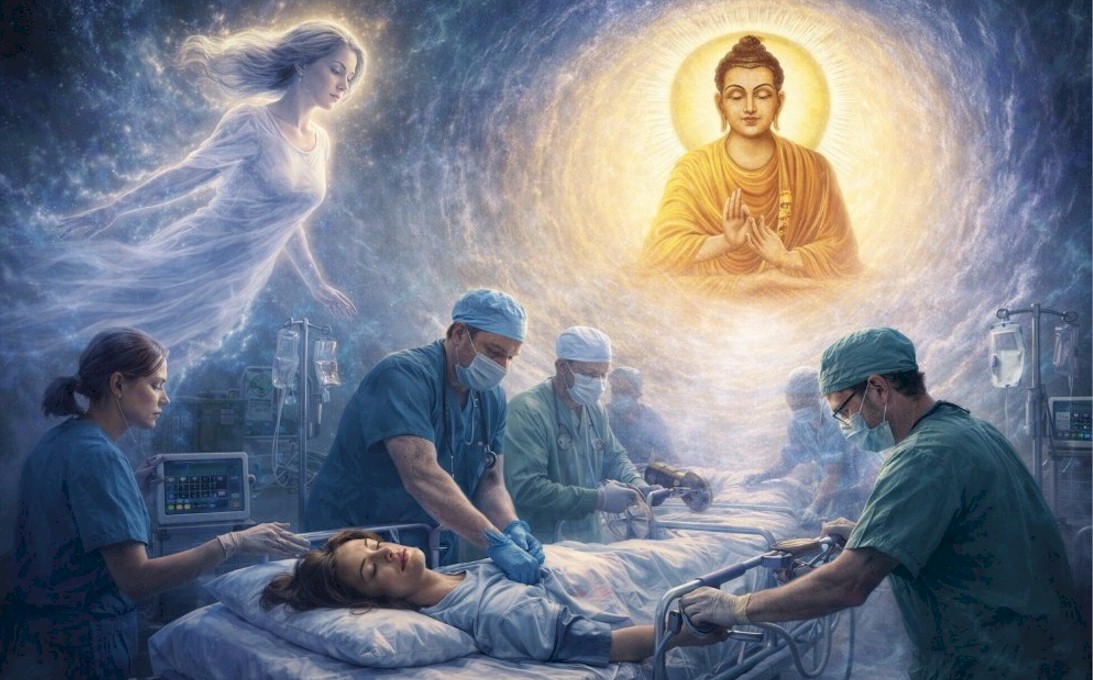
NDEs consistently describe encounters with a radiant Being of Light – an overwhelming presence of intelligence, love, and meaning that transcends ordinary perception. While often interpreted through religious or cultural lenses, these encounters frequently point beyond any single tradition toward a universal spiritual reality. Buddhism, with its emphasis on direct experience, non-duality, emptiness, and the illusory nature of fixed identities, offers a particularly compelling framework for understanding why the Being of Light appears in so many forms, including the Buddha. The following NDEs reveal the connection between the Being of Light and the Buddha.
Mellen-Thomas Benedict saw the Being of Light in his NDE change into different figures, like Jesus, the Buddha, Krishna, mandalas, archetypal images and signs. He was told that our beliefs shape the kind of feedback we receive from the light. For example, if you were a Buddhist or Catholic or Fundamentalist, you would receive a feedback loop of your own beliefs. The light revealed itself to Mellen-Thomas as our ‘Higher Self matrix,’ a mandala of human souls. He saw that what we call our Higher Self in each of us is a matrix and all Higher Selves are connected as one being. All humans are connected as one being and we are actually the same being, just different aspects of the same being. We are part of the same soul fractaling out in many creative directions, but still the same. Mellen-Thomas saw this mandala of human souls and described it as the most beautiful thing he has ever seen. When he went into it, he experienced an overwhelming love – the kind of love that cures, heals, and regenerates. He was told a grid exists around the planet where all the Higher Selves are connected. Benedict’s near-death revelation suggests that not only are the Higher Selves of Jesus, the Buddha and Krishna, one and the same, but all of humanity’s Higher Selves are one and the same. Perhaps we are different aspects of the same Higher Spirit.
During the fall of 1971, May Eulittt had a “Group NDE” with her cousin, James, and his best friend Rashad, who was from India, where they saw the Being of Light transform into the Buddha. One afternoon the three of them went to the cornfield to cut fodder. To get to the field they had to climb over a metal gate. A storm was brewing at the time. As they were helping each other over the gate, they were struck by lightning causing all three of them to share an NDE – a phenomenon known as a “Group NDE.” The three of them found themselves in a heavenly valley which Eulitt knew to be “heaven“; but at the same time she knew that James and Rashad were seeing it differently. James saw it as the “Gulf of Souls.” Rashad saw it as “Nirvana,” and somehow they knew all this without speaking. The Being of Light appeared before them. Eulitt experienced the Being to be an angel who resembled a strong, Viking Valkyrie. James saw this same Being as his late father, a career Naval officer, in a white dress uniform. Rashad perceived the Being to be the Enlightened One, or the Buddha. The Being spoke first to Rashad and welcomed him. He said that Rashad’s time on Earth was done. He was worthy now of Nirvana. At the same time, however, James received a message of encouragement from the Being of Light in the form of his Naval officer father. At the same time, Eulitt received another message from the Being of Light in the form of a Viking Valkyrie. Eventually, the three of them learned they would not be allowed to stay longer because it was not yet time for Eulitt or for James, only for Rashad. For awhile, they floated above their bodies. Then they reentered their bodies. Months later, Rashad died as foretold by the Buddha.
The Being of Light can transform into any personality that the NDEr wants to be. In her 2023 book, Nine Days of Eternity, Anke Evertz, a German woman of no particular religion, shares the wisdom she gained from the Being of Light during her NDE. In September 2009, Evertz was tending to her fireplace when her clothing caught fire. Unable to extinguish the fire, she suffered severe burns and was eventually placed in an induced coma for nine days. It was during this period that she had an NDE and encountered the Being of Light. When Evertz asked, “Who are you?” the response was both simple and profound: “I can be anything you want me to be.” The Being of Light then transformed into various entities such as Jesus, the Buddha, a Native American chief, and a bear. The Being showed her the interconnectedness of all things. She traveled into the cellular level of her body, witnessed past lives unfolding simultaneously, and grasped the purpose of human existence – to embody and express the boundless creative energy within.
The identity of the Being of Light is a function of the NDEr’s religious background. Dr. Raymond Moody’s states: “The identification of the Being varies from individual to individual and seems to be largely a function of the religious background, training, or beliefs of the person involved. Thus, most of those who are Christians in training or belief identify the light as Christ and sometimes draw Biblical parallels in support of their interpretation. A Jewish man and woman identified the light as an ‘angel.’”
The Being of Light transforms into an Entity according to the NDEr’s religious expectations. NDE researcher Todd Murphy states: “Several studies have indicated that the phenomenologies of NDEs are culture-bound. The observation that the ‘Being of Light’ can appear differently according to a person’s expectations of what God will be like supports the notion that a religion also plays a role.”
Psychic NDEr Betty Bethards learned that the identity of the Being of Light appears according to our expectations: “When we enter the spirit realm, we are given glimpses of things we expected to see in order to bring us comfort. We may briefly see a teacher we worshipped in our lifetime: Jesus, the Buddha, or another guru, according to your expectations.”
The identity of the Being of Light can be God, another spiritual entity, or an energy form which the NDEr can recognize. NDE researcher Dr. David San Filippo states, “The experiencer may encounter a Being of Light reported to be either God, another spiritual deity, or an energy form recognized by non-theists. The encounter with the Being of Light engulfs the experiencer with a sense of unconditional love emanating from the Being.”
Kevin Williams says the following about the Being(s) of Light: “There are many ‘Beings of Light’ appearing in NDEs. The Bible and NDEs show that God is light (1 John 1:5) agreeing with NDE testimony. Souls in the higher spirit realms emanate this light that is God. A ‘Being of Light’ in NDEs can be literally anyone: Jesus, the Buddha, the Hindu god of death, an angel, or even a deceased loved one for example. It usually depends on the person’s religious and cultural background.”
The Being of Light told Natacha P. (a Catholic) that it could transform into any personality she wanted: Natacha P. asked the Being of Light who it was. She experienced the Being as full of love with an overwhelming understanding. She knew that the Being knew everything about her. It responded telepathically: “I will be what you want me to be.” Natacha realized that the Being could not appear in its true form and full goodness, but offered her the choice of what form it would take.
Another example of the Being of Light transforming into whatever personality the NDEr wants it to be: Sandi T. (unaffiliated) encountered a radiant Being of Light and asked what it was. The Being gently replied that she could call it whatever felt right – names like “angel,” “guide,” or “God” were common but merely reflected personal beliefs. Sandi sensed these labels fell short, and the Being agreed, explaining that such terms, though meaningful, were limited by human understanding. When she questioned why she couldn’t define the Being more precisely, the Being said she lacked the usual assumptions that might obscure truth. Though full comprehension was beyond her human grasp, she instinctively knew the Being was good – and for now, that was enough.
The identity of the Being of Light generally conforms to the NDEr’s religious background – but not always. According to NDEr P.M.H. Atwater, “The Beings of Light found in NDEs usually conform to the predominant religion the person was exposed to, but not always. Jesus has appeared in near-death scenarios of Jewish people, for instance; a Muslim man once told me he was met by Buddha.” One western Hindu NDEr, Dr. Rajiv Parti, for example, encountered Jesus as the Being of Light.
NDE researcher Dr. Joel Ibrahim Kreps describes the NDE of Azmina Suleman, a Shia Muslim, who saw the Buddha and other religious leaders in her NDE: “Then, from within that solitary ray of brilliance, I saw several of God’s Messengers manifest themselves and stand before me in all their shining glory… As I watched in stunned silence, I realized that I was once again witnessing a ‘powered down’ version of these illuminated Beings of Light.” Suleman then began to identify the different messengers. She started with the “lone and bearded” prophet Noah and then continued with the pairs of the prophet Moses with Jesus, a crosslegged Buddha next to Lord Krishna, and finally the prophet Muhammad with Hazrat Ali, his son-in-law and successor. In a somewhat surprising association, both to Suleman herself and from the point of view of Muslim and Christian theologians, next to the prophet Muhammad was the Virgin Mary.
In a humorous example, Bryan D. (of several faiths) learned in his NDE that the Being of Light is the Buddha and others. Bryan telepathically asked the Being of Light if he was God. The Being replied “Always!” Bryan thought this answer was incomplete. He asked the Being if he was Jesus. The Being’s reply was “Sometimes.” He asked if the Being was Buddha. The Being replied, “Also yes! Of course! Great question.” He asked if the Being was also Krishna, Jah, and Allah? The Being replied, “And MORE! Ha! You are remembering quickly this time!”
Francis McG. (unaffiliated) asked the Being of Light if he was a religious figure such as the Buddha: “I could feel its love and kindness. I asked if it was Jesus or Buddha or Mohammed? It said, ‘I am the light.'”
NDE researcher Dr. Jack Hiller reported a Buddhist NDEr who saw the light as the Buddha: “There was one Buddhist and his experience… of immersion in a huge zone of light that produced ‘incredible joy.’ He did not see any image of Buddha, but decided it was apt to label this light as Buddha.”
Cheryl G. (metaphysical) learned the Being of Light was the “collective conscious” of everyone including the Buddha: “I encountered a definite being, or a voice clearly of mystical or unearthly origin. A ‘being’ per se, was not my encounter, rather the sense, knowledge, and participation of all, a ‘collective conscious’ if you will… They (including Buddha) were the awareness of ‘all’ in the ‘oneness’. It truly encompasses ‘ALL’
Diego W. (an agnostic) learned some people may say the Being of Light is the Buddha or other religious figures: “Some people will be able to incorporate in their experience the respective education and say that the Being of the Light is Moses, Jesus, Buddha, etc.”
Linda Stewart (a Christian) learned the identity of the Being of Light doesn’t matter – only the recognition of love and truth are important: “The radiant Spirit was Christ, the manifestation and expression of pure love. Because of my Christian education, I knew no other name to call what I felt as I looked at him. Others might have called him Buddha, or Yahweh, or Great Spirit in the Sky, but the naming did not matter, only the recognition of absolute love and truth was important.”
Melanie learned that the identity of the Being of Light doesn’t matter: “I believe that there is one God – whom is that light of love. I believe that the light could be the Christian God, the Muslim God, the Hindu God, the Jewish God, the Buddhist God and I believe that does not matter.”
Michael G. (a “liberal”) learned you can refer to God as the Buddha: “I’m WAY more liberal [after my NDE]. I didn’t think I would be, but I am SO liberal. It’s like I don’t know ‘who’ God is. Buddha? Jesus? Everything? Nothing? Sure! It is whatever you call it.”
- Read more about the Being of Light and the NDE.
Norman Paulsen describes his NDE involving a meditating Buddha: “I am moving northward now, impelled by silent motion, my arms outstretched before me. I am flying higher and higher without effort. There below me is the whole coastline of California! The soft, astral colors surrounding the Earth hang like a perpetual aurora borealis in every direction. My thoughts now reveal facts long known from deep within my soul. To leave the Earth in my present form, I must exit through the north polar vortex. Here, there is a door. Moving northward, my thoughts remind me of all my earthly commitments left behind. There below is San Luis Obispo on the west coast. An astral image of a meditating Buddha – it must be representing Dad! I have not said goodbye to him. This really troubles me; now the image is slowly disappearing like a fog.” Norman Paulsen is a life-long student of Jesus Christ as well as a direct disciple of Paramahansa Yogananda, an NDEr and the first yoga master of India to live and teach in the West. Paulsen founded the Sunburst Sangha-Community which is composed of people who desire to practice a conscious way of life based upon the teachings of the Buddha’s eightfold path of right living and twelve divine virtues.
Virginie R. (a Christian) saw the Buddha during her NDE: “I was advancing towards a very bright, white light at the end of a tunnel… I saw Buddha.”
Scott S. (a spiritualist) witnessed events with the Buddha and others: “My past life previews traveled through time, witnessing spiritual events with figures like Buddha, Yeshua (Jesus), and esoteric teachers from history.”
Kyal L. (of several faiths) may have sensed the Buddha during his NDE: “I may have sensed Buddha. I did not see him but it was during the Zen part of the NDE and I was Buddha as well and all was Buddha.”
Peter S. (Catholic) may have encountered Jesus or the Buddha: “[I encountered] a very beautiful, fresh person in white, with half black hair, don’t know [if it was a] man or woman. I believe it was one of the masters: Jesus, Buddha…”
Laura C. (Catholic) may have seen images of the Buddha and Jesus: “I swear I saw images of the Buddha, Jesus, but I could never truly recall if I put that in my head or that was there.”
3. Thailand Buddhist NDEs
Rooted in centuries-old Buddhist cosmology, Thailand NDEs frequently occur within a moral universe governed by karma, merit-making, reincarnation, and the hierarchical realms of hells and heavens described in Thai traditional texts such as the Phra Malaya. Rather than encountering a formless Being of Light or an abstract transcendental presence, Thai experiencers often report meeting Yama, the Lord of the Dead, and his attendants, the Yamatoots, who guide souls, review karmic deeds, and determine appropriate destinations or rebirths.
According to NDE researcher Todd Murphy: “The Phra Malaya is the only important source of Thai ideas and expectations about death and dying. The Phra Malaya recounts the visions of heaven and hell experienced by a medieval Buddhist monk (Phra Malaya) during his meditation. It first describes his descent into hell. There, he witnessed the hell in which Yama, the Lord of the Dead, assigned the souls of the dead to their appropriate rebirths. There were several options for rebirth available. A person could be reborn as a human with any social status and any degree of attractiveness, as any type of animal, into any one of fourteen hells, or into any one of nine heavens… In the center of the hells was the court of Yama, the Lord of the Underworld, whom Phra Malaya saw judging both humans and animals. After that, he visited a number of heavens.”
Thai NDErs, like those from India, often report having been told that they were taken by mistake, that they were the wrong person, and that they must return to life. One example comes from Todd Murphy’s Thailand NDE research: “He (D. Muangman) then found himself in front of Yama, the lord of the underworld. Yama looked into a book in which his actions were written. Before the judgment could begin, Yama said that he was the wrong person and had to be taken back. The patient ‘sneaked’ a look into the book, and he saw that it was written in Thai. Surprised, (possibly because he expected it to be written in Pali) he took a closer look, and saw the name of a person he knew from his village, with the date of his death written as three days after his own NDE. The man named in Yama’s book did, in fact, die on the date named (D. Muangman, personal communication, 1997).” Todd Murphy states that five of the ten Thai Buddhist NDEs in his collection included NDErs being told by Yamatoots that they were the wrong person, and being ordered back to life.
Todd Murphy describes another Thai Buddhist NDE: “I asked [the Yamatoot] to take me to see the Lord Buddha. I told him I needed to see the Buddha. The Yamatoot looked at the sky and pointed. ‘That big star,’ he said, ‘is the Buddha. And those little stars are the other enlightened ones; those who have followed the Dharma [the Buddhist teachings] to the end. I’m afraid you won’t be able to see them in any other form. You are not pure enough.’ Like the ‘Being of Light’ in Western life reviews, Yama was present during this same NDE during its karmic review, which dealt only with the experiencer having killed chickens; but Yama is anything but a Being of Light. In popular Thai depictions, he is shown as a wrathful being, and is most often remembered for his power to condemn one to hell. Some of the functions of angels and guides (Lundahl, 1992) are also filled by Yama’s servants, the Yamatoots. They guide, lead tours of hell, and are even seen to grant requests made by the experiencer.”
Todd Murphy describes the NDE of Kodien – a Chinese-Thailand Buddhist: “One of the most interesting cases of the effects of karma manifesting in an NDE is in the case of Kodien, a Chinese-Thai.” Kodien encountered deceased friends and realized he was dead. He came to a place where groups of spirits sat with sad, pale faces – some had food and water, others only piles of ash. When he asked a recently deceased friend for food or water, the friend explained that each person could only consume what belonged to them. Kodien’s own provision was ash, which he could not eat, and the water he tried to take burned him. His friend explained that those who had made merit by donating food to monks in life had nourishment, while those who had only offered joss paper had ash. Kodien realized he had followed Chinese customs and rejected Thai merit-making. He was then led into a building filled with many people and brought into a room with a large table.
Todd Murphy describes a Thai Buddhist NDE occurring during meditation: “One night, close to midnight, he sat down to do vipassana meditation. He felt like he couldn’t breath, and he had heart palpitations. He began chanting in his mind ‘Being dead, being dead, being dead.’ He felt a change in his state of consciousness, and found himself looking at his body from outside. He found himself thinking that he had just left his body for a little while the way it can happen during meditation. He walked downstairs, and he saw four people standing at the bottom of the stairs. One of them said that a Yamatoot had told them to come and take him. He was shocked. It was then that he realized that this was not a meditative out-of-body experience. He asked: ‘Am I dead?'”
Todd Murphy describes a heavenly NDE by a Thai Buddhist. A Yamatoot asked whether the NDEr truly wished to see heaven and instructed them to contemplate the Buddha’s “Three Treasures” and pray with focused concentration. When they did so, the hellish realm vanished. The NDEr entered a peaceful, beautiful world with pleasant weather, no hunger, fragrant gardens, and angelic beings gliding through the air. In a palace-like pavilion, a radiant being with a green halo identified himself as Indra, the King of Heaven, and explained that immoral actions lead to hell, while moral living and good deeds lead to rebirth in his heaven. He then opened the NDEr’s “wisdom eye,” imparting the Dharma and revealing universal truths. Then Indra brought the NDEr to the higher World of Brahma, where Brahma appeared with a golden halo and great compassion. Brahma explained that few reach this realm, as it is reserved mainly for those who accumulated great merit, especially disciplined monks. Brahma warned that the NDEr had been separated from the body for seven days and must return soon or be unable to do so.
Todd Murphy describes a Thai Buddhist NDE encounter with deceased loved ones: The NDEr was taken to the next level of heaven, where he encountered many of his old friends, most of whom had been soldiers. They were very happy to see him, and he believed that this was where he would remain forever. They did not know that he would later revive. There were about ten people present. Some offered him food and water, while others took him to see additional friends. Some of these friends were sleeping on beds, and all of them felt sorrowful because they were separated from their families. He asked them where his bed was. They replied that there was no bed for him there because it was not his home; his true home was in the next level above, which was even better. He asked if they could make a temporary bed for him, but they said it was impossible, explaining that they had only two pieces of wood and two nails. He then said it did not matter, as he was in a hurry and needed to go.
Todd Murphy describes the NDE of Thai Buddhist Sanit Tahnarat: “One morning in 1982, while brushing his teeth, Sanit Tahnarat passed out for reasons unknown. He had an OBE in which he saw his own body, unconscious on the floor. He saw clouds approach him, and he was able to take hold of one. He found it was as hard as a stone. He climbed onto it, and sat down. The cloud carried him up to one of the heavens. He saw it was filled with diamonds and jewels. He moved up to another heaven, and saw that it had people dressed like angels. He wanted to see more, so he climbed up the clouds until he came to another plane. There were no people there, just spiritual lights. He heard a voice calling ‘grandfather’ four times. At this, his hands became limp so that he could no longer hold on. As this happened, the cloud disappeared, and he fell to Earth. When he hit the ground, he revived and found someone doing CPR on him.”
Todd Murphy describes the NDE of Thai Buddhist Vissudhikoon: “I asked the Yamatoots to wait a while, because I had to tell my family that I was dead. I told them: ‘Nobody knows I’m here.’ I walked to my house, stood in front of it for a minute, and then went inside. I saw there were a number of people there, and all of them were crying. I saw my husband and daughter sitting together. I tried to run to them, but I tripped on something. I fell. As I hit the floor, I revived.”
Todd Murphy compares Western NDEs with Thai Buddhist NDEs: “While some of the most common phenomenological features found in Western NDEs are either absent or rare in Thai NDEs, there are meaningful correlations that can be drawn. Typical phases appear in both, and with some typical order. Whereas Western NDEs often begin with travel through a tunnel to be greeted by dead friends and relatives, Thai NDEs usually begin with Yamatoots guiding the experiencer on a tour of hell. Thai NDErs may encounter Yama or more often his assistants, the Yamatoots, rather than the Being of Light and angels reported in Western NDEs. Thai NDEs typically include a review of important karmas rather than a Western-style comprehensive life review, and a tour of hell and heaven rather than a transcendent experience. Whereas Western NDErs may reach a ‘point of no return‘ and choose to return to life, Thai NDErs are typically told they were taken because of a clerical mistake and told to return to the body.
“The possibility arises that the same process occurs in both Western and Thai NDEs, and that the only significant differences are in terms of their culturally-derived phenomenological features. It may be that NDEs of all cultures share common patterns, but that these patterns are obscured by the different cultural phenomena through which they manifest. These Thai cases support the idea that NDEs may be characterized partly as subjective events occurring within specific contexts, in which individuals commonly use culturally-derived patterns to confabulate individualized death-process phenomena that serve common psychological functions.”
4. Tibetan Buddhist NDEs
There are many similarities to the teachings of the afterlife as revealed by the Tibetan Buddhism and NDEs. In the NDE, the mind is momentarily released from the body, and goes through a number of experiences akin to those of the mental body in the “bardo of becoming.” NDEs very often begins with an out-of-body experience: people can see their own body, as well as the environment around them. This coincides with what the Tibetan Book of the Dead describes. In the bardo of becoming, the dead are able to see and hear their living relatives, but are unable, sometimes frustratingly, to communicate with them. The mental body in the bardo of becoming is described in the Tibetan Book of the Dead as being “like a body of the golden age,” and as having almost supernatural mobility and clairvoyance. NDErs also find that the form they have is complete and in the prime of life. They find also that they can travel instantaneously, simply by the power of thought. In the bardo of becoming, as well as many other kinds of visions, the mental body will see visions and signs of different realms. A small percentage of those who have survived an NDE describe visions of inner worlds, paradises, and cities of light with transcendental music.
Of course, the most astounding similarity is the encounter with the Being of Light, or the “Clear Light” as described in the Tibetan Book of the Dead. According to the Tibetan teachings, at the moment of death, the Clear Light dawns in all its splendor before the dying person. Tibetan teachings stress that by recognizing yourself as this Clear Light, you will attain liberation from the cycle of reincarnation. Many NDErs are convinced the Being of Light is their Higher Self. This is certainly in agreement with the Tibetan teachings.
The life review appears again and again in NDE reports, and demonstrates so clearly the inevitability of karma and the far-reaching and powerful effects of all our actions, words, and thoughts. The central message NDErs bring back from their encounter with death, or the presence of the Being of Light, is exactly the same as that of the Buddha and of the bardo teachings: that the essential and most important qualities in life are love and knowledge, compassion and wisdom. Not all NDE reports today, however, are positive, and this corresponds to the Tibetan teachings as well. Some people report terrifying NDEs of fear, panic, loneliness, desolation, and gloom, all vividly reminiscent of the descriptions of the bardo of becoming.
The Tibetan Book of the Dead and the NDE
The Tibetan Book of the Dead (Bardo Thodol) composed in the 8th century by Buddhist master Padmasambhava is intended to guide the dying person through the experiences that the consciousness has after death, in the “bardo” – the interval between death and the next rebirth. The Bardo Thodol differentiates the intermediate state between lives into three bardos: (1) The “chikhai” bardo or “bardo of the moment of death”, which features the experience of the “Clear Light of reality”, or at least the nearest approximation of which one is spiritually capable; (2) The “chonyid” bardo or “bardo of the experiencing of reality”, which features the experience of visions of various Buddha forms, or the nearest approximations of which one is capable; and (3) The “sidpa” bardo or “bardo of rebirth”, which features karmically impelled visions which eventually result in rebirth.
The first bardo comes at the very moment of death, when there dawns the Clear Light of the Ultimate Reality. This is the very content and substance of the state of liberation, if only the soul can recognize it and act in a way to remain in that state. The second step is to realize that his own mind and self is identical with the Clear Light, implying that he himself IS the Ultimate Reality, “the All-good Buddha”, transcending time, eternity, and all creation. If he can recognize this while in this supreme state at the moment of death, he will attain liberation – that is, he will remain in the Clear Light forever. This condition is called the “Dharmakaya“, the highest spiritual body of the Buddha.
If the soul is still not liberated at this stage, it will descend into the second bardo. Here the soul of the deceased encounters what are referred to as “the Peaceful Deities.” A particular Buddha-being will appear in radiance and glory, with a bevy of angelic attendants. Then there appears the second-highest God in the Buddhist pantheon – in fact, he is actually the Second Person in the literal Buddhist Holy Trinity. At the same time, there dawns a smoky light from hell; and here we note that, just as the Buddhist heaven is not a permanent, eternal state, neither is its hell. Even the most wretched souls will eventually work their way out of even the deepest pit of hell, just as even the highest and purest souls will eventually lose their footing in heaven and descend again into the cycle of death and rebirth. Liberation is the only way out. If the soul responds to the “dazzling white light” of the second God with the joy of a pure heart, he will be liberated thereby; but if he specifically reacts with ANGER from having indulged in this vice on Earth, he will recoil from the light in fear and be drawn into hell.
In the third bardo the soul encounters the Lord of Death, a fearsome deity who appears in smoke and fire, and subjects the soul to a Judgment. If the dead person protests that he has done no evil, the Lord of Death holds up before him the Mirror of Karma, “wherein every good and evil act is vividly reflected.” Now demons approach and begin to inflict torments and punishments upon the soul for his evil deeds. The instructions in the Tibetan Book of the Dead are for him to attempt to recognize the Voidness of all these beings, including the Lord of Death himself; the dead person is told that this entire scene unfolding around him is a projection from his own mind. Even here he can attain liberation by recognizing this.
Finally there comes a point where it is no longer possible to attain liberation, and after this the soul is given instructions on how to choose the best womb for a favorable incarnation. The basic method is non-attachment: to try to rise above both attraction to worldly pleasures and repulsion from worldly ills. The final words of the Book of the Dead are: “Let virtue and goodness be perfected in every way.”
An interesting phenomenon, little known in the West, but familiar to Tibetan Buddhists, is the “delok“. In Tibet, delok means returned from death, and traditionally deloks are people who seemingly “die” as a result of an illness, and find themselves traveling in one of the three bardo afterlife realms – Tibetan Buddhist afterlife states. They visit the hell realms, where they witness the judgment of the dead and the suffering of hell, and sometimes they go to paradises and Buddha realms. They can be accompanied by a deity, who protects them and explains what is happening. After a week the delok is sent back to the body with a message from the Lord of Death for the living, urging them toward spiritual practice and a beneficial way of life.
Often the deloks have great difficulty making people believe their story, and they spend the rest of their lives recounting their NDEs to others in order to draw them toward the path of wisdom. The biographies of some of the more famous deloks, such as Dawa Drolma, one of the great lamas of the century. At the age of 16 she fell ill and died, but returned to her body after five days. For the benefit of others she recorded every detail of her experiences in the bardo and pure realms. Dawa Drolma is the author of the book, Delog: Journey to Realms Beyond Death.
Lingza Chokyi is another famous delok who had an NDE. She arrived in the bardo realm, which appeared to her like a country. From there, she tells us, there was a bridge that led to the hell realms, and to where the Lord of Death was counting the good or evil actions of the dead. In this realm she met various people who recounted their stories, and she saw a great yogin who had come into the hell realms in order to liberate beings. Finally Lingza Chokyi was sent back to the world, as there had been an error concerning her name and family, and it was not yet her time to die. With the message from the Lord of Death to the living, she returned to her body and recovered, and spent the rest of her life telling of what she had learned.
5. Chinese Pure Land Buddhist NDEs
Pure Land Buddhism is a broad branch of Mahayana Buddhism focused on achieving rebirth in a “Pure Land.” It is one of the most widely practiced traditions of Buddhism in East Asia. It is also known as the “Lotus School” in China or the “Nembutsu school” in Japan. East Asian Pure Land mainly relies on three main Mahayana scriptures: the Sutra of Amitayus, the Contemplation Sutra and the Amitabha Sutra.
The Buddha’s “Pure Land” is a superior place to spiritually train for full Buddhahood, where one can meet a Buddha face to face and study under them without any of the distractions or fears of our world. Since it is much easier to attain enlightenment in Pure Land, many Mahayana Buddhists strive to be reborn in one. The most popular one today is Sukhavati (“Land of Bliss”), the Pure Land of Buddha Amitābha, though some Buddhists may also aspire to be reborn in other Pure Lands (such as Maitreya‘s and Medicine Guru‘s). Although Buddhas are venerated in Pure Land and are seen as savior-like figures, the tradition clearly distinguishes itself from theistic religions, due to its roots in the classic Mahayana understanding of Buddhahood and bodhisattvas, as well as the Buddhist doctrines of emptiness and mind-only.
Several common elements of NDEs resonate strongly with Chinese Pure Land narratives: (1) Welcoming figures: Many NDEs include Beings of Light or compassionate presences. Pure Land sources explicitly portray Amitābha (and sometimes Guanyin/Avalokiteśvara) welcoming the dying. (2) Radiant light and serenity: The hallmark NDE “light” aligns with Amitābha’s epithet “Infinite Light,” and classic Pure Land imagery of pervasive luminosity and bliss. (3) Paradise landscapes: Reports of gardens, music, and beauty mirror Sukhāvatī’s jewel-lakes, lotuses, and celestial music. (4) Deathbed timing: Both traditions give special weight to the threshold moment, suggesting heightened receptivity or spiritual significance at dying.
Chinese Pure Land Buddhism provides a practiced, communal path for dying oriented around Amitābha’s welcoming light; NDEs provide modern first-person stories that often echo that light, the welcome, and the peace – while remaining a distinct genre shaped by contemporary contexts.
- Read more about Chinese Pure Land Buddhism and the NDE.
6. Gnostic Christianity as “Buddhism of the West”
Edward Conze (1904–1979), a leading authority on Buddhism and comparative mysticism, said that Gnostic Christianity is “the Buddhism of the West.” He states that both traditions emphasize liberation through direct inner knowledge (gnosis/prajñā); awakening from ignorance rather than salvation through belief; and experiential wisdom over dogma or institutional authority. Elaine Pagels, a renowned American historian of religion, highlighted how Gnostic Christianity resembled Eastern contemplative paths more than orthodox Christianity.
Buddhism teaches how the practice of good religious and moral behavior can lead to Nirvana (i.e., the state of enlightenment, kingdom of God within). To attain Nirvana, a person must be subjected to the cycle of reincarnation over numerous lifetimes according to how good or bad they were in previous incarnations depending on one’s actions according to God’s law of “karma” or God’s law of “an eye for an eye” as it is known in the West. The goal of Buddhism is to achieve liberation from this cycle of birth and rebirth. The Buddhist view of life in this world is summarized in what is called “the four noble truths.” They are (1) This world is a world of suffering. (2) Desire and the belief in the importance of one’s self causes suffering. (3) The attainment of Nirvana ends this suffering. (4) Nirvana is attained only by following the path of righteousness in action, thought, attitude, and meditation. As it was with Jesus, the Buddha had a community of disciples to carry on his teachings.
The Buddha is regarded by Hindus as the ninth incarnation of the deity Vishnu, following Krishna. The Buddha started a new religion which did not emphasize “gods,” but rather how people can become “awakened” or “enlightened” to liberate themselves from the cycle of birth, death, and rebirth.
Over the millennia, the teachings of both Jesus and the Buddha has spawned many different sects. Each is an attempt to keep the teachings alive under new circumstances. In 1947 in Egypt, early Christian Gnostic texts were discovered which were hidden for thousands of years at the time when orders from the Church called for all heretical texts to be destroyed. One of those text was the Gospel of Thomas which is considered by some scholars to be the earliest gospel ever written and the most reliable. The Gospel of Thomas resonates with this type of Christianity that remarkably resembles Buddhism. It describes Jesus teaching the disciples how to become liberated from reincarnation. The writings of early Christianity discovered in 1947, show that early Christianity contained much more diversity of viewpoint and practice than later Christians acknowledged or even imagined. Because these teachings were smothered, many Christians today are adamant that the only path to God is via the personality of Jesus and this was considered the orthodox formula.
Connected with the triumphs of these two religions there is a historical correlation worthy of mentioning. About three centuries after the Buddha’s death, Asoka the Great, emperor of India, converted to the Buddhist faith and made Buddhism the state religion of the empire of India at that time. This emperor did more than any other person to secure Buddhism’s supremacy in the East. In the same way, about three centuries after the death of Jesus, Constantine the Great, emperor of Rome, became a convert to the Christian faith and made it the state religion of his empire. Because of this, Christianity reigned supreme in the West.
Edgar Cayce learned from NDE-like journeys that Christian Gnosticism is the highest form of Christianity. A close study of Christian Gnosticism shows that this early form of Christianity was more similar to Buddhism than to traditional Christianity. For example, both religions teach: (a) Reincarnation; (b) A philosophy of life where suffering can lead to liberation; (c) The Oneness of all things; (d) The Divine Light; (e) The existence of various afterlife realms to journey through to attain heaven; (f ) The Gnostic goal of every human being attaining Christhood is identical to the goal of attaining Buddhahood; (g) The distinction between “Jesus the human being” and “Christ the spirit of human-divine unity;” and the distinction between “Buddha the human being” and “Dharmakaya the Clear Light of Ultimate Reality; (h) The belief in the ancient concept of karma; (i ) and the importance of performing good works. Note that this is not a complete list.
According to Edgar Cayce, the meaning of the term “Christ” (“annointed”) has less to do with the personality known as Jesus. This term refers to the spiritual condition of human-divine unity – or as Cayce would say – “at-onement“. This unity is the ultimate goal of everyone and is spiritually possible for all. Jesus became “a Christ” in that he attained perfect human-divine unity. It is God’s desire for everyone to attain Christhood – or Buddhahood if you live in the East (same concept). In this respect, it can be said that Jesus and the Buddha became “annointed” because they became a manifestation of the divine nature in humanity. This divine nature is also known by other titles in various religious traditions such as: Dharmakaya, Brahman, Collective Unconscious, and Universal Consciousness.
7. NDEs Involving Buddhist Concepts
 Nancy Evans Bush is a devout Christian who encountered Buddhist entities in the Void during her NDE. She also saw Buddhist Yin-Yang “mandalas” during her NDE: “I was rocketing through space like an astronaut without a capsule with immense speed and great distance. A small group of circles appeared ahead of me. To the right was just dark space. The circles were black and white and made a clicking sound as they snapped black to white and white to black. They were not evil exactly, just mocking and mechanistic. The message in their jeering was Zen Buddhist philosophy, ‘Your life never existed. The world never existed. Your family never existed. You were allowed to imagine it. You were allowed to make it up. It was never there. There was nothing there. There never was anything there. You’re not real.'”
Several years after her NDE, Nancy was looking through a book on Eastern philosophy. What she saw in the book so upset her she threw the book across the room. In the Eastern philosophy book was the same circular shape she saw in her NDE. It was the Chinese symbol ‘yin-yang’ which represents the oneness of all so-called opposite principles we find in the universe.
It is apparent that, while in the Void, Nancy was confronted by Zen Buddhist entities in the Void with her. The Buddhist concept of reality is that nothing in this physical world is real. People consist of a “bundle” of habits, memories, sensations, desires, and so forth, which together delude people into thinking that he or she consists of a stable, lasting self. This false self is what reincarnates body after body. In Buddhism, life in a corporeal body is the source of all suffering. Hence, the goal is to obtain liberation. This means abandoning the false sense of self so that the bundle of memories and impulses disintegrates, leaving nothing to reincarnate and hence nothing to experience pain. “Nirvana” is the Buddhist term for liberation. Nirvana literally means extinction – an extinction that allows a person to become one with all there is – to become “God” (Buddhahood). To attain Nirvana, one must face and accept the concept that physical reality is not real. True reality comes through self-extinction which results in becoming one with the Clear Light.
a. Consciousness Beyond the Physical Body
One of the most consistent features of NDEs is the perception that consciousness continues independently of the physical body. Many NDErs describe leaving their body, observing events from above, and entering nonphysical realms characterized by clarity and expanded awareness. This challenges materialist assumptions that consciousness is solely a product of the brain.
Buddhist teachings similarly hold that consciousness is not identical to the physical body. In Buddhism, consciousness (viññāṇa) is part of a dynamic process rather than a fixed entity, capable of continuing beyond physical death through reincarnation. While Buddhism does not posit a permanent soul, it does affirm that awareness and karmic continuity extend beyond a single lifetime – an idea that corresponds with NDE testimonies of lucid awareness after clinical death.
NDE Parallels
Myriam O. (a Catholic) experienced luminous consciousness as the Buddha described: “Once outside my body – as a consciousness – right above me, in that space between a physical body that had already been left behind in another dimension and a Void, which I perceived as a black empty space, after all my concepts and the Creation itself had fallen off of me and disintegrated, there was a gigantic mass of luminous consciousness. Just as the Buddha described it. Huge. It was like an ocean but above, sort of upside down. A sea of pure consciousness, nothing but consciousness.”
Cougar experienced the Buddha “nature” as the nature of everything: “I have been experiencing ‘Being’ not only as my true nature, but as the nature of everything. This means ‘Being’ is also the true nature of the normally convoluted ego-self. The pure presence of ‘Being’ is the underlying ground both of Essence and for structures of the ego-self… ‘Being’ in psychology is also known as ‘Presence,’ ‘Soul‘ in ancient Greece, ‘Self‘ in these times, ‘Stillpoint’ in Christianity, ‘Buddha Nature’ or ‘Boundlessness’ in Tibet, ‘Atman‘ in Hinduism, ‘Divine Essence’ in Sufism, ‘Nothing or Infinite’ in Kabala, ‘Tao‘ in Taoism, and so on. It can be seen in two basic aspects of either dark shimmering waters or brilliant, Luminous Light.”
Buddhism and NDE research converge notably in their descriptions of consciousness functioning independently of the physical body. In Buddhism, especially within early teachings and later Mahayana and Tibetan traditions, consciousness is not identified with the body but is understood as a stream of awareness that can operate beyond physical form. Advanced meditation practices and teachings on death describe consciousness separating from bodily perception, observing reality with heightened clarity.
Similarly, out-of-body experiences (OBEs) reported during NDEs frequently involve a vivid sense of leaving the physical body, often accompanied by clear perception, expanded awareness, and a sense of identity not rooted in the physical self. NDErs commonly report observing their bodies from an external vantage point while retaining full consciousness, emotion, and cognition.
These testimonies parallel the Buddhist view that consciousness is not generated by the body, but temporarily associated with it. OBEs closely resembles Buddhist descriptions of consciousness separating from the physical form at death, particularly in Tibetan Buddhist death scriptures.
NDE Parallels
While atheist Howard Storm was out-of-body during his NDE, he became more aware: “I became aware that strangely I felt more alert, more aware, more alive than I had ever felt in my entire life. All my senses were extremely acute. Everything felt tingly and alive.”
Dr. Dianne Morrissey was out-of-body, but still aware: “I never felt the injuries, however, because I was no longer in my body. I was actually watching my electrocution from above! How could I be out of my body and still be alive? I wondered, astonished.”
Kimberly Clark-Sharp was out-of-body like taking off an old coat: “I looked at my body, the body I knew so well, and was surprised by my detachment. I felt the same sort of gratitude toward my body that I had for my old winter coat when I put it away in the spring. It had served me well, but I no longer needed it. I had absolutely no attachment to it.”
- Read more about Out-of-Body Experiences and the NDE.
b. Impermanence and the Illusion of the Self
The Buddha taught that the “self” is a temporary aggregation of bodily processes. People clinging to a self identity is what creates suffering. The Buddhist doctrine of anattā (non-self) emphasizes that what we call the “self” is not a permanent essence.
Interestingly, many NDErs report an experience of “ego death.” They describe losing their usual sense of identity while retaining a deeper awareness that feels more authentic and expansive. This loss of ego often brings relief rather than fear, echoing the Buddhist insight that clinging to identity is a source of suffering. In both NDEs and Buddhism, liberation is associated with letting go rather than holding on. NDEs also often involves a “soul merger” with the Light where the NDEr becomes one with the Light.
NDE Parallels
Merrideth H. (a Christian) experienced ego death while out-of-body: “I experienced full ego death and became one with the universe. When I crossed the rainbow bridge I rejoined with my higher consciousness so I had extremely elevated consciousness. It was extremely elevated, like Christ consciousness. But, this only happens when I’m out of my body.”
NDE researcher Kevin Williams on ego death in NDE Void experiences: “The Void has also been understood as a process of ‘ego death’ where the ‘mask‘ of the personality is dissolved to allow the individuality of the soul to be experienced in relation to the Whole that is God.”
Terence M. (a Buddhist) didn’t experience a sense of self as in Buddhism: “The Buddha talked about the eight worldly concerns of pleasure, pain, gain, loss, praise, blame, fame, and disrepute that plague us all… Exactly where is this imaginary self to be found? I certainly didn’t have any reference to one during my complete cardiac arrest caused NDE – not even a thought of any kind.”
Renee M. (a Christian) found a source drawing her into her authentic self much like the Buddha: “I have found a source within that will draw me into my authentic natal self that is surprisingly much like Jesus, Buddha and other amazing super heroes in history.”
Tomas O. (a Catholic) learned that everything is a part of the Buddha nature and others: “I feel everything (including me and you) is part of the ‘I AM‘, Brahman, the Divine, Buddha nature, the Tao and so on. It’s the One playing to be Many.”
Carlos K. (a Buddhist) realized all things are the Buddha including himself: “I recognized Holiness in myself and in everything and everyone. All things were the Buddha. I was Buddha and felt a constant, quiet, springing of sheer joy in me! I received spontaneous healings for hunger, bodily pains and strains, or when feeling cold.”
Cami R. (no faith) learned everyone has the same light as the Buddha: “We each have within us the same light that shined within Krishna and Jesus and the Buddha and everyone who’s ever carried the torch. We are each Divinity’s opportunity to experience and create a unique face of life, to allow it to shine right through our inevitable, insufferable flaws. And when that particular life form is done, we recycle back into the ocean, like a wave that dances and melts back in, to re-form and experience anew, moving our way higher and higher up the spiral of lessons.”
NDEs mirror the Buddhist teachings that liberation comes not from strengthening the ego, but through ego death and the soul merging with the Spirit.
- Read more about the Soul Merging With Spirit.
c. Compassion, Love, and Moral Insight
A powerful aftereffect of NDEs is a lasting increase in compassion, empathy, and concern for others. NDErs frequently report that love is the most important reality in existence and that acts of kindness carry profound spiritual significance. Life reviews – another common NDE element – often involve experiencing one’s actions from the perspective of others, leading to a deep moral awakening.
This aligns closely with the Buddha’s emphasis on compassion (karuṇā) and loving-kindness (mettā). In Buddhism, ethical conduct is not imposed by divine judgment but arises naturally from insight into interconnectedness. Similarly, NDErs often report that moral understanding in the afterlife is immediate and experiential rather than punitive or rule-based.
Religious figures such as Jesus and the Buddha have helped humanity understand how loving others is the way to heaven (Luke 10:25-28) and that this heaven can be found within us (Luke 17:20-21).
NDE Parallels
Christian Andreason learned from his NDE that you don’t have to be a Buddha to hear from God: “I am saying that ANYONE can hear from God! One does not need to be Moses or Jesus or Buddha to hear from their Creator. To hear from God, all one has to do is THINK as the CREATOR thinks. Well, I happen to know that God thinks only ONE central thought, so this should be easy for you! GOD THINKS ABOUT NOTHING BUT LOVE — ALL THE TIME! If you are living your life according to the ways of LOVE (which are the constructive ways that you know deep down in your spirit that are right for you), then you can confidently know that you have the ability to hear from God.”
Julian D. (a Protestant studying mystical Christianity) realized “the Buddha” and “the Christ” share a message of love and life: “I have talked with people about [my NDE] over the years. It is a vast subject for me. And it is very simple, as well. The Buddha, the Christ and others have all summed it up in very simple terms. Be here now. Love is all there is. Life is a dream. The vastness. Source is beyond our comprehension.”
Judy G.‘s (unaffiliated) NDE resulted in living in unconditional love: “I knew without a doubt that death was not an ending, but a wonderful opening to my real life. I would be more knowledgeable and live in unconditional completeness and love. I remember feeling almost unworthy of such an indescribable, unconditional love. I was in awe of how much love was enveloping me.”
Mel W. (a “liberal”) learned that human kindness and love are what is important: “I now understand that a basic human act of kindness amounts to so much more than being president of the United States or a brilliant scientist. I think my earthly job is only a platform to my real job. To accept and spread love. And by love, I mean real love, not some word bandied about in a careless fashion by so many of us.”
Brad K. (unaffiliated) saw the wisdom of the Buddha and others in the application of love: “There was no feeling of anything but my awe, and the love and knowledge and wisdom that this orb projected… It was immense, and total, and its power was love. But I see the wisdom of Buddha, and Jesus, and Gandhi, and others in their application of love to their life situations.”
Like Buddhist teachings, NDEs emphasize love and compassion as a natural expression of an awakened consciousness.
- Read more about Love and the NDE.
- Read more about Life Reviews and the NDE.
d. Realms of Experience and States of Mind
Some NDEs include visions of blissful realms resembling heavens, as well as distressing or hellish realms marked by confusion, fear, or isolation. These NDEs often appear responsive to changes in awareness, intention, or understanding.
Buddhist cosmology likewise describes multiple realms of existence, including heavenly and hell realms. Importantly, these realms are not eternal destinations but impermanent states conditioned by karma and mental states. This resemblance suggests a shared insight: suffering and bliss are not arbitrary rewards or punishments, but consequences tied to consciousness and intention. Heavenly and hellish realms are therefore impermanent states shaped by consciousness and karma.
Kevin Williams describes the 10 dimensions of reality: In Buddhism, there are 10 levels of realization toward enlightenment and 10 directions of the Buddha’s light to 10 Buddha-realms. Pythagoras, perhaps the first great mathematician, believed the cosmos is divided into 10 heavens based on the perfect number 10. In Jewish mysticism, God’s entire creation is composed of 10 emanations of Light from the 10 utterances of God “Let there be” to create the world by the perfect order of 10 along with a hierarchy of 10 angelic realms and the law of the 10 commandments. Christian Gnostics believed in a cosmology of 10 heavens which they based on information from the NDE of the Apostle Paul which they recorded in their scriptures (see the Apocalypse of Paul). In Islam, a legend exists where Muhammad journeyed through 10 heavens which was probably an OBE. The Biblical prophet Enoch in his writings (2 Enoch) mentions he ascended through the 10 heavens. Edgar Cayce learned from his out-of-body travels how our solar system’s 10 major spheres (Sun, Mercury, Venus, Earth, Mars, Jupiter, Saturn, Uranus, Neptune and Pluto) are three-dimensional physical representations of the 10 afterlife realms. During Lynnclaire Dennis‘ NDE, she entered into the light and saw the Universal Pattern and Source of all life which was in a shape that resembles an atom with electrons revolving around it. Her pattern eventually caught the eye of scientists because of its compatibility with the knotted pattern of 10-dimensional space in physics. Quantum physicists, using Superstring Theory, theorize a cosmology consisting of 10 dimensions.
Kevin Williams describes how Buddhism and NDEs reveal the reality of heavenly and hellish afterlife realms. According to the Buddha, “The wise man makes his own heaven while the foolish man creates his own hell here and hereafter.” The concept of heaven and hell in Buddhism is different from traditional Christianity. The Buddha taught that a person’s citizenship in the many heavens and hell realms are not permanent. The Buddha taught that there are heavens and hells not only in the spirit world, but in physical world also. The fire of hell in the physical world is hotter than that of the hell in the spirit world. There is no fire equal to anger, lust or greed and ignorance. The Buddha taught that people burn from various kinds of physical and mental pain: lust, hatred, illusion, sickness, decay, death, worry, lamentation, pain, depression and grief. The Buddha taught that wherever there is more suffering, in life or after life, it is a hell for those who suffer. And wherever there is more pleasure and happiness, in life or after life, it is a heaven to those who enjoy it. The physical world is a combination of both pleasure and pain, and people experience both in order to learn the real nature of life. But in other realms after death, people have less of a chance to learn this reality. In some worlds there is more suffering than pleasure while in some other worlds there is more pleasure than suffering.
NDE Parallels
Nancy Evans Bush, (DancingPastTheDark.com) is a devout Christian, an NDEr, and a longtime researcher with the International Association for Near-Death Studies (IANDS.org), is widely regarded as one of the most important voices in the study of distressing or “hellish” NDEs. Her book, The Buddha in Hell (2014), expands on decades of scholarship, personal experience, and survivor testimony to explore a side of NDEs that is often ignored: encounters marked by fear, darkness, confusion, or spiritual crisis. Rather than presenting these experiences as punishments or literal damnation, Bush reframes them within a broader spiritual and psychological framework. Her central message is that even the most terrifying NDEs can lead to profound growth, insight, and eventual healing. The title “The Buddha In Hell” comes from a striking image Bush uses to describe the paradoxical nature of suffering and awakening. Even in the most terrifying inner landscape – “hell” – the potential for wisdom, compassion, and enlightenment remains present. “Hell” in this context is symbolic, not a theological statement. It refers to an inner realm of: fear, trauma, moral injury, existential crisis, and profound disorientation. Bush proposes that the seeds of transformation are often found in the darkest psychological or spiritual spaces – a theme that resonates with Buddhist, Christian, and mystical traditions worldwide.
Psychic and NDEr Sylvia Browne described how souls meet a spiritual teacher such as the Buddha or Jesus. She says the Council of Elders prepares the soul for their next reincarnation. When they are ready to reincarnate, their family and friends are gathered together to bid farewell. Once they have said their goodbyes, they can meet with a spiritual teacher, such as Buddha or Jesus, to embrace them in their divine light. People are then taken to the Towers and are eased into a deep sleep. The descent into the womb begins and a new life is born on Earth.
Yazmine S. (a Christian) learned that the Buddha ascended from an all-knowing state: “I just knew everything simultaneously so I knew and understood all of everything and everyone. We all share the same atoms. We all have the knowing of all beings. Jesus, Mohammed and the Buddha were ascended from that state.”
- Read more about Afterlife Realms and the NDE.
Consciousness Expansion
In Buddhism, consciousness expansion refers to the progressive awakening of awareness beyond ordinary, ego-centered perception toward direct insight into reality as it truly is. Buddhist teachings describe consciousness as dynamic and layered which agrees with the NDE literature. See this article about the soul and the spirit.
NDE Parallels
Mellen-Thomas Benedict experienced consciousness expansion during his NDE: “Suddenly I seemed to be rocketing away from the planet on this stream of life. I saw the Earth fly away. The solar system, in all its splendor, whizzed by and disappeared. At faster than light speed, I flew through the center of the galaxy, absorbing more knowledge as I went. I learned that this galaxy, and all of the Universe, is bursting with many different varieties of LIFE. I saw many worlds. The good news is that we are not alone in this Universe! As I rode this stream of consciousness through the center of the galaxy, the stream was expanding in awesome fractal waves of energy. The super clusters of galaxies with all their ancient wisdom flew by. At first I thought I was going somewhere; actually traveling. But then I realized that, as the stream was expanding, my own consciousness was also expanding to take in everything in the Universe!”
Dr. Jill Bolte Taylor experienced consciousness expansion during her NDE: “I felt enormous and expansive, like a genie just liberated from her bottle. And my spirit soared free, like a great whale gliding through the sea of silent euphoria. Nirvana. I found Nirvana. And I remember thinking, there’s no way I would ever be able to squeeze the enormousness of myself back inside this tiny little body.”
Josiane Antonette experienced consciousness expansion during her NDE: “My presence fills the room. And now I feel my presence in every room in the hospital. Even the tiniest space in the hospital is filled with this presence that is me. I sense myself beyond the hospital, above the city, even encompassing Earth. I am melting into THE UNIVERSE. I am everywhere at once.”
These NDE testimonies agree with Buddhist cosmology which views afterlife realms as conditional experiences rather than eternal destinations.
- Read more about Consciousness Expansion and the NDE.
e. Karma as the Natural Result of Intention and Action
Karma in Buddhism refers to intentional action – of word, thought and deed – and the ethical consequences that naturally follow from those actions. Unlike a system of divine judgment or fate, karma operates as a moral law of cause and effect: wholesome intentions rooted in generosity, compassion, and wisdom tend to produce beneficial results, while unwholesome intentions rooted in greed, hatred, and ignorance lead to suffering.
NDE researcher Dr. David San Fillipo comments on the Buddhist concept of karma: “Buddhists believe that upon death, there is rebirth to another life. Death is accepted as inevitable and not feared. The believer’s actions in this life will determine his or her level of rebirth. Karma is the force created by the actions of the individual – the effects of actions. Good karma, which is achieved by compassionate actions in this life, leads to a higher existence in the next life. Nirvana is reached by achieving an understanding of the nature of reality. This must be discovered through the experiences of other dimensions of human consciousness (Klein, 1991, p. 103).
“According to Buddhist cosmology, numerous, hierarchically arranged heavens exist along with eight hot and cold hells. The individual spirit exists in one of these realms, based upon the karma created in the previous life, until reborn into another life. This cycle continues until the enlightenment of nirvana is achieved (Klein, 1991).”
NDE Parallels
Ron K. (a fundamentalist Christian) learned that the Buddha was correct about life means suffering: “Ironically, the very things that make living real (our sensory perceptions) are the very things that make living hell. The Buddha was right: life is about suffering. While alive we are captors, chained by the pains and pleasures of our neurons. As long as we pursue sensory pleasure, we must endure pain. Spiritual peace, on the other hand, is the ultimate bliss that floats in the absence of sensory perceptions, ignoring the confusion of ‘good’ and ‘evil.'”
Oleg K. (an atheist) considers the teachings of the Buddha to be most important: “I also consider the teachings of the Buddha to be the most important knowledge revealed to the world, and the Sermon on the Mount by Jesus Christ to be the most accurate and concise instruction on how to end the cycle of rebirth on this suffering-filled Earth.”
NDE researcher Dr. Ken R. Vincent mentioned how reincarnation is not instantaneous after death: “Most Westerners think that reincarnation is instantaneous, but this is not generally so. For the overwhelming majority of Hindus and Buddhists, there is an intermediate state between death and rebirth. This intermediate state is presided over by Yama or Yamaraj. In Hindu mythology, Yama was the first king and king of the dead. His assistants (Yamatoots) weigh your good deeds and bad deeds and, depending on the outcome, send you to heaven or hell for three generations. Other Hindus assert that karma is constantly reassessed on a sort of “karma credit card,” and that the length of your stay in heaven or hell is determined by how much “good” or “bad” karma you have “charged.” Obviously your karma also determines your fate regarding reincarnation.”
Darren R. (a Buddhist) felt karmic consequences of life during his life review: “I felt the effect my words and actions upon the other person at the time. This life review was totally dispassionate; in the sense I was neither frightened nor happy. It was like I was objectively judging my life up to that point, in the smallest of detail, with total truth, and accuracy.”
Gene B. (of Unity Church) felt no condemnation during his life review: “I knew that there was nothing to fear, no condemnation of my life the way it had been lived. I experienced total forgiveness in regards to my life and actions.”
These NDEs closely parallel the Buddhist view that morality arises from awareness, not external judgment.
- Read more about Karma and the NDE.
- Read more about the Life Review and the NDE.
f. Detachment and Liberation
The Buddha taught that suffering (duḥkha) arises from physical attachments and craving. Release from suffering comes through letting go of the same (dhyana). Many NDErs report being told that they must return to life because they still have lessons to learn or work to complete. This presents earthly life as a meaningful opportunity for growth rather than a punishment or accident.
The Buddha taught that human life is precious because it offers a unique opportunity for awakening. Both NDEs and Buddhism emphasize the importance of mindful living, ethical action, and spiritual development while embodied in flesh. Death, in this view, is not an end but a transition within a much larger continuation of learning.
The philosopher J. Martin Strangeweather explains that the Buddha taught his disciples methods for liberating themselves from the cravings of earthly life. According to Buddhism, humans must sever the attachments that repeatedly draw them back into material existence through the wheel of reincarnation. Buddhist practice emphasizes the emptying of the mind of worldly influences and rejects the notion of a unified, permanent self. Instead, the Buddha taught that what humans perceive as identity is impermanent and conditional. He described human existence as consisting of five transient aggregates (skandha): physical form, sensations of pleasure and pain, perception, volition, and self-awareness – each subject to constant change. Because there is no immutable self, Buddhism likewise rejects the idea of an eternal soul or fixed essence. When a person fully extinguishes earthly desires, consciousness becomes transparent and without identity, merging with the totality of existence – from the smallest blade of grass to all gods and goddesses of the seven heavens, transcending even the boundaries of time itself. This exalted state of consciousness is what Buddhism defines as Nirvana.
The Buddha taught that people can be liberated from the cycle of birth and rebirth by freeing themselves from the attachments that leads to suffering. This is accomplished by following the Buddha’s Noble Eightfold Path leading to the ultimate happiness of Nirvana – the highest Buddhist heaven where a person joins all the other Buddhas. This Noble Path consists of the following Four Noble Truths. (1) Understand the true nature of life. Life is about suffering. (2) Suffering originates from clinging to transient things such as desires, objects, ideas, and even our perceptions. (3) The way to end this suffering is to free ourselves from clinging to these attachments. (4) Liberation is attained by following the path of self-improvement called the “middle way” (living between the extremes of self-indulgence and excessive restriction) and this leads to liberation from the cycle of birth and rebirth – and Nirvana.
What is the best path through this spiritual state? It is a question of waking up right now, looking at our own mind. Look at it when it is calm and still and when it is running wild. This is what the Buddha did and what he taught. This is what Jesus meant when he said, ‘The Kingdom of God is within you.’ Beings become easily caught in the net of confused pain. We must develop compassion as boundless as the sky so that all may rest in the clear light of our own awareness. At death, we lose everything we thought was real. Unless we can let go of all the things we cherished in our life we are terrified. We cannot stop struggling to hold on to our old life. All our fear and yearning will drag us into yet another painful reality. Now, without the screens and filters of daily life, at this time, mind itself can be seen directly. In the spiritual state of dying, it is important to recognize our own true nature.
At death, there is an experience of piercing luminosity, pure white light, the clear radiance that rises directly from our own basic nature. Now, there is no darkness, no separation, no direction and no shape, only brilliant light. This boundless sparkling radiance is mind, free from the shadows of birth and death – free from any boundaries of any kind. Now all pervasive light engulfs us completely. All of space is dissolved into pure light. This radiance is the mind of Divinity, the mind of all the awakened ones. Recognizing this is all that is necessary for liberation from birth and rebirth. If we do not recognize our divine nature, a dreamless sleep will happen.
The wisdom of the Light is like a mirror reflecting everything. The Light is the form of consciousness in its complete purity. This wisdom is inseparable from our own heart. But also we will see a diffused white light which we must avoid if we are to achieve liberation. If we follow the allure of the soft white light, we will find ourselves ensnared in the temporary pleasures of being born as a god, living in lordly ignorance of the passage of time and subject to unexpected death.
Then altogether and all at once, the peaceful and wrathful spiritual entities come before us. If we do not recognize them as our own projections, then they transform into the terrifying image of the Lord of Death. This too is our own projection. If we recognize them as projections, Nirvana is attained. Otherwise, it leads to reincarnation. We must choose carefully where we are to be born. In all the possibilities that are present before us, we must choose our new life. If we choose a good human birth in a good place, we can continue on the path of recognizing our own mind. Even though we are desperate for a home, a dark cave in a forest can lead to a birth in the animal realm. If we are consumed by yearning, the realm of hungry ghosts can become a realm of hunger and thirst for us. Rage, bitterness, and anger open all the images of hell. It is best to avoid the extremes of pleasure or pain when selecting a new birth. It is best to be born where we can still recognize the luminous essence of our own mind.
NDE researcher Dr. Ken R. Vincent describes Mahayana Buddhism teachings on “savior gods”: “[Mahayana Buddhists] believe that the Amida Buddha is a ‘savior god’ who can rescue you from hell and take you to the pure land of bliss. Once there, you can work out your final ascent to Nirvana under blissful conditions… It should be noted that in all of the Eastern religions, hell is not permanent but is a method for instruction.”
The Buddha accepted the basic Hindu doctrines of reincarnation, karma, and Nirvana, as well as the notion that the ultimate goal of the religious life is to escape the cycle of death and rebirth. The Buddha asserted that what keeps us bound to the death/rebirth process is desire, desire in the sense of wanting or craving anything in the world. Hence, the goal of getting off the Ferris wheel of reincarnation necessarily involves freeing oneself from desire. Nirvana is the Buddhist term for liberation. Nirvana literally means extinction, and it refers to the extinction of all craving, an extinction that allows one to become liberated.
Where the Buddha departed most radically from Hinduism was in his doctrine of “anatta“, the notion that individuals do not possess eternal souls. Instead of eternal souls, individuals consist of a “bundle” of habits, memories, sensations, desires, and so forth, which together delude one into thinking that he or she consists of a stable, lasting self. Despite its transitory nature, this false self hangs together as a unit, and even reincarnates in body after body. In Buddhism, as well as in Hinduism, life in a corporeal body is viewed negatively, as the source of all suffering. Hence, the goal is to obtain release. In Buddhism, this means abandoning the false sense of self so that the bundle of memories and impulses disintegrates, leaving nothing to reincarnate and hence nothing to experience pain.
NDE Parallels
Ray K. (a fundamentalist Christian) experienced pleasant sensations after letting go of everything: “I just let go of everything. As soon as I let go of the fear, the pleasant sensations began.”
Maria P. (several faiths) surrendered from trying to control events after her NDE: “I surrendered to the Universe and no longer try to control matters or events. I now, literally ask and I receive.”
James E. (unaffiliated) learned we must not want any aspect of physical existence as the Buddha taught: “I feel anyone can discover the light that is we all; we just have to know it’s there, and WANT to find it. Buddha said to attain it; one must not want any aspect of this physical existence.”
Many NDErs report that peace emerges not through control, but through surrender – an echo of the Buddha’s teaching on non-attachment.
- Read more about how NDErs are Told They Are Not Ready To Die.
- Read more about Life’s Mission and the NDE.
g. Knowledge Beyond Words
Buddhist teachings hold that ultimate truth is not something grasped through concepts, doctrines, or intellectual analysis, but realized through direct experience. True wisdom arises when the mind transcends rational thought and perceives reality as it is – immediate, non-dual, and free from mental constructions.
Kevin Williams says NDEs involve translating reality into the language the soul understands: “The many forms and symbols that people meet [in NDEs] – Jesus or the Buddha, a Being of Light, a city or library, even beloved animals – seem less like contradictions and more like translations of one reality into the language a soul understands.”
NDE Parallels
Joyce Hawkes (unaffiliated) experienced oneness through telepathy: “Suddenly I was in the presence of a Being of Light. I could not see the face, could communicate, but not in words or pictures even – in some connection of oneness. I experience that connection in meditation frequently, but I cannot explain it very precisely. It is beyond words and other kinds of experiences.”
Attila P. (a Catholic) experienced understanding without thinking: “[I had][ more consciousness and alertness than normal. Understanding without thinking, instant streaming of self-knowing, being able to comprehend things in an instant.”
These NDE testimonies mirror Buddhist insights of meditation, where wisdom arises through direct realization rather than intellectual reasoning.
- Read more about Knowledge and the NDE.
- Read more about Telepathy and the NDE.
h. Earth Life as a School for Awakening
Buddhist teachings say that human life is precious on Earth because it provides the opportunity for awakening.
In Buddhism, a “bodhisattva” is a person who has attained, or is striving towards, enlightenment or “Buddhahood.” Often, the term specifically refers to a person who forgoes or delays personal Nirvana in order to compassionately help other individuals reach Buddhahood.
In Pure Land Buddhism, by invoking the name of the “savior” Bodhisattva Amitabha Buddha at death, you will be transported to a Pure Land of Bliss by Amitabha (the Buddha of Infinite Light), who is also known as O-Mi-To (China) and Amida (Japan). Once there, you can continue the process of liberation under blissful conditions for as long as it takes. Other Pure Land Savior Bodhisattvas include Ti-tsang and Guanyin (Khuan-Yin) the female Bodhisattva of Compassion.
NDE Parallels
Deb B. (a pagan) learned that Earth is a school: “You are put on this Earth to learn about who you are and how to learn from any mistakes that are made. Earth is a school.”
Greg N. (a Catholic) also learned that Earth is a school: “I now know for certain God exists and that Earth is nothing more than a tough school designed to teach us through the life of ‘hard knocks.'”
Francesca (no strong beliefs) found her reason for living in the teachings of the Buddha: “I am here for a reason and I found it when I found the teachings of Buddha and when I became more accepting of the experience.”
Kathy O.‘s (now a practicing Buddhist) NDE led her to Buddhist philosophy: “I have not become a religious person but I have become very spiritual. I have begun discovering the Buddhist philosophy. I think Buddha had a NDE-Like experience as well.”
Both NDE and Buddhist perspectives frame human existence as purposeful training for spiritual growth, not random suffering.
- Read more about Earth and the NDE.
- Read more about Earth Life and the NDE.
- Read more about Life’s Mission and the NDE.
i. Reincarnation
Reincarnation appears in both Buddhist teachings and many NDEs, suggesting that consciousness continues beyond a single lifetime. Buddhism presents rebirth as a natural process governed by karma, in which intentions and actions shape future lives until liberation from the cycle of “samsara” is achieved. Similarly, numerous NDE testimonies describe encounters with teachings, beings, or life reviews that imply life is part of a larger, ongoing journey of the soul. NDErs often report being shown future lives, being told they must return to complete unfinished lessons, or gaining an intuitive understanding that existence unfolds across multiple incarnations. Together, Buddhism and NDEs offer converging perspectives in which earthly life functions as a “School of the Soul” for moral, spiritual, and conscious growth.
NDE Parallels
Thomas Sawyer (an atheist) learned about reincarnation during his NDE: “If a person dies and merges completely into the light, another reincarnation is improbable. However, it is more usual for people to have earthly attachments and not merge completely with the light. Such souls may have characteristics of their personality, which they do not want merged with the light.”
Cecil (a child of 11 at the time) learned about reincarnation during her NDE: “We are to live on Earth in such a way that we will not need to return to Earth after death.”
Doug F. (a Catholic) encountered his past lives during his life review: “The fear started pulling me into reincarnation and away from all the inclusion and expansive awareness… Then other lives lived started to appear in a visual format. Each life appeared in a bubble; the entire life from beginning to end, in an instant, with awareness of every moment of that life as if it was just lived from birth to death.”
Anni S. (agnostic) encountered past lives during her life review: “I was shown various clips from past lives. I had never before related to reincarnation. I had grown up in a family of non-believers, but I always felt Jesus in my heart. I saw that I had a life as an Indian. I was so strong and powerful. I experienced the whole Indian life and I sensed that I was a man. I lived in harmony with nature and it felt like a wonderful life.”
- Read more about Reincarnation and the NDE.’
- Read more about Reincarnation in the Bible
- Read more about Past Lives during the Life Review.
8. Key Differences Between Buddhism and NDEs
Despite these parallels, important differences remain. Buddhism teaches that ultimate reality (Nirvaṇa) is beyond form, duality, and conceptualization, while NDEs reveal ultimate reality is commonly experienced as a personal, loving, intelligent Light, often perceived as relational and communicative. Buddhism teaches that liberation is attained through long-term disciplined practice – ethics, meditation, and wisdom – across many lifetimes, while NDErs frequently encounter Beings of Light, spirit guides, angels, or deceased loved ones, often playing an active role in guidance or life review. While Buddhism offers a systematic, philosophical path toward awakening, NDEs provide experiences that often affirm the meaning of life, love, and continuity beyond physical death. The two sometimes converge in insights about compassion and impermanence, yet diverge significantly in their understanding of selfhood, ultimate reality, and the afterlife.
NDE researcher and religious studies expert Dr. Ken R. Vincent describes a superficial difference between NDEs and Buddhism: “It is important to realize that the angels, saints, and jinn of the West are the small ‘g’ gods of the East because they perform the same functions… Most of the entities prayed to around the world are dead humans. Humans have worshiped the dead since the beginning of recorded history and quite probably before… One should remember that Roman Catholics who make up 2/3 of all Christians pray not only to God and Jesus, but also to the saints and angels. Jesus and St. Mary are dead humans; so are Lord Krishna, Rama and Seta, the Amida Buddha.”
9. Similarities Between Buddhism and NDEs
Altogether, these NDE testimonies strongly parallel Buddhist teachings without relying on Buddhist language or doctrine. They point toward the same underlying insights: (1) The self is not what we think it is. (2) Attachment is the root of suffering. (3) Compassion is central to spiritual progress. (4) Moral understanding is experiential. (5) Consciousness shapes reality; and (6) Liberation comes through awareness and letting go.
NDEs often involve “ego death” in the Void and the ultimate merger of the soul with the spirit after death. This agrees with the Buddhist concept of the “non-self” (anattā) that the personal self is an illusion created by attachment to impermanent processes (body, feelings, perceptions, mental formations, consciousness). There is no fixed or enduring soul after death. Both NDEs and Buddhism describe the ego (or soul) as non-essential and temporary, rather than a permanent core of identity.
In NDEs, the Void is commonly described as timeless, spaceless, and formless, beyond all conceptual structures. In Buddhism, ultimate reality (śūnyatā/emptiness) transcends time, form, and conceptual designation. Both point to a formless ground of being beyond mental constructs. In NDEs, after ego death, many NDErs describe a merging of the soul with spirit, light, or universal consciousness, while still retaining awareness. In Buddhism, enlightenment involves realizing that what was thought to be the “self” was never separate from reality as a whole. Liberation comes through realization of non-separation, not annihilation of awareness. In NDEs, ego death often leads to profound personality changes: increased compassion, reduced materialism, diminished fear of death. In Buddhism, insight into non-self naturally gives rise to compassion (karuṇā) and wisdom. In both, the realization of non-self produces ethical and spiritual transformation.
The Tibetan Buddhist account of the first bardo after death shows striking parallels with the NDEs of people who have died, experienced themselves floating out of their bodies, having what appears to be real afterlife events, and then being revived. The second bardo is an experience with divine entities which parallels NDE testimonies where a person experiences visions of heaven, hell, and a life review. The third bardo involving the reincarnation of a person’s karmic energy by choosing and entering a new body to be born agrees with many NDE testimonies that affirm reincarnation.
The purpose behind the Buddhist bardo states after death is to provide the dying an opportunity to become enlightened and attain Buddhahood, or if enlightenment is not attained, to secure a favorable rebirth. As it is with Buddhism, the goal to be attained during NDEs is to become one with the Clear Light of Ultimate Reality. NDErs have described this as a “merging” process and “becoming one with the Light.” This loss of ego and at-onement aspect involved in NDEs and the Buddhist bardo journey are identical.
The most remarkable correlation between Buddhism and NDEs is the encounter with a divine light. Buddhists refer to this light as the “Clear White Light” and the Tibetan Book of the Dead‘s description of it is remarkably similar to the Being of Light in NDEs. Buddhists believe this light to be the light from all the enlightened ones which is indistinguishable from true essence of everyone. As it is with Buddhism, NDEs have described this light in the same way. NDErs affirm the light to be everyone and everything. Encounters with Beings of Light and darkness described in NDEs can be found in the “peaceful” and “wrathful” beings encountered in the Buddhist afterlife. At some point in the bardo states, many of the karmic essences of individuals feel a desire, a “pull”, to return to the physical world. This phenomenon also appears in many NDEs when the individual is given a choice to stay or return and this choice results in the individual returning from the NDE condition. Also, as it is with Buddhism, NDEs support the concept of reincarnation.
NDE Parallels
James W. (a Catholic) experienced the white light mentioned by the Buddha and others: “White light is what I remember and the simplest way I can explain the moment is to say, ‘I saw God.’ This is what I ultimately came to understand as a mystical experience but at the time, I had never heard of such a thing. This is what Siddhartha Gautama [the Buddha], Jesus Christ, Meher Baba and many others were talking about.”
NDEs, Emanuel Swedenborg’s afterlife tours, the Buddha’s path to Nirvana, and Jesus’ gospel of love converge on this: what we cultivate within us spiritually becomes the spiritual reality we awaken to after death. Vibration is simply the language many NDErs use for the light within; when love becomes our steady frequency, heaven is the only environment that matches it. Heaven is about good vibrations. We gravitate to those whose hearts want what we want. Birds of a feather flock together. In this state, deeds define us more than doctrines identify us; love opens gates that belief alone cannot. Although heaven is our true home, Earth is our schoolhouse and workshop. We come here to practice a single law: love God by loving one another, everywhere, especially where it’s hardest. Do that, and the “heaven within” gains brightness.
10. Conclusion
NDEs and the teachings of the Buddha converge on several profound insights: consciousness is not reducible to the body, attachment fuels suffering, compassion is central to spiritual growth, and reality extends far beyond ordinary perception. While they arise from different sources – one experiential and modern (i.e. NDEs), the other philosophical and ancient. However, both challenge purely material views of life and death.
Together, NDEs and Buddhism yield a deeper insight on how we live, how we relate to others, and how we understand consciousness itself. Rather than offering dogmatic answers, they point toward transformation through awareness, compassion, and the realization that life is far more expansive than it appears.