This site uses affiliate links to Amazon.com Books for which IANDS can earn an affiliate commission if you click on those links and make purchases through them.
1. Introduction to “A Christmas Carol” and the NDE
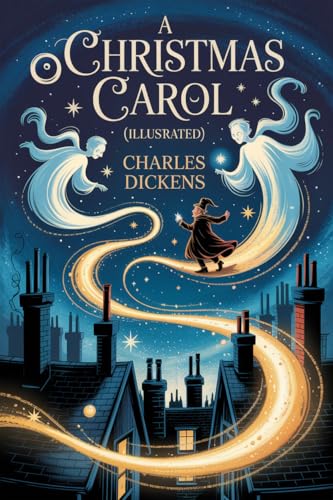
The following is a detailed exploration of the striking similarities between Charles Dickens‘ (1812-1870) “A Christmas Carol” and near-death experiences (NDEs). Although Dickens wrote his novella in 1843 – long before modern clinical NDE research – its central transformation reflects many of the same psychological, spiritual, and moral elements reported by NDErs across cultures.
Charles Dickens’ “A Christmas Carol” is often seen as a moral tale about generosity and compassion, but beneath its literary surface the story follows a pattern that closely resembles a classic NDE. Ebenezer Scrooge undergoes a radical life review, encounters with Beings of Light, sees a possible future death, experiences overwhelming remorse and love, and returns transformed. These themes strongly parallel modern NDE accounts collected by researchers such as Dr. Raymond Moody, Dr. Kenneth Ring, and Dr. Bruce Greyson. The following are the most significant parallels.
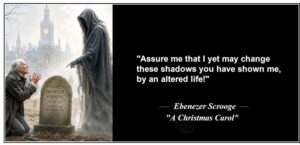
Although Dickens never had an NDE – he wrote one of the most famous NDEs in history. His story of Ebenezer Scrooge’s afterlife journey and his transformation reads like an NDE. Dickens intuitively created a story that mirrors what modern NDEs describe, because he: (a) had his own brushes with death; (b) was deeply immersed in spiritual and moral philosophy; (c) loved supernatural storytelling; and (d) understood the power of a transformational moral awakening. Within his published literature, Dickens wrote about trances, fainting spells, dissociative episodes, emotional collapses, and losing consciousness as a child and adult. While not NDEs, these states often bring vivid imagery and moral reflection which is useful material for writing scenes resembling out-of-body experiences. In his letters and autobiographical notes, Dickens mentions “trances,” swoons, and episodes of losing consciousness. Dickens also frequently visited hospitals, morgues, and workhouses for research, exposing him to death and dying more than most Victorian writers. These experiences gave Dickens intimate exposure to themes of mortality, regret, compassion, and spiritual reevaluation. Dickens also lived during the rise of mesmerism (which he practiced himself for healing) and early spiritualism. This cultural environment influenced Dickens to intuitively develop a narrative that parallels an NDE.
2. A Sudden, Extraordinary Shift in Consciousness
Ebenezer Scrooge is an elderly miser who is pulled out of ordinary consciousness when Jacob Marley and the three Spirits of Christmas (Christmas Past, Present and Yet to Come) appear. His sense of time, space, and physical limitation dissolves – just as NDErs describe leaving their bodies and perceiving reality in an altered state of consciousness. Marley’s ghost wanders the Earth entwined by heavy chains and money boxes forged during a lifetime of greed and selfishness resembling an earthbound condition. Marley tells Scrooge that he has a single chance to avoid the same fate: he will be visited by three spirits and must listen or be cursed to carry much heavier chains of his own. Scrooge floats, moves without walking, and passes through walls which are classic out-of-body traits. He observes scenes invisibly – mirroring NDE testimonies where NDErs watch events without being seen or heard. Dickens repeatedly describes Scrooge’s body as “left behind,” which aligns with consciousness separating from the physical body.
NDE Parallel
NDErs frequently report: (a) a sudden transition from normal awareness to a heightened spiritual state; (b) a feeling of separation from the physical body; (c) a sense that the experience is “more real than real.”
Scrooge experiences a similar separation from ordinary perception, entering a dimension where physical laws no longer apply.
3. Guided by Beings of Light
Jacob Marley appears to Scrooge as a transparent, glowing spirit. The three Christmas Spirits are described as luminous, ethereal, and otherworldly. Each guide expresses a mixture of love, authority, and moral insight. The three Christmas Spirits serve as loving but authoritative guides, a role similar to: (a) Beings of Light; (b) angels; (c) spirit guides; and (d) departed loved ones. The Ghost of Christmas Past is described as a “clear jet of light.” The Spirit of Christmas Present glows as Scrooge’s entire room radiates light and warmth. The Spirit of Christmas Yet to Come is an absence of light – a void, like the NDE “boundary realm.” The Spirit of Christmas Yet to Come in its “dusky shroud” is a personification of death.
In NDE testimonies, these guides help orient the soul, offer protection, and reveal truths the NDEr needs to see.
NDE Parallel
Just like the Spirits of Christmas: (a) Beings of Light often communicate telepathically and radiate compassion; (b) they show the person scenes from their life; and (c) they teach moral and spiritual lessons without condemnation.
The Spirits’ of Christmas mission – awakening Scrooge to love – parallels the educational nature of many NDE guides.
4. The Life Review
This is one of the strongest parallels. The Spirit of Christmas Past leads Scrooge through a panoramic review of key moments from his childhood, youth, and adulthood. He sees: (a) how his choices affected others; (b) the emotional consequences of his actions; and (c) the pain he caused and the love he rejected. NDE researchers often say life reviews are not condemnations but self-judgments stimulated by the presence of love. Scrooge judges himself emotionally as no Spirit ever condemns him. The Spirits show him only what he needs to learn, not to shame him. Scrooge’s remorse arises internally, mirroring how NDErs describe “feeling their own judgment.” This is highly parallel to the classic NDE insight: “You judge yourself through the eyes of love.”
Dickens describes this review as deeply emotional and morally revealing – precisely the way NDErs describe their own life reviews.
NDE Parallel
Modern NDE life reviews often include: (a) re-experiencing events from one’s life; (b) feeling the impact of one’s actions from the perspective of others; and (c) non-judgmental guidance encouraging growth and understanding.
Scrooge’s painful recognition of how he treated others is almost identical to the empathic life review described by NDErs such as Howard Storm, Betty Eadie, Mellen-Thomas Benedict, and countless others.
5. Seeing the Present Moment From a Higher Perspective
Scrooge watches events happening in real time. The Ghost of Christmas Present shows Scrooge: (a) the Cratchit family; (b) his nephew’s home; and (c) scenes across London he never bothered to notice.
This “bird’s-eye view” is also a signature feature of NDEs, where individuals often observe events happening elsewhere – sometimes verified later.
NDE Parallel
NDErs report: (a) seeing loved ones at home or in other locations; (b) observing conversations and actions with extreme clarity; and (c) understanding the emotional states of people they watch.
Scrooge’s expanded awareness mirrors this heightened perspective.
6. A Vision of One’s Own Death
The Ghost of Christmas Yet to Come shows Scrooge his neglected corpse and grave. This is one of the most dramatic moments in the story – a direct confrontation with mortality.
NDE Parallel
Many NDErs are shown: (a) their death; (b) a possible future; and (c) a life path if they do or do not change.
These scenes are often symbolic and transformational, urging moral or spiritual transformation. Scrooge’s terror and remorse upon seeing his unremembered grave mirrors the existential awakening many NDErs describe.
7. A Moral and Spiritual Awakening
Scrooge’s change mirrors post-NDE transformation. After returning, Scrooge: (a) feels overwhelming love; (b) becomes generous and compassionate; (c) changes his entire outlook on life; (d) repairs relationships; and (e) lives with gratitude and joy.
These are among the most widely documented aftereffects of NDEs.
NDE Parallel
Typical long-term aftereffects reported in NDE research include: (a) increased compassion; (b) loss of fear of death; (c) a desire to help others; (d) greater spirituality and purpose; (e) a break from materialism; and (f ) profound joy or gratitude for life.
Scrooge’s “rebirth” is exactly the kind of transformation that NDErs consistently express.
8. The Message of Love, Compassion, and Interconnectedness
At the heart of both “A Christmas Carol” and NDE testimonies is a single message: love is the highest law. Both portray a universe in which: (a) every action affects others; (b) we are accountable for the love we give (or withhold); (c) spiritual growth and redemption are always possible; and (d) compassion is more important than wealth or status.
This moral core aligns perfectly with what NDErs describe in their encounters with the Light of God.
9. A Return With a Mission
While Dickens never uses the word “mission,” the implication is clear: Scrooge is sent back to live differently, to help others, and to repair the harm he caused. Scrooge’s transformation reflects NDE aftereffects such as (a) a personality conversion (from miserly to generous); (b) increased appreciation for life; (c) a desire for service to others; (d) spontaneous joy; and (e) altruism. Scrooge’s post-awakening behavior can be mapped point-by-point to Greyson’s NDE Aftereffects Scale. Scrooge begs the Spirit of Christmas Yet to Come for another chance, echoing the NDE plea “I’m not ready to die.” Scrooge’s return to his body occurs abruptly, with intense emotion which again parallel reports from NDErs.
NDE Parallel
Many NDErs say they return because: (a) their mission was not complete; (b) they have more to teach, love, or contribute; and (c) their transformation must be lived out in the world.
Scrooge’s second chance fits this pattern exactly.
10. A Pre-Modern NDE Narrative in Literary Form
Although Dickens likely did not intend “A Christmas Carol” as an account of an NDE, the structural and thematic parallels are unmistakable. Scrooge undergoes: (a) an out-of-body spiritual journey; (b) guided encounters with Beings of Light; (c) a full life review; (d) a confrontation with his mortality; (e) a profound moral awakening; and (f ) a transformed sense of purpose.
These common elements make “A Christmas Carol” one of the most powerful pre-modern literary examples of something astonishingly similar to what NDErs describe today. Dickens captured, in story form, what modern NDErs and researchers identify as one of humanity’s most mysterious and transformative spiritual phenomena.
Dickens’ narrative fits the model introduced by Dr. Raymond Moody: (a) an out-of-body experience – Scrooge leaving his body and room with the spirits; (b) an encounter with otherworldly beings – Jacob Marley and the three Spirits of Christmas; (c) a “tunnel” or transitional environment – Scrooge’s experience of darkness and entering portals to the afterlife; (d) a life review – by the Spirit of Christmas Past; (e) encountering a barrier – Scrooge seeing his grave as a symbol of the limit of his experience; (f ) Scrooge being told to return to life – with an implicit “mission“; (g) returning to his body – Scrooge awakening in his bed; and (h) a profound transformation – experiencing newfound love and gratitude.
Many Victorian readers of Dickens interpreted the Spirits of Christmas as visions, dreams, or supernatural revelations which mirrors how people today classify NDEs. Dickens also received letters from readers describing their own moral awakenings after reading his story, which parallels modern accounts of NDE “aftershock” transformations.
Philosophical topics common in Dickens’ time include: (a) Swedenborgian afterlife structures; (b) the existence of ghosts; (c) Christian universalism (“redemption for all”) and; (d) the “economy of compassion” in Victorian theology.
11. Conclusion
Although Charles Dickens wrote A Christmas Carol more than a century before NDEs became a subject of scientific study, his timeless story contains many of the same elements that modern NDE researchers have identified in thousands of firsthand accounts. Ebenezer Scrooge’s extraordinary journey includes a shift in consciousness, encounters with spiritual guides, a life review, a vision of his own death, and a profound transformation centered on love, compassion, and service to others. These parallels are so striking that A Christmas Carol can be viewed as one of the most compelling literary expressions of the NDE pattern ever written.
Whether Dickens consciously drew upon spiritual traditions, personal experiences, or intuitive insight, he created a narrative that speaks to universal human questions about life, death, redemption, and the purpose of existence. Like many NDErs, Scrooge discovers that the true measure of a life is not wealth, status, or achievement, but the love we share, the kindness we extend, and the positive impact we have on others.
The enduring popularity of A Christmas Carol may stem from the fact that it touches the same spiritual truths reported by NDErs around the world. It reminds us that transformation is always possible, that no one is beyond redemption, and that every moment offers an opportunity to choose compassion over selfishness. In this sense, Dickens’ classic tale continues to illuminate the same message at the heart of many NDEs: that love is the fundamental reality of existence, and that awakening to this truth can change both our lives and our understanding of what lies beyond death.
12. References
Atwater, P. M. H. (2011). Near-Death Experiences: The Rest of the Story. Hampton Roads.
Brinkley, D. (1994). Saved by the Light. HarperCollins.
Bush, N. (2002). “Afterward: Making Meaning After a Frightening Near-Death Experience.” Journal of Near-Death Studies, 21(2).
Dickens, C. (1843). A Christmas Carol. Chapman & Hall.
Eadie, B. (1992). Embraced by the Light. Gold Leaf Press.
Greyson, B. (2007). “Consistent Features of Near-Death Experiences.” In The Handbook of Near-Death Experiences (pp. 30–54). Praeger.
Moody, R. (1975). Life After Life. Mockingbird Books.
Morse, M., & Perry, P. (1990). Closer to the Light. Villard.
Ritchie, G. (1978). Return from Tomorrow. Fleming H. Revell.
Ring, K. (1980). Life at Death. Coward, McCann & Geoghegan.
Sabom, M. (1982). Recollections of Death. Harper & Row.
Storm, H. (2000). My Descent Into Death. Doubleday.
van Lommel, P. (2001). “Near-Death Experience in Survivors of Cardiac Arrest.” The Lancet, 358(9298), 2039–2045.