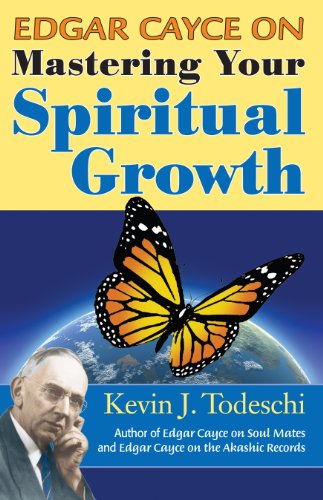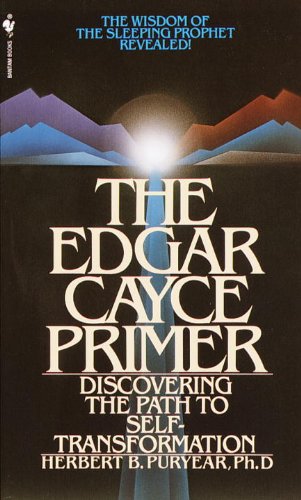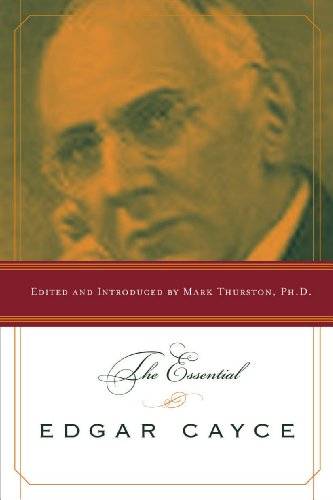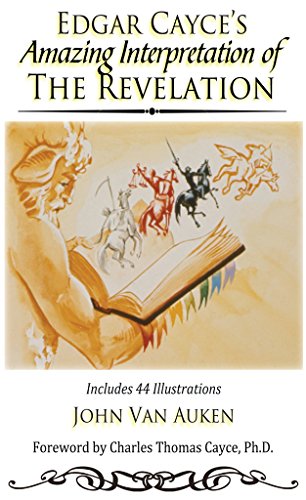
This site uses affiliate links to Amazon.com Books for which IANDS can earn an affiliate commission if you click on those links and make purchases through them.
1. Introduction to Edgar Cayce
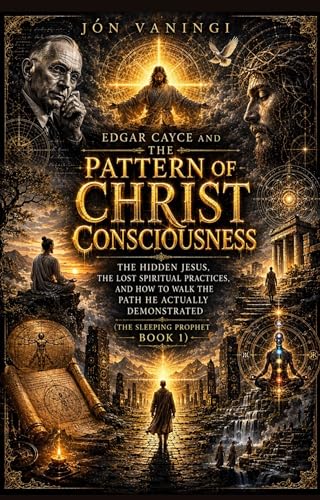
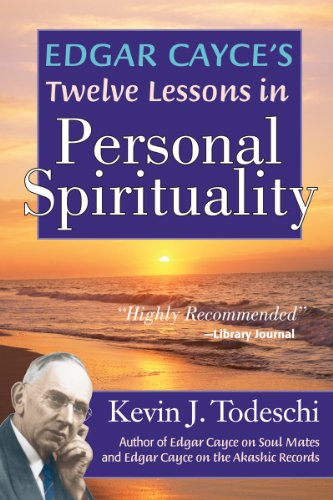
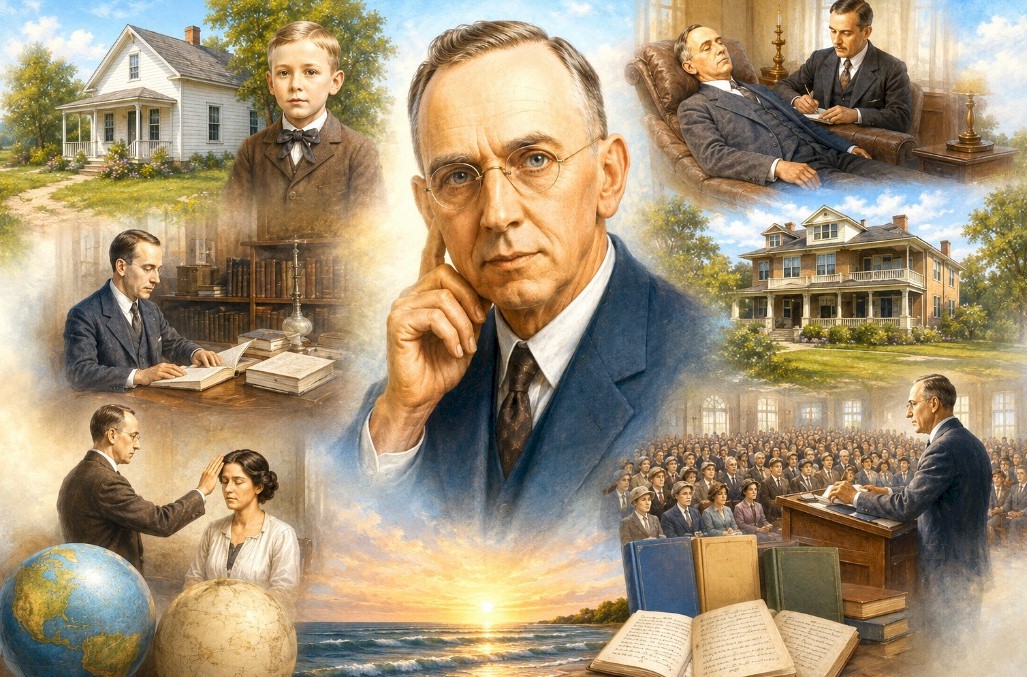
Near-death experiencer (NDEr), Edgar Cayce (1877-1945), remains one of the most mysterious and influential spiritual figures in American history. Often called the “Sleeping Prophet,” Cayce (pronounced “Kay-see”) became famous for entering a trance-like sleep and giving psychic readings on health, spirituality, life’s purpose, dreams, psychic phenomena, reincarnation, astrology, the akashic records, meditation, prayer, ancient mysteries, human origins, and prophecies of the future. During his lifetime, thousands of people sought his help for illnesses and personal problems. Admirers believed he possessed a remarkable spiritual gift. His teachings continue to influence modern ideas about holistic healing, meditation, reincarnation, dream interpretation, and spiritual growth.
2. Early Life and Childhood
Edgar Cayce was born on March 18, 1877, near Hopkinsville, Kentucky, into a deeply religious Christian farming family. From an early age, he developed a strong devotion to the Bible and reportedly promised himself that he would read it once every year for the rest of his life.
As a child, Cayce displayed unusual spiritual interests and experiences that later became part of the legend surrounding him. According to later accounts, he claimed to see angels and communicate with spirits, including the spirit of his deceased grandfather. One famous story tells how Cayce struggled with spelling in school but later remembered entire lessons after sleeping on his textbooks. These stories contributed to his growing reputation as someone with extraordinary abilities.
Despite these experiences, Cayce’s early life was mostly ordinary. He received only a grammar school education, left school at sixteen, and worked on his family farm before taking jobs in bookstores, retail, insurance sales, stationery sales, and photography studios.
3. The Loss of His Voice and the Beginning of the Readings
Cayce’s life changed dramatically in 1900 when he developed a severe throat condition involving partial paralysis of his vocal cords. The illness left him barely able to speak above a whisper, and doctors were unable to cure him.
Around this time, hypnosis was becoming popular in America. In 1901, a traveling hypnotist named Stanley Hart attempted to help Cayce. During hypnosis, Cayce reportedly entered a trance state, which included an out-of-body experience (OBE) and NDE-like experience, and unexpectedly diagnosed his own condition while unconscious. He suggested that increased blood circulation to his vocal cords would restore his voice. After following the recommendation, his voice returned permanently.
This remarkable experience led others to seek his help. Working closely with osteopathy student Al C. Layne, Cayce began performing trance readings for people suffering from illnesses. During these sessions, he would lie down, loosen his tie and shoes, close his eyes, and enter a sleep-like trance. In this condition, he often spoke confidently, beginning many readings with the phrase, “Yes, we have the body.”
One of his earliest famous cases involved a young girl named Aime Dietrich, who suffered severe convulsions and developmental difficulties. Cayce diagnosed a spinal injury and recommended osteopathic adjustments. According to reports, the treatment ended her seizures and restored her normal cognitive development, bringing wider public attention to his abilities.
According to Cayce and his followers, his trance state allowed him to access a universal source of knowledge often called the “universal consciousness,” “super-conscious mind” or “Higher Self,” or later, the “Akashic Records.”
4. Marriage, Family, and Growing Fame
On June 17, 1903, Cayce married Gertrude Evans. She became deeply involved in the readings and usually served as the person asking questions while Cayce was in trance. The couple eventually had two surviving sons, Hugh Lynn Cayce and Edgar Evans Cayce.
In September 1904, Cayce opened a photography studio with Frank Potter, and photography remained his main profession for many years even as his psychic reputation steadily grew. Several business ventures struggled financially, including one photography business destroyed by fire.
By 1905, local doctors had begun studying Cayce’s unusual abilities. People from around the country mailed requests for readings, and Cayce needed only a person’s name, location, and scheduled time in order to provide information about their condition.
National attention arrived in 1910 after homeopathic physician Dr. Wesley Ketchum publicized Cayce’s work. On October 9, 1910, The New York Times published a major article about Cayce’s psychic abilities, dramatically increasing requests for readings. In 1911, Hearst’s Chicago Examiner also featured him.
Despite growing fame, Cayce resisted attempts to commercialize his abilities. He reportedly turned down offers to perform on stage because he wanted to use the readings to help others rather than entertain audiences.
During this same period, Cayce and Gertrude suffered the heartbreaking loss of an infant son. Gertrude later developed tuberculosis, and readings given through Cayce reportedly helped her recover gradually.
5. Medical Readings and Holistic Healing
For many years, Cayce’s work focused mainly on health readings and physical healing. He viewed human beings holistically, believing that the body, mind, and spirit were deeply connected. In his view, illness often had emotional and spiritual causes in addition to physical ones.
His recommendations frequently included fresh foods, exercise, massage, osteopathic adjustments, hydrotherapy, meditation, visualization, castor oil packs, and stress reduction. Many of these ideas were considered unconventional at the time but later became associated with holistic and alternative medicine movements.
Supporters have stated that many patients improved after following his advice. Because of this, Cayce became one of the most influential early figures in holistic healing in America.
6. Spiritual Teachings and Reincarnation
A major turning point in Cayce’s life came in 1923 when he met Arthur Lammers, a wealthy printer deeply interested in philosophy, metaphysics, astrology, and mysticism. Lammers began asking Cayce questions about the soul, reincarnation, spiritual evolution, and humanity’s purpose beyond physical healing.
During these sessions, Cayce introduced ideas that would become central to his later teachings, including reincarnation, karma, astrology, Atlantis, and the Akashic Records — a spiritual record containing the history of every soul and every event throughout time. Cayce taught that souls pass through many lifetimes in order to learn spiritual lessons and eventually reunite with God.
At first, these teachings troubled Cayce because they conflicted with his traditional Christian upbringing. Eventually, however, he accepted them as part of the readings. Thousands of “Life Readings” followed, exploring past lives, soul growth, dreams, meditation, prayer, intuition, and spiritual development.
Although many people viewed Cayce as a psychic, he consistently taught that spiritual growth mattered more than psychic ability itself. He remained a devoted churchgoer and Sunday school teacher throughout his life. One of his best-known teachings stated: “Prayer is talking to God. Meditation is listening to God.”
7. Dreams, Atlantis, and Ancient Mysteries
As Cayce’s teachings expanded, he became widely known for his ideas about dreams, Atlantis, astrology, and ancient civilizations. He believed dreams could provide spiritual guidance, reveal subconscious fears, and even uncover memories from past lives. He encouraged people to keep dream journals and study dream symbolism carefully.
His teachings about Atlantis became especially influential. Cayce described Atlantis as a highly advanced civilization destroyed thousands of years ago and stated that many modern souls had once lived there. These ideas later became highly influential within the New Age movement.
8. Virginia Beach and the A.R.E.
Cayce’s readings repeatedly identified Virginia Beach, Virginia, as the ideal location for his work. Supported financially by stockbroker Morton Blumenthal, Cayce moved there with his family. In 1927, the Association of National Investigators was founded to study psychic phenomena and support Cayce’s work.
In 1929, construction began on Atlantic University, intended to teach the philosophy behind Cayce’s readings. However, the Great Depression caused severe financial problems, and by 1931 the hospital, university, and research association had largely ceased operating.
Later in 1931, Cayce and his followers founded the Association for Research and Enlightenment (A.R.E.) in Virginia Beach. Led largely by his son Hugh Lynn Cayce, the organization preserved Cayce’s readings and promoted the study of spirituality, healing, meditation, dreams, and human potential. The A.R.E. continues operating today and maintains thousands of recorded readings.
Over more than forty years, Cayce gave thousands of readings covering more than 10,000 topics. Altogether, the transcripts produced millions of words of material.
In 1942, author Thomas Sugrue published the influential biography “There Is a River,” which introduced Cayce’s life and teachings to a much larger audience.
9. Final Years and Death
As Cayce’s fame grew, the demand for readings became overwhelming. Between June 1943 and June 1944 alone, he reportedly gave 1,385 readings. The constant workload exhausted him physically and emotionally.
By 1944, Cayce’s health had severely declined from exhaustion and overwork. He developed edema of the lungs and later suffered a stroke that confined him to bed.
On September 17, 1944, Cayce gave his final reading, which was for himself.
Edgar Cayce died on January 3, 1945, in Virginia Beach, Virginia, at the age of sixty-seven. His wife, Gertrude, died only a few months later on April 1, 1945.
10. Legacy
Even after his death, interest in Edgar Cayce continued to grow through books, documentaries, spiritual movements, and the continuing work of the A.R.E.
Writers such as Gina Cerminara and Jess Stearn introduced Cayce’s ideas to wider audiences during the second half of the twentieth century, especially within the growing New Age movement.
Supporters view Cayce as one of the greatest psychics and spiritual teachers of the modern age. Edgar Cayce remains one of the most influential spiritual personalities in modern American history.
11. Notable Quotes From Edgar Cayce
“The spirits of all that have passed from the physical realm remain about the realm until their developments carry them onward, or they are in the realm of communication, or remain with this sphere, any may be communicated with. There are thousands about us here at present.” [Edgar Cayce reading 3744-2]
“The soul is the God-part in you, the living God.” [Edgar Cayce reading 262-77]
“The judge shall be your own conscience; for conscience is that which awakens the mind of the soul; the soul that of your self that is the nearest portion of the dwelling place of the Holy of Holies Himself – the Spirit of the Master.” [Edgar Cayce reading 254-54]
Question: “What is the highest possible psychic realization?”
Answer: “That God, the Father, speaks directly to the sons of men.” [Edgar Cayce reading 440-4]
Question: “Is the destiny of every spiritual entity to eventually become one with God?”
Answer: “Unless the entity wills its banishment … Yet God has not willed that any soul should perish.” [Edgar Cayce reading 900-20]
Question: “If the soul fails to improve itself, what becomes of it?”
Answer: “Can the will of man continue to defy its Maker?” [Edgar Cayce reading 826-8]
Concerning Jesus: “An entity, then, is the pattern of divinity in materiality, or in the Earth. As man found himself out of touch with that complete consciousness of the oneness of God, it became necessary that the will of God, the Father, be made manifested, that a pattern be introduced into man’s consciousness. Thus the Son of Man came into the Earth, made in the form, the likeness of man; with body, mind, soul. Yet the soul was the Son, the soul was the Light.” [Edgar Cayce reading 3357-2]
“Christ [the spirit] is the Universal Consciousness of love that we see manifested in those who have forgotten self, as Jesus [the man], give themselves that others may know the truth.” [Edgar Cayce reading 1376-1]
“He came into the Earth that we, as soul-entities, might know ourselves to be ourselves, and yet one with him; as he, the Master, the Christ, knew himself and yet one with the Father.” [Edgar Cayce reading 3003-1]
“Know the Lord your God is One. And all that you may know of good must first be within self. All you may know of God must be manifested through yourself. To hear of him is not to know. To apply and live and be is to know!” [Edgar Cayce reading 2936-2]
“The Lord abhors the quitter.” [Edgar Cayce reading 518-2]
“Happiness is a state of mind attained by giving same to others.” [Edgar Cayce reading 2772-2]
“The spirit of hate, the antichrist, is contention, strife, fault-finding, lovers of self, lovers of praise.” [Edgar Cayce reading 281-16]
“Let that rather be the your watchword, ‘I am my brother’s keeper.’ Who is your brother? Whoever, wherever he is that bears the imprint of the Maker in the Earth, be he black, white, gray or grizzled, be he young, be he Hottentot, or on the throne or in the president’s chair.” [Edgar Cayce reading 2780-3]
12. Conclusion
The life and teachings of Edgar Cayce continue to inspire curiosity, debate, and spiritual reflection decades after his death. From his humble beginnings in rural Kentucky to his rise as one of the most famous spiritual figures in America, Cayce left behind a remarkable legacy centered on healing, prayer, meditation, and the search for deeper spiritual understanding. His readings introduced millions of people to ideas about holistic health, reincarnation, dreams, intuition, and the connection between the mind, body, and spirit. His influence on modern spirituality and alternative healing is undeniable. Whether viewed as a gifted psychic, a religious mystic, or a cultural phenomenon, Cayce challenged people to look beyond the physical world and consider the possibility of a greater spiritual reality. His message of personal growth, compassion, and spiritual awakening continues to resonate with people around the world today.
13. References
Association for Research and Enlightenment. (n.d.). About Edgar Cayce’s life. Edgar Cayce’s A.R.E. Retrieved 17 May 2026.
Edgar and Aimee Dietrich. (n.d.). All About Heaven.
Wehrstein, KM (2019). “Edgar Cayce“. Psi Encyclopedia. London: The Society for Psychical Research. Retrieved 17 May 2026.
Wikipedia contributors. (n.d.). Edgar Cayce. In Wikipedia. Retrieved May 17, 2026, from Wikipedia: Edgar Cayce