This site uses affiliate links to Amazon.com Books for which IANDS can earn an affiliate commission if you click on those links and make purchases through them.
1. People Don’t Actually Survive Death
Someone emailed me the following argument against the resurrection of Christ and against the survival of consciousness after death:
“With great trepidation, I allowed myself the thought that the resurrection of Christ didn’t accord with science. Death, by definition, is a permanent and irreversible biological state. Later, that quiet tremor became a defiant reality testing rallying cry, as I boldly said: ‘I believe that Jesus Christ was killed, period.'”
2. Kevin Williams Response
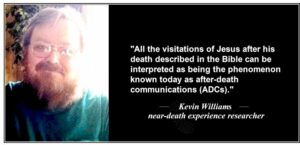
“Unless Jesus was beamed up by a UFO, I came to a similar conclusion myself about the resurrection of Christ in that he probably did not rise bodily from the grave. All the visitations of Jesus after his death described in the Bible can be interpreted as being the phenomenon known today as after-death communications (ADCs). As a very liberal Christian, I don’t see any need to believe in resurrection (or any religious dogma for that matter) to live a spiritual life of loving other people. In fact, the concept of resurrection did not originate with Christianity or Judaism but by the ancient Persians. This fact usually comes as a big surprise to Christians when they learn about this.
“However, I do disagree that there exists conclusive, scientific proof either way of the existence or non-existence of an afterlife. But there is a mountain of circumstantial evidence, albeit mostly anecdotal, suggesting the possibility of the survival of consciousness after death.
“From modern research of after-death communications, it is apparent that multitudes of people throughout history have reported experiences of some form of visitation by deceased loved ones. These are often very subtle experiences spontaneously occurring in a variety of ways including: suddenly hearing a voice, smelling a fragrance, having a lucid dream, experiencing synchronicity, or even full-blown apparitions of the deceased. My entire family experienced after-death communications when my mother died in a tragic car accident. So because of my own experiences and related research, it is apparent to me that the appearances of Jesus to his disciples after his death were ADCs.
“Concerning the fact that nobody has come back from permanent biological death, this is true. But it is also true that millions of people have come very, very close to permanent death and survived to tell their testimony of the experience. To counter skepticism of survival after death, I highly recommend the book entitled What Survives? Contemporary Explorations of Life After Death by Gary Doore which will answer much skeptical arguments concerning survival after death and provide arguments in favor of the Afterlife Hypothesis. The following is a book review by Joel Funk, Ph.D of this book.”
3. About This Book Review
ABOUT THE AUTHOR: Joel Funk, Ph.D., is Professor of Psychology at Plymouth State College. Reprint requests should be addressed to Dr. Funk at the Department of Psychology, Plymouth State College, Plymouth, NH 03264.
ABOUT THE JOURNAL: The Journal of Near-Death Studies from the International Association for Near-Death Studies (IANDS.org) is the only peer-reviewed scholarly journal devoted exclusively to the field of the study of near-death experiences (NDEs). To access the latest issues from the previous three years and receive new issues of the quarterly journal, you must subscribe to the journal simply by joining and becoming a member of IANDS. The Journal of Near-Death Studies also encourages submission of articles. Basic information about the journal is available.
ABOUT IANDS: Your IANDS membership helps provide the financial support for IANDS to pursue their mission of encouraging independent research into NDEs and educating the world about near-death and similar experiences — and their effects and implications. In return, IANDS will give you special access to members-only sections of their website including the Index to the Periodical NDE Literature from 1877 through 2011, their Vital Signs newsletter, annual IANDS conference and educational offerings. Other important links to IANDS include: NDE Accounts – NDE Archives – Store – Support – Publications – Brochures – Facebook – Twitter – YouTube.
The following is a reprint by permission of the article “Book Review: What Survives? Contemporary Explorations of Life After Death” by Joel Funk published in the Journal of Near-Death Studies, 10(4) Summer 1992. 1992 Human Sciences Press, Inc.
4. Book Review: What Survives? Contemporary Explorations of Life After Death
By Joel Funk, Ph.D.
ABOUT THE BOOK: What Survives? Contemporary Explorations of Life After Death, edited by Gary Doore. Los Angeles, CA: Jeremy P. Tarcher, 1990, 287 pp, $12.95(pb)
Just behind the current fascination with the near-death experience (NDE) is the even greater, perennial fascination with the question of whether we survive the death of the physical body, and if so, in what manner. What Survives? is a comprehensive, highly stimulating examination of the scientific, religious, psychological, and philosophical aspects of life after death. The contributors are among the leading lights in the fields of parapsychology and/or transpersonal psychology, and all but one of the articles (by Rupert Sheldrake) were expressly written for this anthology.
Although I expected heated debate over the likelihood of survival per se, the implicit assumption of virtually all the contributors to What Survives? is in the affirmative. That is, they would pretty much unanimously agree with Colin Wilson, in his conclusion to the book’s opening paper, “I now feel perfectly comfortable about acknowledging that I have come to accept the notion of life after death as a virtual certainty” (p. 21). In a sense, much of the book is a polemic, directed against the skeptic in all of us, arguing for the reasonableness of the survival hypothesis. After that question has been “cleared up,” the precise nature of survival is examined, although, somewhat disappointingly, not all the writers actually explore the “what survives” issue.
The book is divided into four sections. The first, The Evidence for Survival, looks at a variety of types of empirical research that lend plausibility to the idea of life after death: Wilson writes engagingly on his conversion from skeptic to believer, with a digression on poltergeists (which he thinks are true discarnate entities!) along the way. Pioneering transpersonal therapist Stanislav Grof provides evidence from his LSD and holotropic research, focusing particularly on out-of-body experiences (OBEs), astral phenomena, and memories of previous incarnations. The reincarnation research of Ian Stevenson is lucidly discussed by Robert Almeder, who convincingly refutes the alternative hypotheses of fraud, clairvoyance, and subconscious impersonation. After reading Almeder’s article, reincarnation seemed like a highly plausible and parsimonious explanation indeed! Arthur Berger‘s article on the history of attempts to construct foolproof means for testing the validity of communications from the dead is somewhat overly technical, but his project is an interesting one. He notes, too, that the telepathic qualities of the (deceased) sender seem to be at least as important as those of the receiver.
A collaboration between F. Gordon Greene and Stanley Krippner on panoramic visions, the familiar “life review” of NDEs, highlights this section. The details of the panoramic vision, including “forward” or precognitive vision, are presented, and three different types of theory elucidated. The authors then proffer their own theory, reminiscent of P. D. Ouspensky’s conceptualization of time, which involves a temporal “spatialization” into a four-dimensional universe during NDEs and related phenomena. This proposal is an ingenious attempt to explain the otherwise “impossible” simultaneity of experience during panoramic visions. Somewhat disconcerting, though, was the authors’ concluding section on the conundrums related to the judgment of the “soul” and the paradox of free will. Rather than offer simple answers, they leave the reader swimming alone in rather profound spiritual waters! Finally, the late Scott Rogo contributes a chapter on spontaneous contact with deceased loved ones, apparently a surprisingly common occurrence. In sum, the articles in Section One present a highly convincing case for the probability of survival, contact between living and “dead,” and even reincarnation.
Section Two, The Challenge of Materialism, is philosophically rather than scientifically oriented. David Lorimer contrasts the predominant Western philosophy, namely nonpurposive, amoral scientific materialism, which states that consciousness is an epiphenomenon of brain, with the antinomian view first promulgated by F.C.S. Schiller, William James, and Henri Bergson. This rival philosophical view, the “transmissive” theory of mind (see this book Irreducible Mind: Toward a Psychology for the 21st Century), contends that although consciousness is transmitted via the brain, it is not produced by the brain as materialism believes. Somewhat frustratingly, the article ends rather abruptly after the delineation of this radical viewpoint.
Along somewhat similar lines, Sheldrake’s essay debates the idea that memories are stored in the brain. Rather, he contends, memory is a resonance to invisible morphogenetic fields, one’s own (as in memory), or others’ (as in telepathy). Sheldrake only briefly touches on the survival question, but maintains that survival is at least consistent with his theory of morphic resonance.
Perhaps the most exciting essay in the entire anthology is Mark Woodhouse‘s elegant tour de force, “Beyond Dualism and Materialism: A New Model of Survival.” Woodhouse proposes a metaphysical model uniting energy (objectively) and consciousness (subjectively) into a hierarchical monism. In other words, all levels of the great Chain of Being, from matter to spirit, are viewed as manifestations of differences in degree (not kind) of energy/consciousness. More to the point of the book, he cogently demonstrates that both materialism and dualism – the view that a completely nonmaterial soul may “inhabit” a physical body – are incompatible with survival, whereas energy monism easily accommodates survival within its purview. Woodhouse illuminates a number of subtle issues derived from his model: interdimensional penetration and apparitions, whether an “astral body” might conceivably be photographable, and the ultimate permanence or impermanence of the individual personality. He ends with some mind boggling speculation, in the manner of NDErs’ prophetic visions, on the imminent emergence of a large-scale shift in the evolution of humanity up the hierarchy of energy/consciousness.
Well-known parapsychologist and cartographer of consciousness Charles Tart completes Section Two. Tart first reveals the flaws of materialism by citing the massive evidence of parapsychology, then goes on to explain why survival research has gone “out of fashion.” The most intriguing point Tart makes is that, given what we know about the plurality (not unity!) of consciousness, when we die we will most likely be in a state of consciousness quite different from our “normal” consciousness. “What survives” the physical body is likely to be an altered form of consciousness, reminiscent, in its fluidity, of dreaming. Furthermore, the finding that much knowledge is state-specific, i.e., nearly impossible to comprehend from the vantage point of a second, different, state of consciousness, explains in part the difficulty NDErs have first, remembering the details of what they have learned, and second, communicating what they can remember with others who are limited to “ordinary” states of consciousness.
Part Three, Death and Beyond in the Perennial Philosophy, looks at the after-death state from the point of view of various religious traditions. Ram Dass gives a general introduction to Yogic and Buddhist views of death and the importance of the proper attitude and thoughts at the moment of death. Georg Feuerstein follows with an analysis of the belief in immortality in India. Perhaps due to experimentation with a psychedelic referred to as soma, the belief in an afterlife was pretty much taken as a given in early Vedic culture. The goal of existence was not endless survival, however, but freedom from the cycle of death and rebirth, i.e., enlightenment. Feuerstein carefully distinguishes several views of liberation, concluding that Tantrism represents the flower of Indian thought. Unlike the more ascetic Indian traditions, Tantrism’s emphasis is on immanence, i.e., the notion that the Divine can be found here in the illusory world of samsara, not just in the transcendence of nirvana. Feuerstein’s article goes well beyond the issue of what survives, however, and may be a bit abstruse for the average reader, despite his considerable skill as a writer.
Squarely addressing the question “What survives?” is transpersonal theoretician Ken Wilber‘s essay on the stages of dying outlined in Tibetan Buddhism. As usual, Wilber is erudite, yet incisive. He first clarifies exactly what reincarnates (not the mind or personality!) and then carefully examines about a dozen stages in the dying, death, and rebirth process. Most pertinent is his discussion of the NDE in the light of the Tibetan tradition. Wilber cautions first that the light seen in the NDE may not be “exactly the highest level” (p. 187). More disturbing, though, is his caveat that the NDE is only the “fun” side of dying, which can be followed by “the bardo [after death] ordeal – a real nightmare unless one is very familiar with these states through meditation” (p. 188). The remainder of the article compares the experiences of meditation (quite literally) with the dying process. Although the subsequent article, by Tibetan lama Sogyal Rinpoche, is nicely written and quite thoughtful, it covers much the same ground as Wilber’s paper. An article by a representative of a Western religious or esoteric (e.g., Anthroposophical) tradition would have been welcome here. Such a conspicuous absence is one of the book’s few weaknesses.
Section Three concludes with an extremely insightful and artfully written study by well-known near-death researcher and theoretician Kenneth Ring. Here Ring pushes beyond the NDE, focusing on the those who have truly “mastered death,” i.e., practitioners of shamanism. From shamans and other visionaries, we learn of the existence of an ontologically real “imaginal” (not imaginary) world, which is normally entered at physical death, but which can be encountered during life as well (as occurs voluntarily by the shaman and inadvertently during the NDE). The imaginal world is not some exotic alien geography, however; instead it is best viewed, Ring maintains, as the landscape of our own soul, an outward projection of our inner self. Ring cautions that a complacent waiting for a glorious future, basking in the love of an unconditionally accepting Being of Light, may easily “blind us to the rest of the imaginal journey to follow” (p. 214). And there is a vital lesson here, for “though we meet our soul in ‘the next world,’ we make it in this one” (p. 213). As does Wilber, Ring draws serious implications for how to live before death.
Section Four returns to Earth, focusing on various psychological issues surrounding death, dying, and the afterlife. Stephen Levine, in a somewhat meandering fashion, explores death and the dying process from the perspective of the Buddhist Vipassana (insight) meditative tradition. Amidst a number of arresting anecdotes, Levine draws attention to the ultimate purpose of living and dying: overcoming the illusion of separateness. In Levine’s view, death presents itself not merely as a potentially glorious experience, as reported in most NDEs, but as an opportunity to dissolve the individuality of the experiencer itself and become one with the Light.
Quite unique is the next chapter, a collaboration between Lisa Ann Mertz and Lorin Smith, a shaman among the Kashaya Pomo tribe in California. Most of the article consists of quotes by Smith on his work, not on Earth, but in the afterlife world, where he is establishing a “vocation” as a teacher for prematurely deceased adolescents. This fascinating account might have worked better as a companion piece to Ring’s more theoretical article on shamanism, especially since the imaginal landscape described by Smith depicts a more “objective” geography than one would have expected from reading Ring’s paper.
Possibly the most original essay in the entire compendium is philosopher Michael Grosso‘s startlingly titled “The Fear of Life After Death.” Turning the tables on the materialist objection that people are strongly motivated to believe in survival, Grosso advances the idea that materialists are equally as motivated to disbelieve in life after death! For example, despite the contention of psychologists like Sigmund Freud and Otto Rank that belief in an afterlife is a result of childish wish fulfillment and/or narcissism, the anthropological record shows that “Quite to the contrary, the facts indicate that the first people feared not extinction, but life after death; they feared not death, but the [spirits of the] dead” (p. 242). Grosso enumerates at least a half dozen other reasons why people today might fear life after death, e.g., fear of judgment or karmic retribution, fear of helplessness in a strange environment, and even fear of enlightenment. Equally eye opening is his evolutionary paradigm of survival, which holds that the afterlife itself is emerging or evolving! Grosso believes that the growing number of other-world experiences, such as NDEs, may modify nature itself and create, through Sheldrakian morphogenetic fields, “a new form of life after life” (p. 252). More, one major aspect of this evolution is taking place, paradoxically enough, on Earth itself as the human species gradually undergoes what Grosso terms “resurrection,” a “transform[ation] into a higher type of spiritual body” (p. 251), ultimately leading (potentially) to the creation of a Paradise on Earth. There is much more, but Grosso’s rich and subtle exposition defies easy synopsis.
David Feinstein next explores our “personal mythologies” of death, both secular and spiritual, and their often subliminal effects on our lives. Unfortunately most of this article concerns an elaborate technique for encountering one’s myths; while this is undoubtedly effective in a live workshop setting, the “how to” approach does not gel terribly well with the rest of the anthology.
The final essay in Section Four, by the book’s editor, Gary Doore, illustrates the similarities, even identities, between shamanism, yogic mysticism, and some contemporary near-equivalents, such as the NDE. All such transcendent experiences are means of “practicing philosophia in the original Socratic sense of ‘preparation for death’ “(p. 271). The NDE may be a harbinger, Doore speculates, of the democratization of such “preparation for death,” necessitated by the perils inherent in our destructive Western lifestyle. The urgency of a global transformation of consciousness recurs frequently throughout the anthology.
Concluding the book is editor Doore’s jewel of an epilogue, which raises the fundamental question, “Given that we cannot prove (nor disprove) the reality of life after death, is there any philosophical justification for belief in an afterlife?” Doore answers by focusing on the pragmatic consequences of survivalism as contrasted with agnosticism or materialism. Since belief in an afterlife is far more likely to engender spiritual meaning, cosmic purpose, and moral order, it is clearly preferable to the alternative hypotheses. I, for one, am in complete agreement.
What Survives embraces far more than “just” life after death, viz., orientation to the process of dying, near-death experience, spiritual evolution, parapsychological phenomena, reincarnation, shamanism, mysticism, and meditation. Most of all it reveals how understanding death and its transcendence can change the meaning of life and subsequently how we live, both individually and collectively. Anyone interested in such issues-and that includes all of us – will find What Survives compelling and immensely profitable reading.
5. Conclusion
In the end, What Survives? is a bold and interesting look at one of the oldest questions people ask. It doesn’t give one simple answer. Instead, it brings together many different ideas—scientific, philosophical, and spiritual. Together, these ideas suggest that consciousness might continue beyond the physical body. Not every essay answers the main question directly, but the overall message is strong. It leaves the reader feeling that survival after death is not just possible, but worth thinking about.
One of the most interesting things about the book is how it questions common materialist views. It also takes experiences like near-death events, reincarnation research, and mystical traditions seriously. At the same time, the book admits that things are not simple or certain. It encourages readers to think more deeply about what the mind is, who we are, and what reality really means.
The biggest strength of What Survives? is not just what it says about life after death. It’s how it changes the way we think about life right now. The book encourages a more open way of thinking about consciousness and existence. It leaves the reader with a clear idea: how we live, think, and grow today may be closely connected to whatever part of us continues on.